_edi.png)

Your sales targets are aggressive, and your hiring budget is tight. Finding top-tier talent locally feels impossible. In fact, your 30-second Google search results are not convincing enough to make a firm, unique decision.
Nearly 46% of US organizations expect to expand international hiring more quickly than in other regions by early 2026. If you're one of the supporters of these statistics, you might hit the wall of compliance.
Vague regulations, foreign tax laws, and the terrifying risk of worker misclassification stop you cold. In this blog, we provide a direct, nine-step playbook for hiring overseas contractors compliantly.
Take a Look:
- Global sales hiring is accelerating: 46% of US companies plan to expand international recruitment by early 2026.
- The Employer of Record (EOR) market was valued at USD 4,591.5 million in 2024, confirming its importance as companies expand compliance-driven hiring.
- IRS rules require US companies to collect Form W-9 for US contractors and Form W-8BEN for non-US contractors, ensuring proper global tax documentation.
- The UK’s IR35 regulations mandate a formal Status Determination Statement to decide whether a contractor is a “disguised employee.”
- Permanent establishment risk arises when contractors act as dependent agents, making Contractor of Record (CoR) models essential for reducing tax exposure.
How to Hire Overseas Contractors?
Picking the wrong hiring model isn’t a small mistake. Because hiring shapes your legal exposure, compliance burden, and overall cost.
If you skip this step, fines can wipe out every advantage you hoped to gain. Here's how you can start:
Step 1: Pick the Right Engagement Model
Before you search for talent, choose your engagement framework. This is your primary risk management tool. You have three core options.
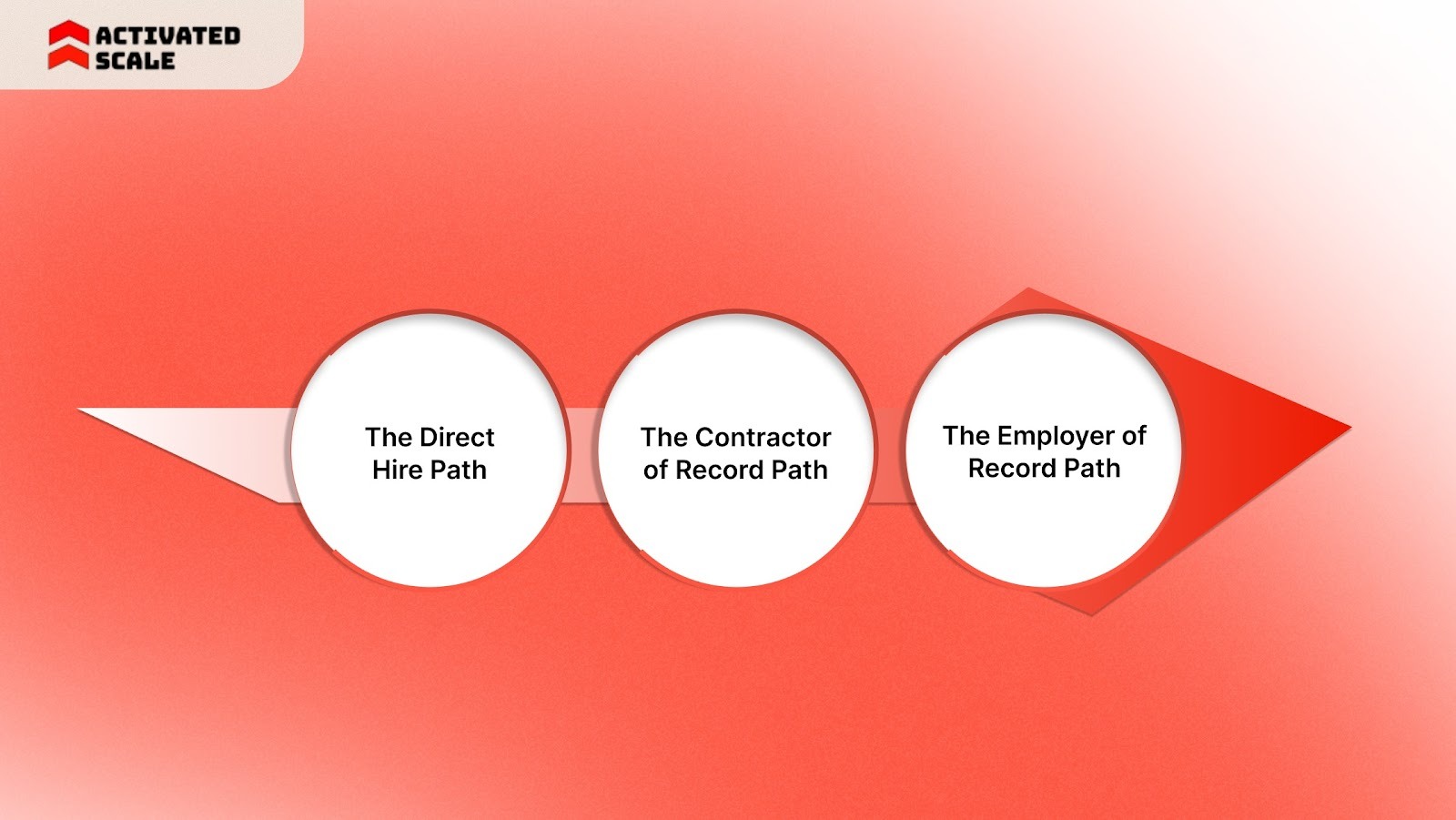
- The Direct Hire Path
Your company manages all elements. You create the contract and handle global payments and tax forms. This path offers maximum control.
Your team must master foreign labor laws. A single mistake leads to severe penalties. Use this only for very short, well-defined projects in a single, familiar country. - The Contractor of Record (CoR) Path
A specialized partner acts as the legal employer. Firms like Deel or Remote manage compliance. They provide locally valid contracts. They process invoices and global payments.
It transforms legal complexity into a predictable operating cost. - The Employer of Record (EOR) Path
This model is for hiring employees, not contractors. An EOR becomes the legal entity in a foreign country. Use this only if you need to convert a top contractor to a full-time team member. It is a solution for permanent hiring.
In fact, the global Employer of Record platform market was valued at USD 4,591.5 million in 2024 and remains the go-to compliance-outsourcing tool for companies expanding globally.
Also Read: 7 Steps to Optimize Your Sales Funnel for Improved Conversion Rates
Step 2: Correctly Classify the Worker (The Most Critical Step)
The core question is simple: Is this person a contractor or an employee? Regulators use strict tests to decide. They look at control. You cannot control a contractor's hours or methods.
They can work for other clients. You pay for a specific result, not their time. If you treat them like an employee, they are an employee in the eyes of the law.
Use this checklist to assess the relationship. Getting multiple "Employee" column answers is a major red flag.
Country-Specific Rules and Required Forms
The rules change based on where your contractor lives. You must know the local tests and documents.
- For Contractors in the United States:
US authorities use an "economic reality" test. They focus on control and independence. For a US citizen or resident contractor, you must collect a Form W-9.
This form provides their Taxpayer Identification Number. You use it to issue a Form 1099-NEC at year-end if you pay them $600 or more. This reports their income to the IRS. - For Contractors in the United Kingdom:
The UK enforces IR35 rules (off-payroll working). These rules decide if a contractor is a "disguised employee." If IR35 applies, you must deduct income tax and National Insurance.
You must perform a "Status Determination Statement." This formal document declares the worker's status. You must provide it to the contractor.
For any non-U.S. person contractor, always collect IRS Form W-8BEN. This certifies their foreign status. It protects you from US backup withholding tax requirements.
Our Contract-to-Hire Sales Recruiting service at Activated Scale lets you engage top-tier, vetted sales professionals who can guide you in maintaining legal compliance in your team.
Step 3: Source, Vet, and Secure Top Global Talent
Your sourcing strategy should move beyond a single platform. Combine channels for better results.
Key Sourcing Channels:
- Remote-First Job Boards: Sites such as Activated Scale attract sales professionals built for distributed work.
- Professional Networks: LinkedIn is powerful. Search for profiles with "open to contract" indications.
- Sales Communities: Engage niche communities where your ideal candidates already gather.
Vetting requires a structured approach. You cannot rely on a single interview.
The Four-Pillar Vetting Framework:
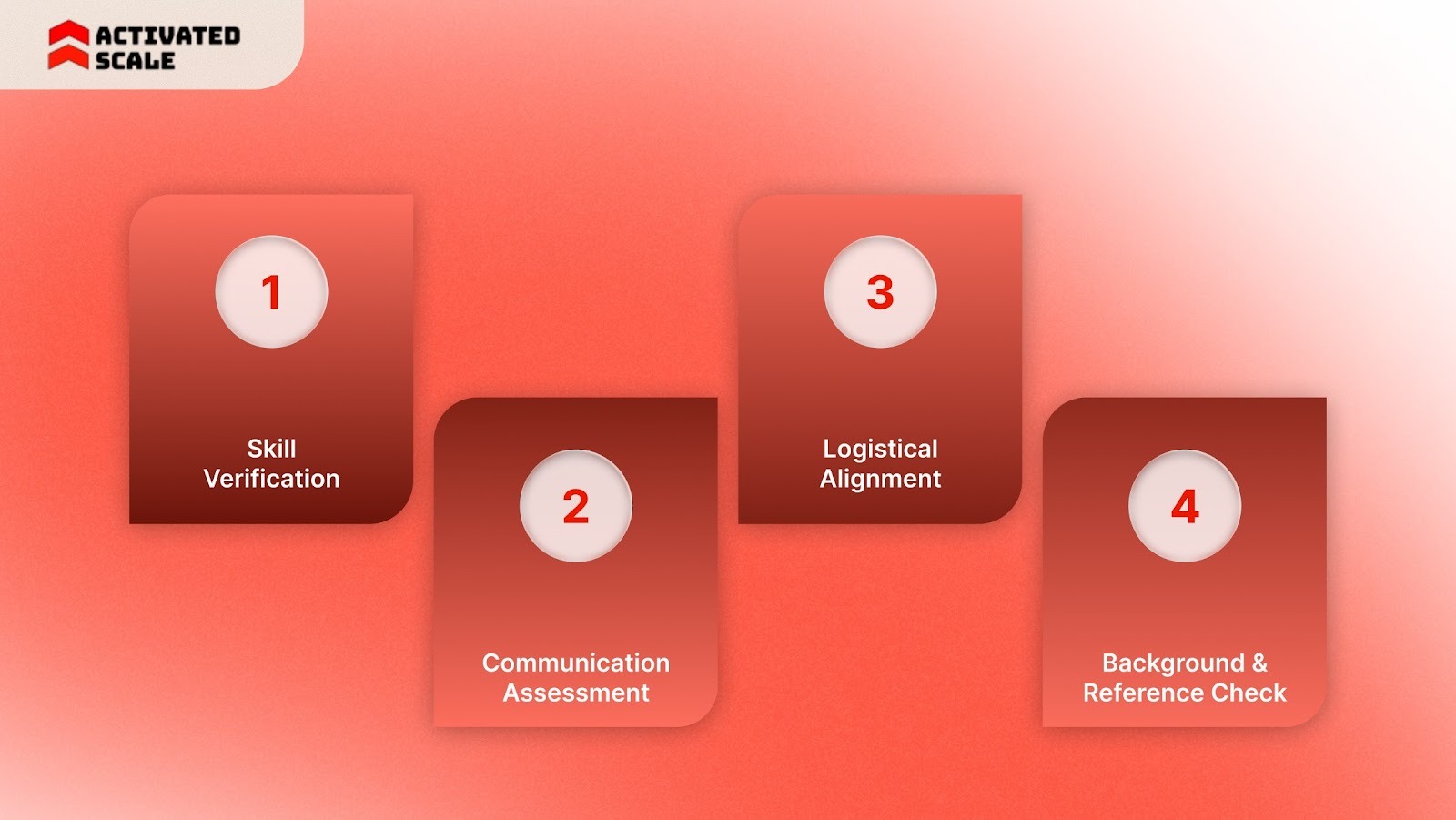
- Skill Verification: Review past work samples and portfolios. For sales roles, analyze past pipeline metrics (if shareable). Conduct a paid, role-specific test task.
- Communication Assessment: Test their proficiency in your primary language. Evaluate their responsiveness and clarity in written communication skills.
- Logistical Alignment: Confirm time zone overlap. Even 2-3 shared hours prevent major delays. Discuss their available work hours upfront.
- Background & Reference Check: Verify identity with official documents. Always contact 2-3 past clients. Ask about reliability, work quality, and communication.
Critical Compliance Step:
Always get the contractor's explicit consent for background checks. This is a legal requirement in places like the EU under GDPR.
Step 4: Your Contract is Your Shield
A weak contract exposes you to immense risk. Intellectual property disputes, scope creep, and legal conflicts will arise. A generic template from your country is useless abroad. It may even be illegal.
The 6 Non-Negotiable Contract Clauses:
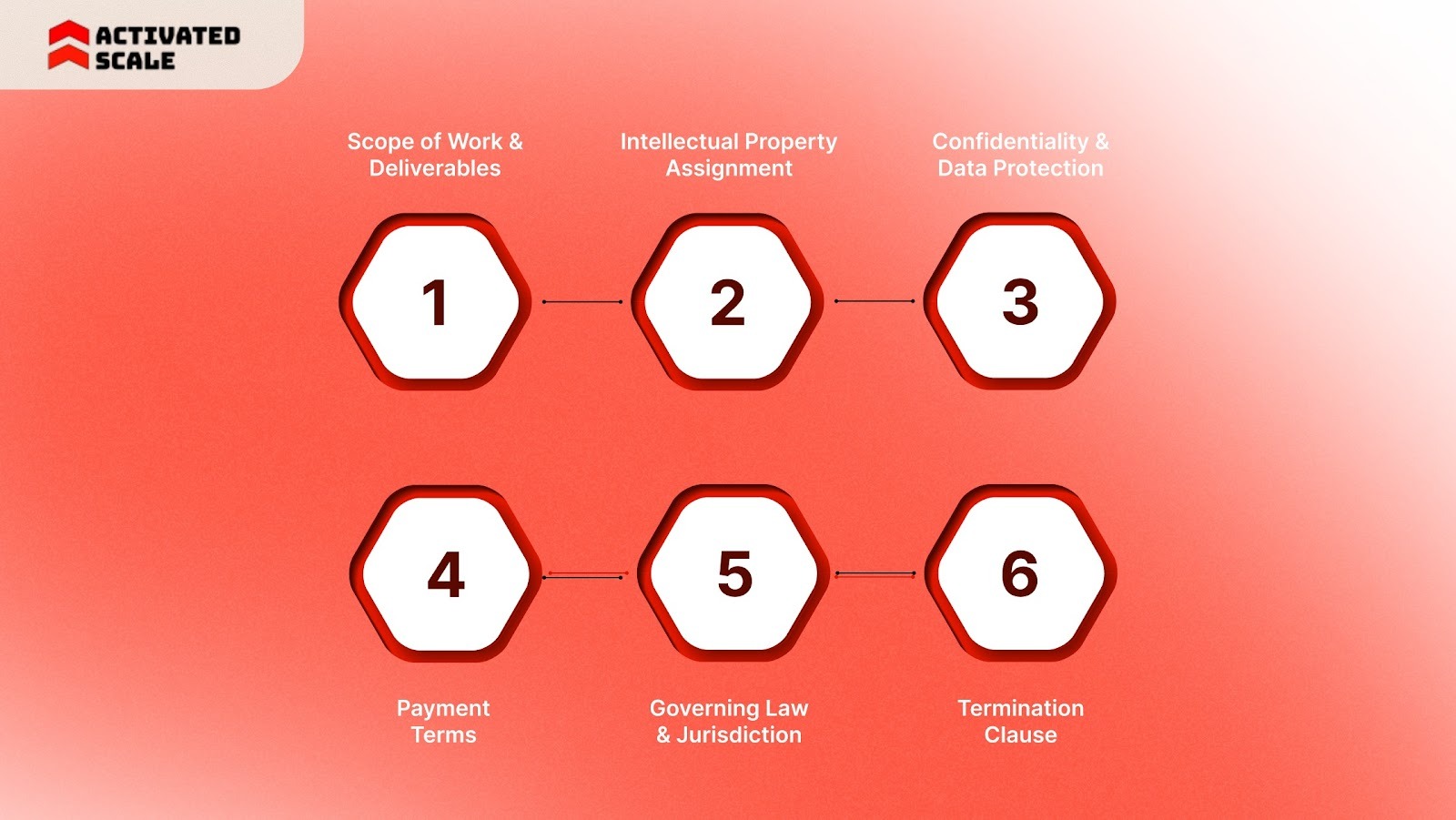
- Scope of Work & Deliverables: Define the exact outputs. Use clear metrics. For a sales contractor, specify targets (e.g., "generate 15 qualified meetings per month").
- Intellectual Property (IP) Assignment: This clause is vital. It must state that all work product belongs to your company. This includes sales scripts, process documents, and call recordings.
- Confidentiality & Data Protection: Protect your customer lists and sales data. If they handle EU data, attach a Data Processing Agreement (DPA) for GDPR compliance.
- Payment Terms: Specify the currency, amount, schedule, and method. Example: "$5,000 USD, paid monthly via Deel, within 30 days of invoice."
- Governing Law & Jurisdiction: Which country's laws govern the contract? Name the city for dispute resolution. This provides crucial certainty.
- Termination Clause: Define notice periods for both parties (e.g., 30 days). Outline conditions for immediate termination.
Execution Best Practice:
Use a secure e-signature platform like DocuSign. It provides a legal audit trail. Store the final signed copy in a secure, centralized system.
Step 5: Set Up Compliant Global Payments
Payment delays destroy contractor relationships. Hidden fees erode their pay and your trust. The goal is for contractors to receive the correct amount, on time, every time.
Build Your Payment Process on Three Pillars:
- Currency: Always pay in the contractor's local currency. This protects them from unfair conversion fees. It is a sign of respect and professionalism.
- Cost Transparency: Choose a platform with transparent fees. Use providers that offer the real mid-market exchange rate.
- Automation & Efficiency: Use a platform that supports batch payments. Approve all invoices once. Then pay your entire global team with one click. This saves countless admin hours.
Good options include direct local bank transfer, Wise, PayPal, or Revolut. Specialized platforms like Deel provide their own card solutions.
Activated Scale ensures your new international sales contractors hit the ground running. Reps from our Fractional Sales Leadership service help design and implement effective onboarding playbooks personalized for global, remote teams.
Step 6: Launch Them for Success with Structured Onboarding
Poor onboarding sets up even great talent for failure. They will be slow to contribute. This is where your investment starts paying returns.
The sales contractor onboarding checklist:
- Week 1: Access & Foundation
- Provide all system logins (Customer Relationship Management (CRM), email, communication tools).
- Share essential sales documentation: product sheets, buyer personas, pitch decks.
- Introduce them to the team via a scheduled video call.
- Schedule training on your specific sales process and tools.
- Week 2: Integration & Alignment
- Define clear 30/60/90-day goals and Key Performance Indicators (KPIs).
- Pair them with a team mentor for ongoing questions.
- Review communication protocols (channels, response times, meeting rhythms).
- Ongoing:
- Establish a regular (e.g., weekly) one-on-one check-in meeting.
- Provide continuous access to recorded training and sales enablement materials.
Also Read: Important KPIs and Metrics to Measure Lead Generation Success
Step 7: Manage Performance and Mitigate Ongoing Risk
Hiring is just the beginning. Without active management, projects drift, and risk accumulates. The nature of work can evolve from contractor-like to employee-like.
Establish a clear performance rhythm:
- Schedule Regular Check-ins: Hold brief, focused weekly or bi-weekly calls. Discuss progress, blockers, and priorities. Document key points.
- Provide Objective Feedback: Frame feedback around the agreed-upon scope and deliverables. Avoid directing how they do the work; focus on what needs to be achieved.
Proactive compliance monitoring:
- Beware of Scope Creep: Adding ongoing, integral tasks can unintentionally change the relationship's nature. It can make a contractor look like an employee. Regularly review the scope of work.
- Stay Informed on Law Changes: Labor regulations are updated frequently. Use a platform with a compliance monitor. It should alert you to relevant legal changes in your contractors' countries.
Step 8: Know When to Convert a Contractor to an Employee
The most successful contractor relationships sometimes evolve. When a contractor becomes central to your operations, continuing the arrangement poses a high misclassification risk.
Signs it's time to convert:
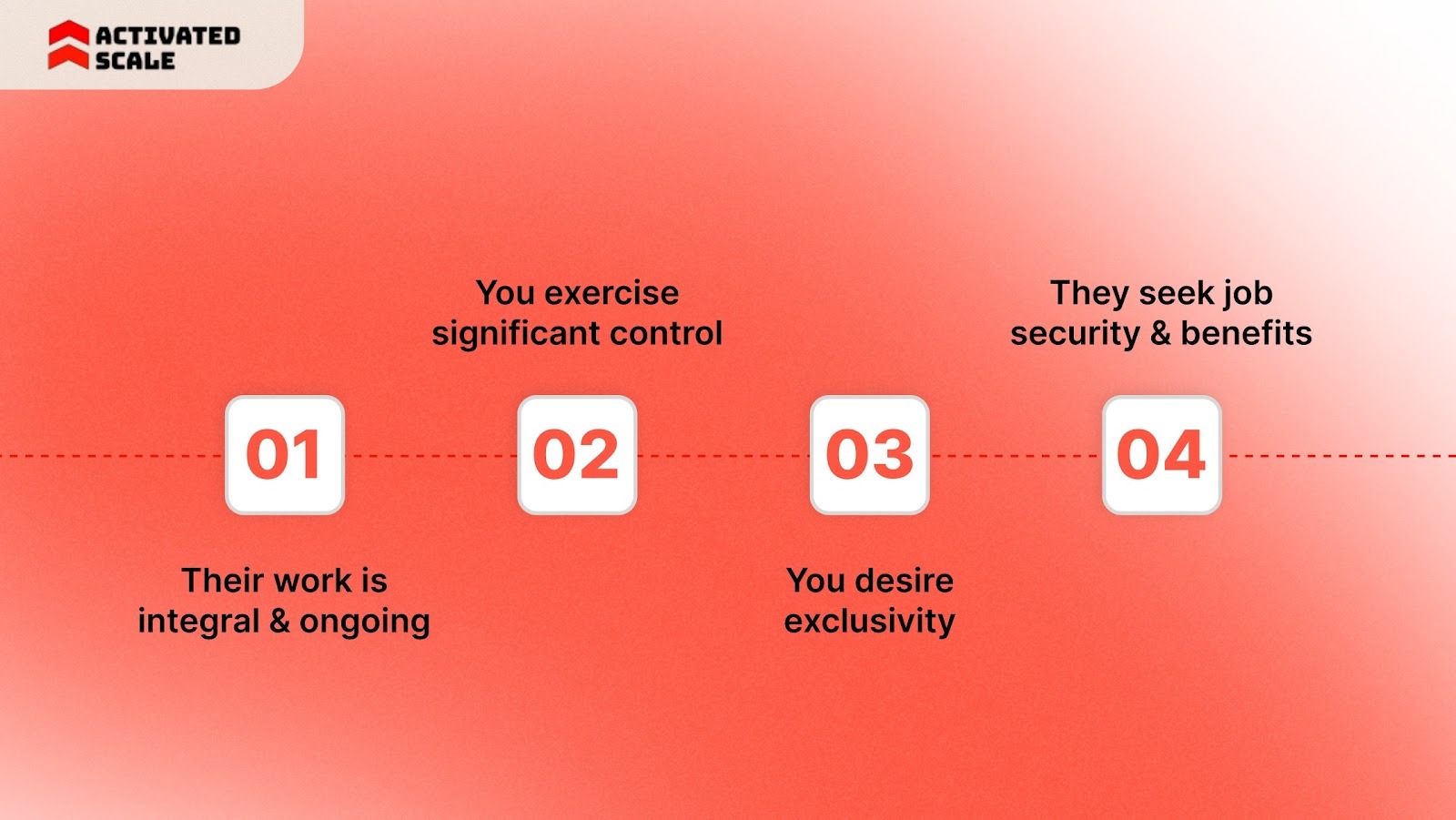
- Their work is integral and ongoing. They are no longer working on a discrete project but performing a core, continuous business function.
- You exercise significant control. Their schedule, methods, and tools need to be aligned with your team's.
- You desire exclusivity. You need them to stop working for other clients and commit fully to your company.
- They seek job security and benefits. To retain this top talent long-term, you need to offer the stability of employment.
This conversion, when done correctly, secures vital talent. It also eliminates the mounting compliance risk of a long-term contractor arrangement.
Activated Scale's Fractional Selling service provides reps with strategic oversight to make this transition compliant. They also ensure your critical sales talent is secured permanently, with all contracts, payroll, and benefits set up correctly from day one.
Conclusion
Hiring overseas contractors is a powerful strategy for sales leaders. The journey, from choosing the right engagement model to managing performance, requires a disciplined approach.
Each step in this guide exists to protect your business. It turns the fear of fines and audits into a clear process for growth. You can do all this without incurring undue legal risk.
The final step is choosing the right partner for execution. Activated Scale is your ideal partner in global sales hiring.
Let’s build your compliant, high-performing global sales team. Schedule your consultation with Activated Scale today.
Frequently Asked Questions (FAQs)
1. How do we handle end-of-year tax reporting, like the 1099-NEC, for a foreign contractor?
You generally do not issue a 1099-NEC to a true foreign contractor. The IRS Form W-8BEN, which certifies their non-US status, exempts you from this requirement.
Issuing a 1099 for a foreign contractor can create confusion with the IRS. Always rely on the W-8BEN as your primary documentation.
2. Can a contractor working for us from a country we don't operate in create a "permanent establishment" tax risk?
Yes, this is a significant but often overlooked risk. If a foreign tax authority determines your contractor is a dependent agent creating a fixed place of business for you, it may establish a "permanent establishment."
This could make your company liable for corporate taxes in that country. Using a reputable Contractor of Record (CoR) service is a primary method to mitigate this risk, as they act as the local legal entity.
3. What's the best way to handle a situation where our top-performing contractor is clearly acting like an employee?
This is a trigger for immediate action. Continuing the arrangement poses a high misclassification risk. The compliant path is to convert them to an employee using an Employer of Record (EOR) service.
This formalizes the relationship, provides them proper benefits, and eliminates your legal exposure. It is a strategic decision to retain top talent.
4. Are there specific red flags during contractor vetting that signal future compliance problems?
Yes. Be aware of contractors who insist on being paid as a sole proprietorship but cannot provide a registered business name or tax ID.
Candidates who are reluctant to sign a clear IP assignment clause may not understand or respect the compliance boundaries required for the role.
The Ultimate Guide to Hiring a Salesperson!
Get the step-by-step guide to hiring, onboarding, and ensuring success!