_edi.png)
Remote work is changing how teams scale expertise, rather than being a fad. More than one-third of U.S. workers perform remote work at least some of the time. This shows that flexibility is now standard in knowledge-driven roles, especially in tech and development.
This shift underpins why remote staff augmentation is no longer a stopgap. Companies now expect to build teams that combine internal strategy with external execution fast and without long hiring cycles.
Staff augmentation fills specific skill gaps, such as AI, cloud, data, and cybersecurity, while keeping core direction in-house.
In a nutshell
- Remote staff augmentation is now a core workforce strategy, not a temporary fix. Companies use it to access skills faster than traditional hiring allows.
- The primary driver is speed and flexibility, not just cost. Teams bring in experienced talent when needed and scale down without long-term obligations.
- Remote augmentation works best for specialized, outcome-driven roles such as engineering, data, AI, and increasingly, revenue and sales execution.
- Keeping strategy in-house is critical. Successful teams outsource execution while retaining ownership of decisions and direction.
- Hiring risk is reduced because companies can evaluate real performance before making permanent commitments.
- Future-ready teams design hybrid workforces, blending full-time employees with remote augmented talent to stay agile as markets change.
What Is Remote Staff Augmentation?
Remote staff augmentation is a hiring model where companies extend their existing teams with remote, contract-based professionals for a defined period or scope of work.
Instead of committing to full-time hires, businesses bring in specialists who integrate directly into internal workflows while working from their own location. These professionals operate as part of the team, not as an external vendor.
Remote staff augmentation is typically used when companies need skills quickly, want flexibility, or prefer to avoid long-term headcount risk.
How it works in practice:
- Companies identify skill gaps or short-term capacity needs
- Remote professionals are added to existing teams
- Day-to-day work happens inside the company’s tools and processes
- Engagements scale up, down, or end based on business needs
This model sits between full outsourcing and full-time hiring. The company retains control over priorities and execution while gaining access to talent that may not be available locally.
Remote staff augmentation is especially effective for roles that require close collaboration but don’t justify a permanent hire yet.
Why Remote Staff Augmentation Is Becoming a Core Growth Lever
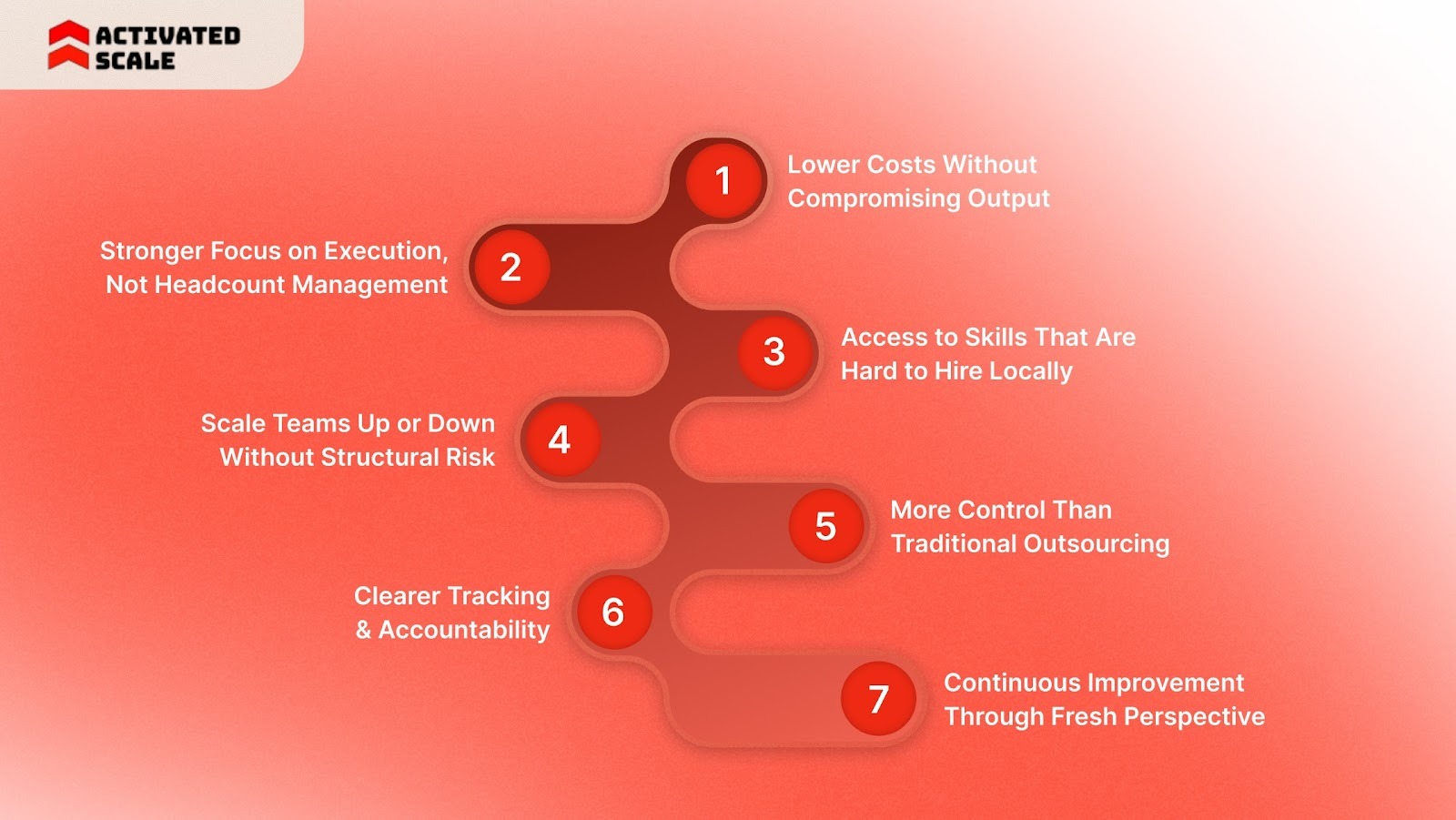
Remote staff augmentation isn’t just a hiring workaround. For startups and scaling teams, it’s a way to access specialized talent, control costs, and stay adaptable without slowing execution.
Below are the most practical benefits.
1. Lower Costs Without Compromising Output
Remote staff augmentation reduces expenses tied to full-time hiring, office space, long-term benefits, and idle capacity during slow periods. Teams pay for contribution, not overhead.
The advantage isn’t cheap labor. It’s cost efficiency with skill alignment, especially when projects require senior expertise for a defined window.
This is why many founders adopt contract or fractional models before committing long-term, testing value first, then scaling.
2. Stronger Focus on Execution, Not Headcount Management
Remote professionals are hired for outcomes, not availability. That clarity changes how work gets done.
Studies consistently show that remote workers report higher focus levels when distractions are reduced. The real impact, however, comes from hiring specialists who already know how to deliver.
Instead of ramping junior hires, teams plug in experienced contributors who can move work forward immediately.
3. Access to Skills That Are Hard to Hire Locally
Location stops being a constraint. Skill fit becomes the priority.
Remote staff augmentation allows teams to source:
- Engineers with niche technical stacks
- Product designers with domain experience
- Growth or data specialists for short-term initiatives
This mirrors how some companies approach sales hiring. For example, Activated Scale connects startups with pre-vetted, U.S.-based sales professionals on a fractional or contract-to-hire basis, removing geography while preserving quality.
4. Scale Teams Up or Down Without Structural Risk
Startups rarely grow in straight lines. Roadmaps shift. Priorities change.
Remote staff augmentation supports:
- Rapid team expansion during product launches
- Short-term boosts for MVP or migration work
- Controlled downsizing without layoffs
This flexibility is especially useful before headcount decisions become irreversible.
It’s the same logic behind using fractional leadership: validate impact, then commit.
5. More Control Than Traditional Outsourcing
Unlike project-based outsourcing, staff augmentation keeps decision-making internal. Augmented team members work inside your systems, follow your processes, and align with your priorities.
You retain:
- Direct task ownership
- Daily visibility into progress
- Control over scope and timelines
This balance, external expertise with internal ownership, is what makes the model durable.
6. Clearer Tracking and Accountability
Most remote professionals operate comfortably within modern delivery stacks. That makes progress easier to monitor and adjust.
Common advantages include:
- Faster onboarding into tools like Jira, Linear, or ClickUp
- Transparent output tied to milestones
- Easier performance reviews based on delivery, not presence
This improves predictability without adding management overhead.
7. Continuous Improvement Through Fresh Perspective
Augmented staff bring patterns from other teams and environments. That outside exposure often improves internal workflows.
Over time, teams benefit from:
- Better process discipline
- More realistic delivery estimates
- Incremental quality improvements
This is why many founders pair augmentation with fractional leadership. Activated Scale’s Fractional Sales Leadership follows this same principle by integrating experienced operators to improve systems, not just execution.
Must read: How to Get Started on Remote Closing Jobs
6 Hiring Models That Shape Remote Staff Augmentation Outcomes
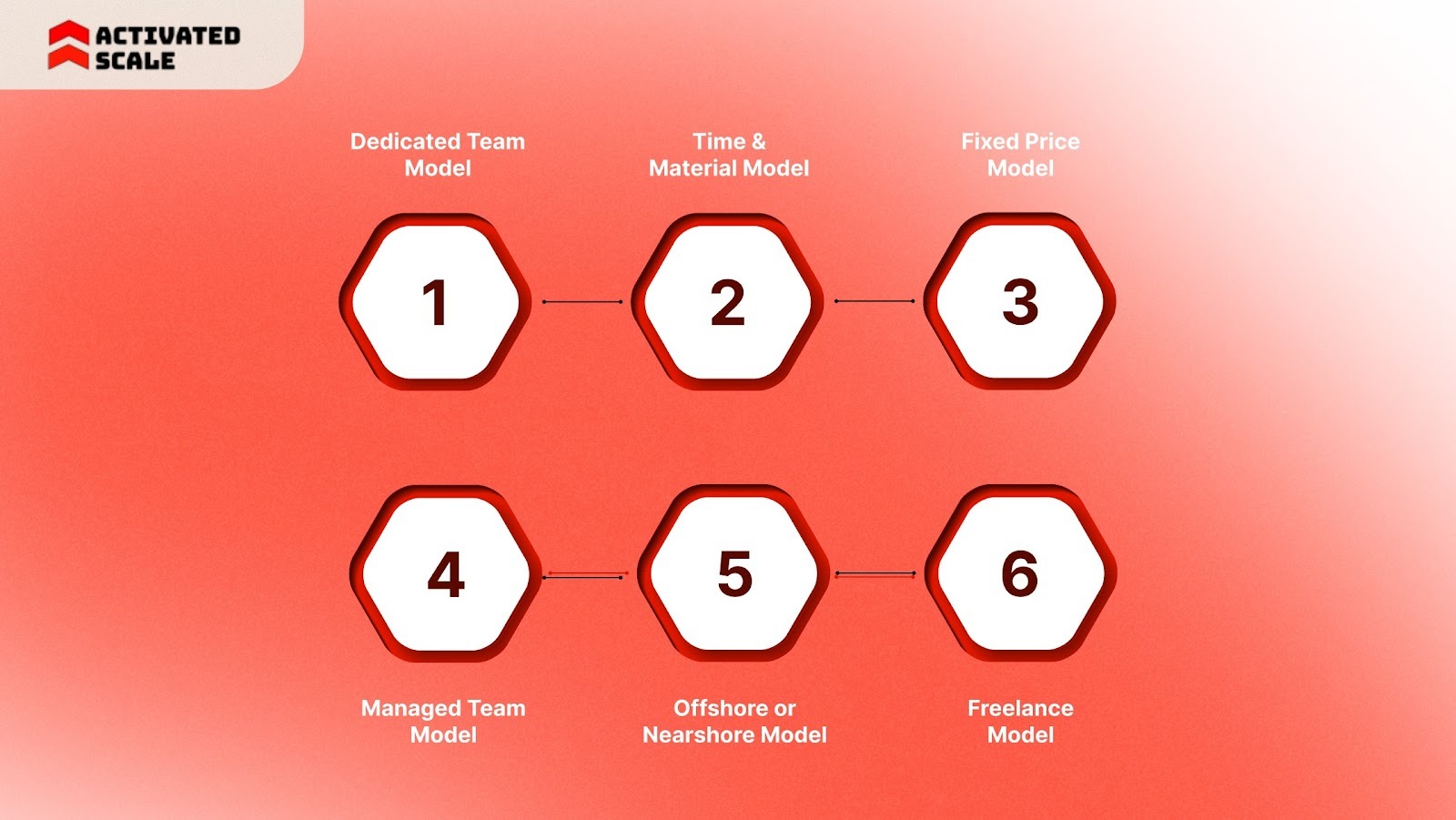
Remote staff augmentation is not just about adding people. It is about choosing how responsibility, risk, and control are distributed. Each hiring model solves a different operational problem. Picking the wrong one usually leads to delays, rework, or budget drift.
Below is how each model actually functions in practice, and when it makes sense.
1. Dedicated Team Model
This model assigns a stable group of remote professionals to your project. The team works only for you and builds deep product and domain context over time.
The core motive is continuity. Teams stay aligned with long-term goals instead of cycling in and out. Knowledge stays within the project, which reduces onboarding friction and decision lag.
Impact:
- Higher delivery consistency
- Stronger ownership and accountability
- Slower initial setup, better long-term velocity
Best for: Products with long roadmaps and evolving complexity.
2. Time & Material Model
You pay for actual hours worked rather than fixed outcomes. Scope can change without restarting contracts.
The motive here is flexibility. This model accepts uncertainty and allows teams to adapt as requirements become clearer.
Impact:
- Faster iteration cycles
- Easier experimentation
- Requires close oversight to prevent scope creep
Best for: Early-stage builds and discovery-heavy projects.
3. Fixed Price Model
Work is delivered against a predefined scope, timeline, and budget.
The motive is cost certainty. Risk shifts to the service provider, but only if requirements are locked early.
Impact:
- Predictable spend
- Limited room for change
- Rework becomes expensive if assumptions break
Best for: Short-term projects with stable requirements.
4. Managed Team Model
The provider manages the team and delivery. Your involvement stays strategic.
The motive is operational relief. This works when internal leadership bandwidth is limited.
Impact:
- Lower internal management load
- Faster execution once aligned
- Requires strong trust and reporting discipline
Best for: Teams outsourcing execution but keeping strategy in-house.
5. Offshore or Nearshore Model
Teams are sourced from other regions to optimize cost or access scarce skills.
The motive is economic leverage. Lower rates increase capacity, but coordination becomes critical.
Impact:
- Lower hourly costs
- Higher communication overhead
- Time zone planning becomes non-negotiable
Best for: Well-defined workstreams and non-core development.
6. Freelance Model
Individuals are hired for specific tasks or short bursts of work.
The motive is speed. Freelancers solve immediate gaps without long-term commitments.
Impact:
- Fast onboarding
- Minimal continuity
- Knowledge exits when the contract ends
Best for: Short-term tasks or specialized one-off needs.
Some roles need proven expertise before a full-time commitment. The same logic behind staff augmentation is applied by Activated Scale, where companies work with experienced SDRs, AEs, or sales leaders. Impact is validated first. Commitment follows.
How Remote Staff Augmentation Is Reshaping the Future of Work
Staff augmentation is no longer a short-term hiring fix. It’s becoming a core workforce strategy for companies navigating rapid product cycles, talent shortages, and uncertain growth timelines.
Instead of locking into long-term headcount, teams are using remote staff augmentation to access proven specialists when the work demands it, and scale back when it doesn’t.
This shift is especially visible in startups and growth-stage companies. Product roadmaps move faster than hiring cycles. Skills like AI, data engineering, and RevOps are needed immediately, not after months of recruiting. Staff augmentation closes that gap without slowing execution.
Why Remote Staff Augmentation Continues to Grow
- Access to specialized talent, on demand
Remote augmentation removes geographic limits. Companies hire for skill and experience, not location. This matters when niche expertise is required quickly.
- Speed without long-term risk
Hiring full-time is slow and expensive. Augmented talent can start in weeks, sometimes days, allowing teams to hit deadlines without permanent commitments.
- Cost control with flexibility
Remote models reduce overhead tied to local hiring. Teams pay for output, not idle capacity, which helps during uneven growth cycles.
- Built for startups and scaling teams
Early-stage companies often need senior-level execution before they can justify senior-level salaries. Augmentation makes that possible.
This same principle is why founders apply staff augmentation beyond engineering.
When revenue teams need experienced operators but aren’t ready for full-time hires, models like Activated Scale follow a similar approach. Companies engage vetted, U.S.-based sales professionals through their services, validating impact before committing long-term.
Key Trends Shaping Remote Staff Augmentation
- Remote-first hiring is now standard
Distributed work is no longer a perk. It’s infrastructure. Teams are built assuming remote collaboration from day one.
- Demand for narrow, high-impact skills
Generalists are harder to scale. Companies now augment teams with specialists who solve defined problems fast.
- Elastic team sizing
Headcount expands and contracts with workload. Augmentation allows this without repeated hiring and layoffs.
- Time-zone leverage
Offshore and nearshore talent enable round-the-clock progress, especially for development and support-heavy workflows.
Remote staff augmentation is moving from “temporary help” to intentional workforce design.
AI will improve talent matching. Hybrid teams will dominate. The strongest companies will be those that test expertise through real work before committing long-term.
Staff augmentation isn’t replacing full-time teams. It’s becoming the filter that ensures every hire earns their place.
Learn more about: How to Recruit Top Talent in 7 Steps
Where Staff Augmentation Meets Revenue Teams
Remote staff augmentation works best when companies need experienced operators without locking into full-time hires too early.
That challenge isn’t limited to engineering. Sales teams face the same pressure. Hiring SDRs, AEs, or sales leaders before product-market fit is proven adds risk and slows execution.
This is where Activated Scale fits naturally into the staff augmentation model.
Activated Scale supports this model through flexible engagement options:
- Contract-to-Hire Sales Recruiting – Work with vetted, U.S.-based sales professionals on a trial basis before committing to a full-time hire.
- Fractional Selling – Add experienced SDRs or AEs to run outbound or close deals without expanding permanent headcount.
- Fractional Sales Leadership – Bring in seasoned sales leaders to set strategy, build playbooks, and guide execution during key growth phases.
Each option allows teams to test real sales execution, evaluate results in live cycles, and scale only when performance is proven.
Conclusion
Remote staff augmentation has become a practical way to scale expertise without slowing teams down. It lets companies access experienced talent, control costs, and adapt quickly as priorities shift, without committing to long-term headcount too early.
The teams that succeed aren’t outsourcing ownership. They’re using flexible talent models to test execution, prove impact, and scale only when it makes sense.
That same approach increasingly applies to revenue teams. Activated Scale helps companies work with vetted, U.S.-based sales professionals, so performance is proven before commitments are made.
Connect with Activated Scale to explore flexible sales talent built for modern teams.
FAQs
1. What exactly is remote staff augmentation?
Remote staff augmentation is the extension of your internal team with external experts who work virtually to execute defined tasks while your internal leadership retains strategic control.
2. How is it different from traditional outsourcing?
Traditional outsourcing hands over whole processes. Augmentation adds specific skills directly into your team’s workflow without surrendering oversight or direction.
3. What roles are best suited for remote staff augmentation?
Positions with clear deliverables and measurable outcomes, software engineers, AI/data specialists, cloud devs, UX designers. It also increasingly includes sales execution and leadership expertise.
4. Does remote staff augmentation reduce hiring risk?
Yes. You engage talent for defined durations or outcomes, evaluate real execution, and scale only when performance is proven, reducing long-term hiring commitments and bad-hire costs.
5. How do companies integrate remote augmented staff effectively?
Best practices include:
- Clear project scopes and milestones
- Regular syncs with internal teams
- Shared tools and communication workflows
- Outcome-based evaluation
The Ultimate Guide to Hiring a Salesperson!
Get the step-by-step guide to hiring, onboarding, and ensuring success!