_edi.png)

Outbound sales don't fail because teams don’t try hard enough; they fail because many start executing before they’re ready. Without a clear outbound sales plan, even the most motivated sales reps end up sending generic messages, targeting the wrong accounts, and burning pipeline trust early.
For B2B startups and growth-stage companies, outbound remains one of the fastest ways to generate predictable revenue. It gives teams control over who they target, how they engage, and how quickly they can test new markets. But speed without structure creates noise, not results.
Quick Snapshot:
- Outbound sales gives teams control over growth, enabling targeted outreach to decision-makers and predictable pipeline creation instead of relying on inbound demand.
- Outbound fails most often due to poor preparation, not effort. Hiring reps before validating ICPs, messaging, and channels leads to low response rates and wasted pipeline trust.
- High-performing outbound teams rely on clear segmentation, buyer-specific messaging, and repeatable processes, not high activity volume.
- Outbound should be tested before scaling. Starting small and validating what converts reduces hiring risk and prevents premature full-time headcount.
- Flexible, execution-first models accelerate learning. Fractional or contract-based outbound execution helps teams prove results before committing to long-term hires.
What Is an Outbound Sales Team and Why It Still Works
An outbound sales team follows a proactive sales model, where businesses initiate contact with potential customers instead of waiting for inbound interest. Rather than relying on SEO, content, or organic lead flow, outbound teams deliberately reach out to targeted prospects through cold calling, outbound emails, LinkedIn outreach, and direct prospecting.
What makes outbound sales powerful is control. Teams decide who to contact, when to engage, and which accounts to prioritize, often focusing on specific industries, buyer personas, or high-value decision-makers. This level of precision allows companies to build a pipeline intentionally instead of reacting to inbound demand.
When executed with the right strategy, an outbound sales plan helps businesses:
- Generate a predictable pipeline and revenue
- Shorten sales cycles by reaching buyers earlier
- Build direct, one-to-one relationships with prospects
- Scale outreach in a repeatable, measurable way
For startups and growing teams, outbound sales isn’t about volume; it’s about focus, timing, and execution. The effectiveness of the team depends less on activity count and more on how well the outreach strategy aligns with the target market.
Why an Outbound Sales Team Drives Consistent Growth
Inbound can bring leads, but it rarely gives control. When demand slows or competition increases, inbound-only teams feel it first. An outbound sales team gives businesses a way to create a pipeline on their own terms.
With a clear outbound sales plan, teams can:
- Target specific accounts instead of waiting for interest
- Control pipeline volume and forecast revenue more accurately
- Test messaging quickly and double down on what converts
- Expand into new segments without relying on organic demand
Outbound sales are also repeatable. Once targeting, messaging, and outreach are defined, teams can refine execution, improve conversion rates, and scale results without guessing.
For companies focused on predictable revenue and faster market expansion, an outbound sales team isn’t about replacing inbound; it’s about owning growth instead of reacting to it.
Outbound vs. Inbound Sales: Which Model Fits Your Growth Strategy?
When building an outbound sales plan, it’s important to understand how outbound sales differ from inbound sales and why many B2B startups rely on outbound to drive predictable growth. While both approaches can generate revenue, they vary significantly in control, speed, and execution.
Below is a clear comparison to help teams choose the right approach.
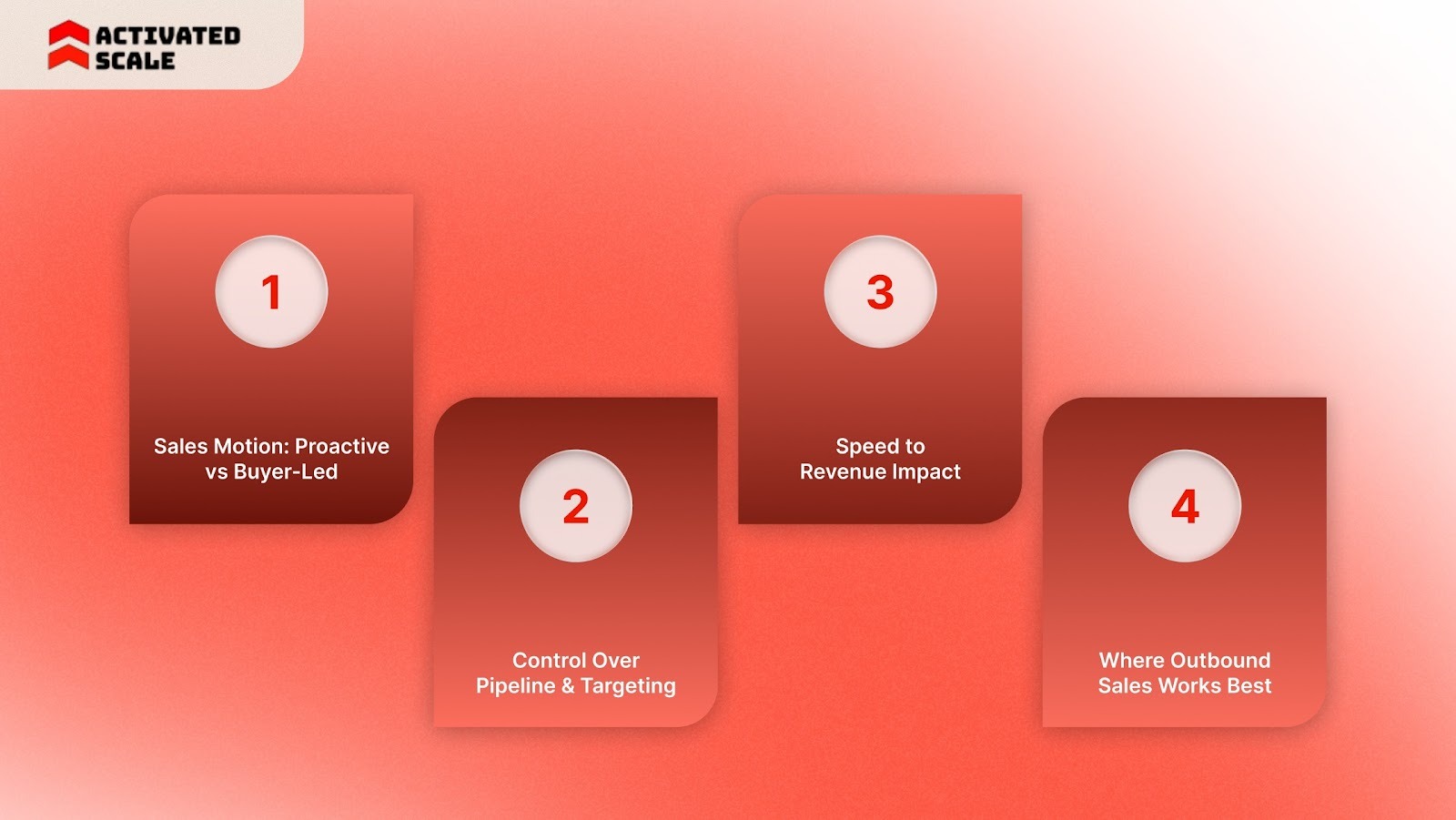
1. Sales Motion: Proactive vs Buyer-Led
Outbound Sales
Outbound sales follow a proactive motion. Sales teams identify target accounts and decision-makers, then initiate contact through cold emails, calls, LinkedIn outreach, and direct prospecting. The focus is on reaching the right buyers early rather than waiting for demand to surface.
Inbound Sales
Inbound sales are buyer-led. Companies attract prospects through content, SEO, social media, ads, and referrals. Sales engagement begins only after a prospect shows interest, often later in the buying journey.
2. Control Over Pipeline and Targeting
Outbound Sales
Outbound provides greater control over pipeline creation. Teams decide:
- Which accounts to target
- When to engage
- How to personalize outreach
This makes outbound ideal for account-based strategies and precise ICP targeting.
Inbound Sales
Inbound pipeline depends heavily on traffic, rankings, and engagement. Lead quality and volume fluctuate based on external factors like algorithm changes or campaign performance.
3. Speed to Revenue Impact
Outbound Sales
A focused outbound sales plan can generate qualified conversations within weeks. Because reps engage decision-makers directly, feedback loops are faster, and revenue impact is more immediate.
Inbound Sales
Inbound typically requires longer timelines. Content creation, SEO authority, and lead nurturing often take months before producing consistent, sales-ready opportunities.
4. Where Outbound Sales Works Best
Outbound sales are particularly effective for:
- B2B SaaS and tech companies
- High-ticket or complex solutions
- Enterprise or mid-market buyers
- New market entry with low brand awareness
- Teams needing predictable pipeline generation
Inbound performs well for lower-ACV products and brand-led growth, but outbound remains the fastest way to test markets and build early traction.
Inbound builds long-term demand. Outbound creates an immediate opportunity.
For startups and growth-stage companies, a well-executed outbound sales plan offers speed, control, and predictability, especially when revenue targets can’t wait for organic momentum to build.
Learn more about: What is the First Step in Managing Outsourcing?
Building the Right Outbound Sales Team From Scratch: A 6-Step Execution Framework
A solid outbound sales plan only works if the right team is in place to execute it. Even the best product struggles to scale without a focused outbound team that knows who to target, how to engage, and how to convert conversations into revenue.
Here’s a practical, step-by-step framework for building an outbound sales team from scratch, designed for startups and growth-stage companies that need speed, clarity, and a predictable pipeline.
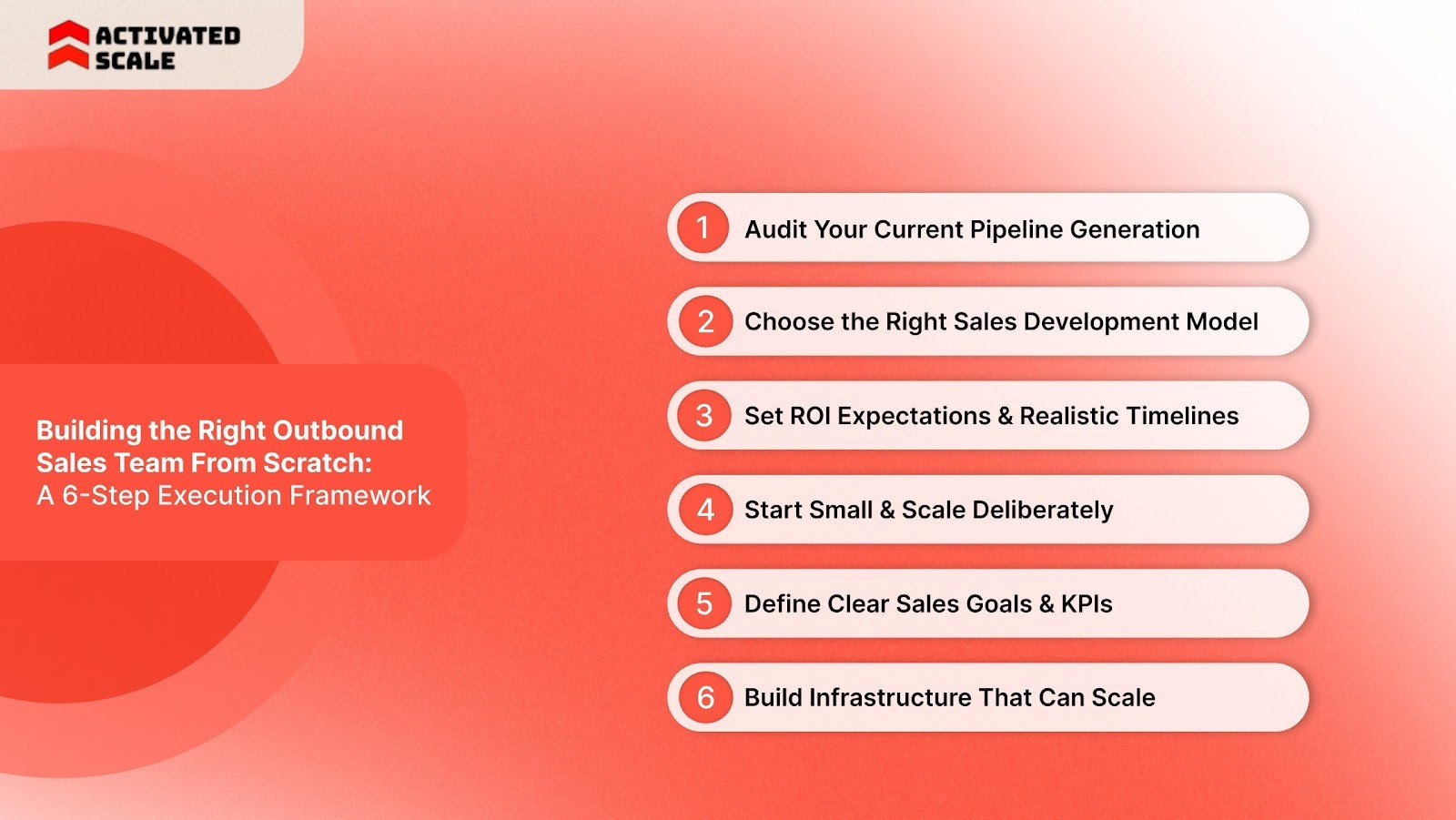
Step 1: Audit Your Current Pipeline Generation
Before hiring SDRs or launching outbound campaigns, get clear on what’s already working and what isn’t. The goal is to understand where revenue actually comes from, not just where leads originate.
Focus your audit on:
- Lead sources: Identify which channels generate qualified opportunities, not just volume.
- Lead quality: Review which segments consistently reach the SQL stage and convert.
- Conversion performance: Track lead-to-opportunity and opportunity-to-close rates.
- Cost efficiency: Measure cost per opportunity against revenue generated.
- Sales feedback: Use SDR insights to understand which leads convert faster and why.
This audit prevents you from scaling outbound on weak assumptions or poor data.
Step 2: Choose the Right Sales Development Model
Your outbound structure should reflect how your buyers prefer to engage and how quickly you need results.
Common models include
- Outbound-first: Proactive targeting and direct outreach; best for B2B SaaS, enterprise, and new-market entry.
- Inbound-led: Sales responds to marketing-generated demand; slower but efficient long term.
- Hybrid: Combines outbound control with inbound momentum for flexibility.
For startups needing a predictable pipeline early, outbound is often the fastest path to market feedback and revenue.
Step 3: Set ROI Expectations and Realistic Timelines
Outbound sales are not instant, but they are measurable.
Set expectations upfront:
- Plan for a 3–6 month window to evaluate performance meaningfully.
- Track reply rates, meeting rates, conversion quality, and pipeline velocity early.
- Review qualitative feedback from prospects alongside quantitative metrics.
If results are strong, document what’s working and standardize it. If not, adjust targeting, messaging, or sequencing before scaling further.
Step 4: Start Small and Scale Deliberately
Avoid overbuilding early. Start with two SDRs to test outreach strategies, messaging, and ICP fit.
Initial cost areas typically include:
- Base salary and commissions
- Sales tools and outreach infrastructure
- CRM and data tools
Once you identify repeatable success, scale headcount with confidence instead of guesswork.
Step 5: Define Clear Sales Goals and KPIs
Outbound teams need clarity on what success looks like. Choose metrics that reflect efficiency and quality, not just activity.
Key outbound KPIs to track:
- Sales cycle length
- Cost per opportunity
- Email open and reply rates
- Calls-to-close ratio
Industry benchmarks to aim for:
- Average conversion rate: ~3%
- Email open rate: 65%+
- Reply rate: ~8–9%
Set targets that stretch performance without encouraging spammy or low-quality outreach.
Step 6: Build Infrastructure That Can Scale
Outbound success depends on systems that support consistency and growth.
Prioritize:
- CRM discipline: Centralized tracking of every interaction
- Outbound tools: For sequencing, tracking, and reporting
- Data-driven targeting: Continuous refinement based on performance
- Automation and integrations: Reduce manual work and errors
Your infrastructure should evolve as the team grows, without slowing execution.
Building an outbound sales team requires speed, experience, and flexibility, three things many startups struggle to balance. Activated Scale supports outbound execution by connecting companies with sales leaders who already understand outbound motions, tooling, and buyer behavior.
Outbound Sales Strategies That Drive Scalable Growth
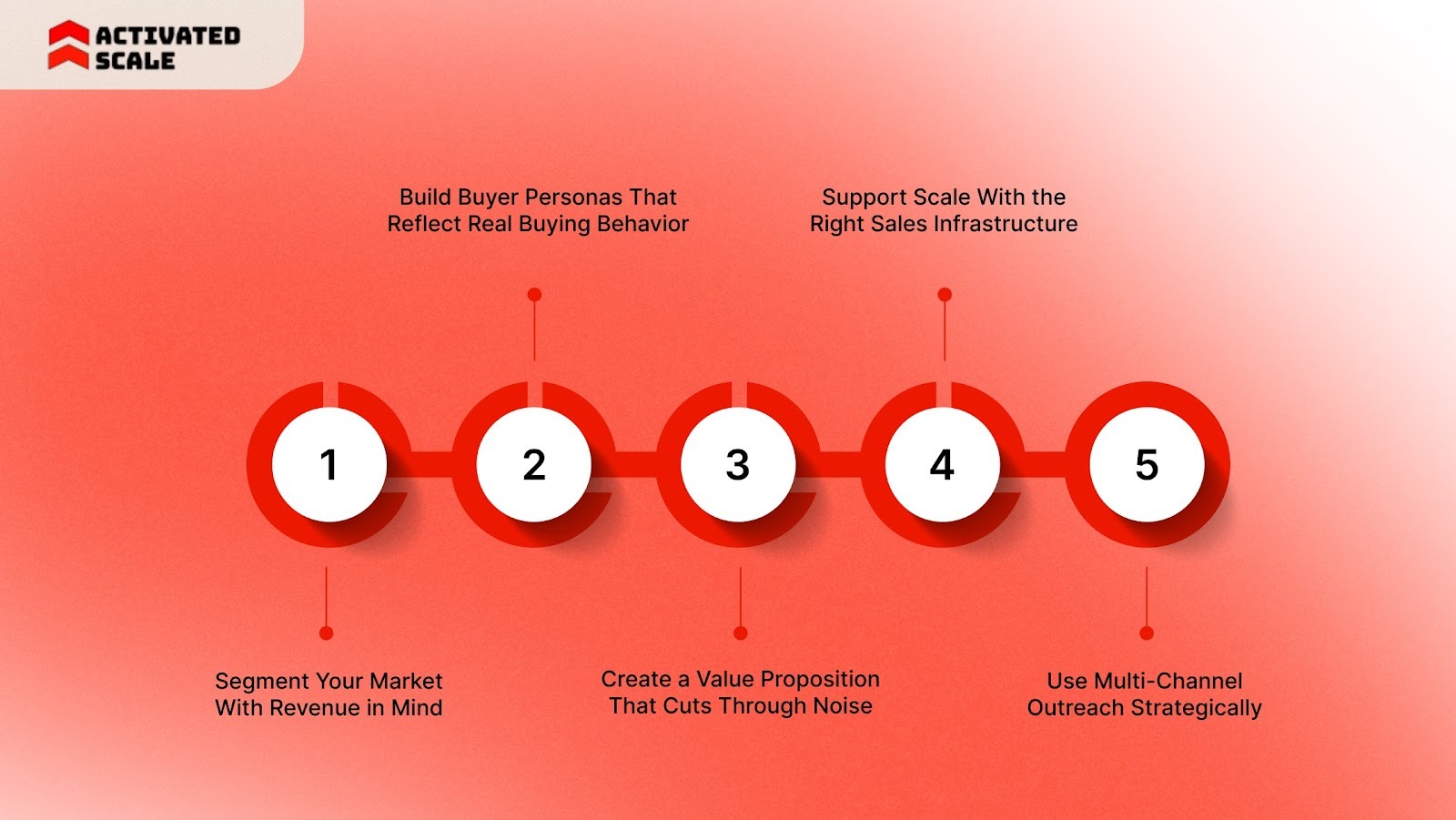
Before building an outbound team or finalizing an outbound sales plan, it’s critical to get the strategy right. Outbound succeeds when targeting is precise, messaging is relevant, and execution is repeatable. Without this foundation, even the best sales reps will struggle to generate consistent results.
Below are the core outbound strategies that support scalable, predictable growth.
1. Segment Your Market With Revenue in Mind
Effective outbound sales starts with intentional market segmentation, not broad targeting. Instead of selling to everyone, focus on well-defined segments where your solution delivers clear value.
Segment based on factors such as
- Industry or niche
- Job role and seniority
- Company size and growth stage
- Existing tools or technology stack
Strong segmentation allows teams to prioritize high-fit accounts and avoid wasting outreach on low-probability prospects.
2. Build Buyer Personas That Reflect Real Buying Behavior
Once segments are defined, translate them into detailed buyer personas. These personas should reflect how decisions are actually made, not assumptions.
Focus on:
- Core pain points and business priorities
- Decision-making authority and internal buying dynamics
- Objections commonly raised during sales conversations
- Preferred communication style and level of detail
Clear personas enable messaging that feels relevant, specific, and timely, key factors in outbound response rates.
3. Create a Value Proposition That Cuts Through Noise
Outbound messaging only works when it answers one question quickly: Why should this buyer care?
A strong outbound value proposition:
- Addresses a specific business problem
- Clearly explains the outcome, not just the feature
- Differentiates you from alternatives in the market
Generic claims don’t convert. Precise, outcome-driven messaging does.
4. Support Scale With the Right Sales Infrastructure
Scalable outbound requires systems that support consistency and visibility. This includes:
- A CRM to track conversations and the pipeline
- Outreach workflows that ensure timely follow-ups
- Reporting to measure reply rates, meetings booked, and conversion trends
The goal isn’t automation for its own sake; it’s creating a repeatable process that sales reps can execute reliably.
5. Use Multi-Channel Outreach Strategically
Relying on a single channel limits reach. High-performing outbound teams combine:
- Direct calling
The key is coordination. Messages across channels should reinforce one another, not repeat the same pitch. Relevance and timing matter more than volume.
Strong outbound strategies only work when executed by the right people. This is where Activated Scale fits naturally into an outbound sales plan.
With the strategy in place, the next step is clear: building an outbound sales team that can execute consistently and scale results.
Must read: Outside Sales Rep for Revenue Growth & Account Expansion
Executing an Outbound Sales Plan Without Guesswork
Most outbound sales plans fail at the same point: execution before clarity. Teams hire full-time reps before validating ICPs, messaging, or channels, then spend months fixing what could have been tested earlier.
Here, Activated Scale takes a different approach.
Instead of pushing startups into long-term sales hires, Activated Scale enables short-cycle outbound testing. Teams can deploy experienced SDRs or AEs on a fractional or contract basis to validate:
- Which segments actually respond
- What messaging converts to meetings
- Which channels perform consistently
Only after outbound signals are clear do teams scale headcount.
Why this matters for outbound teams
- Outbound becomes measurable faster: Messaging, ICPs, and activity benchmarks are tested in real conditions, not guessed in planning decks.
- Hiring follows evidence, not assumptions: Teams commit to full-time roles only after seeing repeatable pipeline creation.
- Leadership support without overhead: Fractional sales leaders help translate early outbound data into GTM structure, quotas, and playbooks.
For companies building an outbound sales plan, this model shifts the risk away from hiring and toward learning. The result is faster iteration, cleaner execution, and outbound teams built on proof, not hope.
Conclusion
Building an outbound sales team isn’t about hiring fast; it’s about executing with intent. A strong outbound sales plan starts with clear segmentation, sharp messaging, and disciplined multi-channel outreach. But the real advantage comes from testing early, learning quickly, and scaling only what proves effective.
This is where execution models matter. Instead of committing to full-time hires before outbound signals are clear, teams can validate ICPs, messaging, and channels first. Activated Scale supports this approach by enabling startups to run outbound experiments with experienced, U.S.-based sales talent, then scale with confidence once results are repeatable.
Don’t lock in headcount before outbound work. Learn how Activated Scale helps teams test, refine, and scale outbound sales the right way.
FAQs
1. What is an outbound sales plan?
An outbound sales plan defines how your team proactively targets, engages, and converts specific buyers through channels like email, calls, and LinkedIn.
2. Is outbound sales better than inbound for startups?
Outbound is often faster and more controllable early on, especially for B2B, high-ticket, or low-awareness markets.
3. How long does it take to see results from outbound sales?
With focused targeting and experienced execution, teams can start booking qualified conversations within weeks.
4. What roles are essential for an outbound sales team?
Most teams start with SDRs for prospecting, supported by AEs for closing and leadership to define ICPs and messaging.
5. How can startups reduce risk when building outbound teams?
By testing outbound motions before committing to full-time hires, using flexible, short-cycle execution models.
The Ultimate Guide to Hiring a Salesperson!
Get the step-by-step guide to hiring, onboarding, and ensuring success!