_edi.png)

Most prospects now arrive at the first call already knowing what they want. In fact, 75% of B2B buyers do not prefer a sales rep in their buying journey,
So, how do you ensure your sales pitch looks less like a "pitch" and more like assistance? Because if you fail to provide a personalized experience, then the meeting will lack value, leading to a missed opportunity.
Since you're in this field for a long time, you already know what to say. But how you say it matters more than ever. In this blog, you'll get real sales pitch examples that help move deals forward.
At a Glance
- Mastering diverse pitch types, whether short or long, ensures you're prepared for any sales situation.
- Grab attention immediately with a relevant statement, statistic, or shared challenge that resonates with the prospect.
- Clearly address the pain point the prospect is facing to show you understand their challenge.
- Explain how your solution benefits the prospect and provide social proof or relevant metrics to build trust.
- End with a direct, easy-to-follow next step to keep the conversation moving forward.
What Makes a Perfect Sales Pitch Actually Work in 2026?
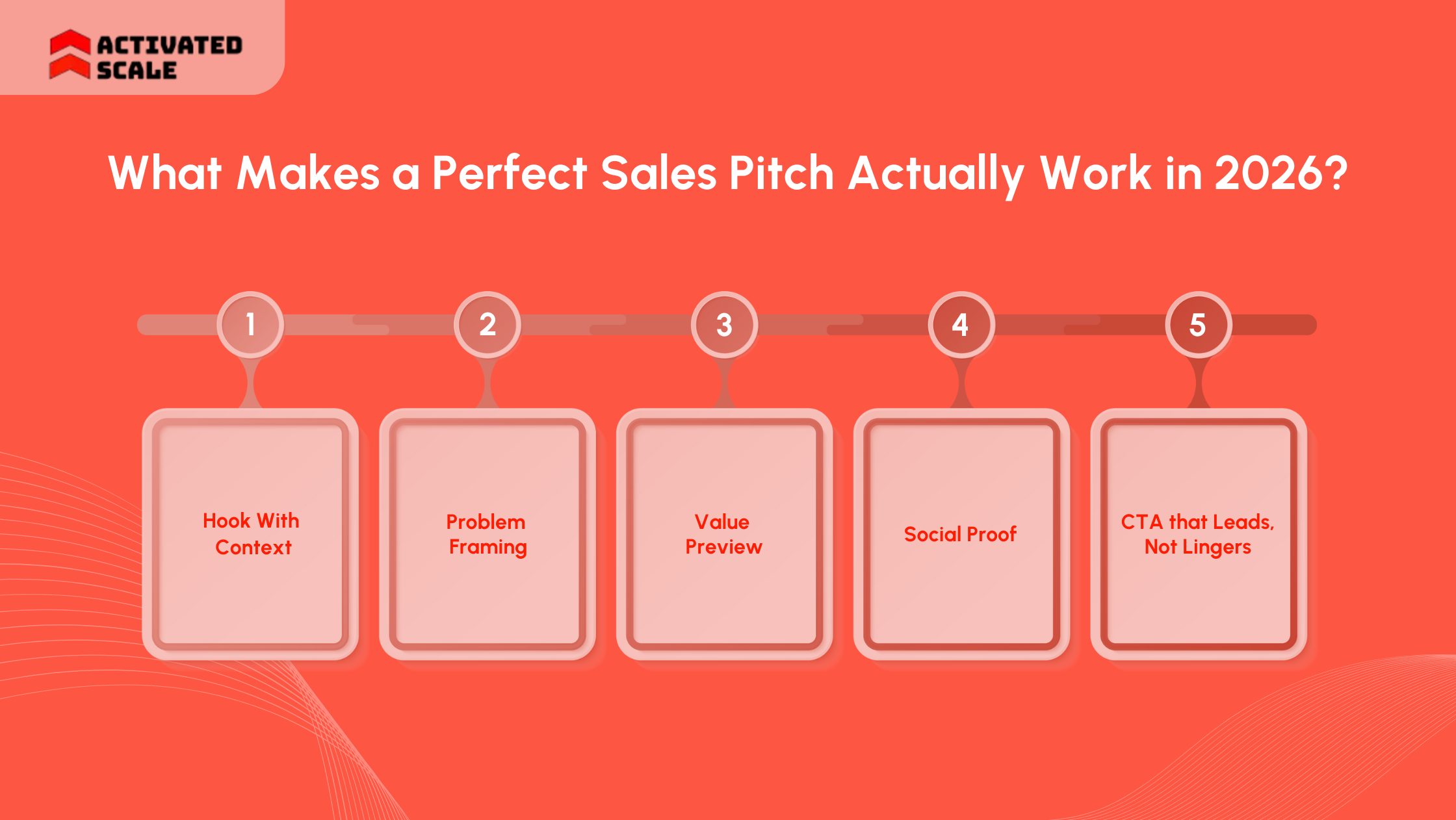
You're not here to learn what a pitch is. You're here because what you say in the first 20 seconds either sparks curiosity or kills the deal.
A good pitch is short, specific, and speaks their language. However, too many reps still wing it.
No structure, no angle, no point. That's where deals stall. To fix that, every pitch you deliver, email, call, or demo should include these elements:
1. Hook with context
Start by showing you understand what matters to them. You're not pitching a product; you're opening a conversation. A good hook mentions something current or specific:
- "Saw your team hiring new reps. Ramp time must be tight right now."
- "Noticed your team's push into mid-market. Pipeline gaps can hit fast."
- "Your CEO's new product update caught my eye. Big shift for your team."
- "Your last post mentioned stalled demos. That's a tough spot."
- "Saw the quarter-end spike on LinkedIn. You must be juggling deals."
2. Problem framing
Next, name the challenge they're already dealing with. Use real language, especially industry-specific:
- "Reps book meetings, but many calls end with no clear next step."
- "Your team works hard, but admin work still slows them down."
- "Managers lose hours coaching because data stays scattered."
- "Prospects research early, but reps still struggle to stand out."
- "Deals stall because follow-up timing isn't consistent."
3. Value preview
Now shift the lens. What changes if they listen to you? Don't pitch features, describe an outcome:
- "Teams using us double-qualified calls within three weeks."
- "Reps close faster with cleaner talk tracks and real buyer cues."
- "Managers get full visibility, so coaching happens in minutes."
- "Your follow-up timing becomes automatic, so fewer deals slip."
- "Reps hit targets earlier with clearer daily priorities."
4. Social proof
Skepticism is high. So back it up with names, numbers, or outcomes:
- "A fintech team like yours cut meeting prep time by 60%."
- "SDRs at Ramp boosted connect rates after two weeks with us."
- "A SaaS team in Austin saw 3x more booked demos last quarter."
- "One RevOps lead used our workflows to cut admin hours in half."
- "A startup with a 10-person team used this to hit targets for the first time."
5. CTA that leads, not lingers
The worst CTA? "Let me know if this is of interest." The best? Direct and assumptive:
- "Can you do ten minutes after your standup tomorrow?"
- "Want a quick look? I can show you on one screen."
- "If this fits, I can walk you through it Thursday morning."
- "Want me to share a short walkthrough?"
- "Open to a quick call so we can check fit?"
You've seen what goes into a strong pitch. A clear structure helps, but execution is what separates reps who get polite replies from reps who get real interest.
That gap comes down to habits, not luck.
Also Read: Role and Responsibilities of a Sales Development Coordinator
6 Best Practices of Marketing Pitches to Prevent Them from Falling Flat
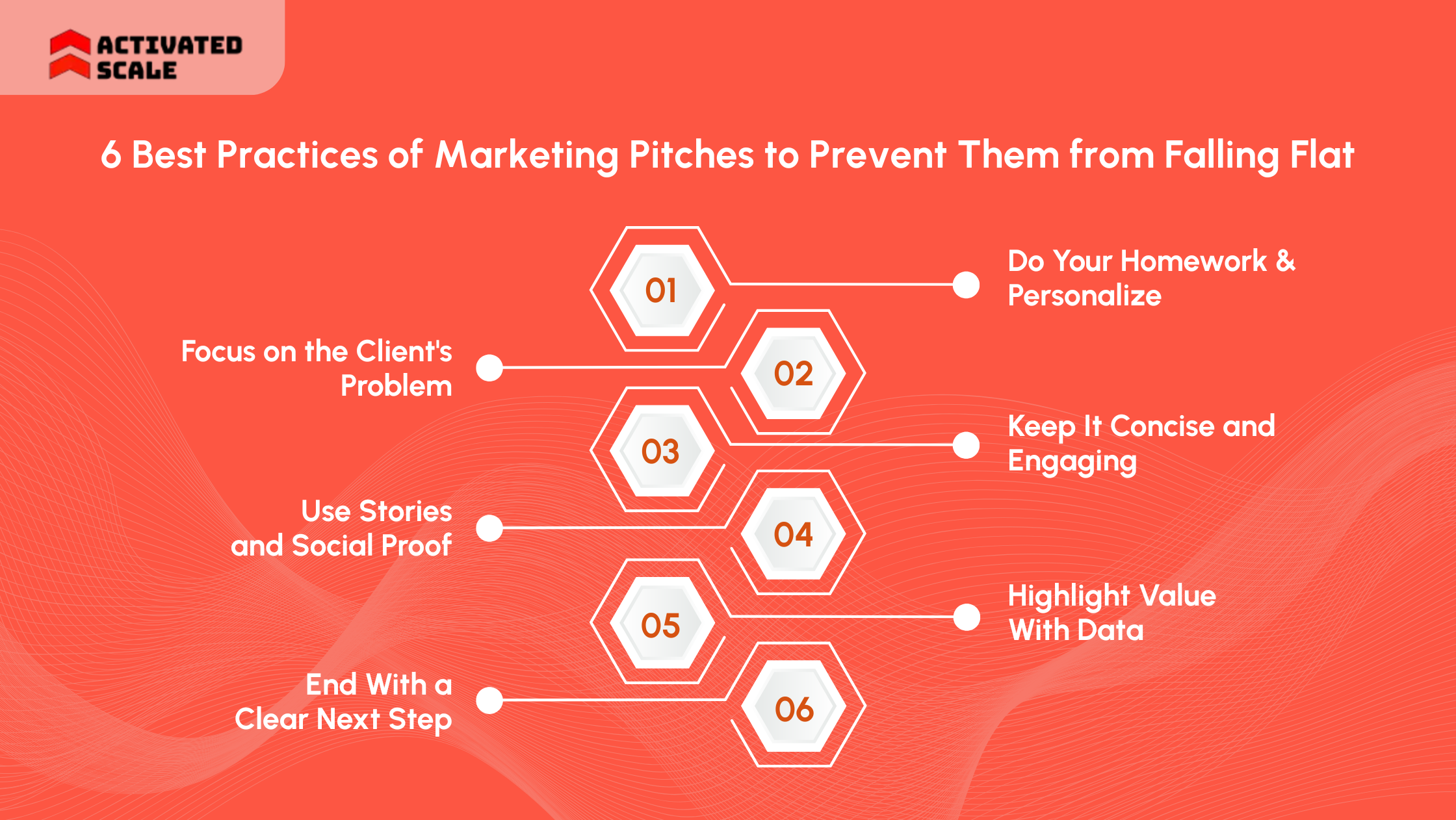
Reps with solid skills still miss deals when they skip the basics that keep a pitch sharp. These principles matter no matter the format.
You can send a video, write an email, or open a call, but the core rules stay the same. Miss them, and the pitch feels flat even if the idea is strong.
1. Do Your Homework & Personalize
Buyers expect real preparation. Research their industry, their team size, their role, and their current focus. Use details they already care about.
An overwhelming majority of B2B buyers, 84%, now judge a sales rep on their ability to provide consultative insight. Make the pitch sound like it was written for one person.
2. Focus on the Client's Problem
Prospects don't want a tour of features. They want someone who sees what slows them down. Lead with the pain or goal they feel today.
That keeps you aligned with their world. When you position your offer as the direct fix, they stay engaged because the pitch reflects their reality.
This creates a smoother shift into the value you deliver.
3. Keep It Concise and Engaging
Buyers skim, multitask, and judge fast. Deliver your main point quickly. In longer calls or demos, reset their attention after a few minutes by asking a question or sharing a short story.
This stops conversations from going stale. Clean, tight sentences keep the listener focused on what matters.
4. Use Stories and Social Proof
Prospects trust results more than promises. Share a quick story about a team with similar goals. Keep it simple: What problem they had, what changed, and what the impact was.
A single name or number boosts credibility and reduces doubt before it forms.
5. Highlight Value With Data
Use one or two results that matter for their role. Something like "Booked meetings jumped 27% in three months" hits harder than a long description.
Data gives your pitch weight and shows the impact reps can expect when they take the next step with you.
6. End With a Clear Next Step
Never end with an open loop. Guide the buyer toward one action. Ask for time, a short look, or a quick call.
The CTA should be easy to accept and specific so the buyer knows exactly what happens next. This keeps momentum moving and helps deals move forward instead of stalling.
Reach out to Activated Scale's open sales talent source to find a role that helps you grow.
Principles are powerful, but execution is everything. The following scenarios will show you exactly how to adapt your pitch, ensuring you make the most of every opportunity.
10 Top-notch Sales Pitch Examples to Win Over Any Prospect
86% of B2B deals hit a standstill before they ever reach the finish line. That means every pitch needs to hit the mark before the buyer's journey stalls.
Mastering the right pitch at the right time can mean the difference between getting a "maybe" and a "yes." The key is knowing when to use each style.
Below, we break down 10 different sales pitch examples customized to different situations:
1. The One-Liner Pitch (Ultra-Concise Impact)
The one-liner pitch should deliver just enough information to intrigue and prompt further conversation. Many buyers said that clarity in communication is critical to closing a deal.
A strong one-liner should focus on the outcome your solution provides. For example, you might say:
"We help e-commerce companies increase checkout conversion by 30% with an easy-to-integrate plugin."
This approach quickly conveys who you help and the value you bring. Keep it under 140 characters to ensure it's easy to remember and repeat.
Tip: Craft your one-liner ahead of time. When an opportunity strikes, you can deliver it smoothly without hesitation.
2. The Elevator Pitch (30-Second Summary)
Sales reps say they lack the resources to communicate their value to buyers effectively. In this case, an elevator pitch is a classic.
You get around 30 to 60 seconds to introduce yourself, your company, and the solution you provide. For example:
"We help healthcare financial teams automate billing processes, saving an average of 15 hours per week. One client even saw a 25% faster payment cycle."
This format covers the key pain point, the value offered, and a concrete result, all in about 30 seconds. It's ideal for brief encounters or when someone asks you, "So, what does your company do?"
Tip: Keep your language simple. Your goal is to explain the benefits in a way that's clear to anyone, regardless of their industry background.
3. The Phone Sales Pitch
Getting a prospect on the phone is an opportunity to build rapport and directly address their needs. In a phone sales demo, you need to hook their attention with a relevant issue immediately.
Start by briefly introducing yourself, then lead with a fact or insight that resonates with their situation:
"I noticed your company is growing fast in online retail. We've helped companies in your space increase online sales by 40% over the past quarter."
This demonstrates that you understand their industry and can offer real results. Emphasize outcomes over features.
Tip: Be conversational. A successful phone pitch is less of a scripted sales pitch and more of a dialogue that feels authentic to the prospect.
4. The Voicemail Pitch
A cold voicemail has a 90% chance of being ignored, making it one of the least effective outreach channels. Voicemails are often the overlooked step in the sales process, but when done correctly, they can be a powerful tool.
So, your voicemail should be brief, personalized, and intriguing enough to encourage a callback.
A good voicemail pitch doesn't over-explain; it sparks curiosity:
"Hi, this is Taylor from XYZ Security. We recently helped a local bank reduce its cybersecurity response time by 50%. I'd love to discuss how this might apply to your team.
I can send you an email with more info."
Notice how it's under 30 seconds, provides relevant proof, and prompts the recipient to call back.
Tip: Smile while speaking; it makes your message sound friendlier and more engaging. Always include a specific callback number to make it easy for them to reach you.
Ready to take your sales skills to the next level? If you're looking to join a startup that matches your salary expectations, look at the Job Section of Activated Scale today.
5. The Email Sales Pitch
Email is still one of the most effective ways to reach prospects. However, your email should feel personal and valuable to the reader.
A good email pitch should include a strong subject line, a personalized introduction, and a clear value proposition. For example:
"Hi Maria, I saw your company is hiring new sales reps this quarter. We help SaaS companies like yours ramp new hires 50% faster with our training platform. Here's a demo link I'd love to share with you."
The key is personalizing the first line to show relevance and offering something of value upfront, like a demo or useful resource.
Tip: Keep it concise and visually easy to read. Use bullet points and break up text for easy scanning. Always end with a clear, low-pressure CTA that asks for a quick action.
6. The Social Media Pitch
Social selling is growing rapidly, especially on platforms like LinkedIn, where prospects are active and engaging. A social media pitch starts by using a recent post, common connection, or shared interest to warm up the conversation.
For example:
"Hi Jane, I saw your recent post about scaling customer success teams. It really resonated with me. I've been working with a few SaaS companies tackling this challenge and thought I'd reach out.
One of the things we've found most helpful is automating support ticket prioritization, which can reduce response times by up to 40%. I'd love to connect and discuss how this might help your team."
This pitch works because it's conversational, personal, and directly relevant to what the prospect cares about.
Tip: Don't overdo it with formalities or a long pitch. This is about starting a relationship, not closing a deal in a single message.
7. The Video Sales Demo
Video sales demos stand out because they engage multiple senses like sight, sound, and motion, making them memorable. In fact, to maximize your reach, think that a video is shared 1,200% more than text-based content.
A short, personalized video message can quickly capture attention and convey information more dynamically than text alone.
For example, in your video, you could say:
"Hi, I'm Ella from MarketingPro. I know your team is busy, so I wanted to show you how our platform can help. Let me walk you through how our tool works in just 60 seconds. Here's a quick demo."
This approach combines a personal touch with an engaging visual demo. It shows the prospect you're willing to invest time to deliver value directly to them.
Tip: Keep it under 2 minutes. Make sure your message is clear and easy to follow, with good audio and video quality.
8. The Sales Presentation Pitch (Deck Pitch)
The sales presentation pitch is a formal pitch where you have the prospect's full attention, whether it's in a boardroom or over Zoom.
A great presentation pitch starts with a strong hook, outlines the problem, and then positions your solution as the clear answer.
For example:
"Thank you for your time today. Let me start by asking: Did you know 60% of manufacturers report supply chain issues due to stockouts?
Today, we're going to show you how our solution can reduce these issues by 90% and give you more control over your inventory."
This type of pitch should follow a clear structure—problem → solution → proof (through case studies or data) → next steps.
Tip: Maintain eye contact, speak confidently, and be prepared for questions. Practice beforehand to ensure your delivery is smooth and engaging.
Ready to close more deals? Marketing pitch examples are designed to fit different sales scenarios, so if you want to restart your career, look at the Job Services at Activated Scale.
9. The Follow-Up Pitch
The follow-up pitch comes after an initial conversation or meeting. It's a focused message that refers back to what was previously discussed, moving the conversation forward.
For example:
"Hi Sam, it was great meeting you last week at TechWorld. I really appreciated your thoughts on data security challenges.
Following up, I've attached a short case study showing how we helped a similar fintech company improve its security measures by 40%.
Let's schedule a demo so we can dive deeper into how this might work for you."
A well-crafted follow-up pitch serves to remind the prospect of the conversation, nudging them closer to taking action.
Tip: Be polite but assertive, always suggest a clear next step (like scheduling a demo or phone call) to keep the momentum going.
10. The Pain-Point Story Pitch
The pain-point story pitch taps into the power of storytelling. People connect with stories, especially when they see themselves in the scenario.
A good story illustrates a common pain point and shows how your solution solved it for someone in a similar situation.
For example:
"When Jen, an operations manager at a warehouse, kept staying late to solve inventory issues, she knew something had to change.
After using our product, Jen was able to eliminate 80% of errors and leave by 6 PM each day. Her stress levels dropped, and the shipments went out on time every time."
Here, you're painting a picture of the prospect's pain; you help them visualize their own success story after using your solution. This makes the pitch more relatable and memorable.
Tip: Keep the story brief, just a few sentences that highlight the problem, the solution, and the result.
Also Read: Who is a Sales Development Engineer and How to Become One
The Bottom Line
Mastering a strong sales demo about knowing your prospect. No matter which sales pitch example you use, each should be crafted for maximum impact.
So, follow these examples and best practices to better engage with prospects and ultimately, close more sales. Don't just stick to one pitch style; adapt and refine your approach as you move forward.
Ready to take your sales game to the next level? Let's talk! Explore top-tier opportunities to join a dynamic team.
FAQs
1. What's the best pitch type for cold outreach?
The one-liner or elevator pitch is perfect for cold outreach as it grabs attention quickly and clearly outlines your value.
2. How long should my email pitch be?
Keep it concise, aim for under 150 words with a clear value proposition and CTA.
3. How do I make my phone pitch stand out?
Focus on the prospect's specific pain points and make the conversation more about solving their problem than about your product.
4. What's the key to a great voicemail pitch?
Keep it under 30 seconds, highlight a relevant result, and mention a follow-up.
The Ultimate Guide to Hiring a Salesperson!
Get the step-by-step guide to hiring, onboarding, and ensuring success!