_edi.png)
Hiring sounds straightforward until volume, speed, or uncertainty enters the picture. Roles stay open longer than expected, internal teams get stretched, and every bad hire becomes expensive to undo. That’s why staffing agencies continue to play a central role in how companies hire today, not as shortcuts, but as risk-management tools.
Staffing agencies help businesses move faster by taking ownership of sourcing, screening, and employment logistics, while employers retain control over performance and outcomes.
Whether the need is temporary coverage, contract-to-hire flexibility, or permanent placement, staffing agencies exist to reduce friction in the hiring process.
Quick Snapshot
- A staffing agency helps businesses hire faster by managing candidate sourcing, screening, and employment administration
- Staffing agencies support temporary, contract, contract-to-hire, and permanent roles, depending on business needs
- The main benefits are speed, flexibility, and reduced hiring overhead, especially during periods of uncertainty or growth
- Common trade-offs include higher long-term costs, less control over sourcing, and weaker cultural fit for strategic roles
- Staffing agencies work best for short-term, variable, or test-before-hire needs rather than permanent leadership roles
- For revenue-critical sales roles, companies often prefer contract-to-hire or fractional models that validate performance first, such as those offered by Activated Scale
What Is a Staffing Agency?
A staffing agency helps companies fill roles by sourcing, vetting, and placing workers, without the business having to manage the entire hiring process alone. Instead of just introducing candidates, staffing agencies often stay involved throughout the worker’s engagement.
Unlike simple recruiting services, staffing agencies typically handle more than resumes and interviews. They manage onboarding, coordination, and, in many cases, ongoing employment logistics. This makes them especially useful for roles that need to be filled quickly or flexibly.
It’s important to separate staffing from recruiting. Recruiting focuses on finding and placing a candidate. Staffing covers the full employment cycle, from hiring and onboarding to retention and eventual offboarding. That broader responsibility is what allows staffing agencies to support businesses at scale, especially when headcount needs change frequently.
What Do Staffing Agencies Do?
Staffing agencies help businesses fill roles quickly by managing the parts of hiring that consume the most time and create the most risk. Instead of companies sourcing, screening, and coordinating candidates themselves, staffing agencies step in to run the process end to end.
Their work typically includes:
- Sourcing candidates through existing networks and databases
- Screening for skills, experience, and availability
- Coordinating interviews and feedback
- Handling employment logistics like contracts, payroll, and compliance
This allows companies to stay involved only where it matters, final selection and performance, while offloading the operational burden of hiring. The level of involvement is flexible: some teams use staffing agencies to fill urgent gaps, while others rely on them as an ongoing hiring partner.
Staffing Agency vs. Temp Agency
The difference comes down to scope, not quality.
A staffing agency supports multiple hiring needs, temporary, contract, contract-to-hire, and permanent roles. They’re built for flexibility and longer-term workforce planning.
A temp agency is narrower. Its primary focus is short-term labor for immediate needs, such as seasonal spikes, coverage gaps, or project-based work. Once the assignment ends, so does the relationship.
In short:
- Temp agencies solve short-term labor shortages
- Staffing agencies solve broader hiring and workforce challenges
Staffing Agency vs. Recruiting Agency
Recruiting agencies typically specialize in permanent placements, often for senior or highly specialized roles. Their success is measured by long-term fit rather than speed.
Staffing agencies operate differently. They place candidates across:
- Temporary and contract roles
- Temp-to-hire positions
- Permanent roles at multiple levels
They’re designed for companies that need flexibility, whether that’s testing talent before committing, scaling teams up or down, or filling roles that don’t justify a full-time hire yet.
The key distinction isn’t talent quality, it’s how much flexibility and speed your business needs.
Also read: Top 10 Series A Recruiting Agencies: Choose the Best One
How Do Staffing Agencies Work?
Staffing agencies exist to compress the hiring cycle and remove operational friction. Instead of employers spending weeks sourcing, screening, and managing logistics, the agency takes ownership of execution while the employer retains final hiring control.
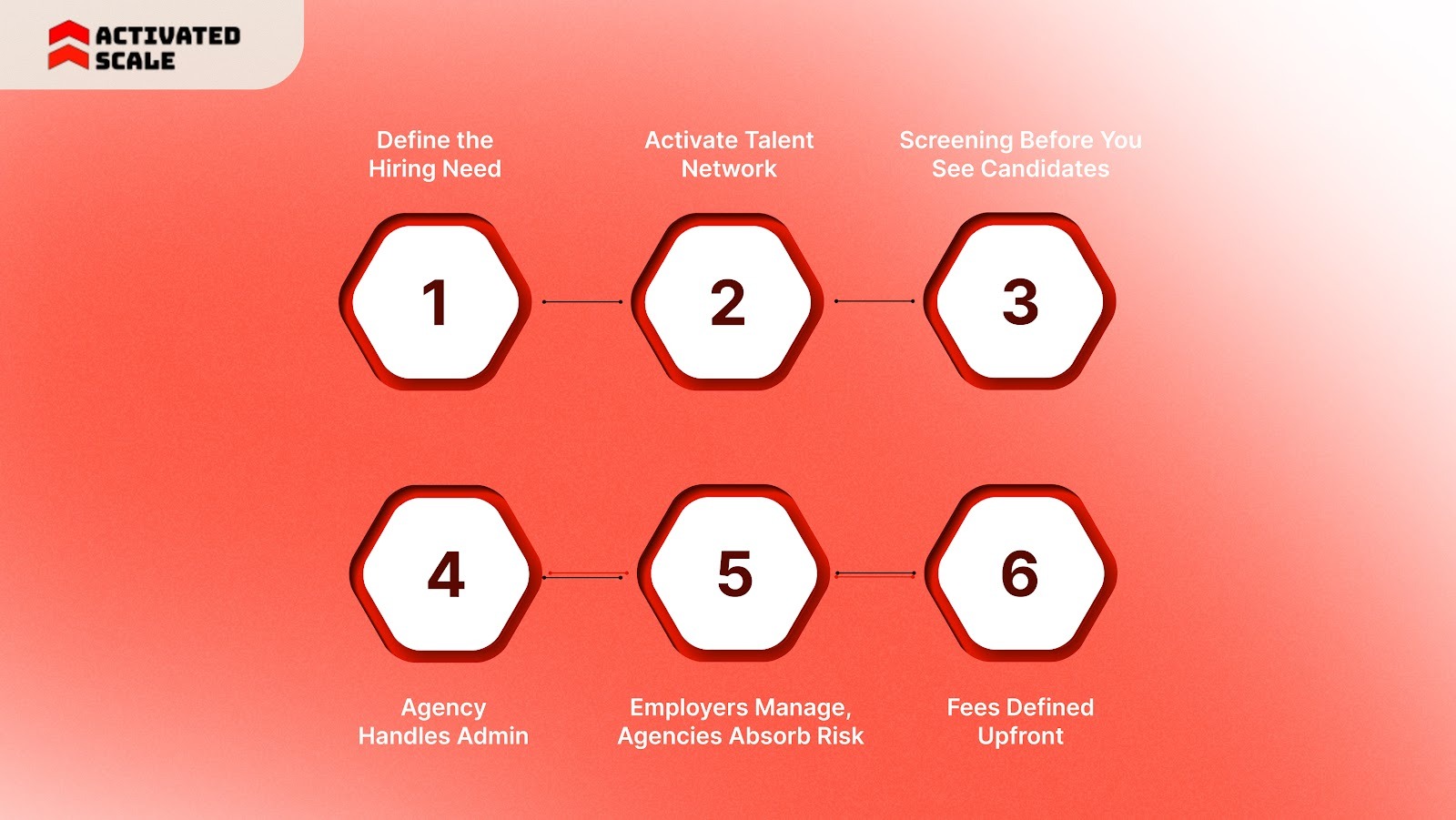
Here’s how the process typically works in practice.
1. Employers Define the Hiring Need (Clearly)
The process starts when a business approaches a staffing agency with a specific requirement, not just a job title, but context.
This usually includes:
- Role type (temporary, contract, temp-to-hire, or permanent)
- Required skills and experience
- Pay range and timeline
- Duration of the role and urgency
The clearer the input, the better the outcome. Staffing agencies work best when they’re solving a defined problem, not guessing intent.
2. The Agency Activates Its Talent Network
Once requirements are set, the agency taps into its existing talent ecosystem rather than starting from scratch. This is where speed comes from.
Candidates are sourced through:
- Pre-vetted internal talent pools
- Ongoing recruitment pipelines
- Job boards, referrals, and direct outreach
This same network-driven model is why companies increasingly prefer contract-to-hire approaches. Platforms like Activated Scale apply this concept to sales hiring, connecting companies with pre-vetted sales professionals so teams can test real performance before committing long term.
3. Screening Happens Before Candidates Reach You
Staffing agencies reduce noise by handling early-stage screening and qualification.
This typically includes:
- Skill and experience interviews
- Availability and role-fit checks
- Background or compliance screening (where required)
Only candidates who meet the defined criteria move forward. Employers stay involved at the decision stage, not the filtering stage.
4. Employment Administration Is Handled by the Agency
Once a candidate is selected, the staffing agency manages the employment logistics. In many models, the agency becomes the employer of record.
This often includes:
- Contracts and documentation
- Payroll and tax handling
- Compliance requirements
By offloading this work, companies avoid administrative drag while still directing day-to-day execution.
5. Employers Manage the Work; Agencies Absorb the Risk
The employer oversees:
- Daily responsibilities
- Performance expectations
- On-the-job training
If the placement doesn’t work out, the staffing agency handles replacement or adjustment, protecting the employer from restarting the hiring process.
This risk-buffering logic is why flexible hiring models are gaining traction beyond staffing as well.
6. Fees Are Defined Upfront
Staffing agencies charge either:
- A markup on wages (temporary or contract roles), or
- A flat placement fee (permanent hires)
Terms are agreed on upfront, keeping costs predictable.
Staffing agencies work because they remove uncertainty from hiring. By owning sourcing, screening, and employment logistics, they allow businesses to move faster, stay flexible, and focus on execution instead of recruitment mechanics.
What Are the Types of Staffing Agencies?
Staffing agencies aren’t one-size-fits-all. Different models exist to solve different hiring problems, such as speed, flexibility, specialization, or leadership needs. Understanding these types helps businesses choose the right approach instead of defaulting to whatever sounds familiar.
Temporary Staffing Agencies
Temporary staffing agencies focus on short-term roles, ranging from a few days to several months. These agencies handle hiring, payroll, benefits, and compliance, while the employer manages the day-to-day work.
This model works best for:
- Seasonal demand spikes
- Project-based work
- Short-term coverage gaps
It prioritizes speed and flexibility over long-term fit.
Permanent Placement Agencies
Permanent placement agencies specialize in full-time hires. Their role is to source, screen, and present candidates, while the employer becomes the direct employer once hired.
Fees are usually calculated as a percentage of the candidate’s annual salary, making this model better suited for roles where long-term retention is the priority.
Contract-to-Hire Agencies
Contract-to-hire agencies bridge the gap between temporary and permanent hiring. Candidates start on a contract basis, giving both sides time to evaluate fit before committing.
This approach reduces hiring risk and is increasingly popular for roles where performance matters more than resumes. The same logic is applied in sales hiring through platforms like Activated Scale, where companies can validate SDRs, AEs, or sales leaders in real-world conditions before making a full-time offer.
Executive Search Firms
Executive search firms focus on senior and leadership roles, including C-suite executives and directors. These searches are more deliberate, involving deep vetting, confidentiality, and targeted outreach.
Because of the stakes involved, executive search typically comes with higher fees and longer timelines, but delivers candidates suited for strategic leadership rather than execution-heavy roles.
Industry-Specific Staffing Agencies
Industry-specific agencies specialize in a single sector, such as healthcare, IT, engineering, or finance. Their value lies in understanding role-specific requirements, certifications, and market dynamics.
This specialization improves candidate quality and reduces screening time, especially for technical or regulated roles.
A similar specialization exists in revenue hiring. Instead of using generalist staffing firms, many companies turn to providers like Activated Scale for sales-specific talent, combining industry context with flexible hiring models such as Fractional Selling and Fractional Sales Leadership.
Each staffing model solves a different problem. The key isn’t choosing a staffing agency, it’s choosing the right type based on risk tolerance, urgency, and long-term goals.
The Benefits and Drawbacks of Using Staffing Agencies
Staffing agencies can be a strong lever for speed and flexibility, but they’re not a universal solution. The value depends on why you’re hiring, how long you need the role, and how critical the fit is to success.
Below is a clear breakdown of where staffing agencies work well and where they can fall short.
Pros of Using Staffing Agencies
- Faster access to ready-to-work talent
Staffing agencies are built for urgency. When roles need to be filled quickly, due to sudden demand, backfills, or project work, they can surface candidates far faster than internal recruiting cycles.
- Reduced hiring and administrative burden
Agencies handle sourcing, screening, payroll, compliance, and contracts. This removes a significant operational load from internal teams and lets managers focus on execution instead of hiring logistics.
- Lower short-term risk through temporary or trial-based roles
Temporary and contract-to-hire arrangements allow companies to evaluate performance on the job before making a permanent commitment, especially useful when resumes don’t tell the full story.
- Access to broader or specialized talent pools
Many agencies maintain active pipelines of candidates you wouldn’t easily reach through job boards alone, including niche or short-availability talent.
Cons of Using Staffing Agencies
- Higher cost if roles become long-term
Staffing agencies are cost-effective for short-term or flexible needs, but markups can become expensive if a role quietly turns permanent without renegotiation.
- Limited control over sourcing and selection
You don’t fully own the hiring process. Agencies prioritize speed and skill match, which can sometimes come at the expense of deep cultural or team alignment.
- Not all agencies understand your business context
Generalist staffing firms may not specialize in your industry or role type, leading to candidates who look good on paper but require more ramp time in practice.
- Geographic or coverage limitations
Some agencies operate only regionally, which can be a constraint for companies hiring across multiple locations or markets.
Staffing agencies are most effective when you need speed, flexibility, or short-term coverage. They’re less effective when the role is deeply strategic, long-term, or highly dependent on cultural fit.
The key isn’t whether staffing agencies are “good” or “bad”, it’s whether their model matches the hiring problem you’re trying to solve.
Must read: What Is a Sales Recruiter? Everything You Need to Know
How to Choose the Right Staffing Agency
Choosing a staffing agency isn’t about finding the biggest name or the lowest fee. It’s about finding a partner that understands your hiring context and reduces risk instead of adding friction.
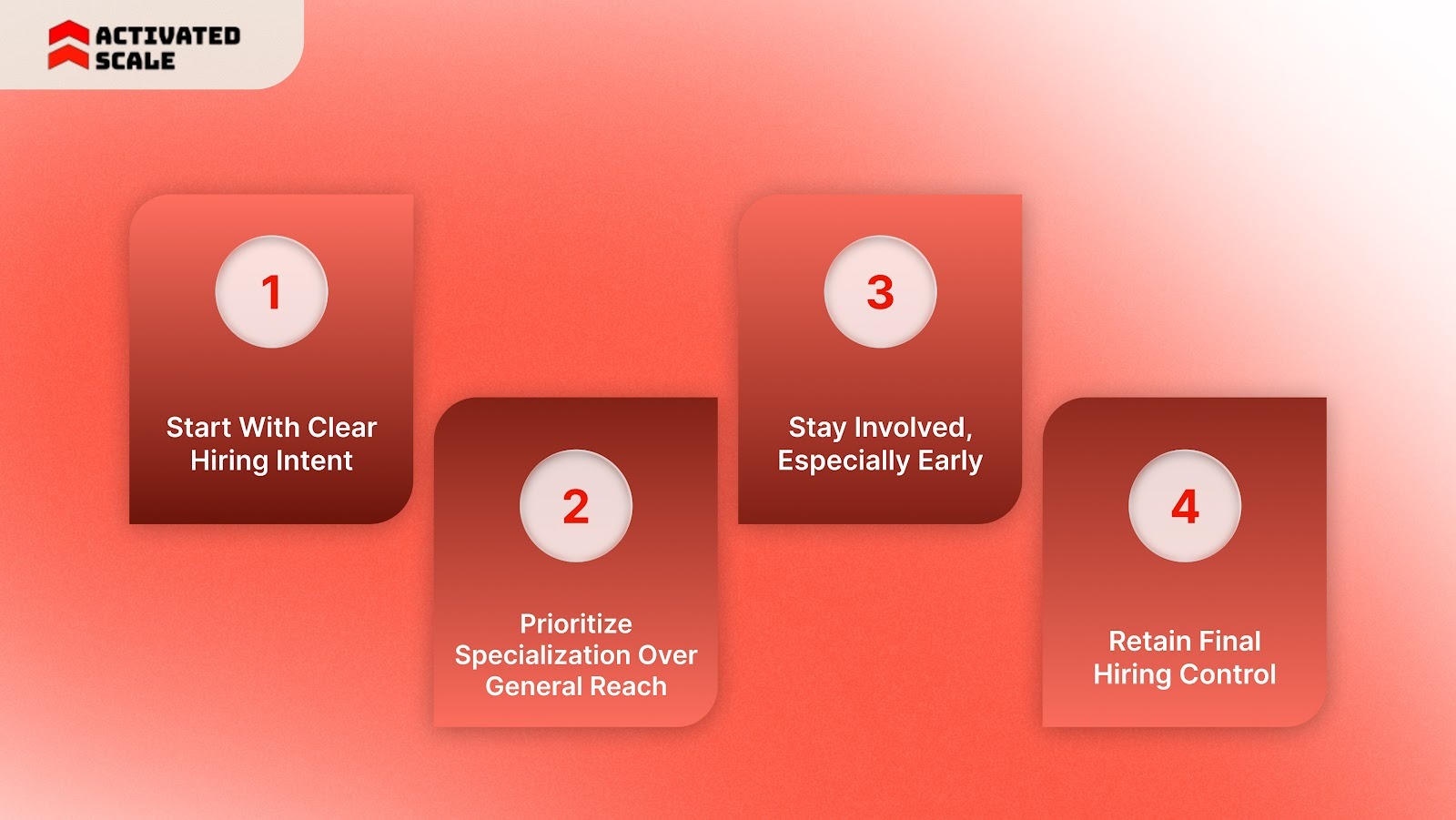
Here’s how to make that decision thoughtfully.
1. Start With Clear Hiring Intent
Before you evaluate agencies, get specific about what you need. Define the role type, required skills, level of seniority, and how long the hire is expected to last.
Agencies perform best when they’re solving a clear problem, whether that’s filling a short-term gap, testing a role before committing, or scaling a team quickly. Vague requirements usually lead to mismatches, regardless of the agency’s reputation.
2. Prioritize Specialization Over General Reach
Not all staffing agencies are built the same. Generalist firms optimize for volume and speed. Specialized agencies optimize for fit and context.
Look for partners that:
- Focus on your industry or role type
- Understand how success is measured in that role
- Can speak to real placement experience, not just resumes
This is why many companies avoid broad staffing firms for revenue roles and instead work with specialists. For example, Activated Scale focuses specifically on sales talent, matching companies with professionals who have sold to similar buyers and deal sizes, reducing ramp and mismatch risk.
3. Stay Involved, Especially Early
Even with a strong agency, early involvement matters. Participating in interviews and giving direct feedback helps the agency calibrate faster.
The goal isn’t to micromanage, it’s to align. Agencies that welcome this collaboration tend to produce better results than those that operate as a black box.
Activated Scale follows this approach by design: companies start by clearly defining goals, then review vetted talent profiles, interview shortlisted candidates, and only move forward once there’s mutual confidence in fit.
4. Retain Final Hiring Control
A good staffing agency filters and advises, but doesn’t decide for you. The final hiring decision should always sit with your team.
This ensures:
- Cultural alignment
- Clear ownership of outcomes
- Accountability on both sides
Agencies that support trial-based or phased engagements make this easier. Whether through temp-to-hire, contract-to-hire, or fractional models, you get real-world performance data before making a long-term commitment.
The right staffing agency feels less like a vendor and more like an extension of your hiring logic. They understand your goals, narrow the field intelligently, and give you room to validate fit before scaling.
That’s ultimately what makes the difference between a hire that “fills a seat” and one that actually moves the business forward.
Conclusion
Staffing agencies exist to solve a specific problem: helping companies hire faster when time, flexibility, or uncertainty make traditional hiring difficult. When used intentionally, they reduce operational drag and keep teams moving without overcommitting too early.
The key is knowing where staffing fits, and where it doesn’t. Short-term needs, variable workloads, and roles that benefit from real-world testing align well with flexible hiring models.
That’s where more modern, role-specific approaches come in. Activated Scale helps startups and growing companies skip the hiring so teams can prove impact before scaling permanently.
Don’t lose another month searching for sales hires. Discover how Activated Scale brings experienced reps to your inbox and helps you hire with confidence.
FAQs
1. What is a staffing agency?
A staffing agency connects employers with workers for temporary, contract, contract-to-hire, or permanent roles and often manages payroll and compliance.
2. How is a staffing agency different from a recruiting agency?
Recruiting agencies focus mainly on permanent placements, while staffing agencies cover temporary, contract, and flexible hiring models.
3. Do staffing agencies handle payroll and compliance?
In many cases, yes. Staffing agencies often act as the employer of record and manage payroll, taxes, and contracts.
4. Are staffing agencies cost-effective?
They’re cost-effective for short-term or flexible needs. For long-term roles, agency markups can become more expensive than direct hiring.
5. When should a business consider alternatives to staffing agencies?
When hiring for strategic roles, revenue-critical positions, or leadership roles, performance needs to be validated before full-time commitment.
The Ultimate Guide to Hiring a Salesperson!
Get the step-by-step guide to hiring, onboarding, and ensuring success!