_edi.png)

As teams grow, roles that once felt interchangeable start to diverge. What worked with a small group of contributors begins to strain when priorities multiply, communication slows, and accountability becomes unclear. This is usually when the question comes up: Do we need a team lead or a manager?
The confusion is understandable. Both roles influence performance, but in very different ways. A team lead keeps work moving day to day. A manager ensures that work aligns with longer-term goals. Mixing the two, or hiring the wrong one at the wrong time, often leads to frustration on both sides.
This guide breaks down the real differences between a team lead and a manager, when each role makes sense, and how to decide what your team actually needs right now.
Quick Snapshot
- A team lead focuses on day-to-day execution, mentoring, and keeping work on track
- A manager focuses on strategy, planning, stakeholder alignment, and long-term outcomes
- Team leads often remain individual contributors; managers hold formal people-management authority
- Hiring the wrong role too early can create gaps in either execution or direction
- Many teams benefit from testing leadership needs before committing to permanent roles
- Flexible models, like fractional or contract-to-hire leadership, help teams scale intentionally
What Is a Team Lead?
A team lead is responsible for guiding a small group of contributors toward day-to-day execution. This role sits close to the work itself, often within the same function, especially in technical or product teams.
Unlike senior managers, team leads stay hands-on. They work directly with team members, help remove blockers, clarify priorities, and ensure tasks move forward as planned. In many organizations, a team lead acts as the bridge between individual contributors and management, translating goals into actionable work.
Because of this proximity, team leads are deeply involved in outcomes. They don't just assign tasks; they collaborate, review work, and contribute alongside the team to deliver results.
Day-to-Day Responsibilities and Working Style
A team lead is deeply involved in the team's daily execution. They focus on keeping work moving, tracking tasks, resolving issues, reviewing progress, and removing blockers as they arise. In technical teams, this often means staying close to bugs, testing, and delivery timelines.
Team leads work side by side with individual contributors. They often step in to do the work themselves when needed, whether that's writing code, reviewing campaigns, or supporting frontline tasks. While the role originated in engineering teams, it now extends across functions like HR, marketing, and sales, where team leads combine hands-on execution with peer coordination.
Position in the Hierarchy and Scope of Ownership
Team leads typically sit closer to execution than strategy. They usually operate below managers in the organizational hierarchy, with individual contributors reporting directly to them.
Their scope is narrower and more immediate. Team leads focus on short-term goals, including daily priorities, sprint commitments, and individual performance improvement. They are responsible for helping their team deliver consistently rather than setting broader organizational direction.
In most cases, a team lead oversees one team, allowing them to stay closely connected to both the work and the people doing it.
Core Responsibilities of a Team Lead
A team lead focuses on day-to-day execution and team support. Their responsibility sits closest to the work and the people doing it. Instead of managing remotely, team leads stay embedded in the team's workflow to ensure progress, clarity, and morale.
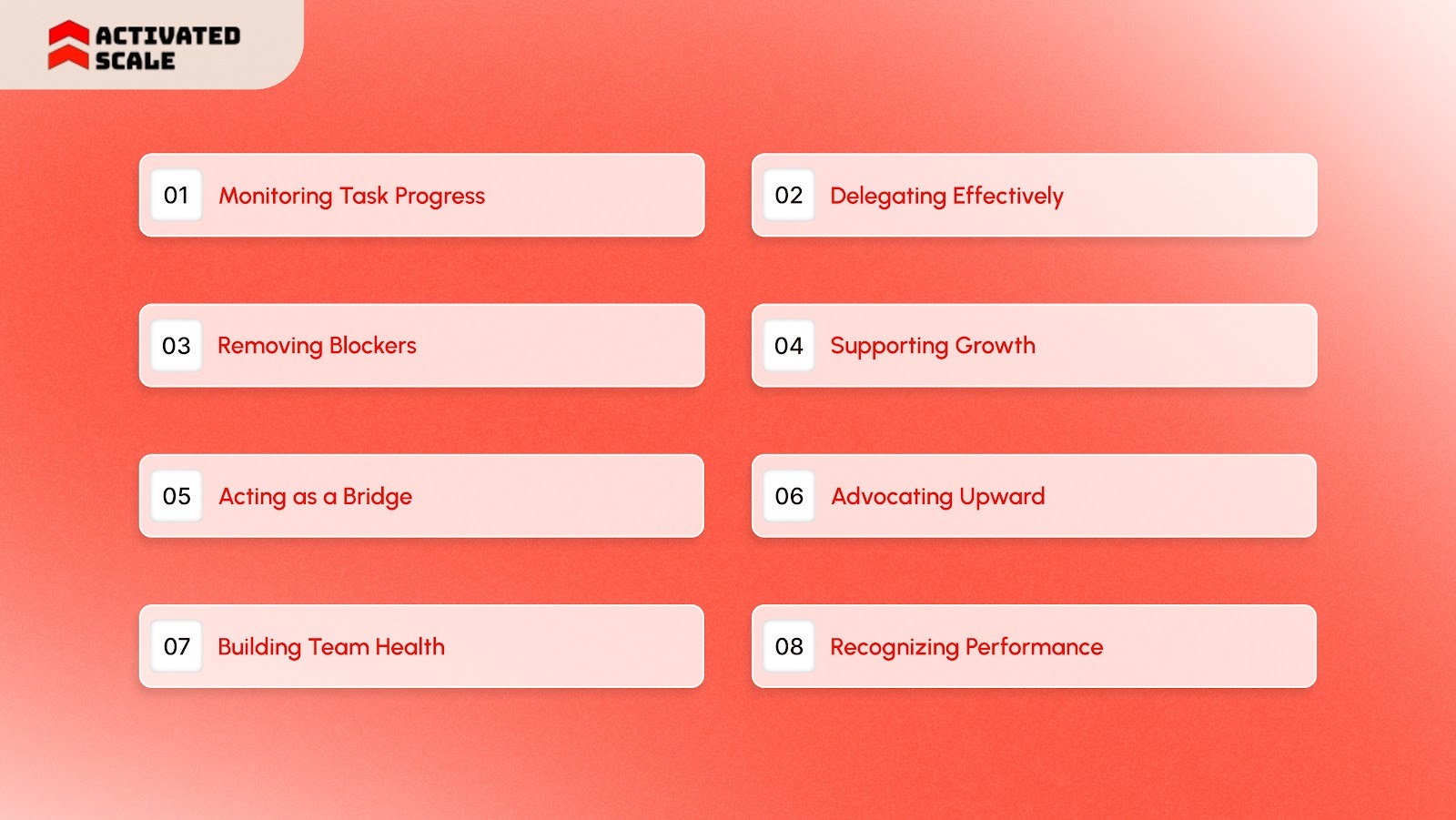
Typical responsibilities include:
- Guiding daily work: Monitoring task progress, adjusting workloads, and ensuring deadlines are met
- Delegating effectively: Assigning tasks based on individual strengths and availability
- Removing blockers: Helping the team solve problems and overcome obstacles as they arise
- Supporting growth: Providing guidance, resources, and ongoing mentorship or training
- Acting as a bridge: Communicating goals and priorities from management to the team
- Advocating upward: Representing team needs, challenges, and suggestions to leadership
- Building team health: Encouraging open communication, trust, and positive working relationships
- Recognizing performance: Reviewing contributions, celebrating wins, and boosting morale
In short, a team lead's success is measured by how well the team performs together.
Essential Skills Every Team Lead Needs
To be effective, a team lead needs a blend of technical credibility and people skills. Unlike managers, team leads are often hands-on contributors as well as guides.
Key skills include:
- Strong technical knowledge to support decision-making and earn team trust
- Team-building ability to foster collaboration and accountability
- Interpersonal and communication skills, including intercultural awareness
- Organizational skills to manage tasks, priorities, and timelines
- Motivation and positivity to keep the team engaged during pressure or change
- Advocacy and leadership skills to represent the team and influence decisions
These skills allow a team lead to lead by example, supporting both the work and the people behind it.
Building strong team leads isn't just about promotion; it's about support and structure. When teams lack experienced guidance, companies often turn to fractional leadership models to fill the gap temporarily.
Platforms like Activated Scale help growing teams access experienced leaders through Fractional Sales Leadership, giving teams mentorship, direction, and execution support without committing to a full-time manager too early.
What Is a Manager?
A manager holds a formal leadership role focused on strategy, coordination, and business outcomes. Unlike a team lead, who stays close to day-to-day execution, a manager operates at a higher level, overseeing teams, departments, or functions.
Managers are responsible for aligning technical work with business goals. They handle resource planning, workflow optimization, and prioritization to ensure teams deliver value efficiently. This role also acts as a key link between delivery teams and upper management, including directors and the C-suite.
Compared to a team lead, managers typically have:
- Broader scope of responsibility
- Less hands-on involvement in technical execution
- Greater accountability for performance, budgets, and long-term planning
In short, managers focus on what should be done and why, while team leads focus on how the work gets done day to day.
Core Responsibility: Direction vs Execution
A manager's primary responsibility is to ensure that the team's work aligns with broader company goals. They translate leadership priorities into clear objectives and decide what the team should focus on.
At first glance, this may sound similar to a team lead's role, but the distinction is important. While a team lead is responsible for guiding how the work gets done, a manager determines what work needs to be done and why it matters to the business.
In practice, managers act as the bridge between upper management and the team. They take strategic decisions from leadership and turn them into priorities, timelines, and initiatives that the team lead can execute against.
Work Style and Day-to-Day Focus
The daily work of a manager looks very different from that of a team lead.
Team leads spend most of their time close to execution, working alongside the team, reviewing work, solving technical or operational blockers, and supporting delivery. Managers, on the other hand, operate at a higher coordination level.
A manager's day is often filled with:
- Stakeholder meetings and cross-team discussions
- Budget planning and resource allocation
- Aligning expectations with leadership and clients
- Tracking progress across multiple initiatives
Managers are responsible for negotiating priorities, securing leadership approvals, and balancing competing demands across teams. Their focus is less on hands-on execution and more on ensuring the team is set up to succeed within the company’s larger strategy.
Also read: How to Outsource Marketing Strategy With a Senior Director
Hierarchy and Scope of Authority
In most organizations, managers sit higher in the hierarchy than team leads. Team leads typically oversee the day-to-day work of individual contributors, while managers oversee multiple team leads or entire departments.
A manager may be responsible for several teams at once, using team leads as the primary point of coordination and execution. While developers and specialists report to team leads, team leads report upward to managers.
This layered structure exists for a reason. Managers are accountable for overall performance, cross-team alignment, and reporting results to senior leadership or the C-suite. Team leads focus on execution; managers focus on outcomes across teams.
Core Responsibilities of a Manager
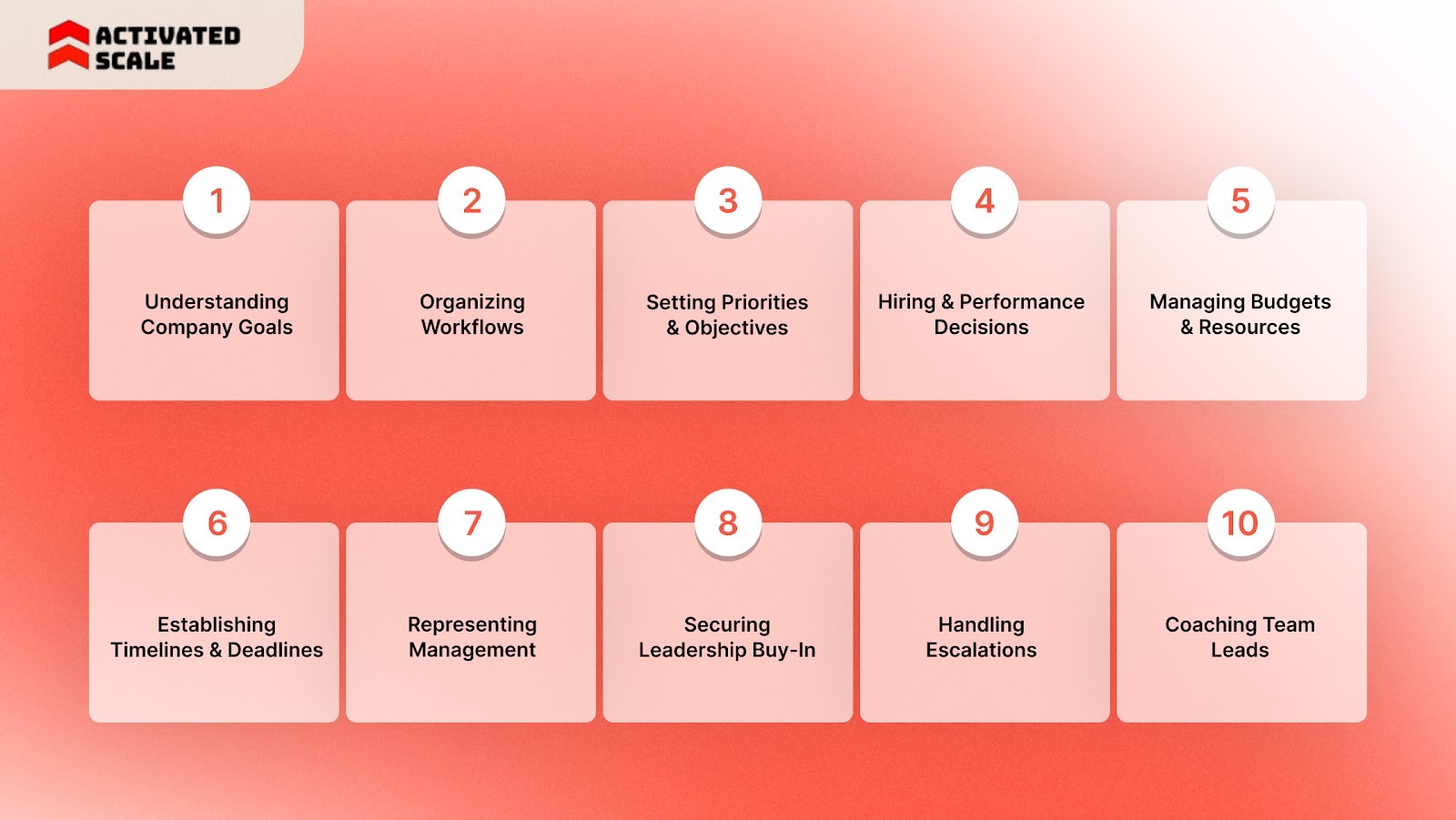
A manager's role is less about hands-on work and more about direction, alignment, and decision-making. They translate company goals into executable plans and ensure teams have what they need to deliver.
Typical responsibilities include:
- Understanding long-term company goals and initiatives
- Organizing workflows across teams or departments
- Setting priorities and objectives with team leads
- Hiring, promotions, and performance decisions
- Managing budgets, expenses, and resource allocation
- Establishing project timelines and deadlines
- Representing upper management to team leads
- Securing buy-in from leadership and stakeholders
- Handling escalations, including dissatisfied customers
- Coaching and supporting team leads through challenges
Managers often act as the buffer between leadership expectations and team realities, balancing delivery pressure with people's needs.
Key Skill Sets Required for Managers
To be effective, managers need a mix of strategic thinking, operational discipline, and people leadership. The role demands comfort with ambiguity and responsibility beyond individual tasks.
Key skills commonly required include:
- Strategic planning and big-picture thinking
- Budgeting, cost analysis, and financial forecasting
- Goal setting and delegation
- Clear communication and stakeholder management
- Problem-solving and decision-making
- Project and time management
- Leadership and team development
While technical knowledge helps, a manager's impact is defined by how well they coordinate people, priorities, and resources at scale.
As teams grow, the gap between execution and leadership becomes more visible. Many companies struggle not because they lack talent, but because they don't have the right leadership layer in place at the right time.
This is where flexible leadership models help. Platforms like Activated Scale allow companies to bring in experienced leaders through fractional or contract-to-hire models, reducing the risk of hiring too early or at the wrong level.
Team Lead vs Manager: How the Roles Actually Differ
While team leads and managers often work closely together, their responsibilities and day-to-day focus differ fundamentally.
Role Comparison Summary
Which One Should You Hire?
There's no one-size-fits-all answer. The right choice depends on what your team actually needs right now.
Ask yourself:
- Do I need someone to guide and coach a small team day-to-day (team lead) or to oversee multiple teams and priorities (manager)?
- Do I want this person to make formal people decisions like hiring and performance reviews (manager) or focus on mentorship and execution (team lead)?
- Am I solving for immediate delivery and skill growth or long-term planning and alignment?
- Does the team need hands-on leadership or organizational direction?
In many growing teams, both roles eventually become necessary. Some start by promoting a strong individual contributor into a team lead role, then bring in a manager as complexity increases.
The key is sequencing. Hiring for the wrong role too early can create gaps in execution or strategy.
Learn more about: Direct Sourcing Strategies to Recruit Top Talent
How to Think About Leadership Hiring as You Scale
The decision between a team lead and a manager often comes down to one question: Do we need better execution right now, or better direction? Getting this wrong can either slow down delivery or overcomplicate the team.
Rather than locking into a structure too early, many teams benefit from testing what kind of leadership actually moves the needle first.
That’s where Activated Scale fits naturally into this equation. Activated Scale gives growing companies access to experienced sales leaders and operators without forcing an immediate full-time management hire.
Teams typically use the Activated Scale when they need:
- Hands-on execution support through Fractional Selling
- Strategic direction and process-building via Fractional Sales Leadership
- A low-risk path to permanent leadership with Contract-to-Hire Sales Recruiting
This mirrors the core takeaway of the team lead vs manager discussion: the right role depends on the problem you’re solving today. Test first, commit once the need is clear.
Wrapping Up
The difference between a team lead and a manager isn't seniority, it's purpose. When teams need momentum and hands-on guidance, a team lead keeps work moving. When alignment, planning, and scale become the challenge, a manager brings structure.
Problems start when teams hire for a title instead of a need. Adding management too early can slow execution. Relying on a team lead for too long can limit growth.
That's why many companies test leadership needs before committing long-term. Platforms like Activated Scale support this approach by offering flexible access to experienced sales leaders through fractional and contract-to-hire models.
If you're deciding how to structure leadership as your team grows, let’s connect and clarify the next move before it becomes costly.
FAQs
1. Is a team lead the same as a manager?
No. A team lead focuses on execution and guiding the team’s daily work, while a manager focuses on strategy, planning, and organizational alignment.
2. When should a company hire a team lead?
When the team needs hands-on guidance, mentorship, and coordination to improve execution without adding management overhead.
3. When does a manager become necessary?
When teams grow larger, require cross-functional coordination, or need formal processes around performance, planning, and resource management.
4. Can one person act as both team lead and manager?
In very small teams, yes, but this often becomes unsustainable as complexity increases. Splitting the roles usually improves clarity and effectiveness.
5. How can companies reduce risk when adding leadership roles?
By validating what the team needs first, often through fractional or trial-based leadership models, before making long-term hires.
The Ultimate Guide to Hiring a Salesperson!
Get the step-by-step guide to hiring, onboarding, and ensuring success!