_edi.png)

Sales leaders are under pressure as roles stay open for weeks. The best reps get picked off faster than your team can react. In 2025, the average time-to-fill for sales roles has jumped to 44 days, and that doesn't include ramp time.
So, you don’t need more vendor calls in 2026. What you need is better control. We’ve spent months studying Chief Revenue Officers (CROs), Go-to-Market (GTM) founders, and Heads of Revenue.
This article reflects that. In this blog, we’ll explore how direct sourcing strategies give companies an advantage in recruiting top talent. At the end of the blog, you’ll walk away with clear strategies and a clear benchmark to act now.
Highlights
- The average time-to-fill for sales roles in 2025 has increased to 44 days.
- Temporary agency markups can raise hiring costs by 25–40%.
- Companies with a strong employer brand receive 50% more qualified applicants.
- Most firms see a measurable impact from a direct sourcing strategy within 3 to 6 months.
- Organizations with aligned hiring stakeholders maintain consistent and measurable programs.
- Centralized data in one CRM or ATS accelerates recruiter response and visibility.
- A branded talent pool improves candidate quality and reduces cost-per-hire over time.
What Do You Understand By "Direct Sourcing" in 2026?
High-performing sales professionals are in demand, and the cost of missing a quarter due to unfilled roles is steep. A strong hiring framework can fix that problem.
Direct sourcing strategy connects companies directly with pre-vetted talent using their own employer brand. Instead of relying on vendors, businesses use their name, network, and data to attract skilled professionals.
Sales teams that apply this model reduce hiring time and improve candidate fit. They also save high costs by cutting third-party fees. This shift puts hiring control back where it belongs, inside your organization.
When you're building your team, you should know what makes direct sourcing worth the shift. Before jumping into a new strategy, you should know whether its benefits are worth your time.
Also Read: Top Performing Sales Recruitment Tactics
Why is Direct Sourcing Becoming an Important Issue That Can't Be Ignored?
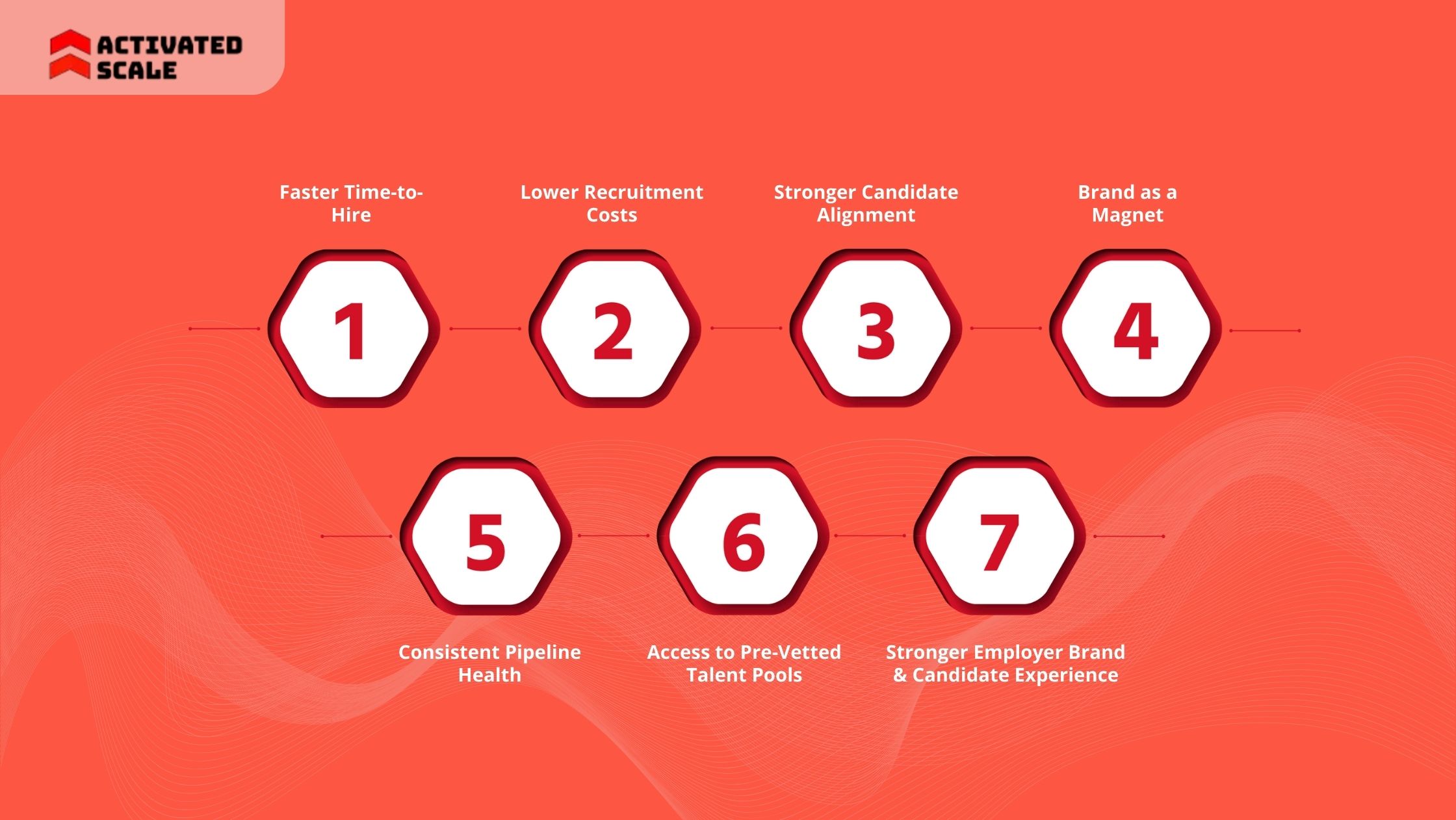
If your best candidates keep vanishing before you close, you’re not alone. Top sales talent is moving faster than most teams can respond. So, what are the benefits you gain from the direct sourcing strategy that help you stay ahead:
1. Faster Time-to-Hire
Hiring delays can crush quotas. Direct sourcing cuts weeks off the timeline by pulling from pre-qualified talent pools. Your recruiters engage candidates already familiar with your brand, reducing friction and speeding up conversions.
2. Lower Recruitment Costs
Temporary agency markups can inflate costs by 25–40%. A direct sourcing strategy helps reclaim that margin. Your brand becomes the recruiter, cutting third-party dependency and giving you a cleaner cost structure.
3. Stronger Candidate Alignment
When candidates apply directly to your company, they self-select for cultural fit. They know your values, products, and customer stories. That alignment leads to higher-quality hires who ramp faster and perform longer.
4. Brand as a Magnet
People trust companies that communicate clearly. A strong employer brand, paired with consistent messaging, turns job seekers into advocates. With direct sourcing, you own every touchpoint, from first contact to onboarding.
5. Consistent Pipeline Health
Sales leaders live by pipeline metrics. The same logic applies to hiring. A maintained direct sourcing pipeline strategy gives you visibility into upcoming availability, making workforce planning smoother.
6. Access to Pre-Vetted Talent Pools
Your best talent might already know your brand. Direct sourcing strategy draws from that “hidden” pool, former contractors, alumni, or even warm leads from past campaigns.
These professionals already understand your business, culture, and expectations. A simple re-engagement campaign can fill open roles faster than cold outreach.
7. Stronger Employer Brand & Candidate Experience
Sales professionals value authenticity. When they apply directly to your company, they engage with your story. That creates trust and loyalty.
In fact, firms with a strong employer brand tend to receive 50% more qualified applicants. A transparent process also boosts candidate satisfaction and referral quality.
Curious how this works for you? Explore Fractional Sales Leadership at Activated Scale, and see how on-demand sales leaders can build your direct sourcing strategy from day one.
Every strong strategy faces resistance once execution starts. Direct sourcing is no exception. Knowing what slows adoption helps you stay ahead and protect Return on Investment (ROI).
What Holds Back a Direct Sourcing Strategy (and How to Fix It Fast)?
Many teams jump into direct sourcing expecting instant wins. Then reality hits: Data gaps, misalignment, and slow adoption. There's only a slight gap between a successful and an unsuccessful direct sourcing strategy.
To ensure the expected result, let's quickly review the challenges the biggest firms have avoided and tackled correctly:
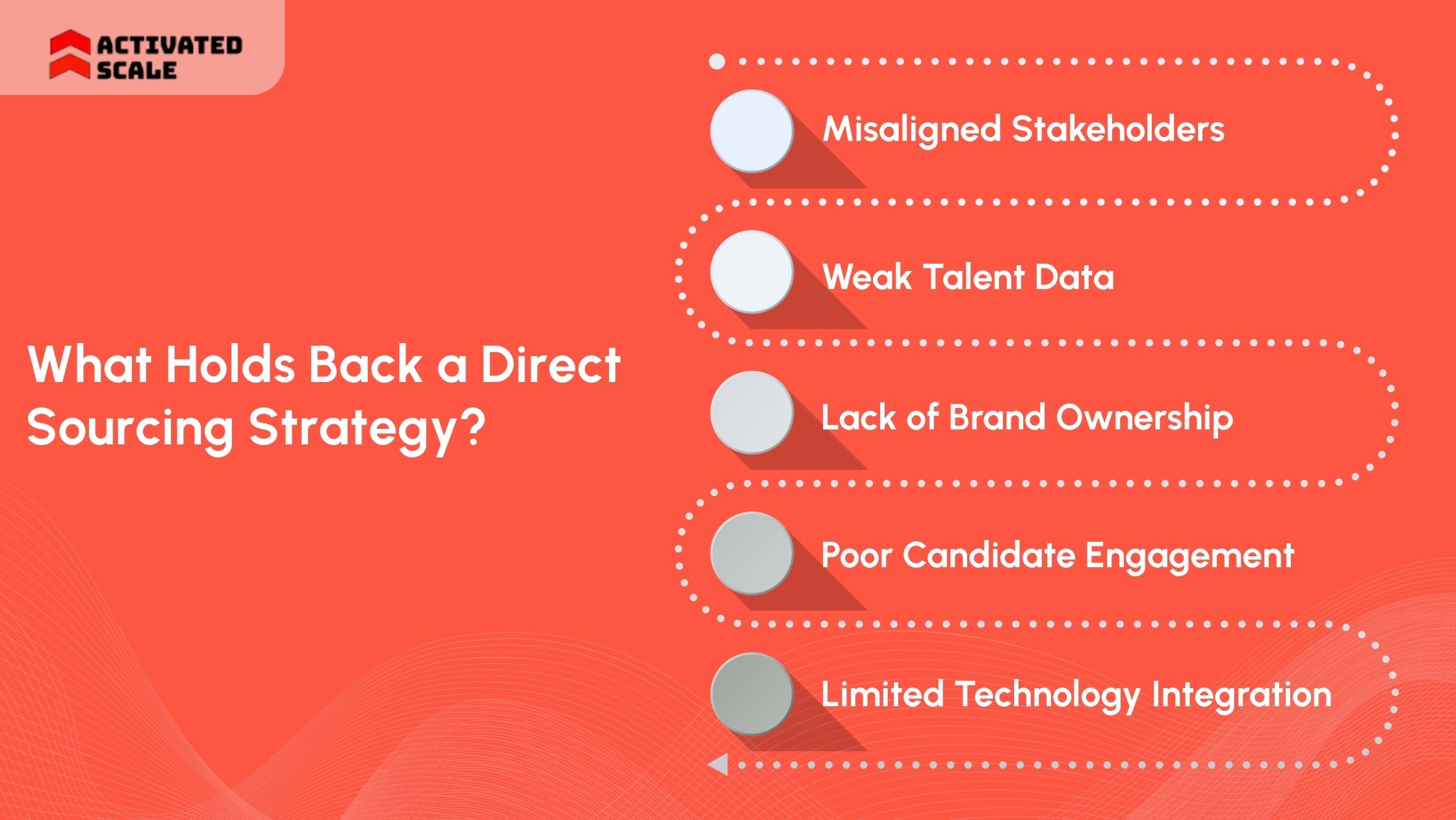
- Misaligned Stakeholders: Without full leadership buy-in, even great initiatives lose traction. HR, procurement, and sales often chase different hiring KPIs.
- Solution: Aligning them early keeps your program consistent and measurable. A clear operating model avoids blame when targets slip.
- Weak Talent Data: Bad data kills speed. When candidate information lives in disconnected systems, recruiters can’t act fast enough.
- Solution: Sales teams should centralize data in one talent Customer Relationship Management (CRM) or Applicant Tracking System (ATS). This setup improves visibility across all sourcing activities.
- Lack of Brand Ownership: Some companies build great talent pools but fail to engage candidates with a real voice. Outsourced messaging feels generic.
- Solution: Keep communications under your brand voice, share content, success stories, and culture snapshots. It builds trust faster than any paid campaign.
- Poor Candidate Engagement: Talent pipelines don’t stay warm on their own. Without consistent follow-up, candidates lose interest.
- Solution: Sales teams should treat engagement like nurturing a lead. Personalized updates, valuable content, and periodic outreach keep interest alive.
- Limited Technology Integration: Disconnected platforms cause recruiter friction.
- Solution: Integration between your ATS, CRM, and vendor systems lets teams track performance and scale operations. When tech stacks work together, hiring velocity improves.
Challenges solved? That's just the start. Now, prove the payoff. You need undeniable numbers that show your direct sourcing strategy’s real impact.
Read Also: Reasons to Always Be Recruiting Sales Talent
What are the Best Direct Sourcing Strategies?
The future of recruiting is proactive, not reactive. Direct sourcing sits at the heart of this shift, helping teams to cultivate relationships with passive talent long before a role opens.
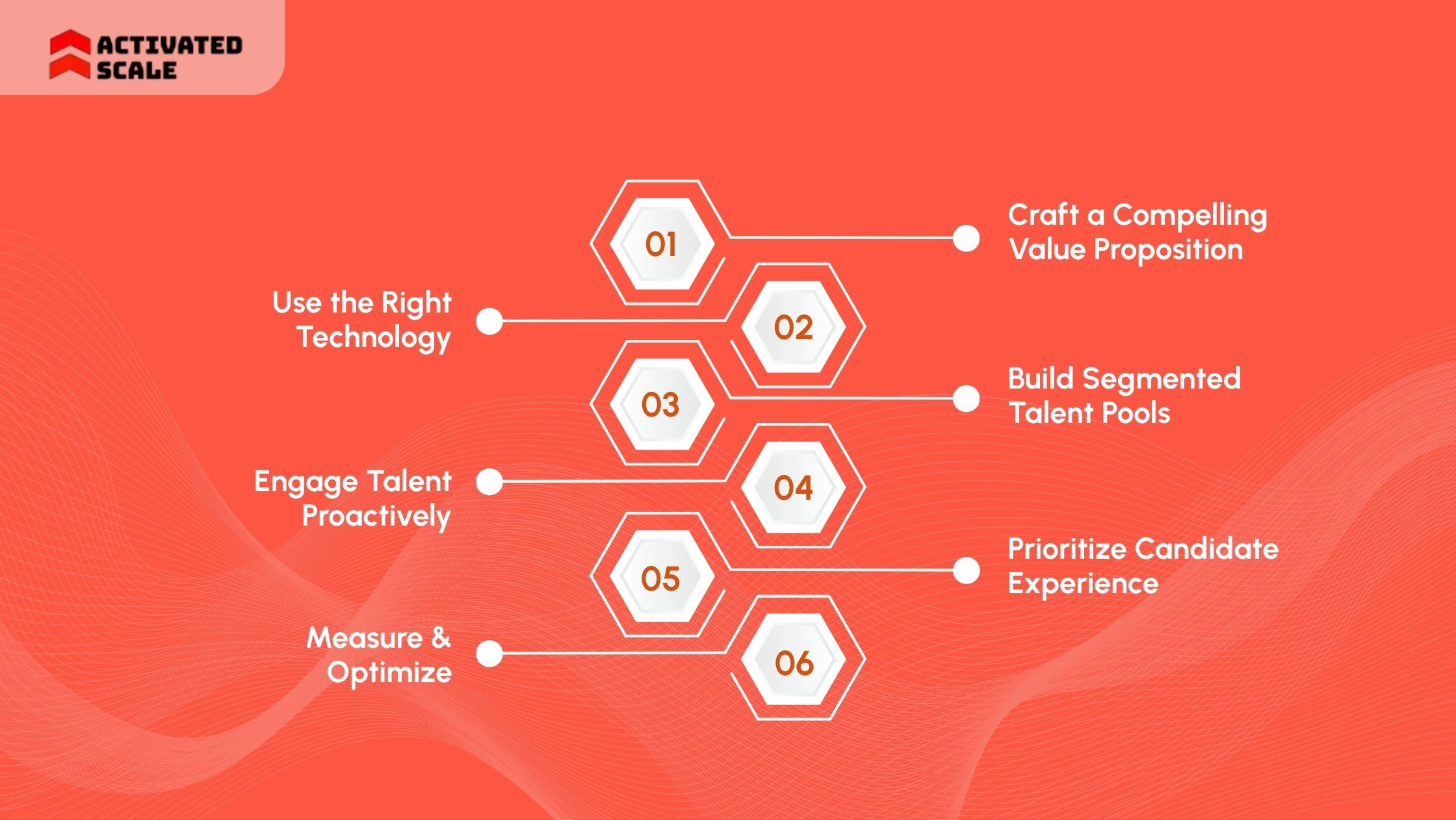
However, to truly future-proof your talent strategy, you need a framework designed for longevity and scale. The following best practices help align those elements and strengthen your direct sourcing program:
Craft a Compelling Value Proposition
Clearly communicate why contractors (and other workers) should choose your company. Develop a strong Employer Value Proposition (EVP) that highlights your unique perks, e.g., flexible work options, career growth, and company culture.
In practice, many organizations use a broader “Worker Value Proposition” (WVP) to include both full-time and contingent. A well‑defined EVP/WVP builds trust and makes your company an “employer of choice.”
Use the Right Technology
Invest in an integrated talent platform or direct-sourcing toolset. Look for Artificial Intelligence (AI)‑powered matching and sourcing features as well as multi-channel outreach (email, SMS, social, etc.).
The goal is to automate routine tasks so recruiters can work efficiently at scale. Use analytics so teams can refine outreach over time (freeing recruiters to focus on strategy)
Build Segmented Talent Pools
Organize candidates into role- or skill-specific communities. Create separate talent pools for, say, software developers, logistics staff, or sales professionals.
Segmentation lets you target each group precisely. Maintaining talent communities by skill or job type quickly matches candidates.
This targeted structure supports personalized messaging for each segment, since you already have a bench of pre‑qualified talent when a new opening arises.
Engage Talent Proactively
Treat your talent pools like customer databases. Use recruitment marketing to stay in touch, for example, send newsletters, social‑media updates, SMS alerts, or hold local events.
Using a CRM or marketing engine to automate personalized outreach, providing regular updates and relevant information.
Spreading your engagement across social channels, text/email, and in‑person events keeps passive candidates interested, so they’re ready to apply when the right role opens.
Prioritize Candidate Experience
Make the application and interview process smooth and respectful. Provide clear, detailed job descriptions and set transparent timelines. Implement automated notifications (for example, confirmation of application receipt and status updates), so candidates aren’t left.
Candidates now expect a “mobile‑first, organize” process. So, by communicating promptly and honestly, you reinforce a positive employer brand, even if candidates who aren’t hired will remember the experience.
Measure and Optimize
Track key metrics to gauge your program’s health. Monitor time‑to‑fill, quality of hire, cost per hire, engagement rates, and other relevant metrics.
Analyze which talent pools and outreach channels are most effective. Continuously refining your approach based on data ensures your direct sourcing remains agile and improves.
Partner With Activated Scale to Build a Smarter Direct Sourcing Strategy
Even the best strategies stall without the right support. Direct sourcing is a team shift. If your internal team is stretched thin or lacks sourcing expertise, Activated Scale fills those gaps fast.
We work with multiple sales talents to hire and deploy them in your team quickly. Our model is flexible, fast, and built for outcomes. Here’s how we help:
Test before you commit. We help you hire vetted Senior Development Representatives (SDRs) and Account Executives (AEs) on a trial basis. So you can assess performance before going full-time. This keeps risk low and candidate quality high.
Need extra pipeline support without adding headcount? Our seasoned SDRs and AEs slot into your process fast.
They help drive outreach, follow-up, and early-stage conversion while your team focuses on closing.
Not sure how to build your sourcing engine? Our fractional sales leaders step in to lead strategy, create playbooks, and map out hiring workflows.
They work hands-on with your recruiters or MSPs to make direct sourcing a repeatable success.
Activated Scale helps you move from vendor dependence to brand-first hiring. We build systems that grow with your sales team, without slowing momentum.
Schedule a strategy session and see how our team can turn your hiring into a repeatable growth engine.
Read Also: How to Build a Scalable Sales Pipeline Step-by-Step
Take Control of Your Hiring
Sales leaders can’t afford delays or markups that drag down growth. Direct sourcing strategy gives you the speed, visibility, and control needed to build strong teams in real time.
The companies winning today are the ones owning their pipelines. So, if you’re ready to move faster and build a team that scales with your goals, partner with Activated Scale.
Our team helps sales organizations design and execute a direct sourcing strategy that fits your structure.
Start building your next high-performing sales team with us. Book a consultation and see how direct sourcing can change the way you recruit.
FAQs
1. How does direct sourcing differ from talent marketplaces like Upwork or Fiverr?
Direct sourcing builds a private talent community around your company’s brand, not a public marketplace. Instead of competing for visibility, candidates join your pipeline based on prior engagement, referrals, or shared alignment with your mission.
This creates long-term relationships rather than one-off project hires.
2. Can direct sourcing work for global or remote teams?
Yes. Many organizations use direct sourcing to manage distributed talent pools across regions. With modern CRM and ATS integrations, recruiters can categorize candidates by time zone, skill, and compliance status.
This approach allows global hiring without losing local insight or speed.
3. What roles are best suited for direct sourcing?
Direct sourcing works best for repeatable, high-demand roles, like sales, customer success, or marketing, where brand familiarity drives engagement.
It’s also effective for project-based work or seasonal hiring. Quick redeployment from a known talent pool matters more than one-time searches.
4. How long does it take to see results from a direct sourcing strategy?
Most companies start seeing measurable impact within three to six months. The early wins come from reactivating known candidates. Over time, the branded talent pool compounds, reducing cost-per-hire and improving quality-of-hire as the database matures.
The Ultimate Guide to Hiring a Salesperson!
Get the step-by-step guide to hiring, onboarding, and ensuring success!