_edi.png)
.jpg)
Most startups often face a tough choice: do you hire fast to hit growth targets or take time to ensure the right fit?
U.S. staffing companies employed an average of 2.2 million temporary and contract workers per week in Q4 2024, up 37,000 from the previous quarter, showing that flexible hiring is becoming a standard approach. This trend reflects the growing need for solutions that balance speed, skill fit, and risk.
Contract-to-hire positions provide that balance, letting teams evaluate talent before offering full-time roles. This blog explains what contract-to-hire positions are and highlights the key benefits for startups and sales teams.
At a Glance
- Contract-to-hire gives startups a low-risk way to evaluate real performance before offering a full-time role.
- It speeds up hiring and lets founders bring reps on board while continuing their search in parallel.
- Both sides get a trial window to confirm fit, expectations, and long-term potential.
- Clear KPIs and structured check-ins raise conversion success and reduce bad hires.
- This model works across functions, but it’s especially useful for sales roles where ramp time and quota impact matter most.
What is a contract-to-hire position?
A contract-to-hire position starts as a temporary role with the option to transition into a full-time job. This model allows employers to evaluate skills, performance, and cultural fit before making a long-term commitment.
The typical durations for tech startups range from 3 to 6 months, giving both parties enough time to assess the match. During the contract period, employees complete regular duties like any full-time team member, while employers monitor results and engagement.
Successful contracts often lead to full-time offers, making this approach a low-risk way to build strong, capable teams.
Contract-to-Hire vs. Direct Hire: Key Differences
For fast-growing startups, every hire carries weight—budget, runway, and execution all depend on getting the right people at the right time. Contract-to-hire roles offer a flexible, lower-risk way to test talent before committing, while direct hires bring immediate stability and long-term alignment.
Here’s a clear breakdown to help you decide which model fits your team’s needs:
Once you understand the differences, the next step is seeing how the trial period actually works for both sides.
Recommended: Hiring Contract-Based Sales Professionals for Startups.
How the Trial Period Works for Both Sides
A contract-to-hire trial period gives both employers and employees a chance to assess fit before committing to a long-term arrangement. It ensures expectations are aligned, reduces hiring risks, and provides practical experience.
From the Employer Perspective:
Employers can evaluate candidates on multiple levels:
- Assess skills, performance, and ramp-up speed
- Observe cultural fit and teamwork
- Identify strengths and areas for improvement before a full-time offer
From Employee Perspective:
Candidates gain clarity on the role and workplace environment:
- Experience day-to-day responsibilities firsthand
- Understand team dynamics and company culture
- Decide if the position aligns with career goals without a long-term commitment
Trial periods typically last 3–6 months, allowing enough time to evaluate mutual suitability. If you’re looking for sales professionals on a contractual basis, Activated Scale can provide pre-vetted candidates, making the trial period more productive from day one.
7 Key Benefits of Contract-to-Hire
Contract-to-hire roles give startups and employees a chance to assess fit and performance before committing long-term. This approach reduces risk, accelerates hiring, and provides flexibility for both sides. Key benefits include:
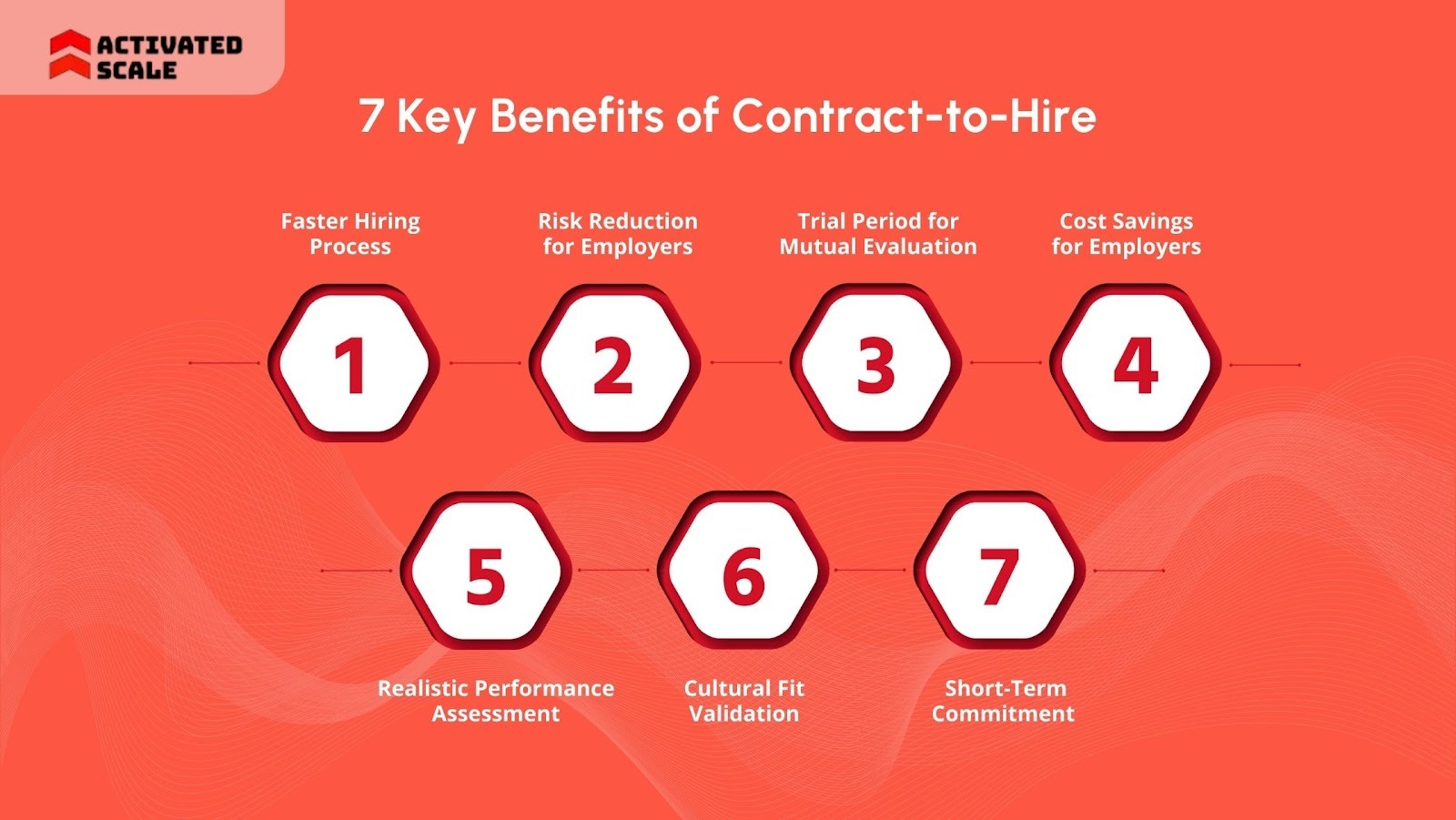
- Faster Hiring Process: Startups can onboard skilled professionals more quickly than traditional full-time hires. Teams can begin evaluating talent immediately, keeping GTM initiatives on track.
- Risk Reduction for Employers: Employers can test skills, cultural fit, and adaptability before making a full-time offer. Sales teams gain early visibility on quota attainment and pipeline contributions, avoiding costly mis-hires.
- Trial Period for Mutual Evaluation: Both sides can assess whether the partnership is sustainable and productive. This reduces uncertainty and helps prevent mismatched expectations after full-time conversion.
- Cost Savings for Employers: Contract-to-hire reduces upfront hiring costs, recruitment expenses, and training waste from mismatched hires. This structure is especially helpful for early-stage startups that need flexibility while controlling budget.
- Realistic Performance Assessment: Temporary assignments allow employers to see actual results rather than relying solely on interviews. Metrics such as calls made, meetings booked, or deals closed provide concrete insight.
- Cultural Fit Validation: Teams can observe how candidates collaborate and align with company values. Employees also understand whether the company culture suits their working style.
- Short-Term Commitment with Long-Term Potential: Employers and employees enjoy a defined trial period, usually 3–6 months. This ensures both parties are confident in moving forward without overcommitting resources.
Alongside these advantages, it’s important to understand where the contract-to-hire model may fall short.
Limitations to Consider with Contract-to-Hire
While contract-to-hire offers flexibility and reduced upfront risk, it isn’t the right fit for every hiring situation. Startups should be aware of the limitations so they can plan timelines, budgets, and expectations more accurately.
Key drawbacks include:
- Longer Hiring Timeline: Full-time conversion happens only after the trial period, which may slow down long-term team building.
- Uncertainty for Candidates: Some high-quality professionals may avoid contract-to-hire roles due to lack of immediate stability or benefits.
- Potential for Cultural Misalignment: Contract talent may feel less integrated into the team during the trial phase, impacting collaboration and morale.
- Higher Hourly/Contract Costs: Contract rates can be more expensive upfront, even if they reduce long-term risk.
- Limited Access to Top Talent Pools: Senior or niche candidates often prefer direct hire roles, making certain positions harder to fill via contract-to-hire.
- Conversion Isn’t Guaranteed: After investing time in onboarding and training, either side can decide not to move forward, creating restart costs in the hiring process.
Now that the challenges are clear, let’s move into negotiating titles and salaries.
Also Check: How Companies Outsource Sales and Successfully Manage Teams.
Negotiating Titles, Salary, and Sales Incentives
Contract-to-hire arrangements give employers a chance to align compensation and responsibilities with proven performance. Waiting until the trial period ends allows teams to make informed decisions and reward candidates based on actual contributions.
Key considerations for employers include:
- Title Adjustments: Promote employees to roles that reflect their skills and impact.
- Salary and Benefits: Offer competitive packages grounded in demonstrated performance, avoiding overcommitment upfront.
- Sales-Specific Incentives: Structure commissions, quotas, and territory allocations based on measurable results, ensuring motivation and fairness.
With compensation clarified, the next priority is staying compliant and avoiding misclassification risks.
Also Read: Sales Outsourcing Pricing: What You Need to Know.
Legal & Compliance Considerations
Contract-to-hire roles must be classified correctly to avoid compliance issues. In many cases, companies need to determine whether the rep should be treated as a W2 employee, someone whose taxes are withheld by the employer and whose schedule, tools, and daily tasks are directed by the company, or as a 1099 contractor.
The right classification depends on how much control the employer has over the work, processes, and expectations.
Key compliance factors employers should review:
- Level of control: More direction on hours, processes, and tools often points to W2 classification.
- Nature of work: Core, ongoing responsibilities typically align with employee status.
- IRS (Internal Revenue Service) and state rules: Some states apply stricter standards when defining contractor status.
- Risk exposure: Misclassification can result in penalties, back taxes, and required back-pay for benefits.
Before onboarding a contract-to-hire rep, employers should assess documentation, scope of work, and reporting expectations to ensure they align with federal and state requirements.
Now, let's see how you can keep the team aligned on results.
Roles Where Contract-to-Hire Works Well
Contract-to-hire hiring fits a wide range of functions, especially when companies need flexibility while assessing long-term fit. Many teams use this model to bring in talent quickly without committing to a full-time hire on day one.
Here are common roles where this approach is effective:
- IT & engineering: Project-based work, system upgrades, and ongoing development needs.
- Marketing: Content, performance marketing, product marketing, and campaign management.
- Operations: Process optimization, vendor management, and coordination roles.
- Sales & customer-facing roles: SDRs, AEs, account managers, and customer success reps.
These roles often come with measurable outputs and well-defined scopes of work, making them suitable for evaluation during the contract stage.
If you’re specifically exploring contract-to-hire options for your sales function, Activated Scale can help. The platform connects startups with U.S.-based sales professionals who’ve already been vetted for experience, communication, and role readiness.
Proven Strategies to Make Contract-to-Hire Work
A strong contract-to-hire setup works best when both sides have clarity, steady communication, and measurable goals.
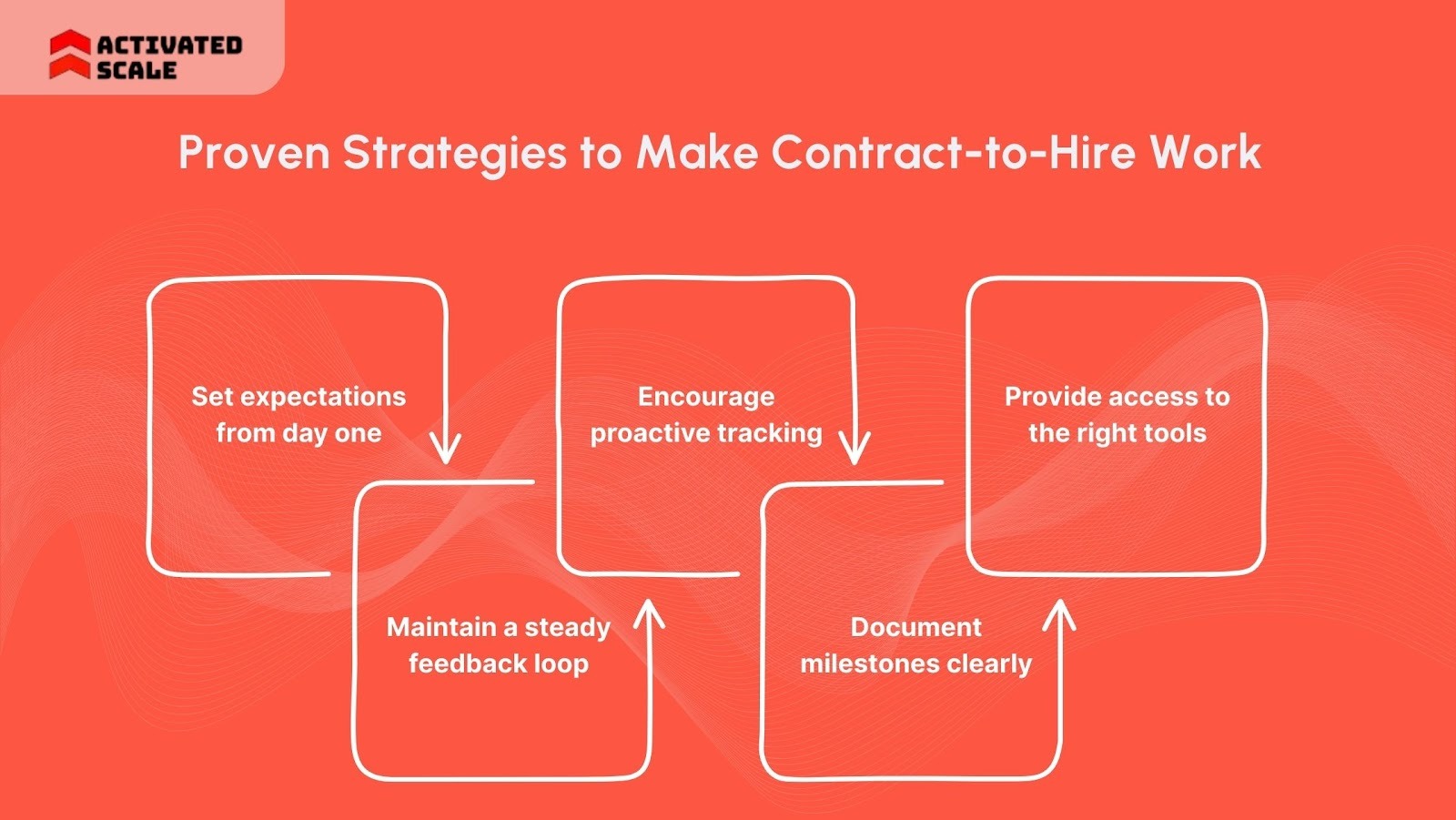
Key practices to follow:
- Set expectations from day one: Define role scope, KPIs, communication rhythms, and the expected contract duration.
- Maintain a steady feedback loop: Frequent check-ins help resolve roadblocks quickly and support consistent performance.
- Encourage proactive tracking (especially in sales): Use activity metrics, pipeline contribution, and early revenue signals to assess trajectory.
- Document milestones clearly: Establish what success looks like at 30, 60, and 90 days so both sides stay aligned.
- Provide access to the right tools and context: CRM access, messaging guidelines, ICP clarity, and product training ensure the contractor can deliver meaningful results from the start.
If you’re applying contract-to-hire specifically to build your sales team, you may need support finding reps who can contribute quickly. That’s where the right partner becomes valuable.
Activated Scale: Your Partner in Contract-to-Hire Sales Talent
Startups move fast, and sales hiring needs to match that pace. Activated Scale functions as a trusted partner for founders who want contract-to-hire reps without the usual risks, delays, or uncertainty.
Instead of sifting through generic talent pools, you get direct access to U.S.-based, pre-vetted sales professionals who can start contributing immediately.
Why teams rely on Activated Scale:
- U.S.-based SDRs, AEs, and Fractional VPs who understand domestic buyers and sales motions.
- Pre-vetted talent evaluated for skill, communication, tech stack fluency, and startup readiness.
- Flexible engagement models, including fractional, full-time contract, or contract-to-hire, based on your stage and budget.
- Faster ramp-up thanks to reps who’ve already worked in similar GTM environments.
Don’t lose time searching for sales talent. Let’s connect today to help you find top U.S.-based reps who are ready to step into a contract-to-hire role and prove impact before you make a long-term decision.
Final Thoughts
A contract-to-hire setup gives startups the breathing room to test talent before committing, but the real challenge is the time lost vetting candidates who never should’ve reached your shortlist. That’s where the model works best, if the right people enter the pipeline in the first place.
Activated Scale removes that friction by sourcing U.S.-based, pre-vetted GTM professionals who can step into contract-to-hire roles with minimal ramp time. It is ideal for teams building or strengthening their sales function.
If you want fewer hiring misfires and a faster path to a high-performing sales team, Activated Scale is the partner that makes every contract-to-hire decision sharper, quicker, and far more reliable. Book a call today to get started!
FAQ’s
1. Is contract-to-hire the same as temp-to-perm?
Not exactly. Temp-to-perm roles usually start with short-term, hourly assignments. Contract-to-hire roles tend to be longer-term, project-aligned, and often used for skilled positions where both sides want time to assess long-term fit.
2. Do contract-to-hire workers follow the same interview process as full-time candidates?
Most startups use a shorter, skills-focused interview process for contract-to-hire candidates. The goal is to assess readiness and ramp-up ability rather than long-term career planning or multi-round cultural interviews.
3. Who manages payroll during the contract period?
This depends on classification. W2 contractors are paid through the employer or a staffing partner. 1099 contractors invoice directly. Many startups use third-party platforms to simplify taxes, time tracking, and compliance.
4. Can startups end the contract early if the role changes or priorities shift?
Yes, contract-to-hire agreements often include flexible exit terms. Startups should ensure the contract outlines notice periods, payment terms, and project completion requirements to avoid disputes.
5. What happens if a contract-to-hire candidate receives another offer during the trial period?
Candidates are free to evaluate opportunities unless an exclusivity clause exists. Startups that maintain strong communication, clear expectations, and momentum during the trial period reduce the risk of losing talent mid-engagement.
The Ultimate Guide to Hiring a Salesperson!
Get the step-by-step guide to hiring, onboarding, and ensuring success!