_edi.png)

Choosing an outsourcing partner is rarely the problem. Choosing the right one is. Many companies enter outsourcing discussions focused on speed or cost, only to discover later that misaligned processes, etc., slow everything down.
The real decision isn’t who can deliver resumes or services fastest, it’s who can operate as a dependable extension of your team over time. A strong partner brings clarity to hiring needs, understands how your business works, and adapts as those needs evolve.
This guide breaks down how to evaluate outsourcing partners with precision, so you’re not fixing avoidable mistakes six months into the engagement.
Core takeaways
- Choosing the right outsourcing partner is about execution quality and long-term alignment, not vendor size or speed.
- Clearly defining scope, role ownership, and outcomes upfront prevents misaligned expectations later.
- Industry-specific experience matters more than generic recruiting capability.
- Strong partners screen for culture fit and communication style, not just technical skills.
- Transparent processes, clear reporting, and collaborative workflows are early indicators of success.
- Flexible engagement models reduce hiring risk by allowing performance to be validated before long-term commitment.
What Does It Mean to Outsource Your Recruiting?
Outsourcing recruiting means partnering with an external firm to run specific parts of your hiring process, or, in some cases, the entire workflow. This can include candidate sourcing, screening, interviews, shortlisting, offer coordination, and contract or payroll support.
Companies typically outsource recruiting to access experienced recruiters, reach wider talent pools, and shorten hiring timelines while keeping internal teams focused on core priorities.
Importantly, outsourcing does not mean giving up control. The intent isn’t to replace internal hiring efforts, but to fill gaps, improve speed, and raise hiring quality where in-house teams are stretched or specialized expertise is needed.
Why More Companies Hand Recruiting to Specialists
Recruiting has become harder to execute well with internal teams alone. As hiring timelines stretch and talent markets tighten, companies increasingly rely on external recruiting partners to stay competitive.
The shift isn’t theoretical. More than 65% of enterprises now outsource part or all of their recruiting, largely because it delivers speed, cost control, and reach that’s difficult to replicate internally.
Here’s why outsourcing recruiting continues to grow:
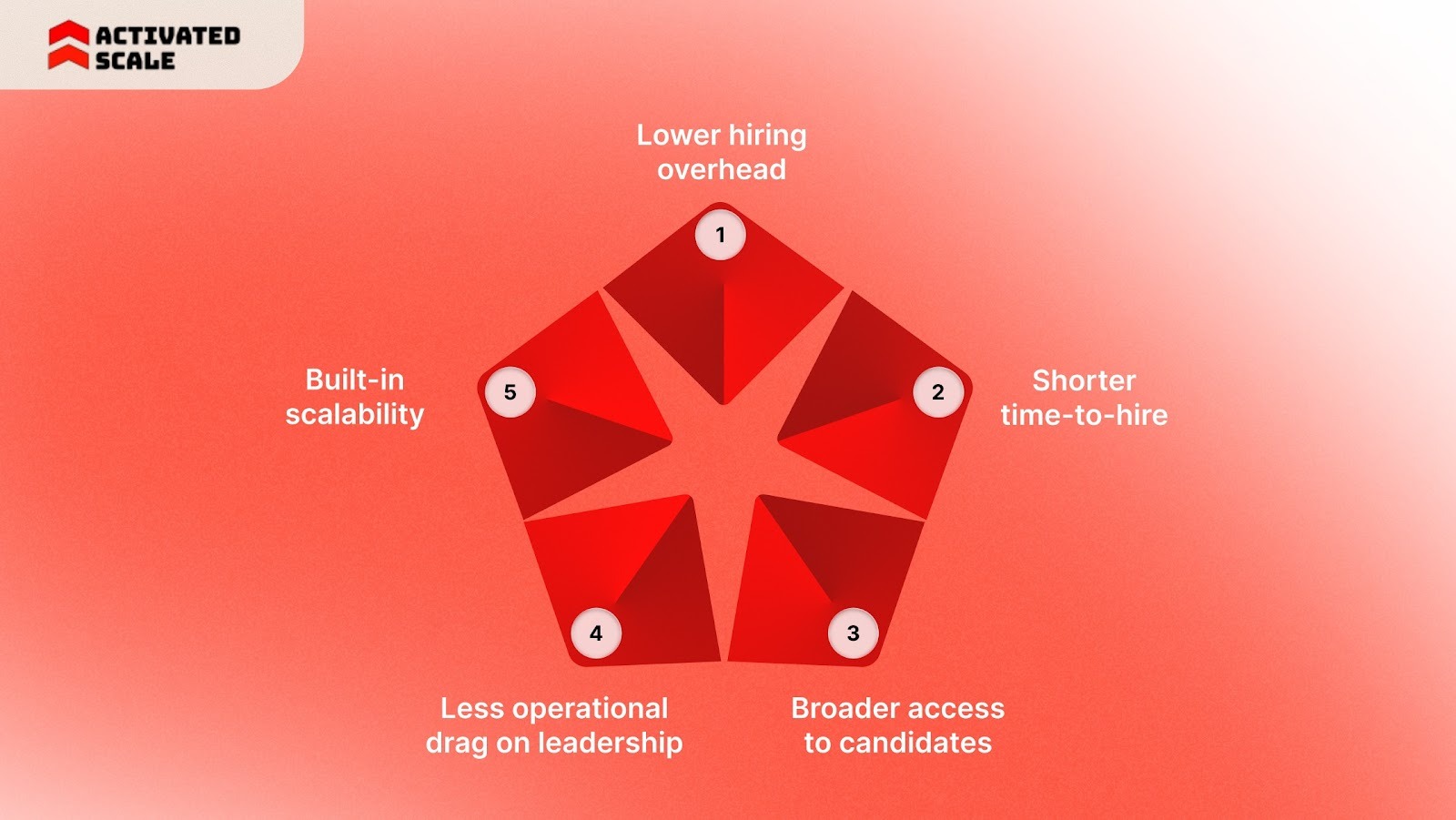
- Lower hiring overhead
External recruiters absorb costs tied to sourcing tools, job ads, screening, and background checks. Companies avoid scaling internal recruiting teams for short-term or uneven hiring demand.
- Shorter time-to-hire
Recruiting firms operate with ready pipelines, tested outreach methods, and dedicated sourcing capacity. This reduces delays that typically come from overloaded in-house teams.
- Broader access to candidates
Agencies engage both active job seekers and passive talent already employed elsewhere. This expands reach beyond inbound applicants and internal networks.
- Less operational drag on leadership
Outsourcing removes day-to-day recruiting tasks from HR and executives, allowing them to focus on culture, performance, and business execution instead of constant hiring logistics.
- Built-in scalability
Smaller and growing companies use outsourced recruiting to compete for senior or specialized talent without committing to permanent recruiting headcount.
The common thread is leverage. Companies outsource recruiting not to abdicate responsibility but to move faster, stay flexible, and hire with fewer internal bottlenecks.
Common Recruiting Outsourcing Models Companies Use Today
Companies outsource recruiting in different ways depending on hiring volume, role complexity, and how much control they want to retain. Below are the most common models, with clear use cases for each.
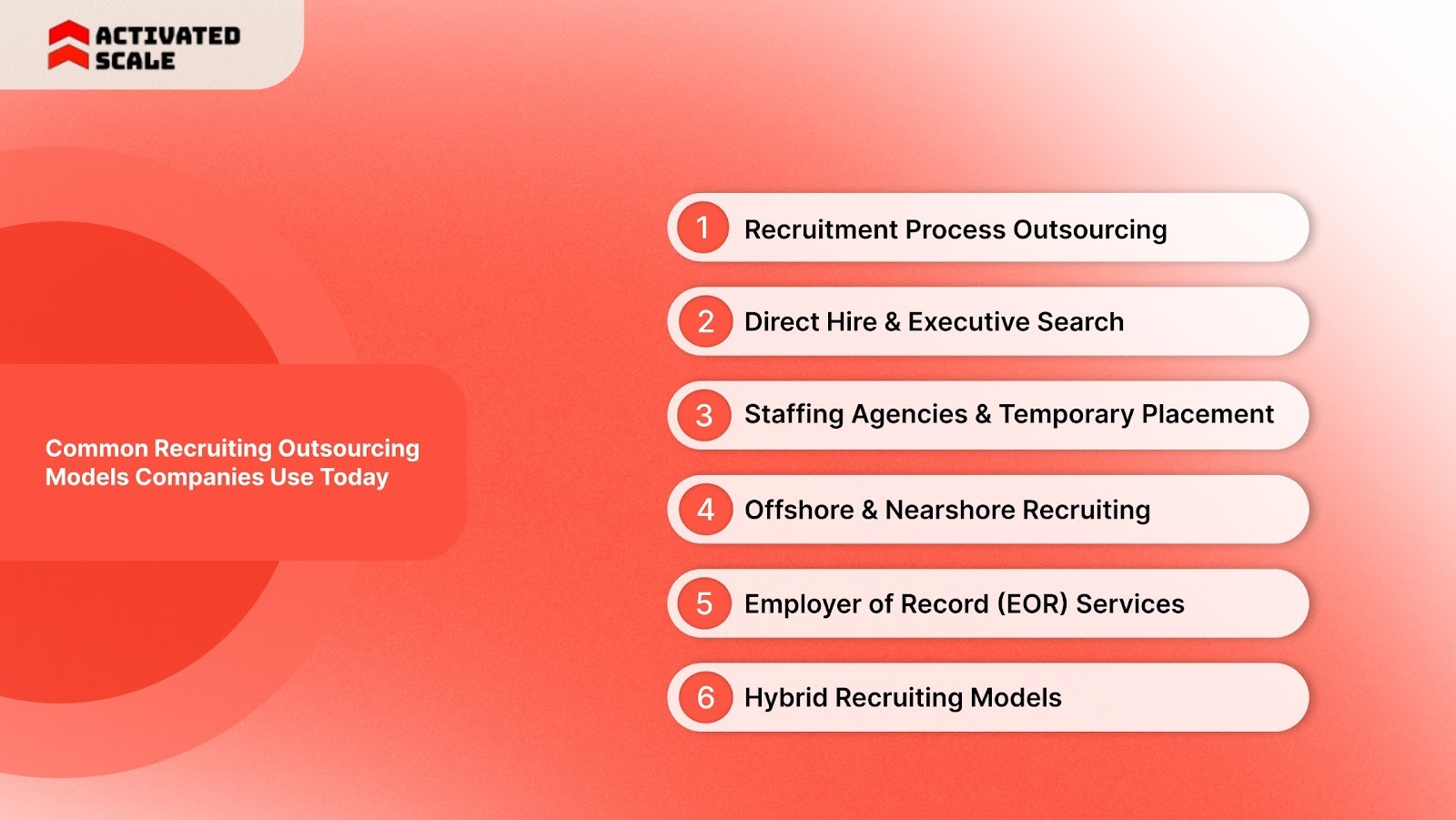
Recruitment Process Outsourcing (RPO)
RPO is a structured, long-term arrangement where an external partner manages part or all of the recruiting workflow. This can include sourcing, screening, interview coordination, and reporting.
Companies typically use RPO when hiring demand is steady and repeatable. The value comes from consistency, process improvement, and reduced internal load rather than quick one-off fills.
Direct Hire & Executive Search
This model is used for hard-to-fill, senior, or leadership roles. Recruiting firms rely on targeted outreach and existing networks to surface candidates who are not actively job hunting.
Direct hire works best when the cost of a wrong hire is high and when discretion, role context, and long-term fit matter more than speed.
Staffing Agencies & Temporary Placement
Staffing agencies focus on short-term, contract, or seasonal hiring. They handle sourcing, employment paperwork, and payroll, allowing companies to respond quickly to workload spikes.
This model is often used by smaller teams or operations-heavy businesses that need flexibility without committing to permanent headcount.
Also read: Pros and Cons of Staffing Agencies
Offshore & Nearshore Recruiting
Some companies outsource recruiting internationally to reduce costs or access broader talent pools. Offshore recruiting is common for technical or support roles, while nearshore options help reduce time-zone friction.
The trade-off is coordination complexity. These models work best when roles are well-defined and communication processes are already mature.
Employer of Record (EOR) Services
An EOR legally employs talent on your behalf in another country. They manage compliance, payroll, and local employment requirements.
This model is useful for global expansion without setting up local entities, but it does not solve sourcing or hiring quality on its own.
Hybrid Recruiting Models
Hybrid approaches split responsibilities. External partners may handle sourcing and early screening, while internal teams retain interviews and final decisions.
This model is increasingly common because it balances speed with control, especially for growing teams.
Across these models, one pattern is clear: companies want proof before commitment. That’s why many teams now look for recruiting partners that allow them to test candidates in real roles before making long-term decisions.
Activated Scale follows this approach for sales hiring. Instead of placing candidates and walking away, it supports contract-to-hire and fractional sales roles, letting teams evaluate performance in live cycles before scaling.
Aligning Outsourcing Models With Real Business Needs
Different stages of growth demand different outsourcing approaches. The mistake many teams make is choosing a model based on size alone, rather than on urgency, complexity, and internal capacity. Here’s how outsourcing models typically map to real operating situations:
- Startups & Scaleups (10–500 employees)
Speed matters more than process maturity. These teams often don’t have dedicated recruiters or time to build repeatable hiring systems. Outsourced recruiting helps them access experienced talent quickly without committing to full internal infrastructure too early.
- Mid-Market Companies (200–1,000+ employees)
Internal HR usually exists, but hiring demand is uneven. RPO support works best here during spikes caused by expansion, attrition, or new initiatives, without forcing permanent headcount growth.
- Enterprises (1,000+ employees)
Consistency and compliance take priority. Full RPO or Employer of Record (EOR) models help standardize hiring across regions while managing legal and workforce complexity at scale.
- Specialized or Executive Roles
When a hire directly impacts strategy or revenue, volume-based models fall short. Executive search or targeted outsourcing is better suited to roles where precision matters more than speed.
- High-Volume Hiring
When dozens or hundreds of roles must be filled fast, staffing agencies or RPO providers bring the process discipline and sourcing capacity internal teams can’t spin up quickly.
The common thread across all of these scenarios is fit over form. The best outsourcing decisions are made when companies choose models that match how work actually gets done, not just what looks right on paper.
This same thinking applies when teams evaluate flexible talent approaches in go-to-market functions. Providers like Activated Scale follow a similar principle: align engagement models to business reality, validate execution first, and scale only once results are clear.
How to Evaluate an Outsourcing Partner Without Costly Missteps
Choosing an outsourcing partner isn’t a procurement task. It’s a decision that directly affects execution quality, team velocity, and long-term outcomes. A structured evaluation helps you avoid mismatches that only surface months later.
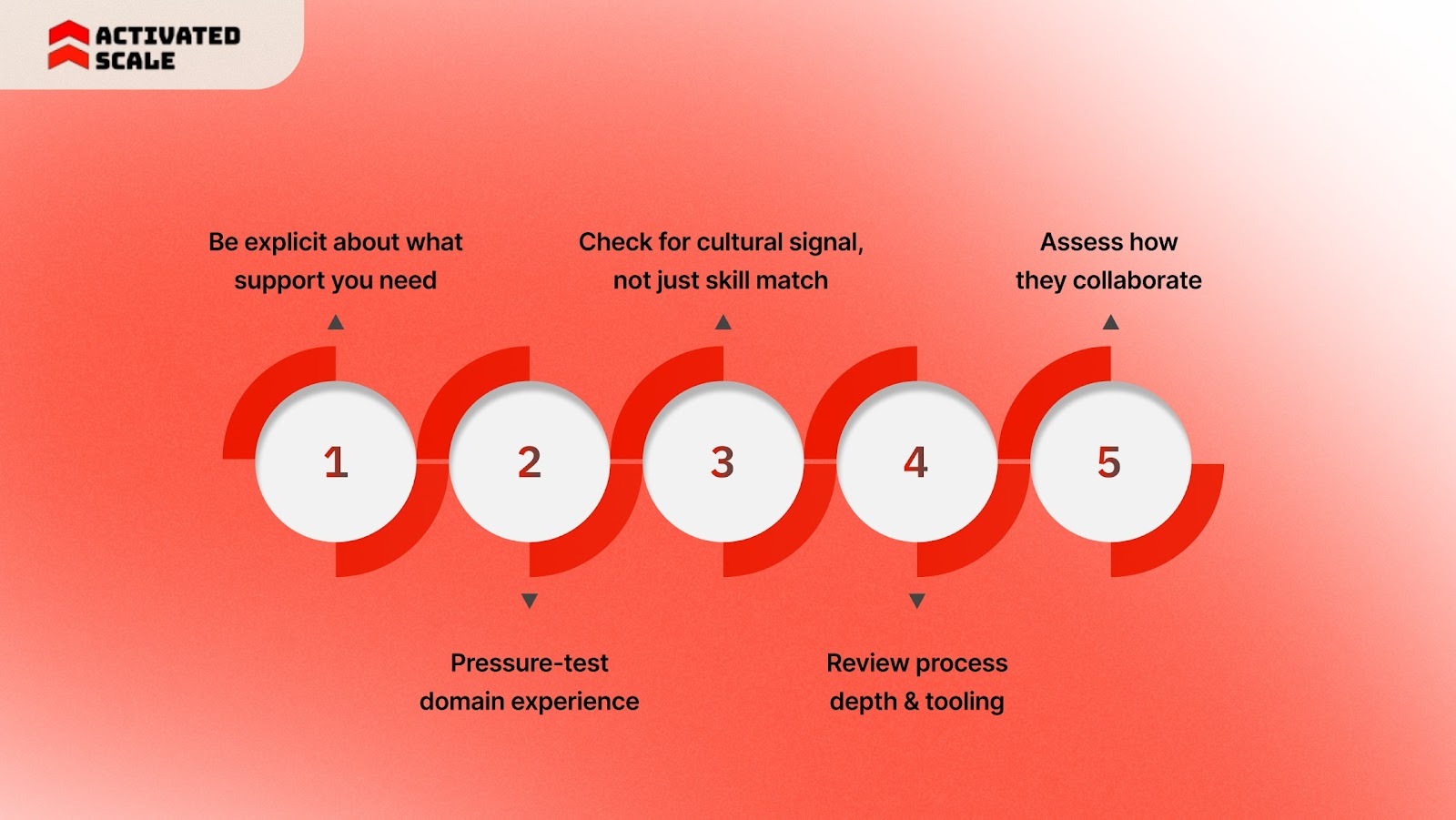
Start by grounding the decision in five practical checks:
- Be explicit about what support you need
Separate specialized roles, volume hiring, and ongoing ownership. Partners perform better when the mandate is narrow and clearly defined.
- Pressure-test domain experience
Don’t stop at logos or years in business. Ask how candidates are sourced, how quality is measured after placement, and what happens when a hire underperforms.
- Check for cultural signal, not just skill match
Strong partners understand how teams actually operate. They screen for communication style, decision speed, and adaptability, not just resumes.
- Review process depth and tooling
Look for structured screening, clear handoffs, and visibility into progress. The best partners can explain why their process works, not just what tools they use.
- Assess how they collaborate
Outsourcing only works when communication is direct and expectations are shared. If reporting, feedback loops, or escalation paths feel vague early, they won’t improve later.
This is where flexible engagement models matter. Activated Scale applies these principles by letting teams validate real execution before committing long term. Their contract-to-hire and fractional sales models allow companies to test fit, performance, and collaboration in live environments, reducing hiring risk while keeping standards high.
The best outsourcing partners don’t ask for trust upfront. They create the conditions to earn it through results.
Learn more about: What is the First Step in Managing Outsourcing?
Choose Partners That Reduce Risk, Not Just Cost
The right outsourcing partner doesn’t just fill gaps. They improve execution, protect momentum, and scale with intent. Clear scope, proven domain experience, strong collaboration habits, and the ability to test before committing are what separate reliable partners from expensive mistakes.
If part of your outsourcing decision involves revenue roles or go-to-market execution, Activated Scale follows this exact philosophy.
Get connected if you want to explore a lower-risk way to validate talent and execution before you scale.
FAQs
1. What’s the biggest mistake companies make when choosing an outsourcing partner?
Rushing into long-term contracts without clearly defining scope, ownership, and success metrics.
2. How do I evaluate outsourcing partners beyond resumes and case studies?
Ask how they handle underperformance, communicate progress, and adapt when requirements change.
3. Is industry specialization more important than recruiting volume?
Yes. Partners with domain experience make better screening decisions and require less onboarding time.
4. Should outsourcing partners manage culture fit or just skills?
Culture fit matters. Poor alignment often leads to early churn or performance gaps, even when skills are strong.
5. When does a flexible hiring model make sense?
When outcomes are uncertain or stakes are high. Trial-based or fractional models allow teams to validate execution before committing fully.
The Ultimate Guide to Hiring a Salesperson!
Get the step-by-step guide to hiring, onboarding, and ensuring success!