_edi.png)

Quarterly revenue reviews often expose the same issue. Pipeline stages mean different things to different reps. Forecast numbers change weekly, and deals sit in “evaluation” for months with little movement.
Professional sales leaders recognize the pattern that the team lacks a structured process.
Most B2B buyers reach around 70% of their decision journey before contacting sales. This shift forces revenue teams to rethink how opportunities move through the pipeline.
In this blog, we address that challenge directly. In 2026, sales leaders need a repeatable system that guides discovery, qualification, and deal progression. Strong sales process design helps teams improve forecasting accuracy, shorten cycles, and scale revenue operations.
Quick Takeaways
- Sales process design creates predictable revenue. Structured pipeline stages improve deal visibility, forecasting accuracy, and sales productivity.
- Clear stage definitions improve pipeline health. Each stage should have defined activities and exit criteria before deals move forward.
- 70% of the B2B buyers complete a large portion of their research before engaging a sales representative.
- Measurement is critical for improvement. Metrics such as stage conversion rate, pipeline velocity, and sales cycle length reveal where deals stall.
- B2B purchasing decisions now involve multiple stakeholders, often nine to 13 people within the buying group. This complexity makes structured pipeline management critical for sales teams.
How Revenue Leaders Design Sales Process?
Sales process design refers to the structured set of stages that guide prospects from first contact to closed revenue. Each stage defines specific activities, qualification signals, and decision checkpoints. Leaders use these stages to track deal progression and coach reps effectively.
Key benefits for the sales process include:
- Consistency across reps: Standard stages help every seller follow the same opportunity structure. Leadership can compare performance across the team.
- Pipeline visibility: Clear stages make stalled deals easier to detect, so sales leaders identify challenges earlier.
- Better forecasting: Structured opportunity stages improve revenue predictions during forecast calls.
- Faster onboarding: New hires ramp faster when the organization already has defined selling stages and pipeline expectations.
Sales Process vs. Sales Methodology
Many revenue teams confuse these two concepts. Each serves a different purpose in revenue operations.
Leaders who combine both create stronger revenue systems. The process governs deal movement. Methodology improves selling effectiveness at each stage.
Benefits alone do not improve revenue performance. Sales leaders still face a practical question during pipeline reviews. What stages should every opportunity pass through before reaching closed revenue?
Read Also: Inside Sales Compensation Plans and Commission Structures
The 8 Core Stages of a High-Performing Sales Process
A high-performing process reflects the way buyers make decisions. Opportunities move through structured checkpoints that confirm interest, budget, and fit.

Most successful revenue organizations follow a framework containing these eight stages below to begin before the first sales call and continue after the deal closes:
Stage 1: Market Research and ICP Definition
Sales teams must identify the organizations most likely to benefit from their solution. This stage focuses on defining the Ideal Customer Profile (ICP).
Revenue leaders analyze firmographics, industry segments, company size, and buying signals. Clear ICP criteria help sales teams prioritize high-probability opportunities.
Stage 2: Prospecting and Lead Generation
After defining the ICP, sales teams begin outreach. Prospecting includes outbound campaigns, inbound lead follow-up, referrals, and partner introductions.
The goal at this stage involves identifying decision makers and generating initial interest. Sales development representatives often manage this phase through targeted outreach.
Stage 3: Lead Qualification
Qualification determines whether an opportunity deserves a sales effort. Reps evaluate budget, authority, need, and timing.
Many teams use frameworks such as Metrics, Economic Buyer, Decision Criteria, Decision Process, Identify Pain, and Champion (MEDDIC) or Budget, Authority, Need, and Timeline (BANT) during this stage.
Qualification prevents unproductive deals from entering the pipeline.
Stage 4: Discovery and Needs Analysis
Discovery helps sales teams understand the buyer’s business challenges. Sales representatives ask structured questions to uncover operational challenges.
This stage reveals the true impact of the problem. Decision makers often clarify priorities during discovery conversations.
Stage 5: Product Presentation or Demo
The demo stage introduces the solution to stakeholders. Sales teams demonstrate how the product solves the buyer’s challenges.
Successful demos focus on outcomes instead of features. Reps highlight business impact and operational improvements.
In a strong sales process design, demos occur only after proper discovery. Premature demos often reduce deal momentum.
Stage 6: Objection Handling
A common reason stalls late in the pipeline involves unresolved objections. B2B buying groups now include 13 internal stakeholders and nine external stakeholders on average, each bringing different priorities and concerns to the decision process.
Buyers often raise concerns about pricing, implementation effort, or competing priorities. Sales representatives must address these concerns with clear answers.
Sales teams need experienced reps who can address these concerns with confidence. Activated Scale helps startups access experienced Account Executives through the Fractional Selling service. These professionals handle complex conversations, respond to buyer objections, and keep deals moving forward.
Stage 7: Closing the Deal
The closing stage converts opportunity into revenue. Final negotiations occur during this phase.
Legal reviews, contract approvals, and pricing discussions often take place before signature. Sales leaders monitor this stage closely to protect forecast accuracy.
Stage 8: Post-Sale Follow-Up and Expansion
Modern revenue teams extend the sales process beyond the initial deal. Customer success teams support onboarding and product adoption.
Satisfied customers create expansion opportunities. Cross-sell and upsell conversations often occur after early product success. This final stage strengthens long-term revenue growth and customer retention.
To do so, you need to design a sales process that is easy to implement and gets you covered from stage zero to one.
How to Design a Sales Process Step by Step?
Sales leaders must treat process design as an operational system rather than a simple pipeline diagram. Each stage should answer three questions: What information must be confirmed? What activity moves the deal forward? What signals confirm the deal should progress?

The following steps outline a practical framework used by many successful revenue teams.
Step 1: Analyze Your Current Sales Performance
Process design should start with data. Revenue leaders must examine existing pipeline activity before introducing new stages.
Key questions include:
- Where do deals stall most often?
- Which stages have the lowest conversion rates?
- How long do opportunities remain in each stage?
Pipeline reviews often reveal hidden issues. Some teams discover that most deals fail during qualification. Others see delays between demo and proposal.
Step 2: Define the Buyer Journey
Sales processes should mirror how buyers evaluate solutions. Understanding the buyer journey helps sales teams guide prospects through decision stages.
Typical buyer journey stages include:
- Problem recognition
- Solution evaluation
- Vendor comparison
- Final decision
Sales leaders must map these decision stages to their pipeline structure. When the process reflects real buyer behavior, deals progress more smoothly.
Step 3: Identify Key Sales Stages
After mapping the buyer journey, revenue leaders define the core pipeline stages. These stages represent the checkpoints where deals advance.
Most B2B pipelines include stages such as:
- Awareness: Early conversations with potential buyers
- Evaluation: Discovery and solution discussion
- Decision: Proposal and negotiation
Clear stage definitions reduce confusion across the sales team.
Step 4: Define Entry and Exit Criteria
Entry criteria define what information must exist before a deal enters a stage. Exit criteria confirm that the stage objectives are complete.
Examples include:
- Confirmed business problem
- Budget approval
- Stakeholder alignment
Clear qualification rules strengthen sales process design and prevent weak opportunities from entering the pipeline.
Step 5: Assign Sales Activities to Each Stage
Each stage should include specific actions that move the opportunity forward.
Examples include:
- Discovery conversations to uncover business challenges
- Product demonstrations that address identified needs
- Follow-up discussions with decision makers
Key Metrics That Will Help You:
- Conversion rate between stages shows how effectively the progress is made
- Sales cycle length reveals how long deals remain active
- Pipeline velocity measures revenue movement through the pipeline
- Win rate indicates closing effectiveness
- Customer acquisition cost tracks the efficiency of revenue generation
Frameworks That Strengthen Sales Process Design:
Several frameworks help sales teams evaluate opportunities and guide buyer conversations.
1. MEDDIC Qualification Framework
MEDDIC helps teams evaluate deal viability through factors such as metrics, economic buyer involvement, and decision criteria. Many enterprise sales teams rely on this framework to improve deal qualification.
2. Situation, Pain, Impact, Critical Event, and Decision (SPICED) Discovery Framework
SPICED focuses on structured discovery conversations. Sales representatives explore the buyer’s situation, pain points, impact, critical events, and decision process.
3. Solution Selling Framework
Solution selling focuses on diagnosing customer problems before proposing a product. The approach positions the seller as a problem solver rather than a product presenter.
These frameworks support stronger sales process design by improving qualification quality and discovery depth.
Step 6: Align Sales Tools and Customer Relationship Management (CRM) Systems
Technology supports process execution. CRM systems track opportunities and record stage progression.
Sales teams often integrate additional tools for outreach and conversation analysis. The right stack improves pipeline visibility, rep activity tracking, and forecast quality.
CRM Platforms
- Salesforce Sales Cloud for pipeline management, forecasting, workflow automation, and deal tracking.
- HubSpot Sales Hub for deal pipeline management, task automation, contact tracking, and stage customization.
Sales Enablement Tools
- Gong for conversation intelligence, call analysis, and buyer engagement insights.
- Clari for pipeline inspection, sales engagement workflows, and revenue visibility.
Revenue Analytics Platforms
- Clari for forecasting, pipeline analysis, and revenue insights across the go-to-market team.
- Gong for revenue intelligence built from customer conversations and deal signals.
Step 7: Document the Process and Train the Team
Process documentation helps teams follow the same structure. Leaders should create playbooks that describe stage definitions, qualification rules, and recommended actions.
Sales managers must reinforce this structure during coaching sessions. Consistent training helps teams apply the process effectively.
Many organizations still struggle after implementing a process. The structure exists inside the CRM, yet deals continue to stall.
The issue often lies in execution mistakes rather than process design itself. Certain errors quietly weaken even well-structured pipelines.
Read Also: How to Measure and Prove RevOps ROI
5 Common Sales Process Design Mistakes to Avoid
Poorly designed processes can create friction across the sales organization. Weak sales process design leads to stalled opportunities, inconsistent forecasting, and confused sales teams. Identifying these mistakes helps revenue leaders build stronger pipelines.
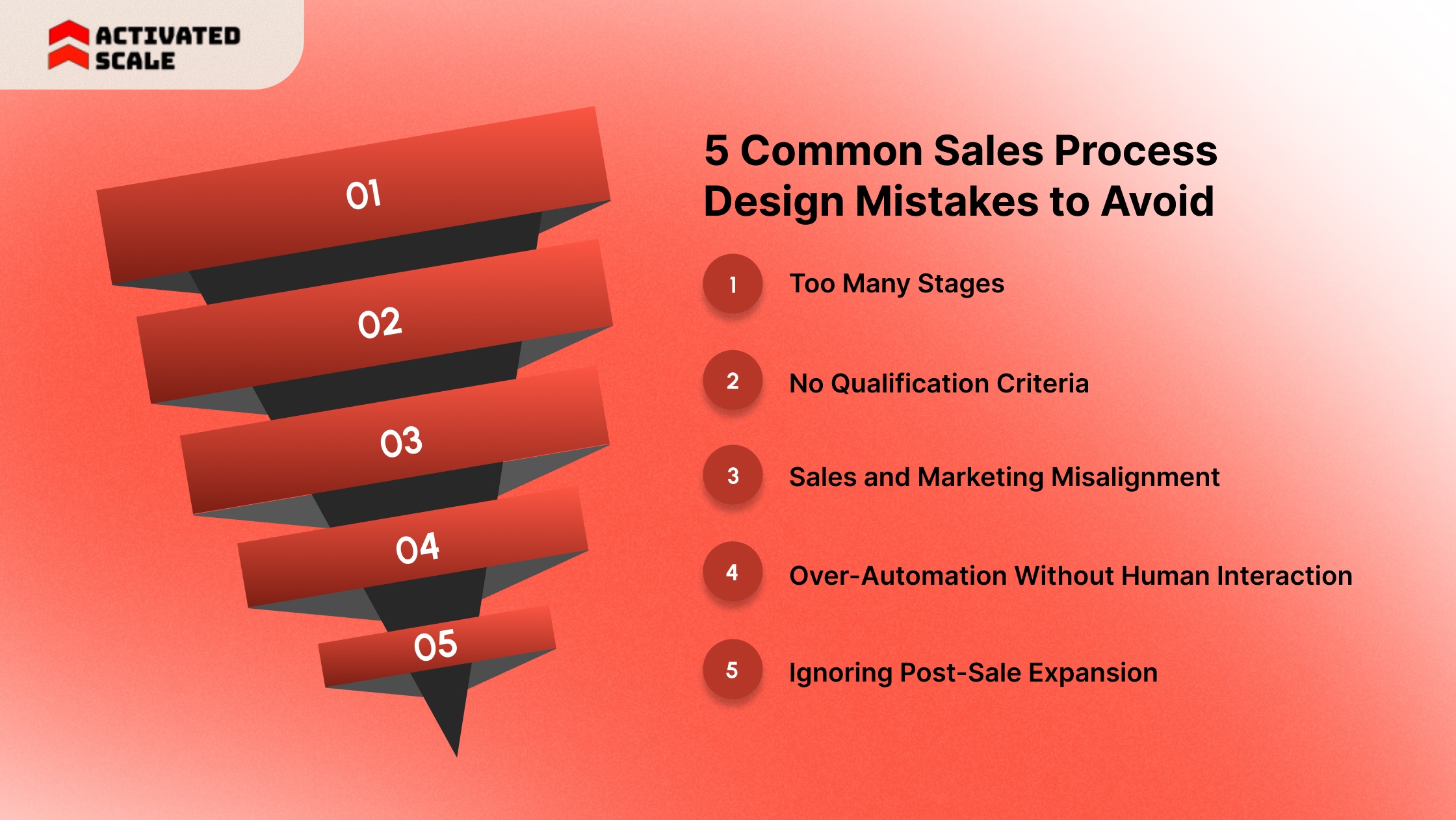
1. Too Many Stages
Some organizations create overly complex pipelines. Deals pass through ten or more stages before reaching a close.
Complex pipelines create confusion. Sales representatives struggle to determine when deals should advance. Pipeline reviews become harder for leadership.
How to improve it
- Review pipeline data monthly: Sales leaders should examine stage conversion rates every month. Data reveals which stages create delays or confusion.
2. No Qualification Criteria
Reps move deals forward based on assumptions rather than verified buyer intent. Weak qualifications often fill the pipeline with low-probability deals. These opportunities consume selling time but rarely convert.
How to improve it
- Identify challenges: Pipeline analysis reveals where poorly qualified deals stall. Leadership can then introduce stricter qualification checkpoints.
3. Sales and Marketing Misalignment
Sales and marketing teams often define lead quality differently. Marketing may generate leads that do not match the sales team’s target accounts.
This misalignment weakens pipeline quality. Sales teams spend time pursuing leads that rarely convert.
How to improve it
- Test new outreach strategies: Sales and marketing leaders should collaborate on targeting experiments. Data from these tests improves lead quality.
- Review pipeline data monthly: Conversion analysis reveals which lead sources produce qualified opportunities.
4. Over-Automation Without Human Interaction
Automation tools can improve efficiency across sales operations. Some organizations rely too heavily on automated outreach sequences.
Buyers still expect meaningful conversations during the evaluation process. Automated messages rarely address complex business problems.
How to improve it
- Test new outreach strategies: Sales leaders should evaluate which outreach approaches generate meaningful conversations.
- Train reps based on insights: Coaching helps sales teams personalize communication and improve discovery conversations.
5. Ignoring Post-Sale Expansion
Many pipelines end once the deal closes. Revenue teams miss expansion opportunities inside existing accounts.
Customer success teams often identify sales techniques as cross-sell and upsell opportunities after implementation. Sales leaders should include expansion planning as part of the revenue process.
How to improve it
- Review sales pipeline data monthly: Leaders should track expansion revenue from existing customers.
- Train reps based on insights: Sales and customer success teams must collaborate to identify cross-sell and upsell opportunities.
Expansion conversations require experienced sellers who can work across existing accounts. Activated Scale helps startups access experienced Account Executives through Fractional Sales Leadership, giving teams the ability to pursue expansion opportunities without hiring full-time.
This gap often weakens sales process design. In that case, hired reps from Activated Scale help many successful organizations.
How Activated Scale Benefits Leaders in Designing a Sales Process?
Activated Scale helps startups and growth companies solve this problem by connecting them with vetted, U.S.-based sales professionals. These professionals step into existing pipelines and execute proven selling frameworks.
Instead of rushing into full-time hires, companies gain access to experienced talent that strengthens pipeline performance quickly. These are the services we offer:
1. Contract-to-Hire Sales Recruiting
Hiring mistakes in sales are expensive. A weak hire can disrupt pipeline health and forecasting accuracy.
Activated Scale allows companies to hire experienced sales professionals on a contract-to-hire sales recruiting basis. Leaders evaluate performance before making a long-term hiring decision. This approach supports a stronger sales process design framework by ensuring the right sellers operate within the pipeline.
2. Fractional Selling
Early-stage and scaling companies often lack enough sales capacity. Deals sit in the pipeline without consistent follow-up.
Activated Scale provides fractional Account Executives (AEs) who help generate pipeline, run discovery calls, and manage deal progression.
For that, you can hire reps from our Fractional Selling service. This support allows companies to execute their sales process design without waiting months to hire full-time sellers.
3. Fractional Sales Leadership
Many startups lack experienced leadership to build structured pipelines.
Activated Scale's Fractional Sales Leadership service connects companies with fractional Vice Presidents of Sales who design playbooks, structure pipeline stages, and guide sales teams.
These leaders help organizations build scalable sales process design frameworks that support long-term revenue growth.
To start seeing results now, talk to the experts of Activated Scale before your competitor does.
Final Thoughts
Pipeline conversion, forecast accuracy, and deal velocity all affect revenue growth. Sales teams spend time on poorly qualified deals, while high-value opportunities stall.
Strong sales process design assessment improves return on sales investment. Sales managers gain better insight into deal health and forecast reliability.
However, execution still depends on the right talent. Many organizations struggle to hire experienced sellers who can run discovery, qualify deals, and manage complex buying groups.
Book a call with Activated Scale to help companies close that gap. So your business gains access to vetted U.S.-based sales professionals who know how to operate inside structured pipelines.
FAQs
1. What is the difference between a sales process and a sales pipeline?
A sales process defines the stages and activities that guide a prospect from first contact to closed revenue. A sales pipeline represents the visual view of opportunities moving through those stages inside a CRM.
2. How often should sales leaders review their sales process?
Sales leaders should review pipeline performance monthly and evaluate the entire process quarterly. Conversion rates, deal velocity, and stage duration reveal where the process requires improvement.
3. How many stages should a sales process include?
Most B2B sales teams operate with five to eight stages. The exact number depends on deal complexity and buyer behavior. Too many stages create confusion. Too few stages reduce visibility into deal progression.
4. How can startups design a sales process with a small team?
Startups should begin with a simple framework that includes qualification, discovery, proposal, and closing stages. As the company grows, leaders can add more structure and automation.
The Ultimate Guide to Hiring a Salesperson!
Get the step-by-step guide to hiring, onboarding, and ensuring success!