_edi.png)

Revenue Operations (RevOps) has shifted from a back-office function to a strategic growth engine for modern scaleups. RevOps unifies marketing, sales, and customer success around shared goals, data, and processes to produce predictable revenue outcomes.
According to industry research, companies with mature RevOps functions are twice as likely to exceed revenue goals and more than 2x as likely to surpass profit targets compared with organisations that still operate in siloed ways.
In scaleups, proving the ROI of RevOps is essential. Leaders must link operational efficiency to measurable business outcomes such as faster pipeline velocity, higher conversion rates, and improved forecast accuracy.
Before we dive in
- RevOps ROI is measurable when teams align marketing, sales, and customer success with shared metrics, data, and processes, leading to predictable revenue outcomes.
- Quantifiable performance gains include higher win rates, increased throughput, and improved forecasting accuracy upon full adoption of RevOps.
- Core ROI metrics include customer acquisition cost (CAC), customer lifetime value (CLV), sales cycle length, pipeline velocity, and revenue growth rate.
- Common pitfalls include siloed data, inconsistent tracking, and fragmented forecasting, which obscure true ROI and lead to suboptimal budget decisions.
- Advanced strategies such as predictive lead scoring and early customer success involvement improve lead quality and retention, directly impacting revenue outcomes.
- Building a unified data framework that links signals to revenue impact enables scaleups to demonstrate RevOps ROI with confidence and justify continued investment.
What RevOps ROI Measures in Real Terms
RevOps ROI reflects whether alignment across sales, marketing, and customer success is improving revenue creation and retention. It is not tied to a single campaign or channel. It shows up in how efficiently the go-to-market system operates as a whole.
Because RevOps changes shared processes and systems, its impact is rarely immediate. Early gains appear as reduced friction. Financial returns follow as those efficiencies compound.
To assess RevOps ROI, the focus should be on operational outcomes that directly affect revenue:
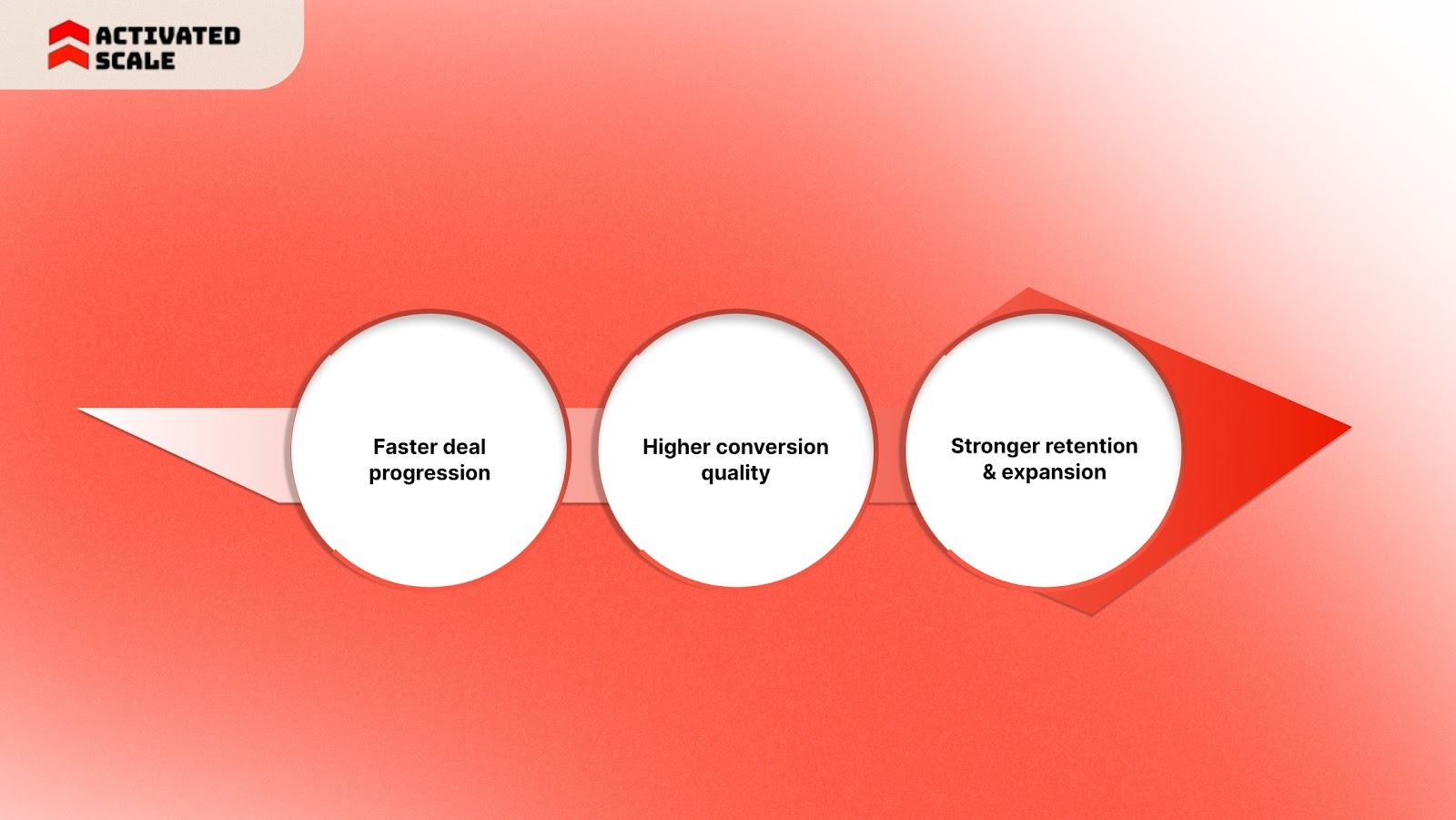
- Faster deal progression: Opportunities move through the funnel with fewer delays and handoffs.
- Higher conversion quality: Pipeline is cleaner, with fewer stalled or misqualified deals.
- Stronger retention and expansion: Existing accounts grow because teams act on the same customer signals.
These outcomes are measurable only when revenue data is consistent and centralized. If metrics live in disconnected tools or require manual reconciliation, RevOps performance becomes difficult to validate.
RevOps ROI is not about isolated wins. It is about whether alignment reduces friction across the revenue lifecycle and whether that reduction can be proven with data.
Why RevOps ROI Matters for Scaleups
Revenue Operations plays a direct role in how efficiently a company grows. According to research from the Boston Consulting Group, organizations with strong RevOps capabilities see around 20% higher sales growth and customer satisfaction. That uplift comes from better alignment across sales, marketing, and customer success, supported by shared data and consistent execution.
The value of RevOps is rarely the issue. The challenge is showing it.
For scaleups, RevOps improvements often span multiple teams and processes. Gains are observed in forecasting accuracy, conversion rates, and retention, but they are not always attributable to a single initiative. Without clear measurement, the impact remains difficult to communicate to leadership.
This is why RevOps ROI matters. When outcomes are measured and linked to revenue performance, RevOps moves from a background function to a visible growth lever. Clear ROI makes investment decisions easier and provides a baseline for improving how RevOps supports scale.
Why Proving RevOps ROI Feels So Elusive
Many teams assume RevOps performance is being measured because dashboards exist. In practice, most dashboards track activity rather than impact. When reports fail to show how operational decisions influence revenue outcomes, visibility turns into noise.
The real challenge is not data availability. It is connecting operational change to financial results.
Several issues consistently get in the way:
- Metrics that differ across marketing, sales, and customer teams
- Inconsistent definitions of key stages, such as what qualifies as an SQL
- Disconnected tools that fragment the funnel view
- Forecasts driven by assumptions instead of observable behavior
- Unclear attribution around what actually influenced pipeline movement
This pattern appears frequently in growing teams, and Activated Scale sees it firsthand when working with scaleups. Even when operational improvements are real, RevOps ROI becomes difficult to defend if ownership, metrics, and execution aren't aligned across teams.
The fix begins with a shift in focus. Measure outcomes, not activity. Align teams around shared definitions and ensure everyone is operating from the same underlying data.
The following metrics help anchor RevOps ROI to measurable business results.
Focus on Revenue Metrics That Reflect Real Impact
Not all KPIs are useful for proving RevOps value. The metrics that matter are those that directly link operational efficiency to revenue outcomes.
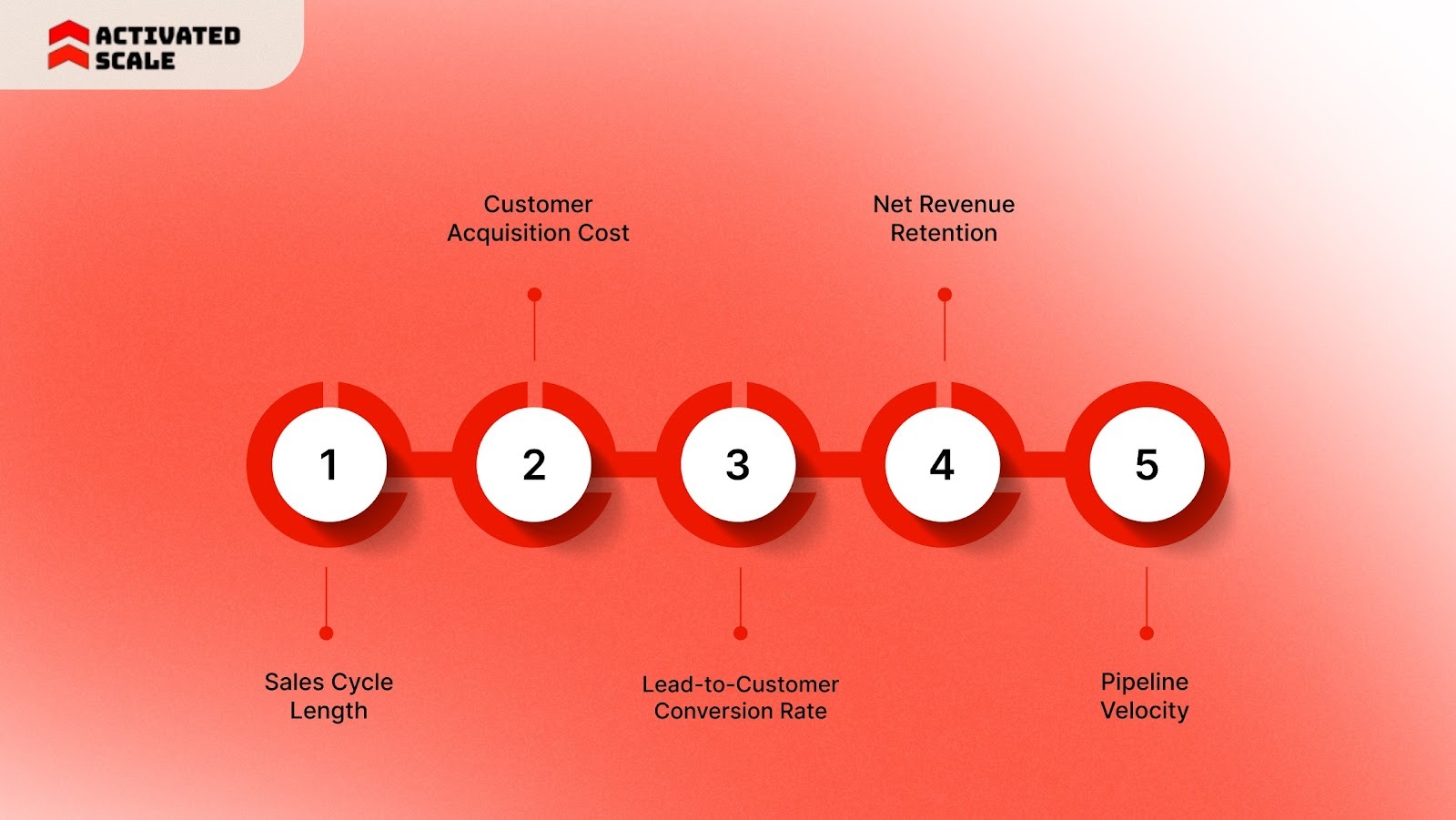
Sales Cycle Length
This tracks the time from the first engagement to the close. Effective RevOps removes friction across handoffs, shortens decision timelines, and improves seller productivity.
Customer Acquisition Cost (CAC)
As funnel operations become more aligned, wasted effort declines. CAC should trend down over time or support higher-quality, higher-value deals.
Lead-to-Customer Conversion Rate
This metric exposes breakdowns between marketing and sales. Strong RevOps alignment reduces leakage and improves follow-through across stages.
Net Revenue Retention (NRR)
RevOps impact extends beyond acquisition. NRR shows whether existing customers expand, renew, or churn. Operational consistency improves onboarding, engagement, and expansion motions.
Pipeline Velocity
Pipeline velocity measures how quickly revenue progresses through stages. When bottlenecks are removed and ownership is clear, deal momentum increases, and forecasts stabilize.
Consistently using these metrics replaces subjective explanations with evidence. More importantly, it creates a shared language for evaluating RevOps ROI across teams.
Build a Revenue Intelligence Foundation That Actually Works
You don't need more dashboards. You need visibility into how revenue moves from first touch to long-term retention. That's the role of a revenue intelligence framework.
A functional framework connects data across teams and stages, so decisions are based on shared context rather than isolated reports.
At a minimum, it includes:
- A well-integrated CRM such as HubSpot, Salesforce, or Zoho, with consistent, accessible data
- Clearly defined lifecycle stages that align marketing, sales, and post-sale teams
- Multi-touch attribution that shows influence from the first interaction through closed-won
- Regular performance reviews that guide changes in strategy, not just explain past results
When these elements are missing, teams rely on partial data. Marketing optimizes for leads, sales focuses on pipeline, and post-sale tracks retention, without a shared view of what actually drives revenue.
Learn more about: How to Build a Strong Sales Pipeline: A Sales Leader's Guide in 2026
Measure RevOps ROI Using a Before-and-After Baseline
ROI cannot be proven without a baseline. Many teams roll out RevOps changes without capturing "before" metrics, which makes it difficult to isolate impact later.
A clear baseline keeps measurement honest.
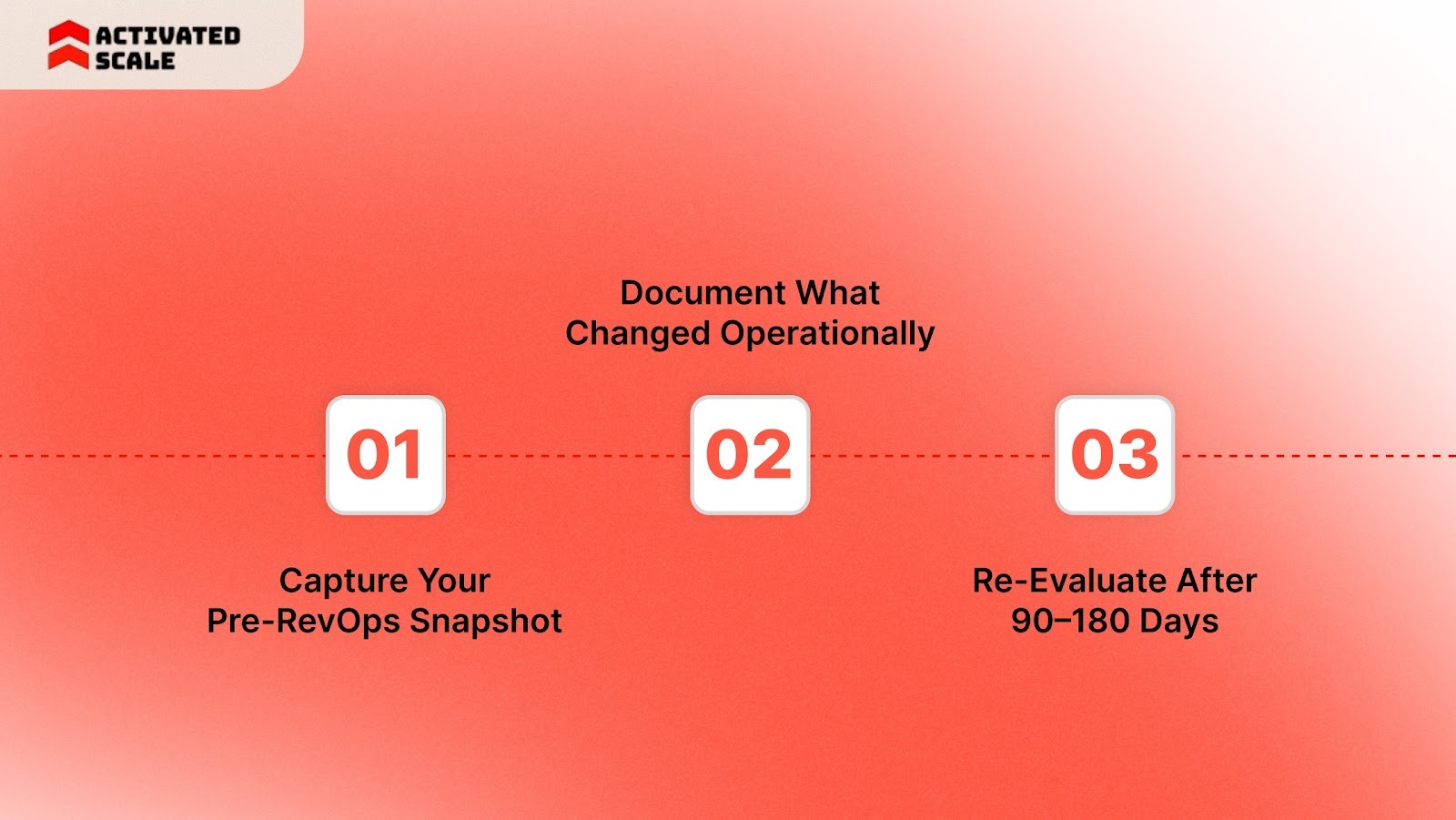
Step 1: Capture Your Pre-RevOps Snapshot
Start with data from before major operational changes. Focus on metrics that reflect revenue efficiency, not vanity activity:
- Average deal size
- Sales cycle length
- Customer acquisition cost (CAC)
- Funnel conversion rates
- Net revenue retention (NRR)
This snapshot establishes how revenue performed under the old operating model.
Step 2: Document What Changed Operationally
Next, record the specific changes introduced through RevOps. These might include:
- Lead qualification or scoring updates
- CRM integration between marketing and sales
- Faster or clearer handoff processes
- Improved onboarding or post-sale workflows
Being explicit here matters. ROI depends on linking outcomes to real operational shifts.
Step 3: Re-Evaluate After 90–180 Days
Revisit the same metrics after one or two quarters. Adjust for seasonality and focus on trends, not one-off spikes. Most RevOps improvements show measurable movement within this window.
Once you see consistent change, calculate ROI:
Divide the incremental revenue impact by your RevOps investment to understand the return multiple.
This approach turns RevOps ROI from a narrative into a measurable outcome, and gives leadership a clear basis for scaling what works.
Advanced Strategies to Increase RevOps ROI as You Scale
Once a RevOps foundation is in place, ROI improves through better signal quality and tighter cross-team alignment. At the scaleup stage, small efficiency gains compound quickly when revenue decisions are based on the right inputs.
1. Shift Lead Scoring Toward Revenue Probability
Many scaleups still score leads based on surface-level engagement. Clicks, downloads, and demo requests indicate interest, but they do not consistently predict deal value or likelihood of closing.
More effective scoring models factor in the revenue context, such as:
- Firmographic alignment with closed-won accounts
- Industry-specific buying patterns
- Historical deal size by account type
- Average time-to-close across similar opportunities
Predictive tools like MadKudu and 6sense help operationalize this by connecting CRM data with revenue outcomes, not just activity.
For scaleups, this is where structured RevOps execution matters. Through its work with growing companies, Activated Scale helps standardize lead scoring, qualification, and routing across teams. By aligning qualification models with actual revenue outcomes, sales effort is directed toward opportunities with the highest likelihood of return.
The result is fewer wasted touches and higher ROI per rep hour.
2. Bring Customer Success Into Revenue Decisions Earlier
Customer Success is often treated as a post-sale function. At scale, that separation limits revenue efficiency.
When CS insights are included earlier in the pipeline, RevOps teams can:
- Flag prospects that resemble high-expansion or long-retention customers
- Identify onboarding risks before deals are finalized
- Feed real usage friction back into positioning and upsell strategy
Platforms like HubSpot (with custom lifecycle and NPS logic) and Gainsight make this visibility actionable by connecting customer health data directly to pipeline reviews.
At scale, RevOps ROI improves not by adding volume, but by improving decision quality across the full revenue lifecycle.
Also read: Best Sales Strategies and Examples for Success
How Activated Scale Helps Scaleups Prove RevOps ROI
RevOps ROI breaks down when execution lacks ownership, not when metrics are missing. Scaleups often have the data but lack the structure or leadership to translate it into consistent outcomes.

Activated Scale helps scaleups close that gap by providing experienced, U.S.-based revenue operators who support RevOps execution where it matters most.
Their services support RevOps ROI by:
- Contract-to-Hire Sales Recruiting to validate RevOps or revenue leadership against real performance before committing full-time.
- Fractional Sales Leadership to align sales, marketing, and customer success around shared metrics and improve forecast accuracy.
- Fractional Selling to maintain pipeline discipline and execution consistency as revenue operations scale.
By focusing on people and operating structure, not just tools, Activated Scale helps scaleups connect RevOps execution to measurable revenue outcomes that leadership can stand behind.
Conclusion
For scaleups, RevOps ROI is proven through execution, not theory. When marketing, sales, and customer success operate on shared data and consistent metrics, revenue performance becomes easier to measure and easier to improve. Attribution is clearer, forecasts are more reliable, and growth decisions are grounded in evidence rather than assumptions.
The challenge is not whether RevOps works, but whether its impact is measured correctly. Without unified metrics and clean operational signals, ROI remains difficult to defend at the leadership level. Scaleups that invest in proper RevOps measurement frameworks gain visibility into what drives revenue efficiency and where to allocate resources as they grow.
As revenue complexity increases, the ability to quantify RevOps impact becomes a competitive advantage.
Explore practical ways to measure and strengthen RevOps ROI with confidence.
FAQs
1. What is RevOps ROI?
RevOps ROI measures the revenue impact of aligning marketing, sales, and customer success through shared processes, data, and metrics. It focuses on efficiency, predictability, and growth outcomes.
2. Which metrics best prove RevOps ROI for scaleups?
Common metrics include CAC, CLV, pipeline velocity, win rates, and sales cycle length. Forecast accuracy and retention trends also indicate RevOps effectiveness.
3. How quickly can scaleups see RevOps ROI?
Early improvements often appear within one to two quarters. Faster pipeline movement and better forecast visibility are usually the first measurable signals.
4. Why do many teams struggle to prove RevOps ROI?
Siloed data and inconsistent KPIs obscure the true impact on performance. Disconnected tools make it difficult to tie operational changes to revenue outcomes.
5. Does RevOps affect retention and expansion revenue?
Yes. Aligning customer success with sales and marketing improves onboarding, renewals, and upsell timing. This increases lifetime value and long-term revenue stability.
The Ultimate Guide to Hiring a Salesperson!
Get the step-by-step guide to hiring, onboarding, and ensuring success!