_edi.png)

Sales operations rarely fail because teams lack ambition. They fail because execution breaks down between strategy and day-to-day work.
That gap has consequences. Forecasts drift, pipelines stall, and leadership reacts rather than plans. Overwhelmed sellers bogged down by tool sprawl and non-selling tasks are 45% less likely to attain quota, as per Gartner's 2024 Sales Survey.
This guide outlines sales operations best practices to help teams regain control, improve predictability, and turn processes into performance without adding unnecessary complexity.
Before we dive in:
- Forecast accuracy improves when pipeline reviews are structured, and stage criteria are enforced. Without consistent deal inspection, projections drift, and confidence erodes.
- Sales cycle length, win rate, and ramp time reveal operational friction. When these metrics stall, the issue is usually process clarity, not rep effort.
- Clean CRM data directly impacts territory design, compensation logic, and revenue visibility. Poor data hygiene creates downstream planning errors.
- Tool sprawl reduces quota attainment. Sellers overloaded with non-selling tasks are significantly less likely to hit quota, making workflow simplification a revenue priority.
- Ownership determines execution quality. When decision rights and accountability are clearly defined, processes stick, and performance stabilizes.
What is Sales Operations?
Sales operations is the function that manages the systems, processes, tools, and data behind revenue generation. It ensures pipeline discipline, reliable forecasting, clean CRM data, and structured execution so sales teams can focus on selling instead of navigating operational friction.
Its purpose is simple: make revenue predictable and scalable.
Roles and Responsibilities of a Sales Operations Team
Sales ops teams can range from a single generalist to a structured department. As companies grow, responsibilities expand from execution support to strategic leadership.
Key roles include:
- Vice President or Director of Sales Operations: Leads the function and partners with revenue leadership to drive efficiency, forecasting accuracy, and scalable growth strategy.
- Sales Operations Manager: Implements processes, manages CRM and tools, runs forecast cadence, and enforces best practices across the sales team.
- Sales Operations Analyst: Analyzes pipeline data, conversion rates, sales cycle length, and performance trends to improve decision-making and revenue visibility.
- Sales Operations Representative: Handles day-to-day administrative support, CRM updates, reporting assistance, and operational tracking.
As sales complexity increases, many teams bring in experienced operators or fractional sales leadership to install structure before committing to full-time hires; a flexible model, platforms like Activated Scale help facilitate.
Why Sales Operations Strategy Is the Difference Between Control and Chaos
Sales operations without a strategy stay reactive. Teams scramble on pricing. CRM data can't be trusted. Forecasts change every quarter. New tools accumulate, but adoption remains low.
A sales operations strategy prevents this before it becomes an issue. Instead of fixing problems after they slow revenue, teams design processes and systems for the next stage of growth. That shift alone changes how sales scale.
When sales ops is strategic, three outcomes follow. Growth stops hitting operational ceilings. Revenue teams and leadership work from the same assumptions. New reps ramp faster because execution is consistent, not improvised.
Without that foundation, issues compound quickly, Silos form, Tools overlap, and Forecasting loses credibility. Decisions are increasingly based on gut feel rather than data.
Strong sales operations don't react to scale. They make scale predictable.
Also read: Top 10 Online B2B Sales Courses to Boost Team’s Spirit in 2026
8 Stages to Design a Scalable Sales Operations Framework

A strong sales operations strategy isn't about adding tools or layers of process. It's about building an operating foundation that fits your business model today and continues to work as you grow. Here's an eight-phase framework sales leaders use to move from reactive support to predictable revenue execution.
Phase 1: Define the Role Sales Ops Plays in the Business
Start with clarity. Sales operations only work when their purpose is explicit. Align sales ops with company goals, then define ownership boundaries. What does sales ops own versus enablement, finance, or RevOps? Where does decision authority live?
A simple mission statement helps anchor this, something like:
Enable predictable revenue by building scalable processes, reliable insights, and low-friction sales execution.
Without this clarity, sales ops becomes reactive by default.
Phase 2: Assess Where You Actually Stand Today
Before making any changes, take an honest look at your current state.
Review four areas:
- People
- Processes
- Technology
- Data
Most teams fall somewhere between manual and semi-structured. Using a maturity lens helps set realistic expectations and avoids overengineering too early. The goal isn't perfection. It's knowing your starting point.
Phase 3: Focus on the Few Priorities That Matter Most
Sales ops fails when everything becomes a priority.
Identify three to five initiatives that materially improve execution. Balance fast wins, like basic pipeline hygiene, with longer-term investments, like cleaner data models or better forecasting discipline. Prioritize based on impact and effort. If it doesn't move revenue predictability, it can wait.
Phase 4: Establish a Clear Operating Model
Structure matters more than most teams expect.
Decide whether sales ops is centralized under one leader or embedded across teams. Then define ownership clearly:
- Who owns CRM changes?
- Who manages compensation logic?
- Who runs forecast reviews?
Ambiguity here creates friction later. Document decision rights early and revisit them as the org evolves.
Phase 5: Choose Tools That Reduce Work, Not Add to It
Technology should simplify execution, not create more coordination overhead.
Start with core systems like CRM, forecasting, and quoting. Add supporting tools only if they integrate cleanly and share data reliably. Tools that operate in isolation usually increase manual work rather than reduce it.
Fit and integration matter more than feature depth.
Phase 6: Standardize the Processes That Drive Predictability
Document the few processes that directly affect outcomes. This includes pipeline standards, forecast cadence, territory logic, and team handoffs. Capture what works in simple playbooks and automate compliance where possible. The goal isn't control. It's consistency.
Phase 7: Measure What Helps You Improve Decisions
Metrics only matter if they lead to action. Track indicators like forecast accuracy, sales cycle length, win rate, ramp time, and data quality. Use them to spot patterns, not to create noise. Build feedback loops so insights drive change, not just dashboards. Sales ops should make decisions easier, not heavier.
Phase 8: Drive Adoption Through Change Management
Even good systems fail without buy-in. Bring sales leaders into decisions early. Explain why changes matter. Invest in training that goes beyond one-time rollouts. Watch adoption closely and address resistance before it hardens.
Progress sticks when teams understand the "why," not just the process. Sales operations break down when structure outpaces clarity. Teams add tools, processes, and roles before they've aligned on ownership and priorities.
This framework keeps sales ops focused on what it's meant to do: reduce friction, improve visibility, and support execution at scale.
As companies grow, this is often where experienced sales operators or fractional sales leadership add value, helping teams design systems that fit their stage instead of copying enterprise playbooks too early.
The takeaway is simple. Build for where you are, stay flexible, and let structure serve execution, not the other way around.
Also Read: Guide to Hiring the Right Salesperson for your Business
9 Sales Operations Best Practices That Actually Work in 2026

Strong sales operations turn intent into execution. These practices focus on clarity, discipline, and decision-making, not busywork.
1. Build a Clear, Documented Sales Process
Sales operations break down when deals move forward without shared definitions. Document how a deal progresses, what qualifies it to advance, and which actions are required at each stage. This removes guesswork for reps and managers alike.
Teams that formalize stage criteria often see faster deal movement because opportunities no longer stall due to unclear ownership or next steps.
2. Enforce Data Hygiene With Real Accountability
Every downstream decision depends on clean data. When CRM inputs are inconsistent, forecasts drift, and territory planning weakens.
Set clear data standards, enforce validation rules, and assign ownership for ongoing cleanup. Regular audits matter more than one-time fixes. Teams that treat data hygiene as an operating rhythm see sharper forecasts and fewer surprises.
3. Align Sales Ops With Finance, Product, and Legal
Sales don't operate in isolation. Misalignment across teams shows up as delayed deals, pricing confusion, and contract friction.
Regular cross-functional syncs work best when they focus on solving real blockers rather than reporting status. Sales operations should act as the connective tissue, translating field reality into operational decisions.
This is also where many teams feel the strain most. They know what alignment should look like, but lack experienced operators to consistently enforce it. That gap between strategy and execution is often why founders turn to flexible models like Activated Scale, especially before committing to full-time hires.
4. Automate the Work That Pulls Reps Away From Selling
Manual tasks quietly drain selling time. Quote creation, approvals, and data entry shouldn't require constant rep attention. Automation works when it removes friction without adding complexity. The goal isn’t more tools, it's fewer interruptions between a rep and a buyer.
5. Run Consistent, Structured Pipeline Reviews
Pipeline reviews are only useful when they follow a repeatable framework. Weekly manager reviews and monthly leadership reviews should focus on deal health, next actions, and risks, not optimism.
Consistency is what drives improvement. Teams that review the same way, every time, reduce misses and improve predictability.
6. Use Segmented Forecasting, Not Single Numbers
One forecast number hides risk. Segment forecasts by region, product line, customer type, and rep tenure to surface patterns early. Scenario planning helps leadership act before gaps widen. Best-case, worst-case, and most-likely views support smarter hiring, spending, and prioritization decisions.
7. Revisit Territory and Capacity Design Regularly
Territories age faster than most teams expect. Account density, deal size, and cycle length change as companies grow. Quarterly reviews help balance opportunity and effort. When territories stay fair and realistic, rep performance stabilizes and attrition drops.
8. Create Feedback Loops With Frontline Reps
Processes look different in the field than they do in dashboards. Sales operations teams that listen closely catch friction early. Office hours, surveys, and informal check-ins surface issues before they become habits. Acting on feedback builds trust and improves adoption.
9. Build Data Literacy Across the Team
Dashboards only help when people know how to read them. Train reps and managers to understand metrics, trends, and trade-offs. The strongest sales operations teams adjust processes based on evidence, not instinct. Over time, this shifts decisions from reactive to deliberate.
Learn more about: How to Create a Pipeline for Business Development in Just 7 Stages
A Practical Roadmap for Implementing Sales Operations
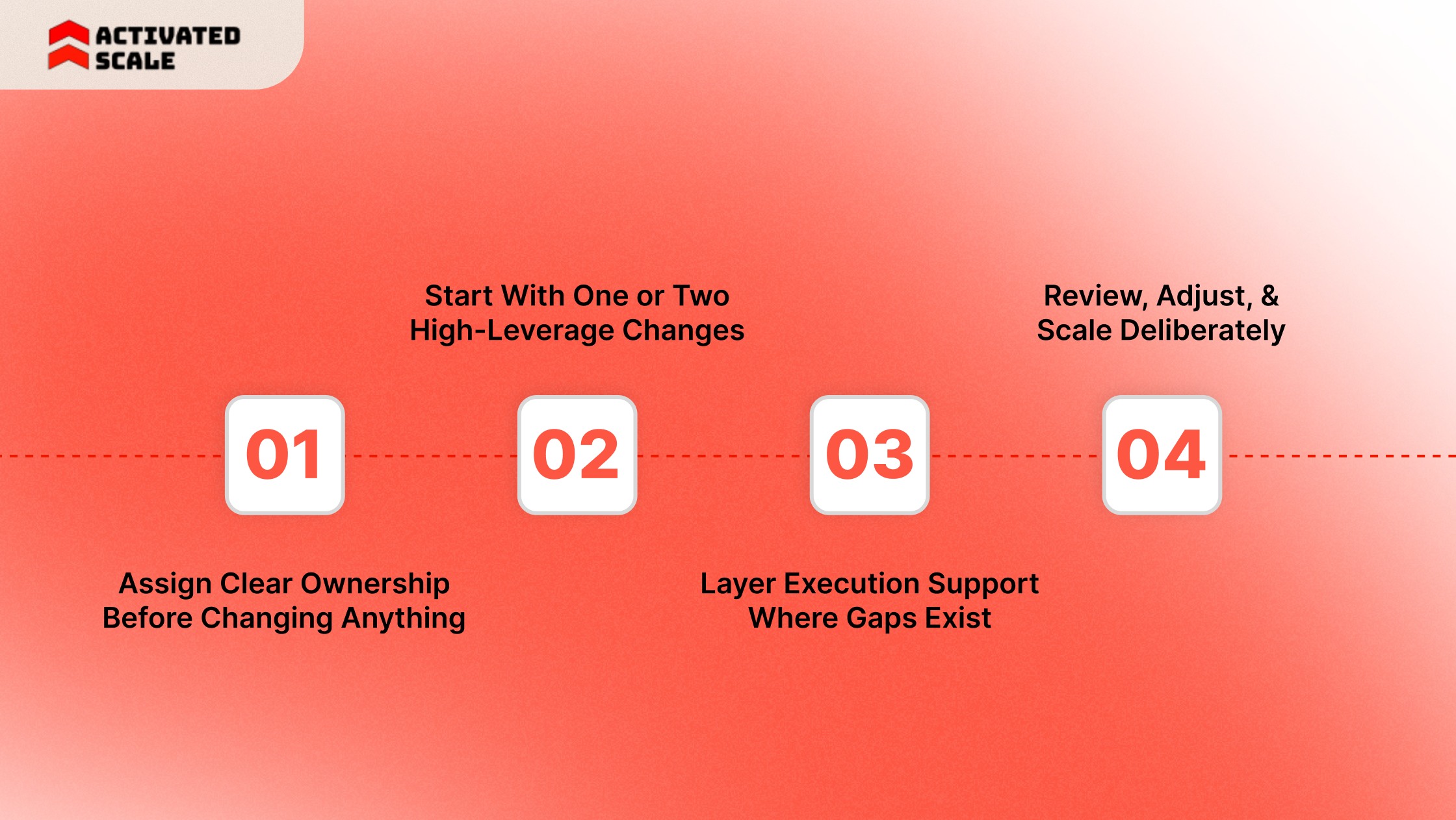
Knowing what good sales operations look like is one thing. Implementing them with limited time, bandwidth, and the wrong mix of experience is where most teams stall.
This roadmap focuses on sequencing decisions so progress compounds rather than breaks down.
Step 1: Assign Clear Ownership Before Changing Anything
Sales operations failures most often stem from unclear ownership, not poor intent. Before rolling out new processes or tools, decide who is accountable for design, enforcement, and iteration.
For early-stage or fast-growing teams, this ownership gap is common. Founders and revenue leaders often know what needs to change, but don't have a dedicated operator to run it day-to-day.
This is where experienced, short-term leadership can create leverage. Many teams bring in external sales operators temporarily to establish structure, then transition ownership internally once systems are stable.
Step 2: Start With One or Two High-Leverage Changes
Trying to fix everything at once creates resistance. The strongest implementations focus on a narrow set of changes that unlock momentum, such as:
- Standardizing pipeline stages
- Cleaning and enforcing CRM data
- Introducing consistent deal reviews
These improvements don't require a full rebuild. They require focus and follow-through.
Teams that lack internal capacity to execute these changes often stall here, not because the work is complex, but because it competes with revenue pressure.
This is why some founders use Activated Scale to access experienced sales operators or reps who can execute alongside the core team without long-term commitment.
Step 3: Layer Execution Support Where Gaps Exist
Once processes are defined, execution gaps quickly become visible. Reps may lack time. Managers may lack consistency. Leadership may lack bandwidth.
Rather than hiring full-time prematurely, many teams choose flexible execution support:
- Contract-to-hire sales recruiting to validate performance before committing.
- Fractional SDRs or AEs to apply new processes without overloading the team.
- Fractional sales leadership to enforce cadence, reviews, and accountability.
The goal isn't to outsource ownership. It's to accelerate implementation while keeping control in-house.
Step 4: Review, Adjust, and Scale Deliberately
Sales operations are not static. Once changes are live, review outcomes against metrics, not assumptions.
Ask:
- Are deals moving faster or just differently?
- Is forecast accuracy improving?
- Are reps spending more time selling or navigating the process?
When results improve, scale thoughtfully. When they don't, adjust quickly. Teams that revisit decisions quarterly avoid locking themselves into systems or headcount that no longer fit.
Sales operations don't create value on their own. Execution does.
The teams that succeed treat implementation as an operating discipline, not a one-time project. They move in phases, test before committing, and bring in experience exactly where it's needed.
Is Your Sales Operations Strategy Working? Track These 5 Numbers
Sales operations are successful when productivity, efficiency, and predictability improve together. The impact shows up in a few core metrics:
- Revenue per rep: Indicates overall sales productivity and operational leverage.
- Selling time vs. admin time: More customer-facing time signals reduced process friction.
- Forecast accuracy: Smaller gaps between projected and actual revenue reflect stronger pipeline discipline.
- Sales cycle length: Shorter, consistent cycles suggest clear qualification and stage management.
- Win rate: Higher close rates point to better targeting, enablement, and execution.
When these metrics trend in the right direction, sales operations is driving real revenue impact, not just internal coordination.
Turning Best Practices Into Execution
Knowing what good sales operations look like is the easy part. Making them work consistently is harder.
Most teams struggle not because the practices are unclear, but because no one owns the implementation end-to-end. Processes slip, data degrades, and reviews turn reactive. Over time, execution gaps widen.
This is where many founders choose flexibility over premature commitment. Instead of hiring full-time before the motion is proven, they bring in experienced operators who can install process, cadence, and accountability early.
If improving sales execution is on your roadmap, let's connect to discuss which support makes sense for your stage.
FAQs
1. What are sales operations' best practices?
Sales operations best practices are structured approaches to managing processes, data, forecasting, territory design, and execution. Their goal is to improve efficiency, predictability, and revenue outcomes.
2. Why do sales operations break down even with good tools?
Tools don't enforce discipline. Without clear ownership, documented processes, and regular reviews, systems drift and data quality decline, regardless of the tech stack.
3. How often should sales operations processes be reviewed?
Core processes should be reviewed quarterly. Pipeline reviews should run weekly or monthly, while territory and capacity planning should be reassessed as the business scales.
4. What's the biggest mistake teams make with sales operations?
Treating sales operations as a support function instead of a revenue driver. When ops lacks authority or leadership backing, best practices don't stick.
5. Can fractional roles really support sales operations?
Yes. Fractional sales leaders and operators are often brought in to design processes, establish cadence, and train teams before companies commit to full-time hires.
The Ultimate Guide to Hiring a Salesperson!
Get the step-by-step guide to hiring, onboarding, and ensuring success!