_edi.png)
.png)
Scaling a sales team in a U.S.-based tech or SaaS startup can feel like solving a puzzle. You have leads coming in, prospects waiting, and pressure to hit growth targets, but assigning the right person to the right part of the sales funnel often causes bottlenecks. This is where understanding distinct sales roles becomes crucial.
Among these roles, the market development representative (MDR) is gaining attention for its focus on connecting marketing efforts with sales outcomes. In this article, we’ll break down how MDRs differ from other sales positions and highlight when your startup might benefit from one.
At A Glance
- Market development representatives qualify and nurture inbound leads, connecting marketing efforts to sales.
- MDRs, SDRs, BDRs, and AEs serve distinct stages in the sales funnel.
- Hire an MDR when inbound lead flow exists, but conversions to sales are slow.
- Clear handoffs, aligned reporting, and defined KPIs help the MDR role perform effectively.
- Startups can utilize vetted U.S.-based SDRs, AEs, and BDRs without committing to full-time hires.
What is a Market Development Representative (MDR)?
A market development representative (MDR) is a sales professional who bridges marketing and sales. Their primary focus is on engaging inbound leads, qualifying prospects, and preparing them for the sales team. MDRs ensure that marketing-generated interest is efficiently nurtured and converted into opportunities.
Unlike traditional sales roles, they focus on lead quality and readiness rather than closing deals. Their scope typically includes understanding buyer intent, maintaining consistent follow-ups, and providing insights to marketing and sales teams to improve targeting and messaging.
Role and Responsibilities of a Market Development Representative (MDR)
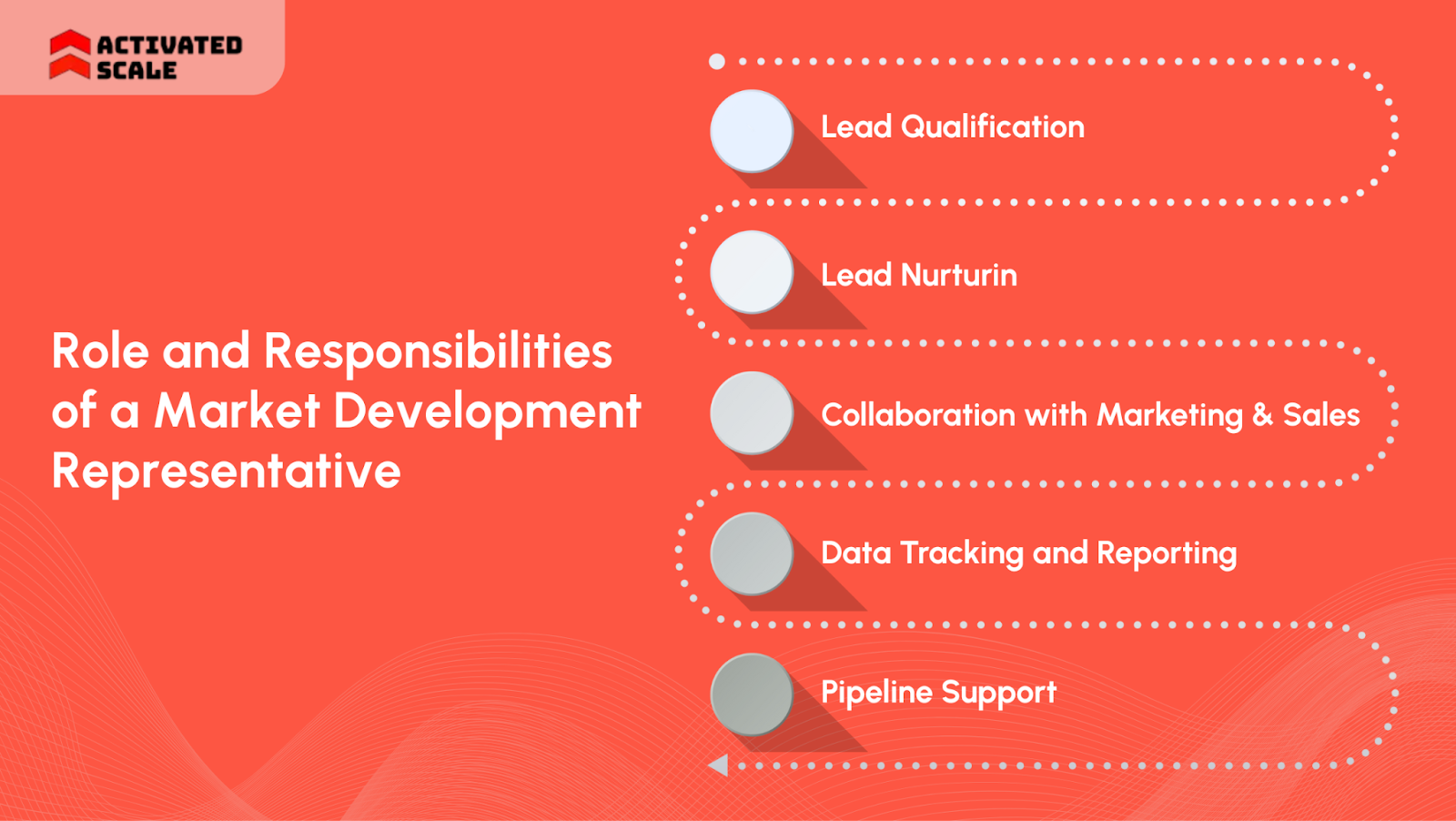
Market development representatives act as the first point of contact for inbound leads, ensuring potential customers are engaged, informed, and qualified before passing them to sales.
Key responsibilities include:
- Lead Qualification: Evaluate inbound leads to determine if they meet the criteria for sales engagement. Focus on lead intent, readiness, and alignment with the ideal customer profile.
- Lead Nurturing: Maintain consistent engagement with prospects through email, calls, or other channels. Educate and guide leads until they are ready for a sales handoff.
- Collaboration with Marketing and Sales: Provide feedback on lead quality, messaging, and campaign effectiveness. Act as a bridge between marketing campaigns and sales execution.
- Data Tracking and Reporting: Monitor and document lead interactions, conversion rates, and engagement metrics. Use insights to improve processes and inform marketing strategies.
- Pipeline Support: Ensure a steady flow of qualified leads into the sales funnel, helping account executives focus on closing deals rather than prospecting.
Now, let’s see how an MDR’s role fits within the broader sales team.
MDR vs Sales Development Representative (SDR)
While both MDRs and SDRs support the sales funnel, their focus and approach are different. MDRs concentrate on qualifying inbound leads and preparing them for sales, ensuring marketing-generated interest is effectively converted.
SDRs, on the other hand, actively generate new leads through outbound prospecting, reaching out to potential customers who may not yet know about your product.
When to Hire:
- MDR: When you have inbound leads that need careful qualification and nurturing.
- SDR: When you need to actively create new opportunities through outbound efforts.
Recommended: B2B Sales Outsourcing: Definition, Benefits, Top Companies.
MDR vs Business Development Representative (BDR)
MDRs and BDRs both contribute to sales growth, but their approaches differ. MDRs focus on nurturing inbound leads and preparing them for sales, making sure marketing-generated interest is converted efficiently.
A BDR's role includes proactively identifying and pursuing new business opportunities, often through outbound prospecting at the top of the funnel.
When to Hire:
- MDR: When inbound leads exist but need proper qualification.
- BDR: When you need to actively pursue new markets or prospects.
Also Read: Strategies for Successful Sales Leadership: Skills and Practices.
MDR vs Account Executive (AE)
MDRs and AEs interact with leads at different stages of the funnel. MDRs qualify and nurture leads, ensuring they are ready for high-value conversations.
AEs manage the full sales cycle, engaging qualified leads to close deals and drive revenue. Proper handoffs between MDRs and AEs reduce duplicated effort and help maintain a steady pipeline.
When to Hire:
- MDR: When your leads need preparation before sales engagement.
- AE: When your team has qualified leads ready to convert into revenue.
Now that the differences are clear, the next step is ensuring the MDR role is structured effectively to maximize impact and streamline your sales funnel.
Recommended: How to Build a Scalable Sales Pipeline Step-by-Step.
How to Structure the MDR Role for Best Results
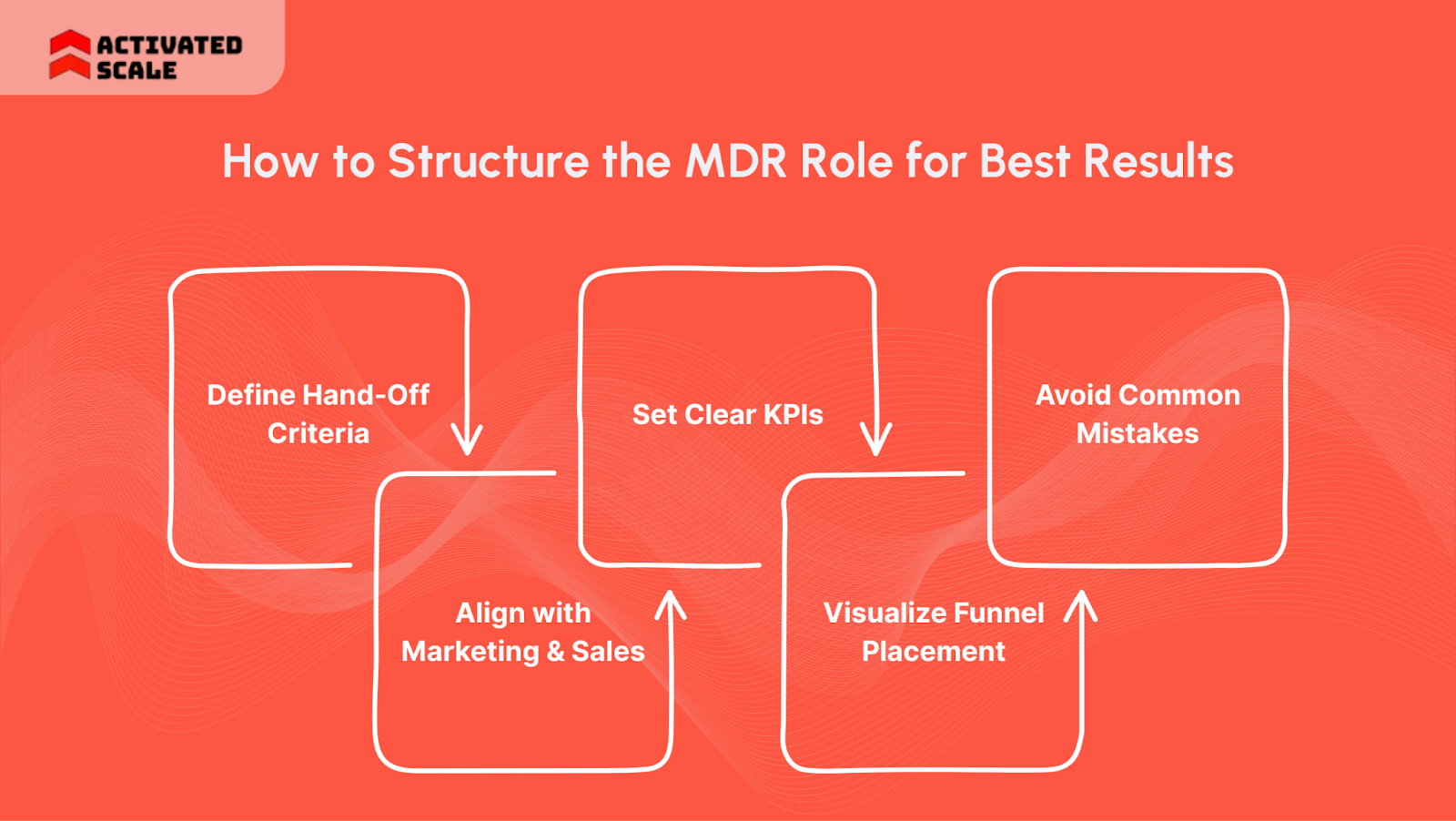
To maximize the impact of a market development representative, it’s important to define their responsibilities, align them with both marketing and sales, and set clear performance metrics.
Key Steps to Structure the MDR Role:
- Define Hand‑Off Criteria: Clearly outline what makes a lead ready for sales engagement. Specify when an MDR should pass a marketing-qualified lead (MQL) to an account executive (AE) to maintain efficiency and avoid stalled opportunities.
- Align with Marketing and Sales: Establish reporting lines and regular communication loops. Encourage MDRs to provide feedback to marketing about lead quality, messaging effectiveness, and campaign outcomes. This alignment ensures both teams work toward the same goals.
- Set Clear KPIs: Track metrics such as MQL → SQL conversion rate, response time to inbound leads, and engagement levels. Measuring these helps identify bottlenecks and optimize performance.
- Visualize Funnel Placement: Position the MDR between marketing and sales in the funnel: Marketing → MDR → AE → Customer Success.
- Avoid Common Mistakes: Do not assign excessive outbound prospecting to MDRs, as their strength lies in nurturing. Avoid unclear role definitions that can lead to duplicated work with SDRs or BDRs.
With the MDR role clearly defined and structured for efficiency, the next question is timing.
Also Check: Effective Sales Performance Tracking for Remote SDR Team
When to Bring a Market Development Representative Onboard
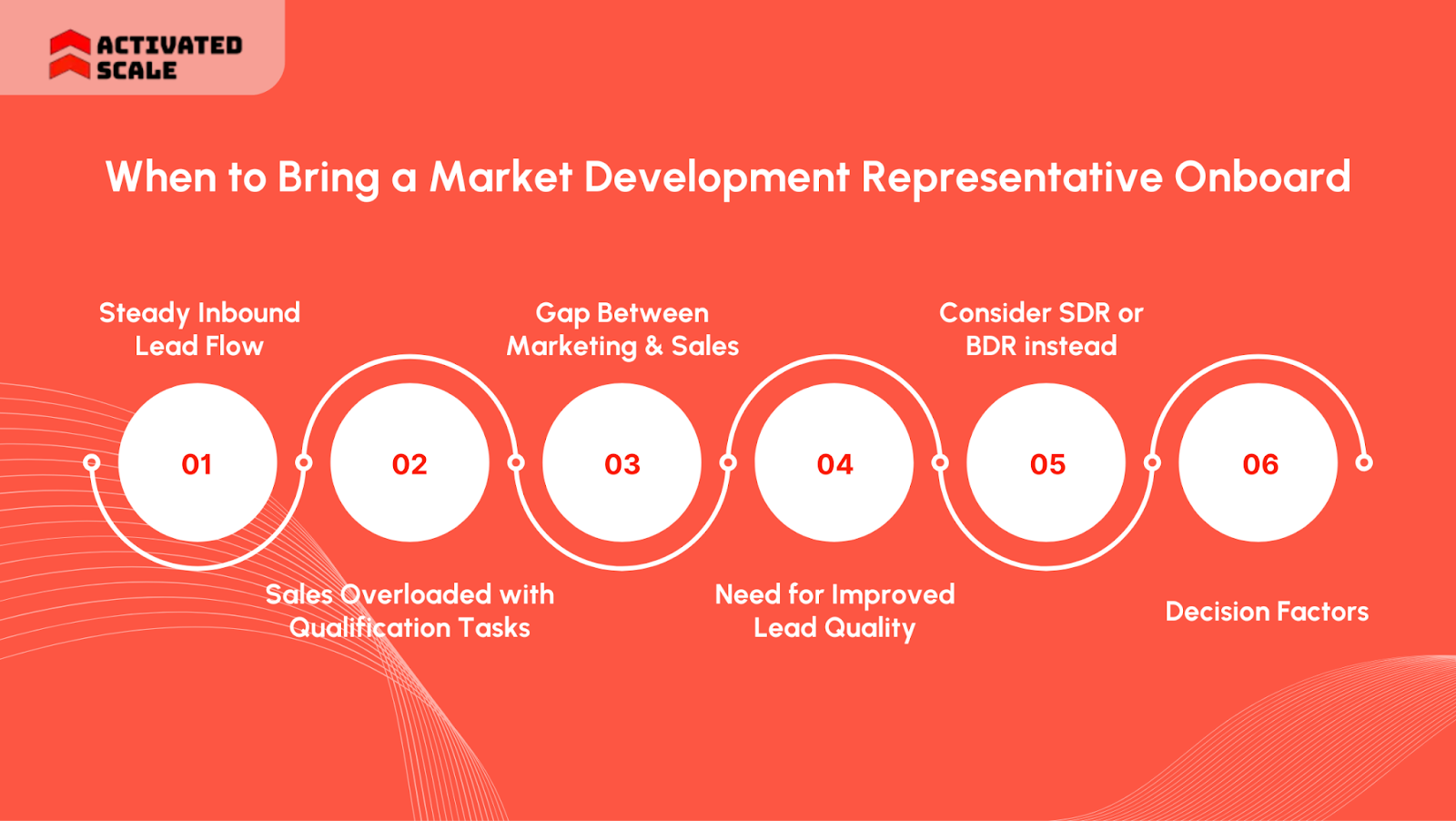
MDRs are most effective when your business has inbound leads but lacks the capacity to qualify and nurture them efficiently.
Signs Your Startup Should Hire an MDR:
- Steady Inbound Lead Flow: You consistently receive marketing-qualified leads (MQLs), but conversion to sales-qualified leads (SQLs) is slower than expected.
- Sales Overloaded with Qualification Tasks: Your sales team spends too much time reviewing and contacting incoming leads instead of focusing on closing deals.
- Gap Between Marketing and Sales: Leads generated by marketing campaigns are not progressing smoothly to sales, indicating a need for a bridge role.
- Need for Improved Lead Quality: You want to ensure that only well-qualified, engaged prospects reach your account executives.
- Consider SDR or BDR instead: If inbound leads are scarce or you need aggressive outbound prospecting to grow the pipeline, an SDR or BDR may be a better first hire.
- Decision Factors: Evaluate lead volume, sales cycle complexity, and budget constraints before hiring to ensure the role adds measurable value.
Evaluating your lead flow, sales capacity, and growth priorities will help determine the right moment to add an MDR to your team.
Conclusion
Sales success depends on placing the right talent at each stage of your funnel. MDRs ensure inbound leads are qualified and nurtured, SDRs drive outbound opportunities, BDRs pursue new business, and AEs focus on closing deals. Aligning these roles with clear responsibilities reduces wasted effort and accelerates revenue growth.
Additionally, if your startup needs flexibility, you can tap into Activated Scale’s network of vetted U.S.-based SDRs, AEs, and BDRs, allowing teams to scale quickly without long-term hiring commitments.
Strengthen your sales process today. Get in touch with our team to find experienced professionals when and where your funnel needs them most.
FAQs
1. What is the main difference between an MDR and an SDR?
An MDR focuses on qualifying and nurturing inbound leads from marketing, while an SDR actively generates new leads through outbound prospecting.
2. When should a startup hire an MDR instead of a BDR or SDR?
Hire an MDR when you have steady inbound leads that need careful qualification and nurturing. If outbound prospecting or new market opportunities are the priority, a BDR or SDR may be more appropriate.
3. How does an MDR work with an account executive (AE)?
MDRs prepare qualified leads and pass them to AEs, allowing AEs to focus on closing deals and managing the full sales cycle efficiently.
4. What KPIs should be tracked for MDR performance?
Key metrics include MQL to SQL conversion rates, lead engagement levels, and response time to inbound inquiries.
5. Can startups use part-time or fractional sales talent for these roles?
Yes. Startups can leverage vetted U.S.-based SDRs, AEs, or BDRs on a fractional basis to fill gaps without committing to full-time hires, ensuring flexibility and cost efficiency.
The Ultimate Guide to Hiring a Salesperson!
Get the step-by-step guide to hiring, onboarding, and ensuring success!