_edi.png)

In sales, the difference between hitting targets and missing them often comes down to how you sell, not just what you sell. Companies that systematize their selling techniques consistently outperform those relying on ad-hoc outreach or intuition. In fact, teams with well-defined pipeline processes see up to 28 % higher revenue growth compared to those without a structured approach.
For startups and scaling teams, it’s not enough to follow trends or copy competitors. The right selling techniques are grounded in understanding your buyer, reducing friction, and aligning your team around measurable outcomes.
This guide walks through real-world strategies and examples that have driven success, giving you actionable insights to adapt and implement immediately.
Before we dive in:
- Teams with defined sales processes and pipelines achieve up to 28% higher revenue growth, proving that systemized selling consistently outperforms ad-hoc outreach.
- Inbound, outbound, consultative, transactional, and value-based selling work best when matched to buyer intent, deal complexity, and decision timelines, not copied blindly from competitors.
- HubSpot scaled through inbound selling, Salesforce won enterprise deals via consultative selling, and Shopify grew rapidly using low-friction transactional sales, showing there is no one-size-fits-all strategy.
- Clear ICPs, repeatable sales processes, aligned sales-marketing teams, and continuous KPI-driven optimization are what turn sales techniques into predictable revenue.
- Fractional and contract-to-hire sales talent enables startups to apply advanced selling techniques immediately, validate performance, and scale only when results justify long-term headcount.
What Is a Sales Strategy?
A sales strategy is a structured plan that helps businesses identify, reach, and convert the right customers while meeting revenue goals efficiently. It’s more than a checklist, it’s a blueprint that aligns the entire sales team on who to target, how to approach them, and the steps needed to close deals consistently.
Key components include:
- Ideal customer profile – defining who brings the most value
- Sales channels – emails, calls, demos, or digital outreach
- Messaging – what to say at each stage of the sales cycle
- Conversion process – turning interest into actual paying customers
A clear sales strategy reduces guesswork, improves results, and accelerates growth, ensuring every team member works toward the same goal with measurable actions.
Why a Clear Sales Strategy is Non-Negotiable
Without a clear sales strategy, teams risk wasting time on the wrong leads, using inconsistent messaging, and missing revenue targets. A well-defined strategy gives your business direction and shows your sales team exactly who to target, how to engage, and what process to follow to convert leads efficiently.
Key benefits of a structured sales strategy:
- Target the right customers: Focus on leads most likely to buy, reducing wasted effort.
- Align your team: Reps, managers, and leadership work toward the same goals with consistent messaging.
- Enable predictable growth: Track performance, refine tactics, and scale what works.
- Reduce guesswork: Follow a defined sales process instead of making random calls or sending scattered emails.
- Strengthen marketing collaboration: Ensure sales and marketing coordinate on timing, messaging, and target audiences.
In short, a strong sales strategy turns leads into customers faster, shortens the sales cycle, and makes growth predictable and scalable.
Types of Sales Strategies Every Startup Should Know
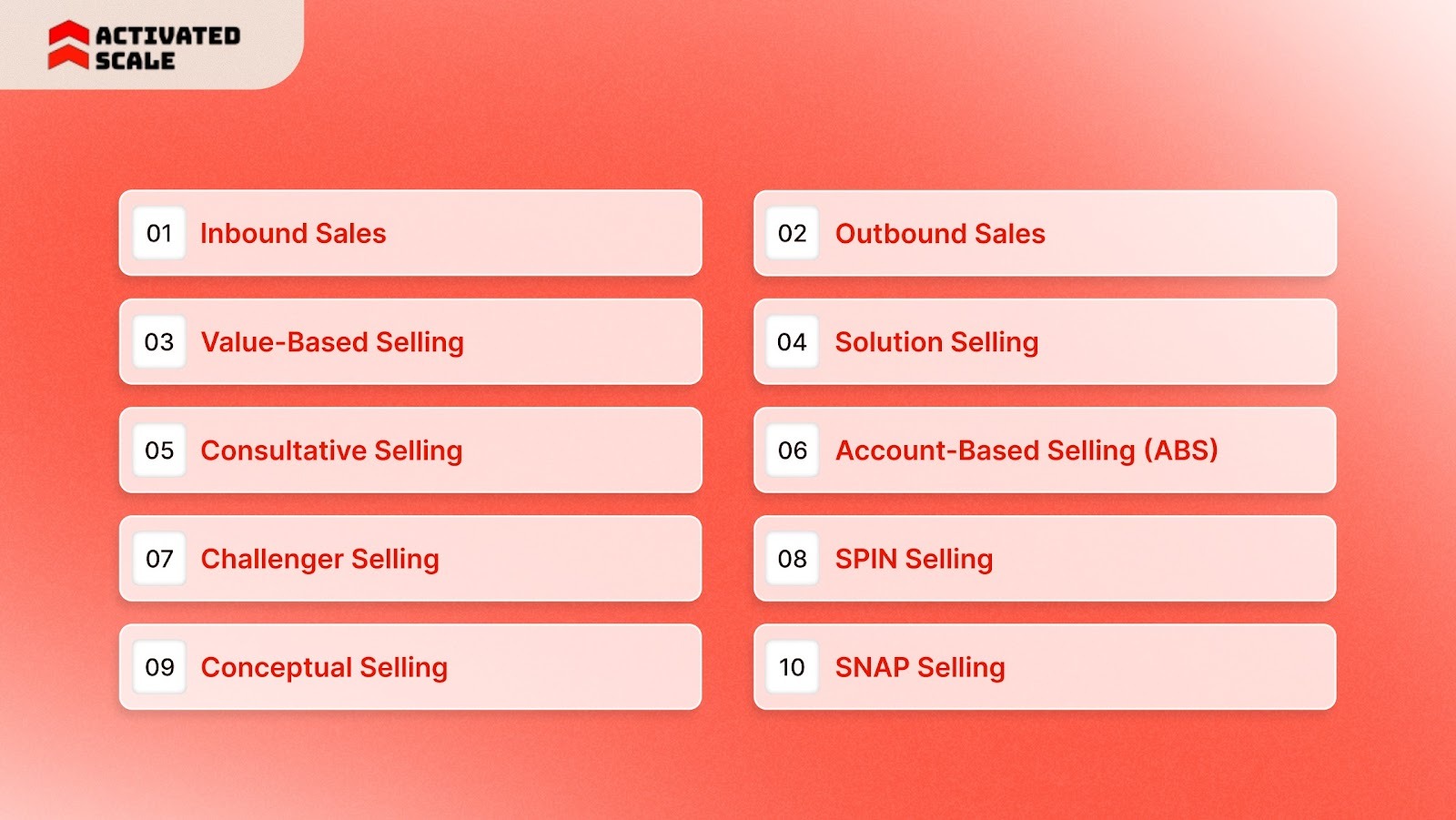
Not every buyer responds to the same approach. The most effective sales teams adapt their strategy based on what they’re selling, who they’re selling to, and where the buyer is in their journey. Using the right type of sales strategy can be the difference between missing targets and consistently closing deals.
Here are 10 proven types of sales strategies, with insights on when and how to use each, so your team can match the approach to the customer, the product, and the stage of the sales process.
1. Inbound Sales
Focuses on leads who already show interest in your product or service.
How it works: Sales teams engage prospects based on their online behavior, content interaction, or inquiries. Conversations are tailored to the buyer’s intent rather than generic outreach.
Why it works: Builds trust and shortens sales cycles.
Best for: B2B SaaS, service-based businesses, and content-driven lead generation.
2. Outbound Sales
Proactively reaches potential customers through calls, emails, or campaigns.
How it works: Reps target specific personas using data-driven lists and craft messages addressing real pain points.
Why it works: Creates demand when inbound interest is insufficient.
Best for: High-ticket deals, enterprise sales, and competitive markets.
3. Value-Based Selling
Shifts the focus from features or price to outcomes and measurable benefits.
How it works: Reps demonstrate how the solution drives ROI or solves business problems.
Why it works: Strengthens positioning, leads to larger deals, and increases client retention.
Best for: Solution-driven offerings with tangible business impact.
4. Solution Selling
Centers on identifying a problem and providing a tailored solution.
How it works: Reps diagnose the buyer’s challenges, quantify impact, and show how the product addresses it.
Why it works: Builds trust and positions your company as an expert partner.
Best for: Complex B2B products, custom solutions, and consulting services.
5. Consultative Selling
Reps act as advisors rather than just sellers.
How it works: They study the buyer’s business, understand goals, and offer recommendations aligned with long-term objectives.
Why it works: Strengthens relationships and fosters repeat business.
Best for: Enterprise accounts, relationship-heavy industries, and professional services.
6. Account-Based Selling (ABS)
Targets a select group of high-value accounts with personalized campaigns.
How it works: Sales and marketing align to create tailored content and messaging for each account.
Why it works: Increases the chance of closing strategic deals and maximizes revenue per account.
Best for: B2B companies selling to large or strategic clients.
7. Challenger Selling
Reps challenge the buyer’s assumptions to bring new insights.
How it works: They educate the buyer on problems they may not even realize exist, offering a fresh perspective.
Why it works: Positions your team as thought leaders and differentiates from competitors.
Best for: Innovative products or disruptive markets.
8. SPIN Selling
Structured methodology: Situation, Problem, Implication, Need-Payoff.
How it works: Reps ask targeted questions to uncover true needs and guide the buyer logically toward the solution.
Why it works: Clarifies pain points and builds a compelling business case.
Best for: Complex, consultative sales cycles.
9. Conceptual Selling
Focuses on how the buyer perceives the solution rather than features.
How it works: Sales teams align the product to the buyer’s vision and objectives, emphasizing ideas and outcomes.
Why it works: Effective when multiple stakeholders influence the decision.
Best for: High-stakes B2B deals or transformative solutions.
10. SNAP Selling
Designed for busy decision-makers: Simple, Invaluable, Aligned, Priority.
How it works: Reps remove friction, highlight the most relevant benefits, and make the buying process easy.
Why it works: Speeds decision-making and reduces buyer overwhelm.
Best for: High-velocity sales environments with time-strapped prospects.
Implementing the right selling techniques takes more than theory, it requires experienced reps who can adapt strategies to the buyer, the product, and the stage of the sales cycle. For many startups, building this expertise in-house takes time, training, and resources that could slow revenue growth.
Platforms like Activated Scale solve this challenge by connecting teams with pre-vetted, U.S.-based sales professionals ready to apply these strategies effectively from day one, helping startups focus on closing deals instead of onboarding and trial-and-error.
Also read: Top 10 Biggest Recruitment Companies in 2026
Selling Techniques to Build a High-Performing Sales Strategy
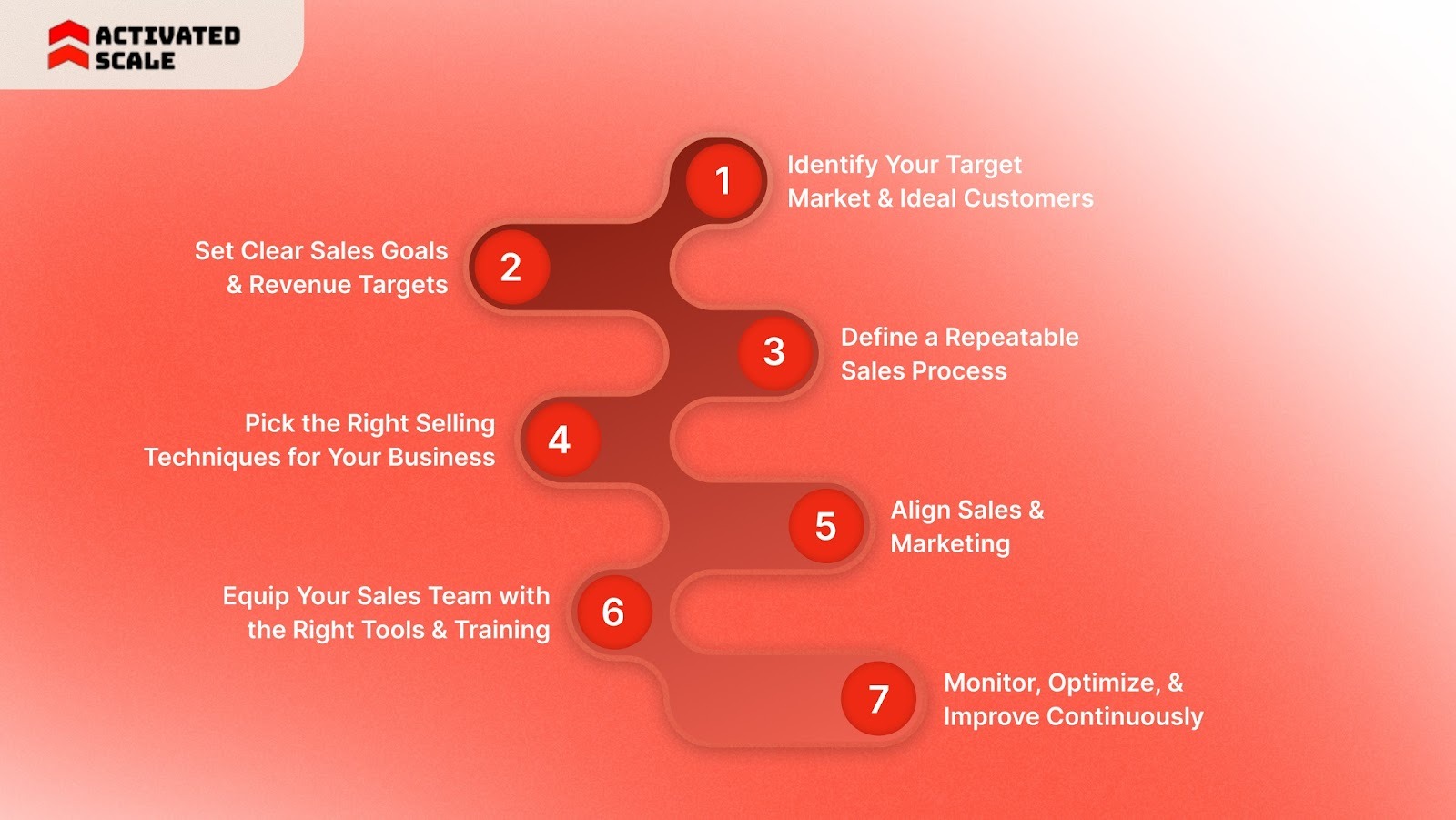
A strong sales strategy isn’t just a plan, it’s the blueprint that helps your team generate leads, convert prospects into paying customers, and consistently hit revenue targets. The best strategies remove guesswork, improve efficiency, and give your sales reps clear direction.
Here’s a step-by-step guide to building a sales strategy that drives results and scales revenue effectively:
1. Identify Your Target Market and Ideal Customers
The first step in any successful sales strategy is knowing exactly who you’re selling to.
- Segment your audience by industry, company size, location, job title, or behavior patterns.
- Create detailed customer personas to understand their goals, challenges, and decision-making criteria.
When your team knows who to focus on, they spend less time on low-fit prospects and more time on qualified leads. Startups can accelerate this process by leveraging insights from tools and partners like Activated Scale, which helps connect to U.S.-based sales talent already familiar with high-value buyer personas.
2. Set Clear Sales Goals and Revenue Targets
Every sales strategy needs measurable outcomes.
- Define monthly, quarterly, and annual targets: revenue, deals closed, average deal size, win rate.
- Align goals with business objectives to give sales managers visibility into performance and pipeline health.
Clear, actionable metrics give your team direction and help identify where to focus effort for maximum impact.
3. Define a Repeatable Sales Process
A consistent sales process ensures each lead moves through your pipeline efficiently.
- Outline stages: prospecting → qualification → demo → proposal → negotiation → close.
- Assign responsibilities and define criteria for moving deals forward.
- Use CRM software and automation platforms to track pipeline progress and identify bottlenecks.
A repeatable process reduces errors, shortens sales cycles, and allows teams to scale faster.
4. Choose the Right Selling Techniques for Your Business
Not all sales strategies are the same. Pick approaches that match your product, buyer type, and deal complexity:
- Inbound sales: Convert leads already showing interest.
- Outbound sales: Proactively reach decision-makers.
- Value-based selling: Highlight ROI and business outcomes, not just features.
- Solution selling: Address specific problems with tailored solutions.
- Consultative selling: Act as a trusted advisor.
- Account-based selling: Personalize outreach for high-value accounts across multiple touchpoints.
For startups building GTM teams, Activated Scale can connect you with sales reps trained in these techniques, allowing you to test and scale without committing to full-time hires.
5. Align Sales and Marketing
Misalignment between sales and marketing slows growth.
- Define clear lead qualification criteria.
- Ensure unified messaging across campaigns, calls, and proposals.
When both teams share the same vision, lead quality improves, conversion rates rise, and your pipeline moves faster.
6. Equip Your Sales Team with the Right Tools and Training
Sales enablement drives performance.
- Provide CRM systems, automation tools, proposal templates, and content libraries.
- Offer regular training on methodologies like SPIN, Challenger, or SNAP selling.
Well-equipped and trained reps convert more leads and shorten sales cycles. Fractional sales talent from Activated Scale often comes pre-trained in these methodologies, giving startups a faster path to results.
7. Monitor, Optimize, and Improve Continuously
A strong strategy evolves with data.
- Track KPIs: conversion rate, pipeline velocity, average sales cycle length, and close rate.
- Analyze customer feedback and sales activity to identify gaps.
- Adjust messaging, update targeting, refine processes, and scale what works.
Continuous improvement ensures your selling techniques remain effective and your revenue growth stays predictable.
How to Evaluate and Fine-Tune Your Sales Strategy for Maximum Impact
A sales strategy isn’t a static plan, it’s a living framework that must evolve with your market, customer expectations, and business goals. Continuous evaluation ensures your approach remains effective, measurable, and aligned with revenue objectives. Here’s how to take a structured, actionable approach:
1. Track the Right Performance Metrics
KPIs provide clarity on what’s working and what isn’t. Key metrics to monitor include:
- Conversion rates at each funnel stage
- Average deal size for different customer segments
- Sales velocity to measure speed from lead to close
For example, if your outbound efforts are generating leads but not closing deals, reviewing email response rates or call-to-demo ratios can reveal specific areas to improve.
2. Align Your Strategy with Business Goals
Your sales strategy should always map to broader objectives, revenue targets, market expansion, or new product launches. Ensure collaboration between sales, marketing, and leadership by:
- Running cross-functional alignment meetings
- Tracking progress against company-wide OKRs
- Updating your playbooks to reflect changing business priorities
This approach ensures every sales activity directly contributes to measurable outcomes.
3. Identify and Close Sales Funnel Gaps
A detailed funnel analysis uncovers where prospects are dropping off. Common gaps include:
- Poorly defined lead qualification criteria
- Inefficient handoffs between SDRs and AEs
- Inconsistent follow-up cadence
Actionable tip: Use CRM data to track lead behavior and test variations, like revised email sequences or targeted call scripts, to optimize each stage.
4. Leverage Customer Feedback
Customer feedback is a critical source of insight. Collect feedback through:
- Post-demo surveys for leads
- Win/loss analysis for deals
- Direct interviews with churned customers
Use this data to refine messaging, adjust outreach, and improve your value proposition. Feedback-driven changes can increase lead-to-deal conversion by highlighting exactly where prospects disengage.
5. Evaluate Your Selling Techniques
Not every method works for every audience. Regularly review your selling approaches to identify high-impact techniques:
- Consultative selling: Focus on solving customer pain points rather than just pitching features
- Value-based selling: Highlight ROI and tangible outcomes for clients
- Solution-selling: Tailor offerings based on specific customer needs
Tip: Pair these techniques with A/B testing in outreach to measure which approach resonates best with your target market.
6. Set a Regular Review Cycle
Schedule quarterly or monthly reviews to assess results, discuss challenges, and implement improvements. Include:
- KPI dashboards to track trends
- Feedback from frontline reps on process bottlenecks
- Adjustments to messaging, scripts, or GTM tactics
A disciplined review cycle ensures your strategy remains agile and market-responsive.
Test execution before committing. Activated Scale's contract-to-hire sales recruiting model lets you validate performance in live deals before scaling permanent headcount.
Learn more about: 12 Sales Training Techniques That Work for Successful Leaders
Real-World Examples from Successful Companies
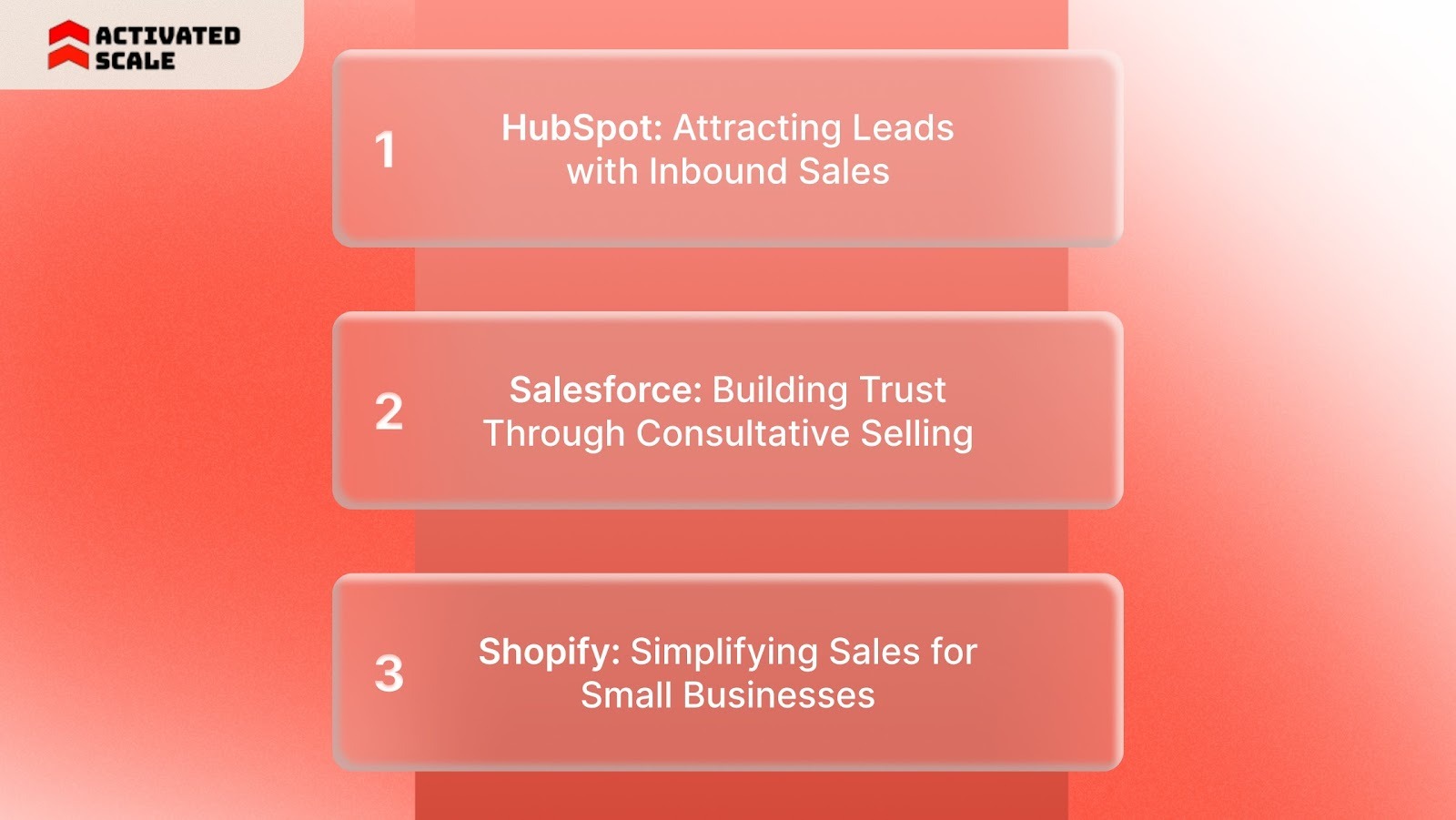
High-growth companies don’t just rely on luck, they execute well-defined sales strategies that scale revenue, win competitive deals, and accelerate market growth. The most effective selling techniques are those designed around a company’s product, target market, and buyer behavior, and then measured and refined for real-world results.
Here are examples from companies that mastered their sales approach:
1. HubSpot: Attracting Leads with Inbound Sales
Challenge: Early on, HubSpot needed to generate demand for its marketing automation platform without relying on cold outreach.
Strategy: HubSpot pioneered inbound selling techniques, using educational content, lead magnets, and SEO to attract prospects. The sales team engaged leads based on behavior, like downloading eBooks or visiting pricing pages, rather than cold calls.
Result:
- Reduced customer acquisition costs (CAC)
- Shortened the sales cycle
- Scaled globally into a SaaS leader
Key Takeaway: Let your product and content pull prospects in, don’t push them away with aggressive outreach.
2. Salesforce: Building Trust Through Consultative Selling
Challenge: Selling complex cloud-based CRM solutions to traditional enterprise buyers was a challenge in the early 2000s.
Strategy: Salesforce implemented consultative selling techniques, training reps to focus on solving business problems rather than pitching features. Sales reps asked deeper questions, tailored demos, and positioned Salesforce as a growth partner.
Result:
- Increased trust with enterprise clients
- Grew average deal size
- Secured leadership in the CRM market
Key Takeaway: For high-value deals, understanding client challenges and offering tailored solutions is more effective than pushing product features.
3. Shopify: Simplifying Sales for Small Businesses
Challenge: Shopify aimed to scale rapidly among small businesses with limited technical expertise.
Strategy: The company used transactional selling techniques, emphasizing simple pricing, self-serve onboarding, and minimal friction. Sales focused on support and upselling after customers were active rather than during the purchase.
Result:
- Scaled to millions of merchants globally
- Aligned sales process with buyer preferences
- Reduced barriers for first-time users
Key Takeaway: Match your sales approach to how your audience prefers to buy, simple, flexible, and low-pressure often wins.
These examples highlight a simple truth: successful sales strategies are grounded in buyer understanding, frictionless processes, and alignment with team goals.
How Startups Can Apply Proven Selling Techniques Without Hiring Full-Time
For early-stage and scaling startups, executing top-tier selling techniques, like consultative or inbound selling, can be challenging without experienced reps. That’s where Activated Scale bridges the gap.
Instead of navigating long hiring cycles, legal complexities, or overseas compliance, startups can access pre-vetted, U.S.-based sales professionals on a fractional or contract-to-hire basis:
- Fractional SDRs: Drive outbound prospecting and top-of-funnel activity, using best-practice techniques to book demos efficiently.
- Fractional AEs: Close deals with consultative selling approaches tailored to your buyers.
- Fractional VPs of Sales: Build and execute go-to-market strategies aligned with revenue goals.
This model allows startups to implement proven selling strategies immediately, test performance, and scale teams only when results justify it, without committing to full-time hires upfront.
Key Insight: Startups don’t have to compromise on execution, Activated Scale brings market-ready sales talent to deliver real-world, measurable results fast.
Conclusion
Mastering the right selling techniques is critical for startups and scaling teams looking to drive revenue fast. The strategies used by companies like HubSpot, Salesforce, and Shopify show that success comes from aligning your approach with your buyers, reducing friction, and consistently measuring outcomes.
For teams without the bandwidth or experience to execute these techniques in-house, Activated Scale provides a solution. By connecting startups, teams can implement proven sales strategies immediately, test performance, and scale hires only when results justify it.
Don’t let talent gaps slow your revenue growth. Explore how Activated Scale can bring expert sales professionals to your team, fast, flexible, and ready to deliver.
FAQs
1. What are the most effective selling techniques for startups?
Techniques like inbound selling, consultative selling, and transactional selling are proven to work, depending on your market and product.
2. Can startups implement these strategies without experienced sales hires?
Yes, by leveraging fractional sales professionals who are pre-vetted and trained in real-world sales techniques.
3. How do I choose the right selling technique for my business?
Start by understanding your buyer’s preferences, deal size, and sales cycle. Align the strategy to your team’s capacity to execute.
4. Are fractional sales teams effective for complex sales?
Absolutely. Fractional AEs and VPs of Sales can handle consultative and enterprise-level selling, building pipelines and closing deals efficiently.
5. How quickly can Activated Scale help a startup implement these techniques?
Startups can onboard fractional SDRs, AEs, or VPs within weeks, allowing teams to execute proven selling strategies without lengthy hiring delays.
The Ultimate Guide to Hiring a Salesperson!
Get the step-by-step guide to hiring, onboarding, and ensuring success!