_edi.png)

Outsourced SDR programs are more common than ever, but that popularity doesn’t automatically translate to success. In fact, a recent industry survey shows only 7% of companies with outsourced SDR teams say their programs really worked, and another 26% say they sort of worked, indicating that execution, not outsourcing itself, is the real challenge.
This stark reality highlights where most teams go wrong: they focus on activity rather than alignment, or they outsource without clear goals, onboarding, and optimization rhythm.
In 2026, the most effective companies treat outsourced SDRs as a strategic extension of their sales engine rather than a vendor. They define precise Ideal Customer Profiles (ICPs), choose partners who operate as collaborators, and build performance measurement into every step.
In a nutshell
- Outsourced SDR success depends more on structure and alignment than activity volume
- Clear goals and a well-defined ICP are non-negotiable before outreach begins
- The right SDR partner should act like an extension of your sales team, not a vendor
- Strong onboarding and communication prevent brand and messaging drift
- Human-led outreach supported by automation outperforms AI-only or manual-only approaches
- Continuous measurement and optimization are what turn outsourced SDRs into real pipeline
- Flexible models like contract-to-hire and fractional SDRs reduce risk before full commitment
What Is an SDR Company?
An SDR company provides sales development as a service. Instead of building and managing an in-house SDR team, you work with an external partner that specializes in outbound prospecting and early-stage lead qualification.
These companies handle top-of-funnel execution. Their SDRs focus on identifying target accounts, reaching out through channels like cold email, cold calling, and LinkedIn, and qualifying interest before handing opportunities to your closers. The output isn’t activity, it’s booked meetings or sales-qualified leads (SQLs).
The key difference from hiring internally is focus and speed. An SDR company brings trained reps, established outreach processes, and the tooling needed to run outbound efficiently from day one. Your internal sales team stays focused on discovery, demos, and closing, without being pulled into prospecting work.
In short: an outsourced SDR company fills your pipeline by owning prospecting and qualification, so revenue teams can concentrate on closing the right deals.
Must read: What is an SDR in Sales? Role, Skills, and Key Differences Explained
Why High-Growth Teams Rely on Outsourced SDRs?
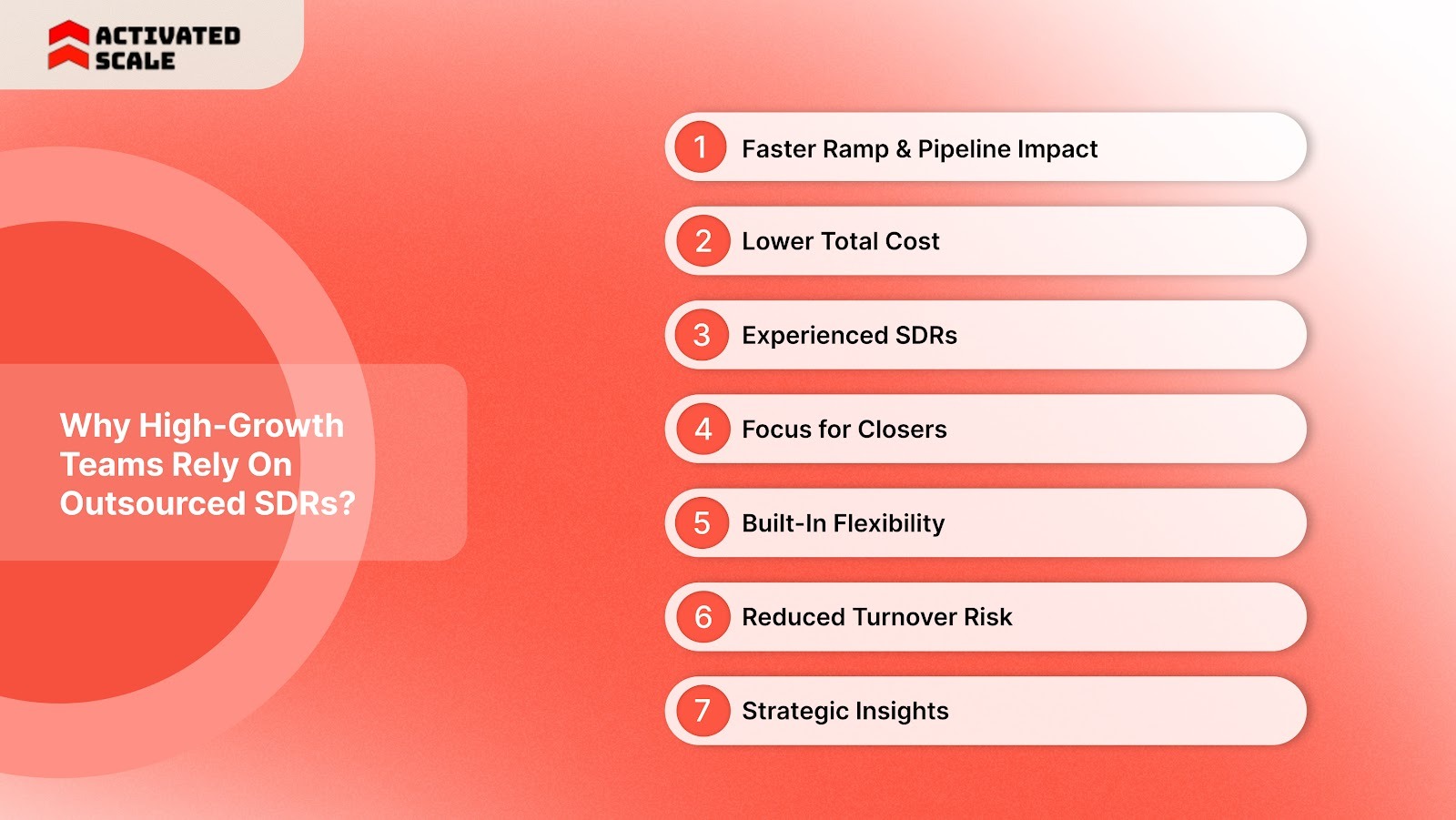
Companies don’t outsource SDRs because it’s trendy. They do it because building pipeline in-house is slow, expensive, and operationally fragile. Here’s why outsourced SDR models continue to win in 2026.
Faster Ramp and Immediate Pipeline Impact
Hiring an in-house SDR takes months. Between recruiting, onboarding, and training, most new reps don’t become fully productive for 3–4 months. Outsourced SDR teams skip that delay. They deploy reps who already know outbound motions, tools, and benchmarks, often producing meetings within weeks.
For companies entering new markets or trying to hit near-term revenue goals, speed matters more than ownership.
This is also why some teams avoid locking into full-time SDR hires too early. Platforms like Activated Scale follow a contract-to-hire approach, allowing companies to validate SDR performance before making a permanent commitment, reducing both ramp risk and long-term cost.
Lower Total Cost (Not Just Lower Salaries)
An in-house SDR isn’t just a salary. When you factor in recruiting, management, tech stack, benefits, and churn, the real annual cost often crosses $110K–$150K per rep.
Outsourced SDR programs remove fixed overhead:
- No recruiting or onboarding costs
- No long-term headcount commitment
- No tooling or enablement spending
That’s why many teams reduce total sales development costs by 30–50% through outsourcing, while maintaining or improving output.
Learn more about: Direct Sourcing Strategies to Recruit Top Talent
Access to Experienced SDRs and Proven Playbooks
Most internal SDR teams are junior by design. In fact, a large portion of SDRs at fast-growing companies have less than one year of experience.
Outsourced SDR firms operate differently. Their reps prospect full-time, across multiple accounts, with tested messaging and data-backed processes. You’re not betting on potential, you’re buying execution that’s already been pressure-tested.
Better Focus for Your Closers
Every cold call made by an AE is a missed opportunity to close revenue. Outsourcing the top of the funnel creates clear role separation:
- SDRs focus on prospecting and qualification
- AEs focus on discovery, demos, and closing
This specialization consistently improves overall sales productivity and deal velocity.
Built-In Flexibility
Sales demand changes. Headcount doesn’t.
Outsourced SDR teams allow you to:
- Scale outbound quickly for launches or new markets
- Pull back without layoffs or morale damage
- Adjust volume as strategy shifts
That flexibility is especially valuable for startups and teams operating with uncertainty.
This flexibility mirrors how some founders scale sales teams through models like Fractional Selling or Contract-to-Hire Sales Recruiting with Activated Scale, testing outbound capacity before scaling headcount.
Reduced Hiring and Turnover Risk
SDR turnover is high, often 30%+ annually. Every departure creates pipeline gaps and management overhead.
With outsourcing, staffing risk shifts away from you. The partner handles hiring, replacements, and ongoing training, ensuring continuity without internal disruption.
Strategic Insight, Not Just Meetings
Strong SDR partners don’t just book meetings, they surface patterns. They share:
- Which messages resonate
- Where objections stall conversations
- How ICP assumptions hold up in real outreach
This feedback loop helps companies refine positioning and outbound strategy faster than internal trial-and-error.
Best Practices for Outsourced SDR Success
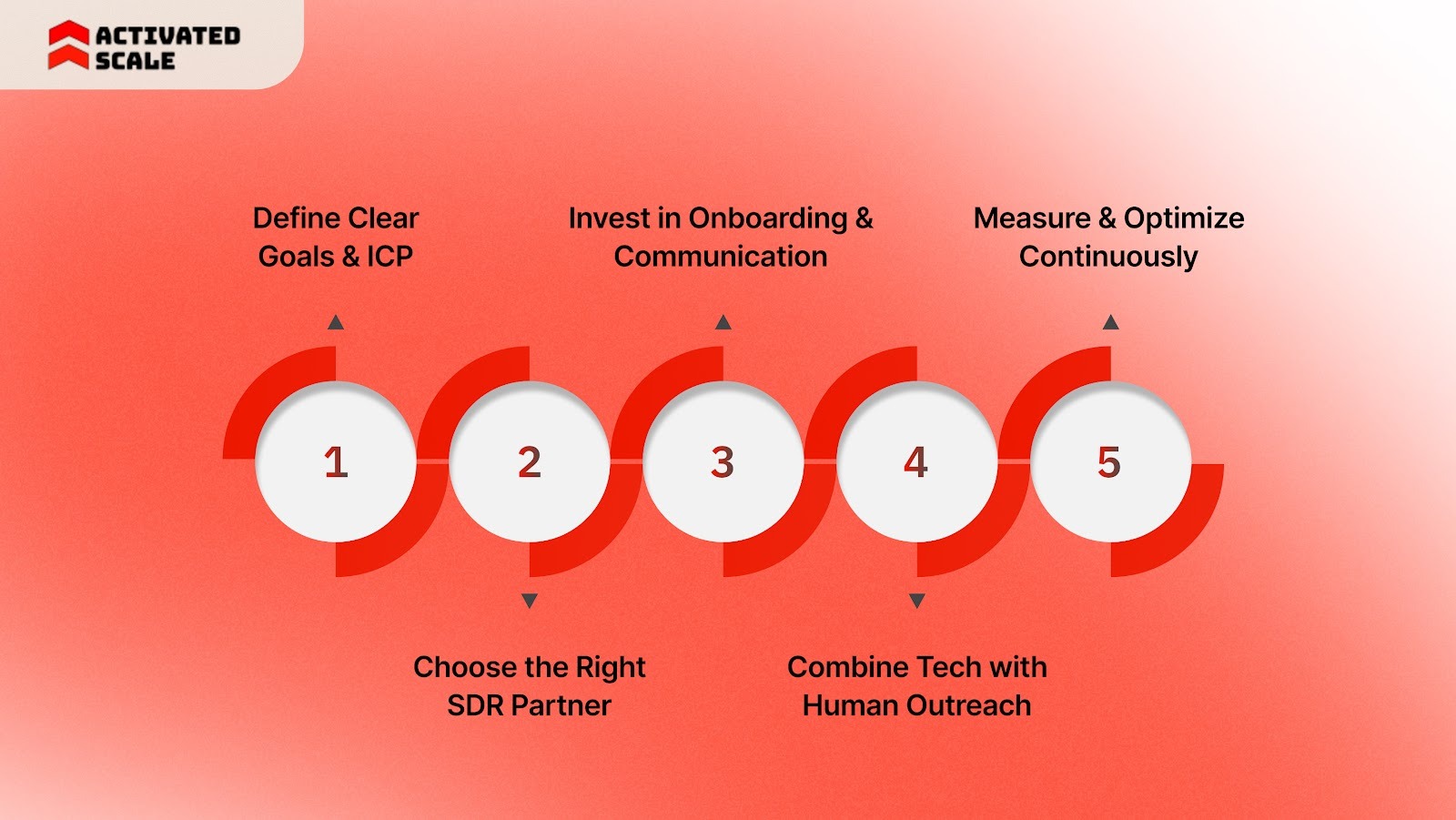
Outsourcing SDRs works when it’s treated like a revenue function, not a plug-and-play service. The most successful teams are intentional about alignment, partner selection, and ongoing optimization. These best practices help ensure your outsourced SDR program drives real pipeline, not just activity.
1. Define Clear Goals and a Precise ICP
Outsourced SDRs can only perform as well as the direction they’re given. Before any outreach begins, define what success looks like and who your SDRs should target.
A strong Ideal Customer Profile (ICP) should clearly outline:
- Company size and industry
- Target geography
- Buyer titles and decision-makers
- Core pain points and buying triggers
Equally important is goal clarity. Whether it’s meetings booked, SQLs generated, or pipeline created, measurable targets keep everyone aligned and prevent wasted outreach.
2. Choose an SDR Partner That Acts Like an Extension of Your Team
Not all SDR outsourcing partners operate the same way. The right partner understands your market, adapts messaging quickly, and communicates transparently.
During evaluation, look beyond promises and ask about:
- Outreach methodology and tooling
- Reporting cadence and performance visibility
- How reps are trained on your product and ICP
Some companies reduce risk here by using contract-to-hire or fractional SDR models, like those offered through Activated Scale, allowing them to validate execution before committing long term.
3. Invest in Structured Onboarding and Communication
Outsourced doesn’t mean hands-off. Strong onboarding sets the foundation for results.
This should include:
- Product and positioning deep dives
- Access to CRM, sales playbooks, and past learnings
- Clear points of contact and communication rhythms
When onboarding is rushed or vague, SDRs fill the gaps with assumptions. When it’s structured, they represent your brand accurately from day one.
4. Combine Technology with Human-Led Outreach
The best outsourced SDR programs don’t rely on automation alone. They use technology to enhance, not replace, human judgment.
AI and automation handle:
- Lead scoring and enrichment
- Outreach sequencing and timing
- Data hygiene and reporting
Human SDRs focus on personalization, relevance, and conversation quality. This balance increases response rates while keeping outreach authentic. Teams that get this right scale volume without sounding robotic.
5. Measure What Matters and Optimize Continuously
Outsourced SDR success isn’t static. It improves through iteration.
Track metrics that tie directly to revenue impact, such as:
- Lead-to-meeting conversion
- Meeting-to-opportunity rates
- Pipeline contribution and quality
Regular reviews help refine targeting, sharpen messaging, and eliminate wasted motion. Many high-performing teams treat their SDR partner as a strategic collaborator, similar to how they work with fractional sales leadership through Activated Scale, focused on learning and improvement, not just output.
Where Activated Scale Fits in an Outsourced SDR Strategy
Most outsourced SDR programs fail for the same reason: companies commit too early, without knowing what will actually work for their market. Scripts look good on paper, activity ramps up, but results lag because execution and fit were never validated.
This is where a more flexible outsourcing model makes a difference.
Activated Scale applies the same best practices discussed above, clear ICPs, fast ramp, experienced execution, but removes the biggest risk: long-term commitment before proof.
Teams use Activated Scale when they want to:
- Test outbound motion before scaling headcount through Contract-to-Hire Sales Recruiting
- Fill pipeline gaps quickly with experienced reps via Fractional Selling
- Add structure and accountability using Fractional Sales Leadership to guide messaging, metrics, and optimization
Instead of outsourcing blindly, founders get a way to validate SDR performance in real market conditions. If it works, they scale. If it doesn’t, they adjust, without sunk cost or stalled pipeline.
That flexibility is often what separates outsourced SDR programs that succeed from those that quietly get shut down.
Conclusion
Outsourced SDR success comes down to execution, not effort. Clear ICPs, strong onboarding, experienced reps, and continuous optimization matter far more than volume or tools.
The teams that win treat outsourced SDRs as part of their revenue system, not a side experiment. They validate what works, adjust quickly, and scale only after results show up.
That’s why many companies use flexible models like those offered by Activated Scale, to test SDR performance through contract-to-hire and fractional approaches before committing long term.
If you want predictable pipeline from outsourced SDRs, let’s connect and pressure-test your approach before costly mistakes set in.
FAQs
1. Are outsourced SDRs better than in-house SDRs?
Not always. Outsourced SDRs work best when speed, flexibility, or short-term pipeline impact is the priority. In-house teams make sense when long-term consistency and internal development are the goal.
2. How long does it take to see results from outsourced SDRs?
Well-run programs can produce meetings within weeks, but meaningful pipeline impact typically shows within 60–90 days once messaging and targeting are refined.
3. What metrics should I track for outsourced SDR success?
Focus on lead-to-meeting conversion, meeting quality, pipeline generated, and feedback from AEs, not just activity metrics like emails sent.
4. What’s the biggest mistake companies make with outsourced SDRs?
Treating the program as “set and forget.” Lack of onboarding, unclear ICPs, and no feedback loop are the most common failure points.
5. How can companies reduce risk when outsourcing SDRs?
By starting with flexible models, such as contract-to-hire or fractional SDRs, and validating performance before scaling headcount.
The Ultimate Guide to Hiring a Salesperson!
Get the step-by-step guide to hiring, onboarding, and ensuring success!