_edi.png)
.jpg)
Most companies are now chasing sharper insight rather than sheer volume. Hiring full-time experts for every niche problem is slow and expensive, so many teams have started borrowing that expertise instead of trying to build it from scratch.
That shift explains the surge in Knowledge Process Outsourcing (KPO). The market is projected to grow from around $125.85 billion in 2025 to nearly $399.67 billion by 2034, which shows how many businesses are turning to external specialists for high-impact work instead of attempting to build deep expertise internally.
This blog will cover what KPO is, why it matters, how it stacks up against BPO, its benefits and risks, and how companies are applying the same approach to new functions like sales, research, and revenue roles.
Quick Snapshot
- KPO focuses on expertise, not execution volume. It covers complex, analytical work that requires domain knowledge, not repetitive processes.
- The core value of KPO is access to specialists. Companies use it to tap into experienced professionals without hiring full-time.
- Control and clarity matter more than cost. Poorly defined ownership, weak communication, or data exposure quickly erase KPO’s benefits.
- KPO works best when the strategy stays in-house. External experts execute and advise; internal teams retain decision authority.
- The KPO model extends beyond traditional functions. The same logic applies to revenue roles when companies need proven expertise before committing long-term.
What Is Knowledge Process Outsourcing (KPO)?
Knowledge Process Outsourcing (KPO) is the outsourcing of high-skill, expertise-driven work that requires deep analysis, judgment, and domain knowledge.
KPO covers complex work performed by specialists, such as financial modeling, engineering analysis, medical research, or data science. These roles typically require advanced degrees and industry experience.
KPO allows companies to access this expertise without hiring full-time specialists. Instead of building and maintaining costly internal teams, businesses engage KPO providers for defined, high-impact work.
KPO services are delivered both onshore and offshore. Offshore models are common, but cost is secondary to accessing qualified experts who can deliver insight, not just output.
Key Areas and Services within Knowledge Process Outsourcing (KPO)
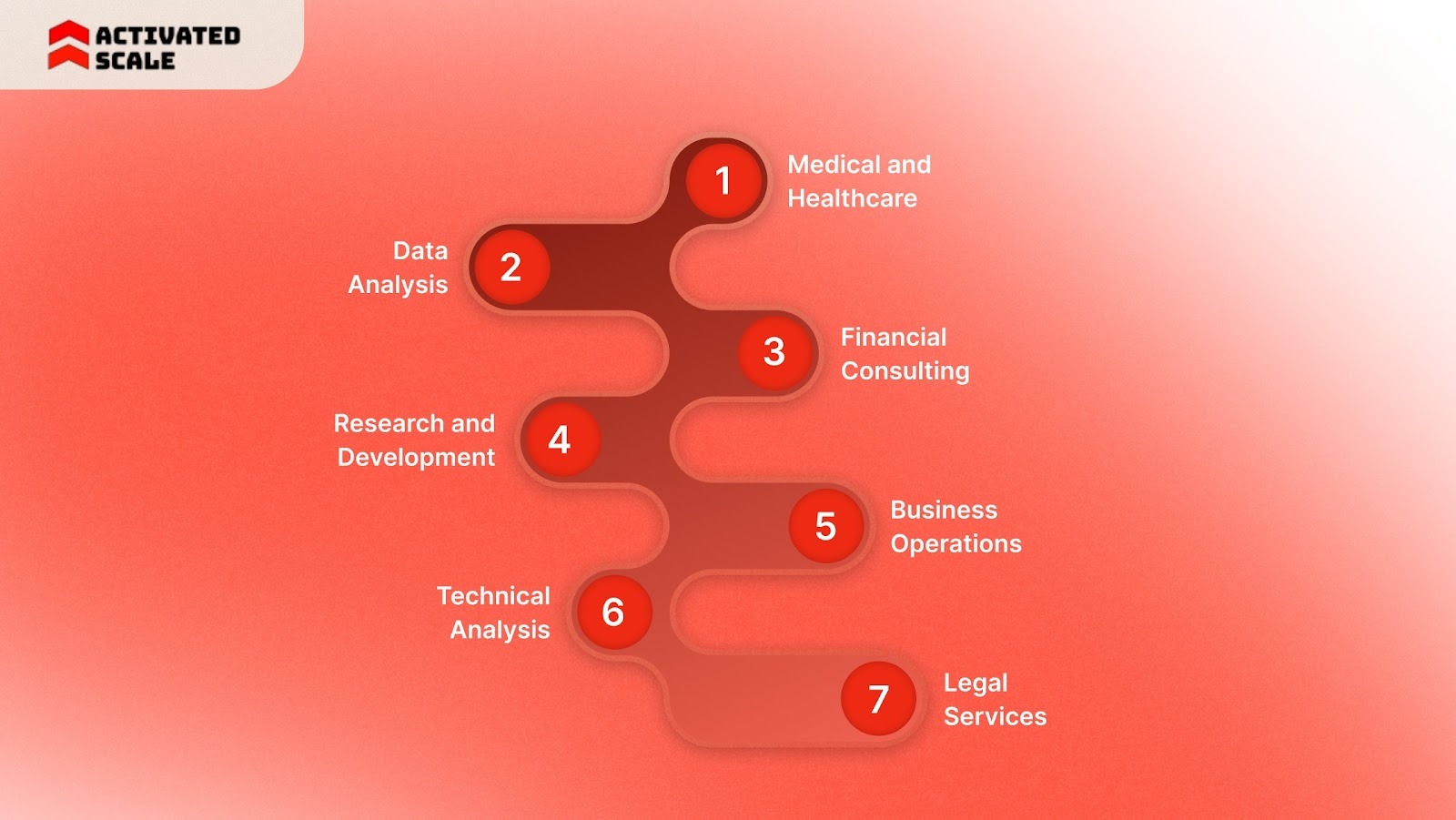
Knowledge Process Outsourcing focuses on functions where expert judgment and domain depth matter more than volume or repetition. KPO providers typically support work that influences decisions, strategy, or outcomes, not just execution.
Common KPO service areas include:
- Medical and Healthcare: Clinical research support, medical data analysis, healthcare analytics, and regulatory documentation are handled by trained specialists.
- Data Analysis: Advanced analytics, data modeling, forecasting, and interpretation used to guide business or operational decisions.
- Financial Consulting: Financial modeling, valuation, risk analysis, investment research, and compliance support performed by qualified finance professionals.
- Research and Development (R&D): Product research, technical documentation, innovation support, and feasibility studies that require subject-matter expertise.
- Business Operations: Market research, competitive analysis, process optimization, and strategic reporting tied directly to business performance.
- Technical Analysis: Engineering analysis, system modeling, and technical evaluations that require specialized training and experience.
- Legal Services: Legal research, contract analysis, intellectual property support, and compliance work conducted under defined legal frameworks.
These areas highlight what defines KPO: specialized knowledge applied to complex problems. Businesses use KPO not to replace core leadership, but to extend their capabilities in areas where hiring full-time experts would be slow, costly, or unnecessary.
How KPO Differs from Traditional BPO
The real difference between KPO and BPO isn’t outsourcing location or cost, it’s decision ownership.
- BPO focuses on execution. Tasks are repeatable, rule-based, and designed to scale through standardization.
- KPO focuses on judgment. The work requires interpretation, analysis, and subject-matter expertise that directly influences business decisions.
In short, BPO follows instructions. KPO helps define what the instructions should be.
KPO vs BPO: Key Differences
Companies typically use BPO to reduce operational load, while KPO is used to extend internal expertise without building permanent specialist teams.
This distinction mirrors how businesses now think about other functions. Instead of outsourcing everything generically, they choose specialized models for high-impact roles. It’s the same reason founders use platforms like Activated Scale, not to outsource sales blindly, but to access experienced, vetted talent where judgment and outcomes matter.
Benefits of Knowledge Process Outsourcing (KPO)
KPO improves decision quality where expertise, not execution, is the bottleneck. By bringing in specialists only when needed, companies reduce risk, avoid long-term hiring costs, and move faster on complex work that internal teams aren’t built to handle.
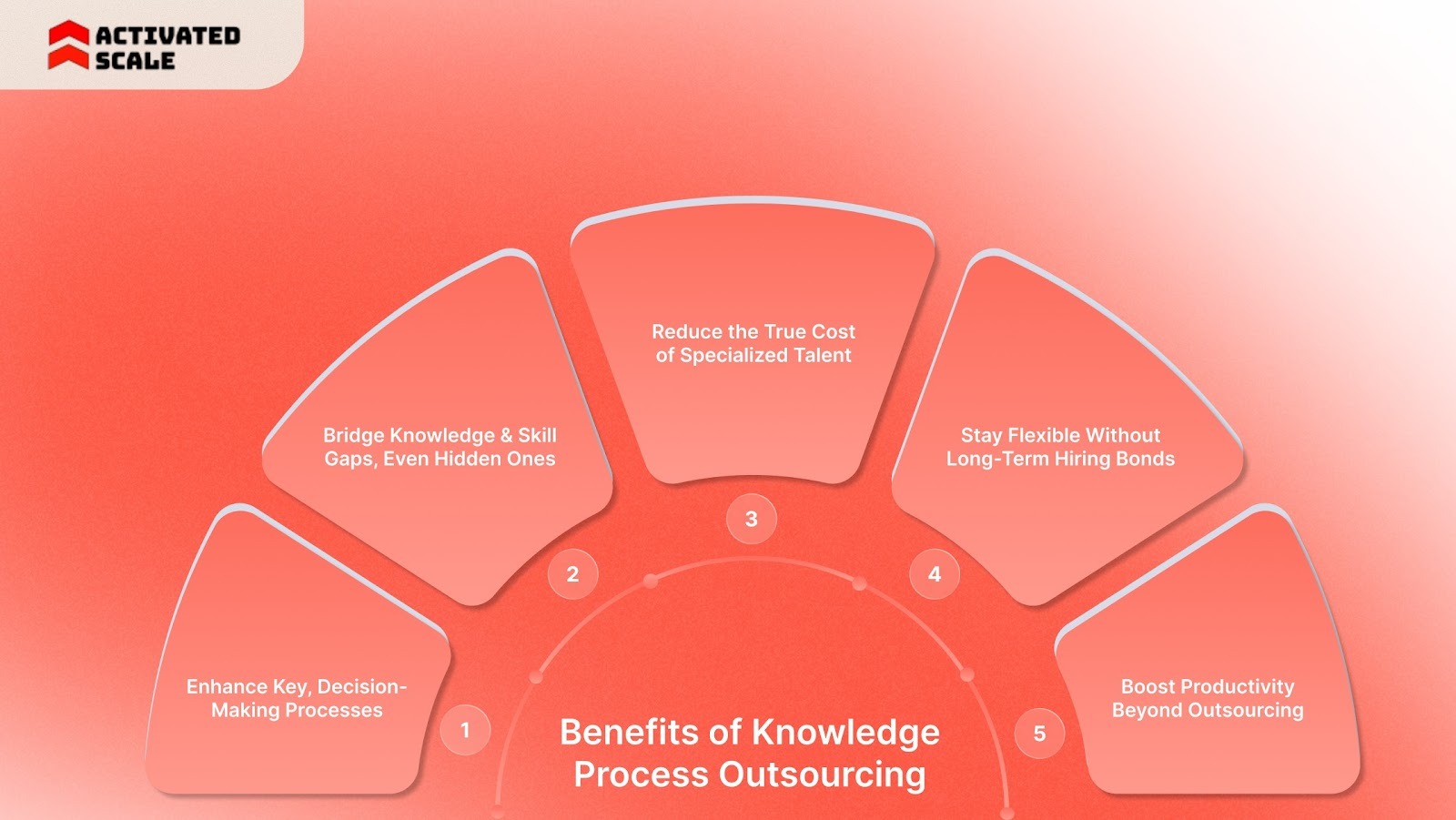
1. Improve Critical, Decision-Driven Processes
KPO is used where process quality directly affects outcomes. Instead of maintaining existing workflows, KPO specialists analyze what’s broken, inefficient, or outdated, and fix it.
Depending on the engagement, providers may:
- Deliver deep research and recommendations, or
- Take full ownership of redesigning and running the process
The result is better decisions, fewer blind spots, and higher-quality outputs in areas that directly influence strategy.
2. Fill Knowledge and Skill Gaps, Including the Hidden Ones
Companies often use KPO to uncover gaps they don’t yet see.
Providers evaluate internal capabilities, competitive positioning, and industry benchmarks to identify where expertise is missing. In many cases, they don’t just highlight the gap; they execute the work needed to close it.
This avoids trial-and-error hiring and prevents teams from operating with incomplete or outdated knowledge.
3. Reduce the True Cost of Specialized Talent
KPO delivers cost savings, but not by cutting corners.
Hiring senior specialists internally comes with long-term fixed costs: salaries, benefits, onboarding time, idle capacity, and retention risk. KPO converts those fixed costs into variable, outcome-based spend.
You pay for:
- Expertise when it’s needed
- Output, not headcount
- Defined scopes instead of open-ended roles
This is especially valuable for functions that require advanced skills intermittently rather than full-time.
4. Stay Flexible Without Long-Term Hiring Commitments
KPO allows companies to move faster than traditional hiring. Specialists can be onboarded quickly for specific initiatives, regulatory changes, or market shifts.
As priorities change, the engagement can scale up, taper down, or end, without restructuring teams or carrying unused capacity.
5. Increase Productivity Beyond the Outsourced Function
When high-complexity work moves outside, internal teams regain focus.
Time and budget previously absorbed by specialist tasks can be redirected toward execution, coordination, and growth. Over time, this improves productivity not just in the outsourced area, but across connected teams.
KPO providers are typically measured on improvement, not maintenance, pushing outcomes forward rather than preserving the status quo.
This model reflects how many companies now approach other high-impact roles: access expertise first, validate results, then decide what to internalize.
Also read: 8 Successful Strategies for Building Your Outsourcing Plan
Key Risks to Consider Before Adopting Knowledge Process Outsourcing
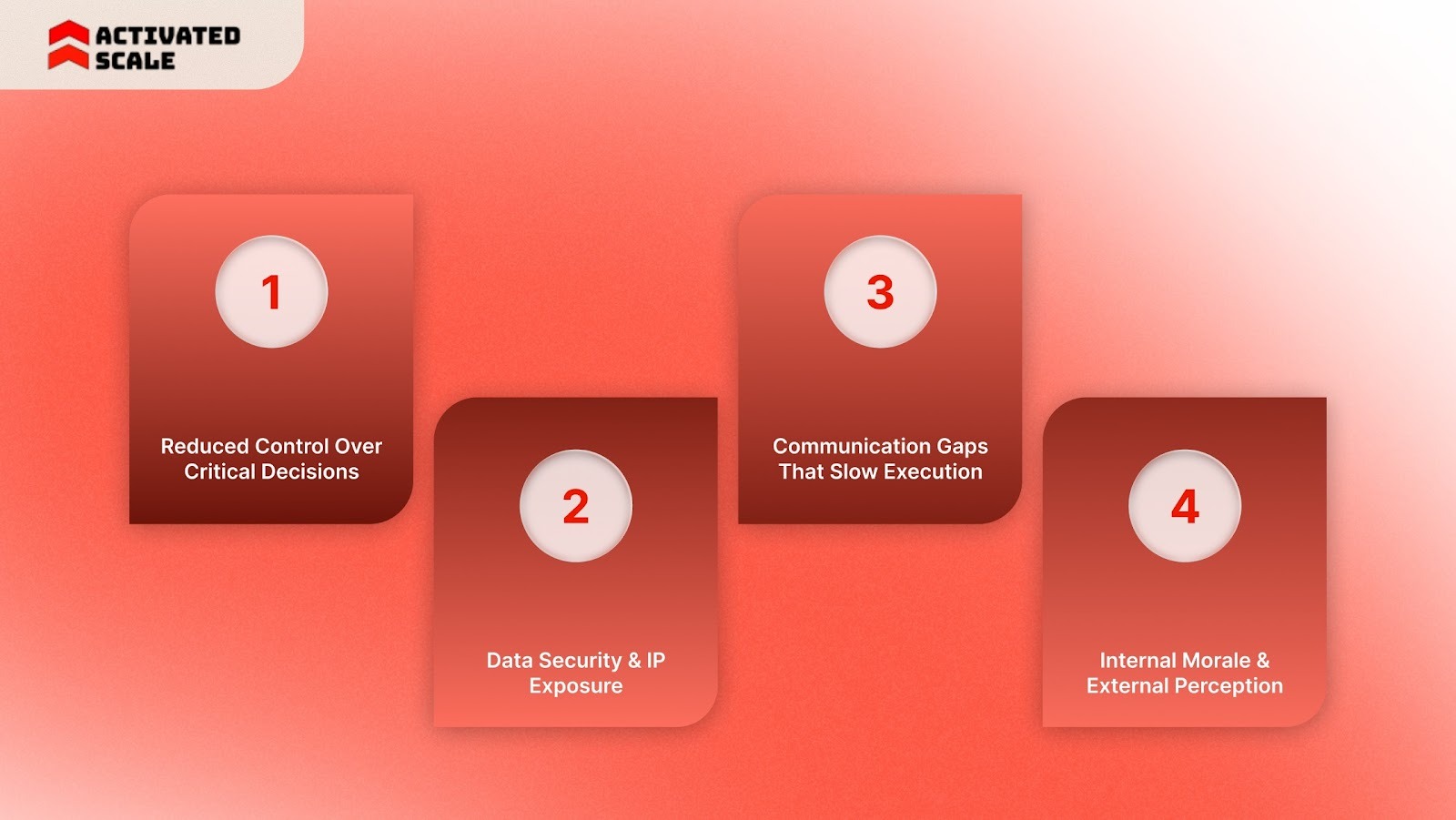
KPO can unlock high-value expertise, but the stakes are higher than with routine outsourcing. When you outsource judgment-driven work, small misalignments can have outsized consequences.
1. Reduced Control Over Critical Decisions
KPO often touches core analytical or strategic work. Once that responsibility moves outside the organization, direct oversight weakens.
The risk isn’t just loss of control, it’s loss of context. If internal teams lack the same depth of expertise, it becomes harder to evaluate whether recommendations are sound or merely plausible. This is why KPO works best when internal leaders can still challenge assumptions and validate outputs.
2. Data Security and IP Exposure
KPO requires sharing sensitive data, financial models, research inputs, proprietary methodologies, or customer information.
Every transfer introduces exposure. Weak security practices, inconsistent compliance standards, or poor access controls can lead to legal risk, IP leakage, or regulatory issues. These risks increase with offshore delivery if governance isn’t tightly defined.
Learn more about: How to Hire Offshore Employees: A Guide for 2026
3. Communication Gaps That Slow Execution
Because KPO work is complex, communication breakdowns are more damaging than in process-based outsourcing.
Common friction points include:
- Time zone misalignment that delays feedback
- Cultural or language differences that affect interpretation
- Vague reporting that obscures assumptions and limitations
If insights aren’t clearly explained or shared in context, internal teams struggle to act on them, undermining the value of the work itself.
4. Internal Morale and External Perception
Outsourcing high-skill work can unsettle internal teams if not positioned carefully. Employees may see KPO as a signal that expertise is being replaced rather than complemented.
Externally, decisions made by KPO partners can affect customer experience or brand perception. If outcomes change without clear communication, even positive shifts can create confusion or distrust.
These risks echo a broader pattern in modern outsourcing: the higher the impact of the work, the more important validation and phased commitment become.
That’s why many companies now prefer models that allow performance to be proven before full handoff, whether in analytics, leadership, or revenue roles. For example, Activated Scale applies this principle in sales hiring through contract-to-hire and fractional models, letting teams validate expertise in real conditions before committing long-term.
KPO delivers value when governance, security, and communication are treated as first-order concerns, not afterthoughts. Without that structure, the same expertise you outsource for advantage can become a source of risk.
What KPO Teaches Us About Outsourcing High-Impact Work
Knowledge Process Outsourcing works best when companies outsource expertise-heavy execution without giving up strategic control. The value isn’t in cost savings alone; it’s in accessing specialists who can deliver judgment, insight, and outcomes that internal teams may not be staffed to handle full-time.
The same principle applies outside traditional KPO functions.
In revenue teams, founders face a similar challenge: they need experienced operators, SDRs, AEs, or sales leaders who can influence outcomes quickly, but hiring full-time too early adds risk. That’s where Activated Scale aligns closely with the KPO mindset.
Activated Scale applies a specialized outsourcing model to sales roles by:
- Matching companies with experienced, U.S.-based sales professionals who have already sold to similar buyers
- Allowing teams to engage talent fractionally or on a contract-to-hire basis, rather than committing upfront
- Keeping strategy and ownership in-house while outsourcing execution to vetted experts
For companies evaluating KPO, or any form of knowledge-intensive outsourcing, the takeaway is consistent. The best partners don’t replace internal leadership. They reduce risk by letting expertise earn its place through results.
Conclusion
KPO works when companies outsource expertise-driven execution, not ownership. The value comes from accessing experienced professionals who can deliver insight and outcomes without locking into full-time hires too early.
When scope, accountability, and decision rights are clear, KPO helps businesses move faster and smarter. When they don’t, the risks outweigh the gains.
This same logic increasingly applies beyond traditional KPO roles. Teams now test high-impact expertise before committing long-term.
If you’re evaluating how to bring in senior expertise without overcommitting, explore how Activated Scale works.
FAQs
1. How is KPO different from BPO in practice?
BPO handles process execution (payroll, data entry, customer support). KPO handles decision-influencing work like forecasting, valuation, research, and strategic analysis.
2. What types of roles are commonly outsourced through KPO?
Financial analysts, market researchers, data scientists, engineers, legal analysts, and healthcare researchers' roles where output quality depends on expertise, not volume.
3. When does KPO fail?
KPO breaks down when companies:
- Outsource unclear or poorly scoped work
- Lose ownership of decisions
- Treat expertise as interchangeable labor
4. Is offshore KPO always better for cost?
Not always. Offshore KPO lowers cost, but communication gaps, time zones, and data sensitivity can outweigh savings for high-stakes work.
5. Can KPO apply outside finance or research?
Yes. The KPO model increasingly applies to revenue and leadership roles, where companies want experienced operators without committing to permanent headcount upfront.
The Ultimate Guide to Hiring a Salesperson!
Get the step-by-step guide to hiring, onboarding, and ensuring success!