_edi.png)
Remember the last onboarding chaos on a new sales hire’s first day? You thought that would be just a quiet environment and a laptop. However, the first meet-up went silent, no one engaged, and the talented reps you hired are now feeling discouraged.
A proper onboarding process received the highest satisfaction score, with 43% of employees reporting that it surpassed their expectations. Now, as a sales leader, how do you define "proper" in your organization?
In this blog, we will tackle the virtual onboarding challenge head-on. You will also learn a practical framework that requires a process to build confident, capable sellers from day one, anywhere.
TL;DR
- 43% of employees report that a proper onboarding process surpassed their expectations, moving it beyond a simple checklist to a critical satisfaction driver.
- Employees who go through a great onboarding process are 69% more likely to stay with the company for three years or more.
- 60% of employees struggle to get the details and answers they need from coworkers.
- The strategic integration of new hires should be treated as a complete 90-day program, structured around a 30/60/90-day plan to guide them from learning to full autonomy.
- Success hinges on a repeatable process that includes a detailed 5-step playbook and a sample 3-day schedule to execute the strategy effectively.
What Exactly is Virtual Onboarding?
You might think you know what it is. However, your current definition could be limiting your results. Most sales leaders see virtual onboarding as a logistical checklist.
They send a laptop, set up accounts, and run training videos. This is a costly misunderstanding. In 2026, virtual onboarding is the strategic, digital integration of new sales hires.
It connects them to your people, process, and purpose before day one through their first 90 days. The goal is a confident, productive seller who feels part of the team. They must master tools and understand customer pain points.
A strong virtual onboarding program has four pillars:
- Compliance (tools and rules)
- Clarification (goals and process)
- Culture (values and team)
- Connection (relationships and trust).
Now, you may know the initial benefits of providing a smooth onboarding training. And till 2025, these were limited. But this year? The whole scenario has changed.
4 Advantages of a Proper Virtual Onboarding
A strong onboarding experience can boost retention, with 69% of new hires staying for three years or longer. This means your rep hits quota faster. They also stay longer. But is that all? Actually no.
Here's more of what you can expect:
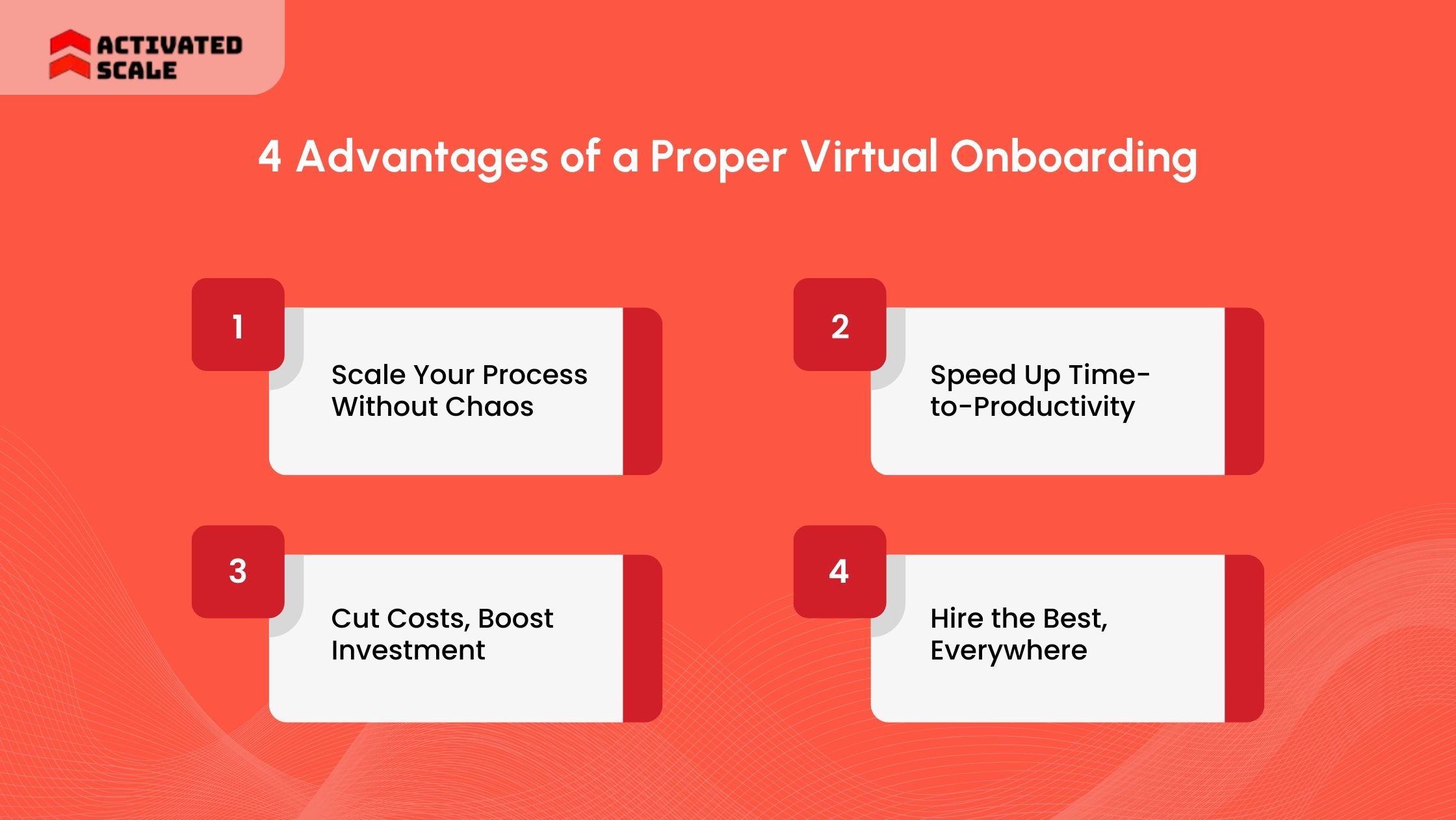
- Scale Your Process Without Chaos
- Onboard reps in multiple cities next week. A standardized digital process makes this simple. Every hire gets the same core training. Your sales message stays unified and strong.
- Speed Up Time-to-Productivity
- New hires complete tasks before day one. They handle paperwork and basic training early. Day one becomes about strategy and connection. A faster ramp means faster first deals.
- Cut Costs, Boost Investment
- Eliminate costs for office space and printed materials. Save on travel for trainers. Redirect these savings. Invest in better sales tools and prospect data. Put money into revenue-generating activities.
- Hire the Best, Everywhere
- Location no longer limits your search. Find the perfect candidate in any city. Build a team with diverse insights and market knowledge.
Now it's time to get a "how-to-guide," so you're prepared before your next onboarding session hits your calendar.
Also Read: A Guide to Hiring and Onboarding Top Outside Sales Representatives
The Complete 5-Step Virtual Onboarding Playbook
Execution separates top teams from the rest. A clear playbook makes it happen. This is your step-by-step guide. It turns strategy into daily action.
Follow these five steps to build a program that creates confident, productive sellers:

Step 1: Secure the Win with Strategic Pre-Boarding
The game starts at the signed offer. Do not wait for day one. Send the welcome package immediately. Include the laptop and team swag. 60% of employees report regularly having trouble getting the details and answers they need from their coworkers.
So, assign a peer "buddy" right away. This buddy answers informal questions. Eliminate first-day anxiety. Build excitement from the first touchpoint.
Step 2: Build the Foundation in Week One
Structure creates confidence. Use the first week to set a rhythm. Balance training with connection. Schedule core sessions on your Customer Relationship Management (CRM) and sales methodology.
Keep these sessions short and interactive. Pair each training block with a social introduction. Arrange 15-minute chats with team members. Give a simple task to complete by Friday.
A Fractional VP of Sales can architect your entire go-to-market engine. So, hire a talented one from Activated Scale's Fractional Sales Leadership service who can design the sales playbook and build the onboarding system.
Step 3: Master the First Impression on Day One
The first days define a new rep's experience. Avoid information overload. Focus on human connection. Start with a live welcome from the team. Make it casual and social.
Set clear expectations for the week. Make them feel welcomed, not just processed.
1. Integrate into the Sales Machine (First 30 Days)
Move from learning to contributing. The manager's weekly one-on-one is critical. Connect them with marketing and product leads. Apply their learning to real work immediately.
2. Develop Pipeline Ownership (Days 31-60)
Shift from support to autonomy. Increase responsibility deliberately. Let the rep lead part of a sales cycle. Encourage them to build their own outreach sequences.
Review pipeline health together weekly. Focus on the quality of their engagements, not just activity. Their confidence will grow with ownership.
3. Drive for Full Autonomy (Days 61-90)
The goal is a self-sufficient seller. They should own their process by this phase. Let them run deals with minimal oversight. Encourage them to present a deal story to the team.
Conduct a formal 90-day performance review. Celebrate their achievements. Set clear goals for the next quarter. They are now a core part of your sales engine.
Step 4: Systematize Knowledge and Resources
Do not let tribal knowledge slow your team. Create a single source of truth. Build a central sales hub. Make onboarding materials easily accessible.
- Communication & Connection Hub: Video conferencing (Zoom, Microsoft Teams) for daily meetings and welcome sessions; instant messaging (Slack, Teams) for quick questions and informal chats.
- HR & Documentation Platform: A dedicated onboarding or HRIS platform (like BambooHR, Workday, or Zoho People) to automate paperwork, e-signatures, and task tracking.
- Learning & Knowledge Management: A Learning Management System (LMS) or a shared digital hub (like Notion, Confluence, or a SharePoint site) for centralized access to training videos, policies, and culture documents.
- Project & Task Management: Tools like Asana, Trello, or Monday.com to give the new hire visibility into team goals and to manage their own onboarding task list.
Your playbook is ready, but your team isn't at full strength. Activated Scale's Fractional Selling service provides immediate access to experienced Sales Development Representatives (SDRs).
Step 5: Measure, Refine, and Scale the Program
Measure your process's effectiveness with data. Track key metrics like ramp time and first-deal close rate. Distribute anonymous surveys at 30 and 90 days.
Review this data quarterly with your leadership team. Identify one improvement to implement for the next hiring cohort. A living playbook scales with your team.
Your 5-step playbook provides the strategy. Now, what does it look like in practice? Strategy fails without execution.
Also Read: Hire SDR: How to Find the Best Sales Development Representatives
A Sample Virtual Onboarding Schedule Checklist
This sample 3-day schedule shows how to allocate time for a new Sales Development Representative (SDR) or Account Executive (AE). Adapt the specific meetings and topics for your team. Ensure every hour drives your new hire toward their first deal.
Day 1: Welcome & Foundation
- 9:00 - 9:45 AM: IT Setup & Systems Briefing (CRM, email, tools access).
- 10:00 - 10:45 AM: Team Welcome Video Call (Introductions & team win sharing).
- 11:00 AM - 12:00 PM: 1:1 with Sales Manager (Quota, territory, 30/60/90 plan).
- 12:00 - 1:00 PM: Virtual Team Lunch (Informal chat with the squad).
- 1:00 - 2:30 PM: Sales Culture & Customer Story Deep Dive (Interactive session).
- 2:30 - 4:00 PM: Review Active Pipeline & Key Accounts (Asynchronous exploration).
- 4:00 - 4:30 PM: End-of-Day Check-in with Buddy/Peer Mentor.
Day 2: Training
- 9:00 - 10:30 AM: Product & Ideal Customer Profile (ICP) Understanding (Meeting with Product/Marketing lead).
- 10:30 - 12:00 PM: Sales Tech Stack Training (CRM, prospecting tools, sales enablement).
- 1:00 - 2:00 PM: Intro to Sales Ops & Support (Key cross-functional partners).
- 2:00 - 3:30 PM: First Prospecting Task Workshop (Building a target list).
- 3:30 - 5:00 PM: Asynchronous Work on First Task.
Day 3: Connection & Forward Momentum
- 9:00 - 10:00 AM: Company-Wide All-Hands Meeting.
- 10:15 - 11:15 AM: 1:1 with Mentor/Buddy on Early Questions.
- 11:30 AM - 12:30 PM: "Meet the Sales Leadership" Q&A Session.
- 1:30 - 2:30 PM: Co-working Session on First Outreach Drafts with a Peer.
- 2:30 - 3:30 PM: Formal Review of 30/60/90-Day Plan & Week 1 Goals with Manager.
- 3:30 - 4:30 PM: Week 1 Wrap-Up & Feedback Session.
- 4:30 - 5:00 PM: Independent Planning for Week 2 Outreach.
Virtual onboarding introduces unique friction. These challenges can stall a new hire's momentum just as they're starting to build it. If ignored, they lead to disengaged reps, slow ramps, and costly turnover.
Read Also: 9 Proven Ways to Scale Your Business Faster and Smarter
The Real Hurdles of Virtual Onboarding (And How to Clear Them)
Accessibility does not equal adoption. For example, during onboarding, every task should start in the hub. Instead of sending a PDF schedule, link to the live page in your wiki.
If a new hire asks a question, answer by sending a direct link to the relevant playbook section. This is just one precautionary step. Here's a list of pitfalls one might face:
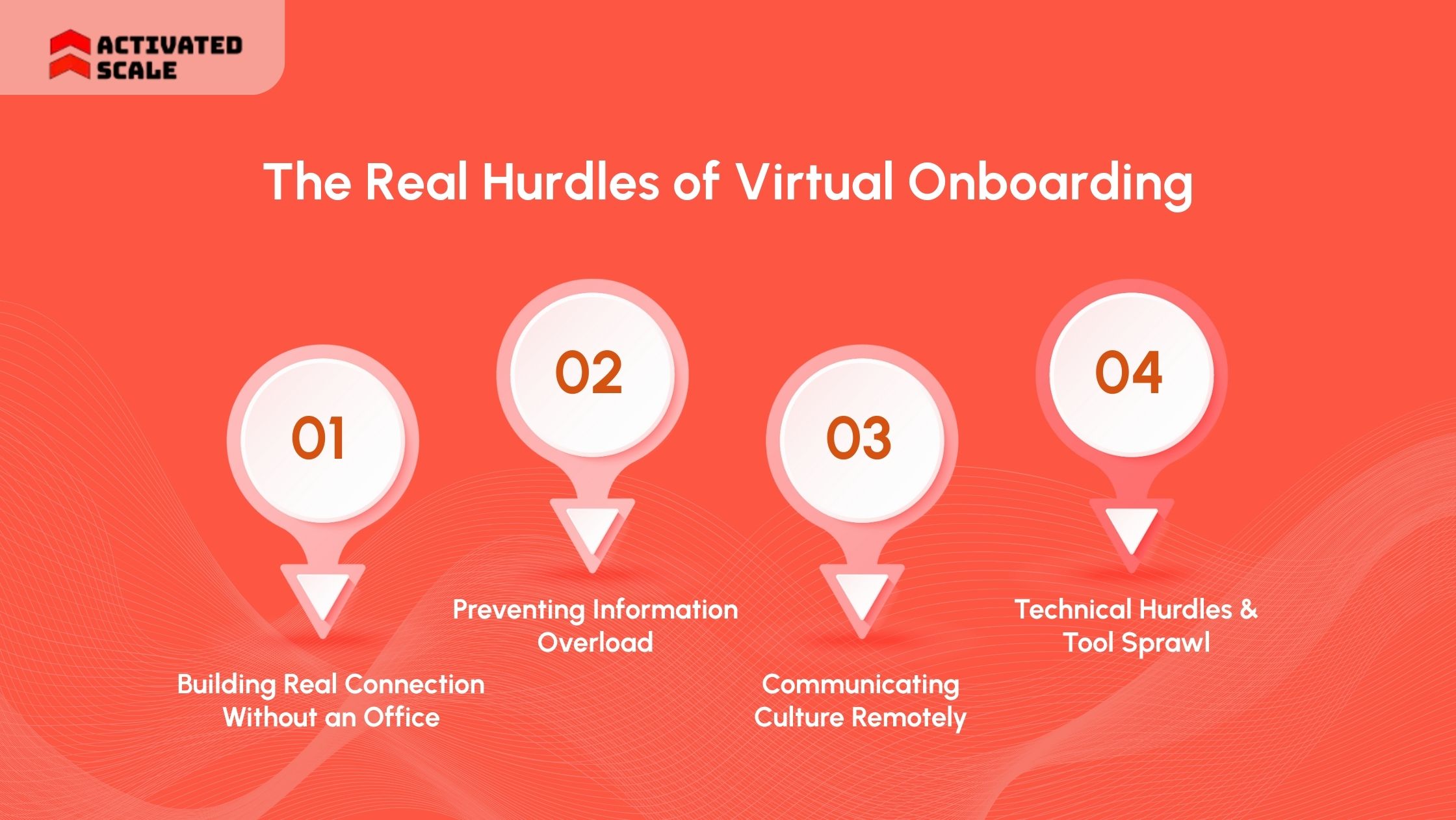
Challenge 1: Building Real Connection Without an Office
The Problem: Organic relationship-building disappears. New hires miss the casual coffee chats and overheard sales calls. This isolation kills morale and slows the transfer of tribal knowledge.
The Sales Leader's Fix: Schedule two non-work virtual coffees for them in week one. Mandate that their peer buddy hosts a 15-minute daily sync for the first five days.
Challenge 2: Preventing Information Overload
The Problem: Day one often becomes a "data dump." You send 50 links to portals, decks, and tools. The new rep is overwhelmed. Critical information gets lost.
The Sales Leader's Fix: The pre-boarding packet covers only HR and setup. Day one focuses on culture and people. Assign one key resource per day for the first week.
Challenge 3: Communicating Culture Remotely
The Problem: Culture often permeates an office through osmosis. Remotely, it becomes invisible. New hires don't understand how decisions are made or what true success looks like.
The Sales Leader's Fix: Make culture explicit. Share recorded "win wires" where top reps break down a deal. Include a "culture document" in onboarding that outlines how feedback is given and how deals are celebrated.
Challenge 4: Technical Hurdles & Tool Sprawl
The Problem: Login issues, software conflicts, and a confusing array of 10 different tools cripple a new rep's first day. They spend hours with IT instead of with the team.
The Sales Leader's Fix: Own the tech setup. IT should do a full system test with the new hire before day one. Create a single "Sales Tech Dashboard" (using a tool like Notion) with links to every essential platform. Simplify the stack to reduce friction.
Need the strategy built with Activated Scale? A Fractional Sales Rep from our Contract-to-hire Sales Recruiting service can help you create consistent top performers.
Conclusion
A world-class virtual onboarding program is your ultimate sales enablement tool. It directly protects your hiring investment. It accelerates revenue from new hires.
This guide provided the strategy, the 5-step playbook, the schedule, and solutions to key hurdles. You now have a complete framework to implement.
The final step is execution. Building and managing this system demands significant focus and expertise in a scaling sales organization.
Activated Scale provides pre-vetted, experienced SDRs and AEs directly into your team. They help you to generate a pipeline and close deals immediately.
Let's build a team that scales. Talk to our team at Activated Scale about your hiring goals.
FAQs
1. How long should a virtual onboarding program last?
A full virtual onboarding program should last 90 days. The first week is for orientation and connection. The first 30 days focus on training and initial contribution.
The final 60 days are for developing autonomy and mastery. The 90-day framework aligns with most sales ramp time goals and probationary periods.
2. How do I onboard a new sales hire who is in a different time zone?
Core hours are essential. Establish a 3-4 hour daily overlap for live meetings and collaboration. Record all essential training sessions for asynchronous viewing.
Pair the new hire with a "buddy" in a similar or adjacent time zone for easier communication.
3. What's the single most important metric to track onboarding success?
Time-to-Productivity (TTP) is the most critical metric. For sales, define this as "days to first qualified meeting" for an SDR or "days to first closed deal" for an AE. This metric directly ties onboarding efficiency to revenue impact.
4. Who should own the virtual onboarding process?
Ultimate ownership rests with the Head of Sales or Sales Operations. HR is a partner for compliance and culture, but sales leadership owns the ramp-to-revenue outcome.
Clear ownership prevents the process from becoming a low-priority, administrative task and ensures it is treated as a core sales function.
The Ultimate Guide to Hiring a Salesperson!
Get the step-by-step guide to hiring, onboarding, and ensuring success!