_edi.png)
Scaling a SaaS startup demands predictable revenue, but building a high-performing sales team in the early stages is expensive, slow, and often high-risk. Hiring experienced SDRs, AEs, or sales leaders can take months, and a single mis-hire can drain valuable capital and stall pipeline momentum.
That’s why many growing SaaS companies are now turning to strategic sales outsourcing as a flexible, lower-risk way to access proven talent and accelerate execution. But outsourcing isn’t plug-and-play; it requires structured planning, clear KPIs, and the right operational framework.
This blog will walk you through the essential strategies that ensure your sales outsourcing plan is structured, scalable, and ROI-driven.
Key Takeaways
- Audit Before You Outsource: The first critical step is using an internal audit to pinpoint the precise sales gap (e.g., top-of-funnel SDR work, GTM strategy, or closing AE capacity) before seeking external talent.
- Prioritize Fractional Talent: For early-stage and scale-up companies, leveraging fractional sales talent (SDRs/AEs/VPs part-time) provides maximum impact and expertise while drastically reducing the time-to-ramp and financial risk.
- Align Location and Expertise: Ensure your outsourcing partner provides U.S.-based, vetted professionals who understand the nuances of the American B2B buying landscape, avoiding the pitfalls of generalized global outsourcing.
- Establish the Playbook First: Never outsource without a foundational sales playbook, including clear ICPs, talk tracks, and tech stack requirements. Clear structure is the foundation of successful external execution.
8 Successful Strategies for Building Your Outsourcing Plan
Before you delegate any part of your sales function, you need a structured roadmap that aligns outsourced talent with your revenue goals. A successful outsourcing plan is not just about reducing cost; it’s about increasing precision, accelerating execution, and eliminating guesswork from your GTM motion.
The following strategies will help you build an outsourcing framework that is scalable, predictable, and ROI-driven.
1. Clearly Define Your Goals and Expectations
The failure of most outsourcing arrangements starts with vague objectives. Before you look outside your organization, you must define the precise revenue gap you are trying to fill.
Pinpointing Your Sales Bottleneck
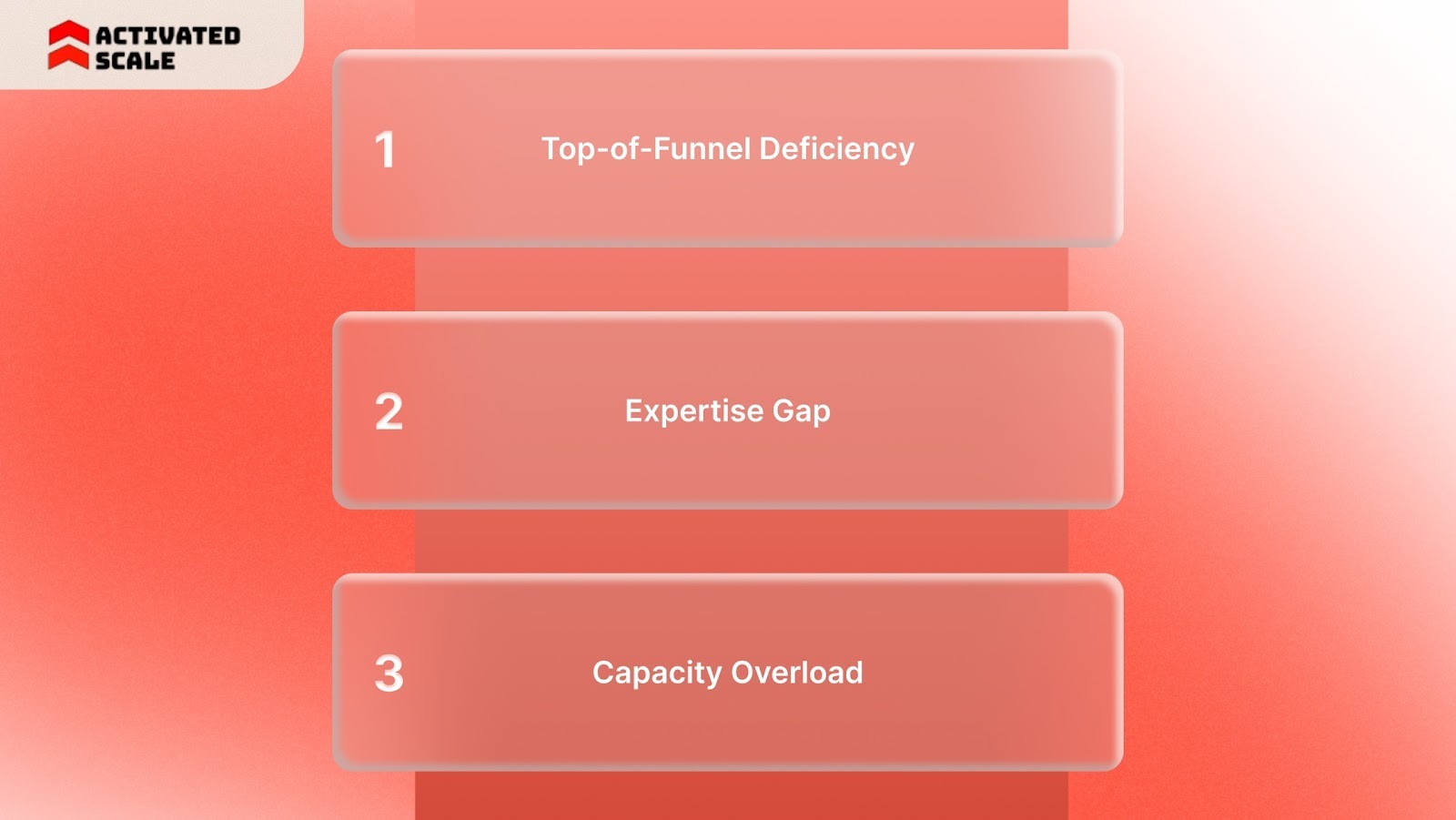
Before considering any external partnership, you must accurately diagnose where your internal sales process is failing or stalling.
- Top-of-Funnel Deficiency: Are your internal reps too busy closing deals to focus on dedicated, high-volume prospecting (SDR function)?
- Expertise Gap: Do you lack the leadership to design a GTM strategy, build a playbook, or set up the right tech stack (Fractional VP of Sales function)?
- Capacity Overload: Do you have too many qualified leads for your existing Account Executives (AEs) to handle, slowing down deal velocity?
By clearly identifying the constraint, whether it’s pipeline generation, strategy development, or deal closure, you can define the specific, non-negotiable outcomes you expect from an external partner. Your goal should be quantifiable: "Increase qualified demo bookings by 20% in the next quarter," not "Get more leads."
Actionable Steps for Goal Setting
- Audit Your Metrics: Use your CRM data to isolate the specific stage of the funnel where performance drops (e.g., Conversion rate from Lead to Qualified Opportunity is 5%, which is too low).
- Define Success KPIs: For a prospecting function, the KPI might be SQLs (Sales Qualified Leads) booked. For a closing function, it's ARR (Annual Recurring Revenue) closed. For leadership, it’s a fully documented sales playbook.
2. Choosing the Right Outsourcing Model: Focus on Fractional Expertise
For startups and scale-ups, committing to a multi-year, large-scale BPO (Business Process Outsourcing) is rarely the answer. The best strategies for outsourcing prioritize flexibility, expertise, and a quick, measurable ramp-up.
The Power of Fractional Selling
Fractional sales engagement provides the highest level of expertise with the lowest commitment risk, perfectly aligning with a startup’s budget cycles and growth uncertainties.
Fractional engagement allows you to access a US-based SDR with 5 years of B2B SaaS experience, or a Fractional VP of Sales who has already scaled a company similar to yours, without the $200k+ annual salary commitment. You pay for the expertise and the output, not the headcount.
This flexibility is precisely where Activated Scale excels. We help you skip the hiring maze by connecting you directly to pre-vetted, experienced, US-based sales professionals, available for fractional or contract-to-hire roles.
3. Scoping for Success: Defining the Role and Boundaries
When outsourcing sales, clarity is your shield against misalignment. A vague scope leads to missed expectations and wasted budget. The most effective strategies for outsourcing involve meticulous documentation of the exact deliverables and the technology stack.
What to Document in Your Sales Playbook
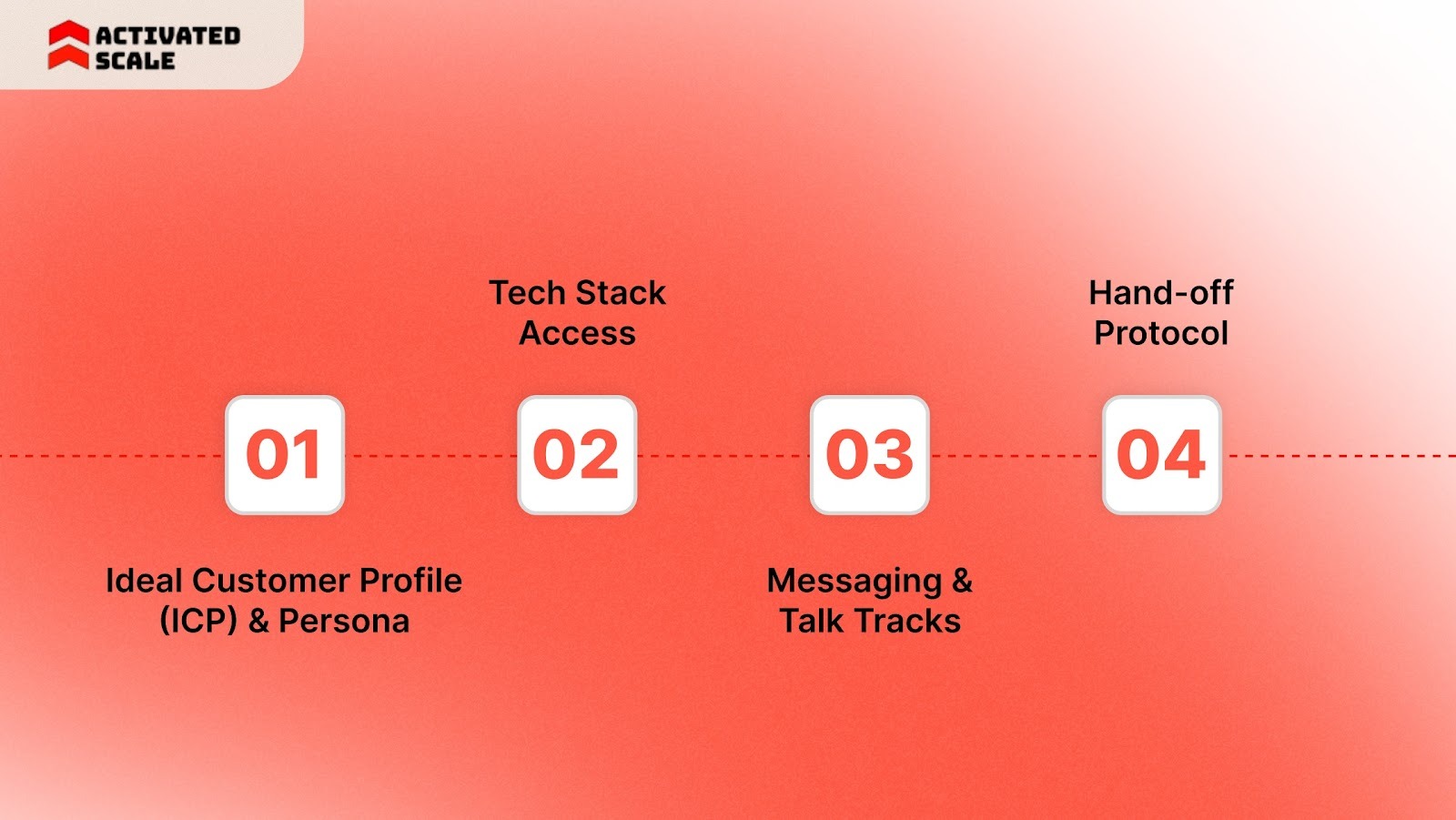
Your external partner, whether it's a Fractional SDR or an Account Executive, must operate within your process, not their own generic one.
- Ideal Customer Profile (ICP) & Persona: Clearly define who they call, who they email, and the specific pain points they should reference. Generic prospecting will waste time.
- Tech Stack Access: List every tool they must use (CRM, Sales Engagement platform, data provider). Ensure all licenses are secured and onboarding to these systems is documented.
- Messaging & Talk Tracks: Provide approved email templates, LinkedIn scripts, and talk tracks for cold calls. Do not leave the messaging up to the external partner; they execute your GTM strategy.
- Hand-off Protocol: Define the exact criteria for a qualified lead and the mandatory steps for handing that lead off to your internal team (e.g., "Must log lead in Salesforce, send a pre-meeting summary email, and schedule the next meeting for the internal AE").
By providing this detail, you treat your outsourced sales function as an extension of your internal team, guaranteeing consistency and quality in every prospect interaction.
4. Selecting Your Partner: Vetting for Expertise and Fit
The quality of your outsourcing plan hinges entirely on the quality of your partner. For high-stakes functions like sales, a cheap, distant solution often leads to bad hires and irreparable damage to your brand’s reputation.
Vetting for SaaS Experience
You need a partner that understands the specific demands of the US B2B SaaS buyer, which is vastly different from other industries.
- Prove US Market Experience: The partner must demonstrate prior success selling to American buyers, understanding regional business culture, and operating within US time zones.
- Verify Role-Specific Skill: If hiring a Fractional AE, verify their closing ratio, average deal size, and experience with your target complexity (e.g., enterprise vs. SMB). If hiring a Fractional VP, verify their GTM strategy track record.
- Focus on Vetted Talent: Avoid general job boards. Look for a marketplace that pre-vets talent for you. The risk of a "bad hire" is highest when relying on unverified resumes.
Also Read: The Art of Spotting Sales Talent: Key Traits to Look for in A High-Performing Sales Team
5. Implement a Phased Rollout (Crawl, Walk, Run Approach)
A major mistake is trying to outsource too much, too fast. Successful strategies for outsourcing involve a deliberate, phased approach, starting with a manageable pilot program before scaling up.
Start with a Pilot Program
Instead of committing to a large team or a long contract immediately, start small to validate your partner and process.
- Pilot Scope: Begin by outsourcing a single, contained function, such as outbound cold email prospecting, to a very specific, small segment of your Ideal Customer Profile (ICP). This limits financial exposure and administrative complexity.
- Proof of Concept (POC) Metrics: Define clear, short-term metrics for success within the pilot (e.g., "Achieve 5 qualified meetings in the first 6 weeks" or "Maintain a 3% reply rate on outbound sequences").
- Iterate and Refine: Use the pilot phase to refine your messaging, perfect the lead hand-off protocol, and fine-tune your tech stack integration. The goal is to perfect the execution playbook before you commit to scaling the effort.
By successfully completing a controlled pilot, you build internal confidence and provide your outsourced partner with a proven model for future scaling. This prevents the entire outsourcing initiative from failing due to initial, fixable bottlenecks.
6. Establishing Governance: Communication and Feedback Loops
Outsourcing does not mean hands-off. Successful strategies for outsourcing establish robust communication and accountability structures from day one. You must integrate the external resource into your daily operational rhythm.
Implementing a Collaborative Framework
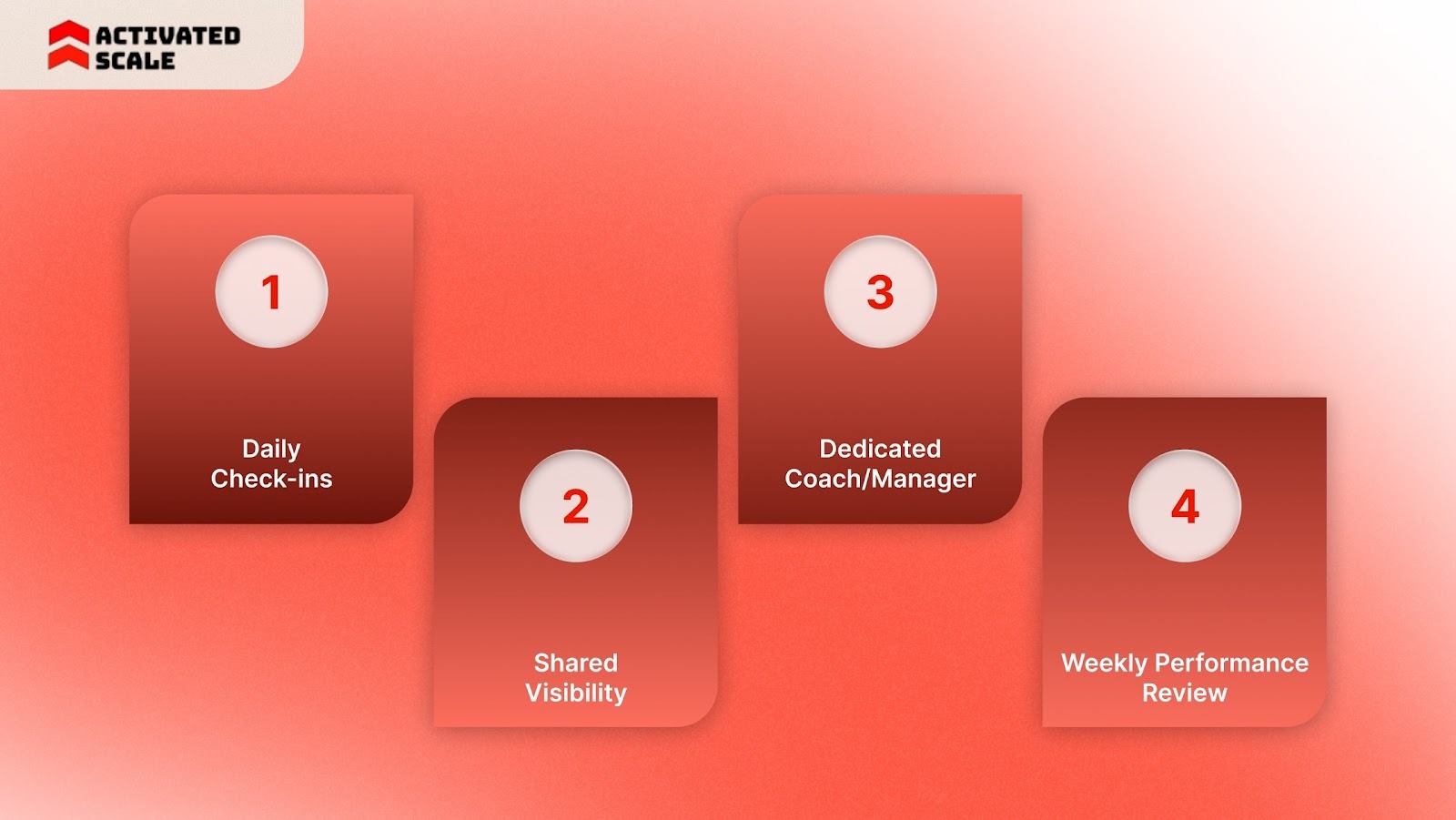
Your external sales partner should feel like a remote member of your team, not an isolated vendor.
- Daily Check-ins: Establish a quick (15-minute) daily stand-up call via Slack or Zoom. This helps monitor progress, clear roadblocks, and maintain cultural connections.
- Shared Visibility: Grant full read/write access to your CRM and sales engagement tools. Accountability requires transparent activity logging. You need to see the calls made and emails sent, not just the results.
- Dedicated Coach/Manager: Designate one internal leader (e.g., the Head of Sales or an internal AE) as the main point of contact. This centralizes feedback and ensures consistent coaching.
- Weekly Performance Review: Dedicate an hour weekly to review key performance indicators (KPIs) against the established goals. Focus on leading indicators (call volume, email replies) in addition to lagging indicators (SQLs booked).
The key is establishing a rhythm of constant, honest feedback. This ensures the outsourced resource quickly adapts to your nuances and delivers the intended results without delays.
7. Structure the Contract for Accountability and Flexibility
Your outsourcing contract should prioritize performance accountability and align incentives with your revenue goals, rather than simply focusing on fixed monthly fees.
Key Contractual Elements
A strong contract is a roadmap for mutual success and a protection against financial risk.
- Performance-Based Clauses: Integrate incentives and penalties based on reaching defined KPIs (e.g., a bonus for exceeding the monthly Sales Qualified Lead (SQL) quota, or a reduced rate if basic activity levels are not met). Avoid contracts based purely on hours worked; pay for validated output.
- Clear Termination and Scale Clauses: Define a straightforward, low-penalty process for scaling down the engagement if market conditions change or scaling up if the pilot is wildly successful. Fractional models should offer monthly or quarterly flexibility, not multi-year lock-ins.
- Data and IP Ownership: Explicitly state that all leads generated, contact data acquired, and any custom playbooks developed during the engagement belong entirely to your SaaS company. Protect your intellectual property from day one.
Structuring your agreement around performance and flexibility ensures that the outsourcing partner is truly invested in your success, treating their role as a direct extension of your GTM team.
8. Maintain a Unified, Transparent Tech Stack
Outsourcing should never introduce "shadow IT" or create data silos. The final strategy is to mandate the use of your existing, centralized technology stack for all outsourced activities.
Ensuring Full Data Visibility
Transparency is the foundation of trust and accountability in an outsourced sales relationship.
- Mandate CRM Usage: Your outsourced team must use your CRM (e.g., Salesforce, HubSpot) for all prospecting and activity logging. Every call, email, LinkedIn message, and lead status change must be logged in real-time. Without this, you lose pipeline visibility.
- Shared Sales Engagement Platform: Provide the external team with licenses and training for your existing Sales Engagement platform (e.g., Salesloft, Outreach). This ensures they use approved, branded templates and talk tracks, preventing rogue messaging and brand damage.
- Centralized Reporting: Use shared dashboards (accessible to both your internal leadership and the outsourced team) that pull data directly from the CRM. This provides a single, undisputed source of truth for tracking KPIs like daily dials, conversion rates, and pipeline value.
This commitment to a shared, unified tech stack is what transforms a group of external contractors into a measurable, accountable part of your integrated sales engine.
Benefits and Risks of Outsourcing Your SaaS Sales Function
Before finalizing your outsourcing plan, it’s essential to understand both the upside and the potential pitfalls. A clear view of the benefits and risks allows you to design an outsourcing model that is strategic, not reactive.
Key Benefits of Sales Outsourcing
1. Faster Access to Experienced Talent
Outsourcing connects you to senior SDRs, AEs, and sales leaders far faster than traditional hiring. This eliminates lengthy recruitment cycles and accelerates revenue operations immediately.
2. Cost Efficiency and Lower Financial Risk
Instead of committing to full-time salaries, benefits, and onboarding costs, outsourcing offers flexible, fractional talent models, meaning you pay only for the expertise you need, when you need it.
3. Rapid Scalability
Need to expand your outbound volume next quarter? Testing a new vertical? Outsourcing allows you to scale up or down without restructuring your internal team or overextending budgets.
4. Access to Specialized Skill Sets
A strong outsourcing partner brings proven playbooks, industry knowledge, and GTM frameworks that early-stage companies may lack internally.
Key Risks of Sales Outsourcing (and How to Mitigate Them)
1. Misalignment in Quality and Expectations
If the outsourced team lacks SaaS-specific experience or US-market familiarity, it can damage brand perception.
Mitigation: Define role scope clearly and choose partners with proven SaaS and US-market credentials.
2. Limited Product Understanding
External sellers may struggle with technical positioning, especially for complex B2B SaaS.
Mitigation: Provide deep onboarding, clear ICPs, talk tracks, and continuous coaching.
3. Inconsistent Communication and Collaboration
Poor communication creates gaps in pipeline visibility and makes performance tracking difficult.
Mitigation: Set recurring check-ins, shared dashboards, and CRM access from day one.
4. Overreliance on the Outsourcing Partner
Companies sometimes offload too much responsibility too quickly, losing internal control.
Mitigation: Maintain internal ownership of GTM strategy and ensure outsourced reps follow your playbook, not their own.
How Activated Scale Supercharges Your Sales Outsourcing Plan
When it comes to building a predictable, scalable sales engine, the quality of the partner matters just as much as the strategy itself. Activated Scale bridges the gap between strategy and execution by delivering pre-vetted, US-based sales talent tailored to the nuances of the B2B SaaS market.
Activated Scale helps you:
- Access fractional and contract-to-hire talent: SDRs, AEs, and VP-level leaders with real SaaS GTM experience
- Slash time-to-hire with a curated pipeline of experts ready to contribute immediately
- Align talent with your goals through role-specific vetting focused on US buyer expectations
- Maintain quality and accountability with clear KPIs, feedback loops, and structured onboarding support
Rather than guessing at generic outsourcing solutions, Activated Scale gives you a targeted, ROI-driven workforce strategy designed for rapid pipeline acceleration and sustained GTM growth.
Conclusion
The success of your scaling efforts hinges on implementing robust strategies for outsourcing that minimize risk and maximize expertise.
Outsourcing your sales function, particularly through flexible, fractional models, allows you to instantly access the senior, US-based talent you need to accelerate GTM execution and drive pipeline growth, all without the prohibitive costs and delays of traditional hiring.
By meticulously defining the scope and leveraging pre-vetted professionals, you transform your sales scaling from a high-risk gamble into a predictable, measurable blueprint for revenue success.
Ready to implement these strategies and access pre-vetted, US-based sales experts instantly? Discover how Activated Scale brings top fractional SDRs, AEs, and VPs of Sales directly to your inbox.
Frequently Asked Questions (FAQs)
Q1. What is the difference between BPO and Fractional Sales Outsourcing?
BPO (Business Process Outsourcing) is typically used for high-volume, low-cost, repeatable tasks often handled by offshore centers.
Fractional Sales Outsourcing involves hiring highly experienced, senior-level US-based professionals (like a Fractional SDR or VP of Sales) for a limited number of hours per week to execute high-value strategic tasks and fill immediate expertise gaps.
Q2. Is outsourcing sales bad for my company culture?
Not if done correctly. By hiring senior, vetted professionals on a fractional basis and integrating them into your daily communication channels, you gain expertise without a culture clash. The Contract-to-Hire model further protects your culture by allowing you to test the fit before making a permanent commitment.
Q3. How do I ensure an outsourced SDR understands my complex SaaS product?
Provide comprehensive training and documentation. This includes: 1) Access to your product demo environment, 2) Recordings of top internal sales calls, and 3) Clear, approved messaging and competitor battle cards. You must treat them exactly like a new internal hire during the onboarding phase.
Q4. What is a Fractional VP of Sales, and why would I outsource that role?
A Fractional VP of Sales is an experienced sales executive hired part-time (e.g., 10-20 hours a week) to set up your GTM strategy, design compensation plans, select CRM/tech stack, and mentor junior leaders.
Startups outsource this role to gain C-suite expertise instantly without paying a full-time executive salary while they stabilize their revenue.
Q5. What is the biggest risk in using low-cost global outsourcing for sales?
The biggest risk is poor quality and lack of market fit. Low-cost offshore reps often lack the native understanding of the US buyer's culture, language nuances, and business etiquette required for complex B2B SaaS sales, which can damage your brand and waste resources.
The Ultimate Guide to Hiring a Salesperson!
Get the step-by-step guide to hiring, onboarding, and ensuring success!