_edi.png)

The sales talent war is brutal. Top performers command high salaries. Open roles stay unfilled for months. Your growth targets are at risk.
So, you need a better strategy, because about 44% of candidates said they had multiple offers on the table when job hunting. Now, expanding your search globally is a necessity for modern sales leaders.
This blog provides a clear, actionable guide that will help you access top talent. You will learn to hire offshore employees effectively. We focus on building high-performance sales teams that can deliver practical steps you can use now.
Quick Key Takeaways
- About 44% of candidates recently reported receiving multiple job offers, making local hiring far more competitive.
- Roughly 52% of recruiters struggle to find qualified talent in their local market, pushing companies to look offshore.
- Around 74% of chief sales officers believe major skill shifts are essential to meet future revenue targets, raising the bar for role precision.
- Offshoring creates 24/7 coverage, which significantly improves lead response times and deal velocity across global cycles.
- Strategic offshore onboarding with structured KPIs and overlap hours directly reduces ramp-up errors and boosts early performance.
What is Offshore Hiring? (And What It is Not)
Offshore hiring means building your dedicated team with professionals who live and work in another country. They become your direct employees or long-term contractors.
They join your meetings, use your systems, and drive toward your long-term goals. This is a crucial distinction from traditional outsourcing. Outsourcing is the transfer of a project or function to a third party. You manage a vendor relationship.
For a sales leader, not all offshore hiring is the same. The right structure determines your control, speed, and success.
1. The Direct Hire Model
You legally employ the professional yourself. You handle international payroll, benefits, and compliance. This offers maximum control and cultural integration. For most companies, managing this alone is a significant challenge.
2. The Partner-Led Model (Using an EOR)
This is the most common and efficient path. You partner with an Employer of Record (EOR) or a specialized staffing agency.
They manage all local compliance, payroll, taxes, and HR. You retain full day-to-day management and direction of the employee’s work.
Offshore hiring may be simple to grasp, but the real value lies beyond the process. For a sales leader, the question isn’t “how does it work?” but “what does it change?”
And the answer is measurable impact across your entire sales organisation.
Also Read: 5 Mistakes You Are Making When Hiring a Salesperson For Your Startup
5 Benefits of an Offshore Sales Team
Some leaders view offshore hiring as a simple cost play. That mindset sells your strategy short. For a sales leader, the right offshore team is a strategic lever.
It directly boosts pipeline, revenue, and competitive edge. Ignore these five benefits, and you fund your competitors' advantage.
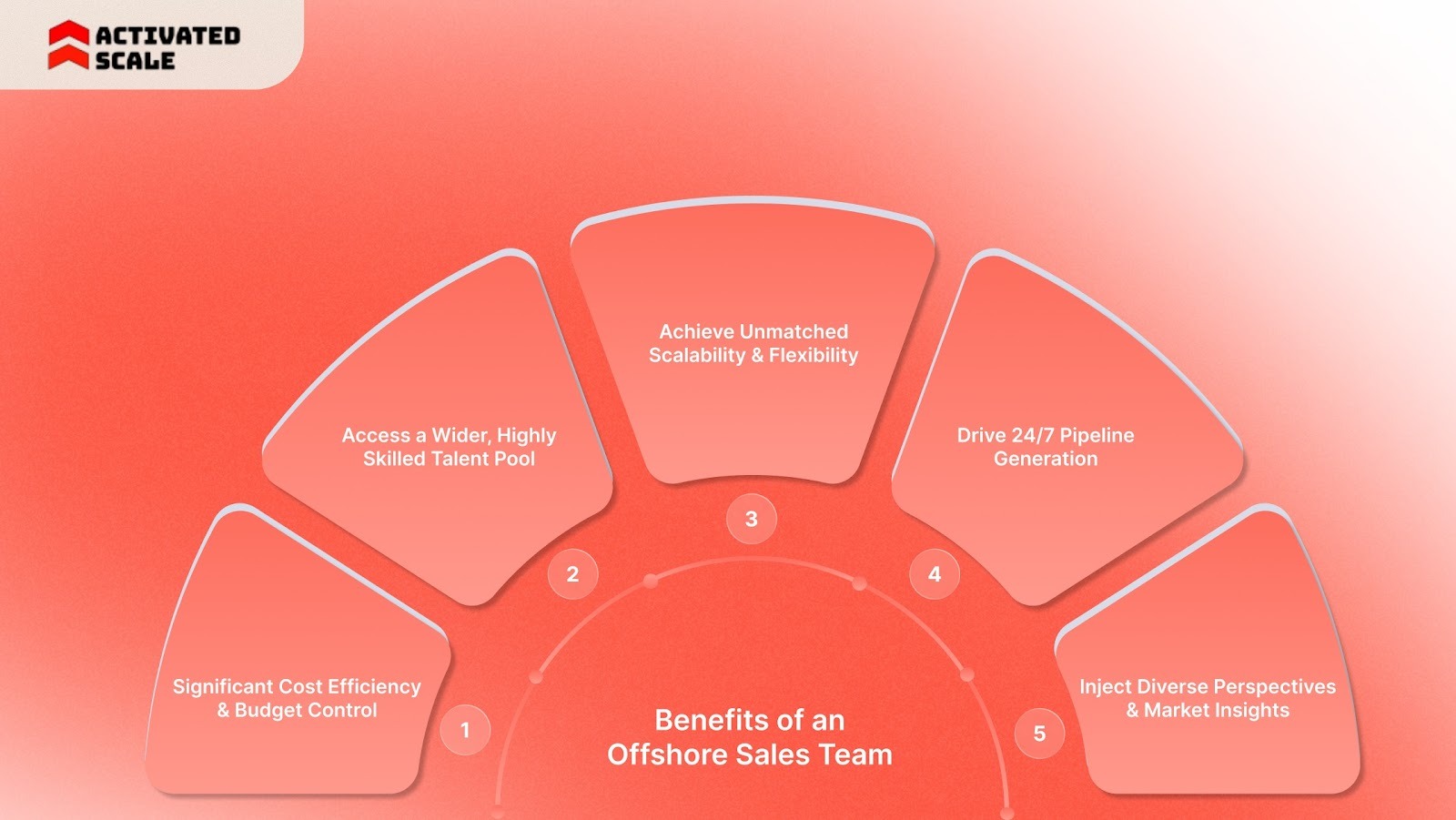
1. Significant Cost Efficiency and Budget Control
Sales talent is expensive, especially domestically. To hire offshore is to access equivalent skills in regions with different cost structures. The savings are substantial.
You can reinvest these funds into better sales tools, higher commissions, or more aggressive marketing. It is about maximizing the impact of every dollar in your budget.
2. Access a Wider, Highly Skilled Talent Pool
The local talent market is a battleground. Offshore hiring opens a global marketplace. You can find specialists with specific language skills or niche industry experience.
52% of recruiters confirmed demanding to find the right candidate. So, you are no longer limited by geography.
3. Achieve Unmatched Scalability and Flexibility
Sales demands fluctuate. You face product launches and quarter-end pushes. Scaling a local team for these moments is slow and rigid. An offshore model provides agility.
You can also adjust based on performance and market needs. This flexibility protects your margins. It also lets you capitalize on sudden opportunities.
4. Drive 24/7 Pipeline Generation
A sales cycle does not respect a 9-to-5 schedule. A lead that comes in after hours can go cold. With a team in another time zone, you create continuous coverage.
This dramatically improves lead response times. It shows customers a truly responsive level of service. This operational model accelerates deal velocity directly.
5. Inject Diverse Perspectives and Market Insights
A team spread across different countries brings diverse viewpoints. These perspectives challenge internal assumptions. A team member in another region may spot a local trend or a unique customer pain point.
This insight can inform your entire sales strategy.
At Activated Scale, we specialize in building high-performance, dedicated sales teams for leaders like you. Our Fractional Selling service gives you immediate access to vetted Sales Development Representatives (SDRs) and Account Executives (AEs).
You’ve seen the five key advantages of an offshore sales team. The logic is solid. However, a strategy only works when you can execute it.
A Step-by-Step Guide to Hiring an Offshore Employee
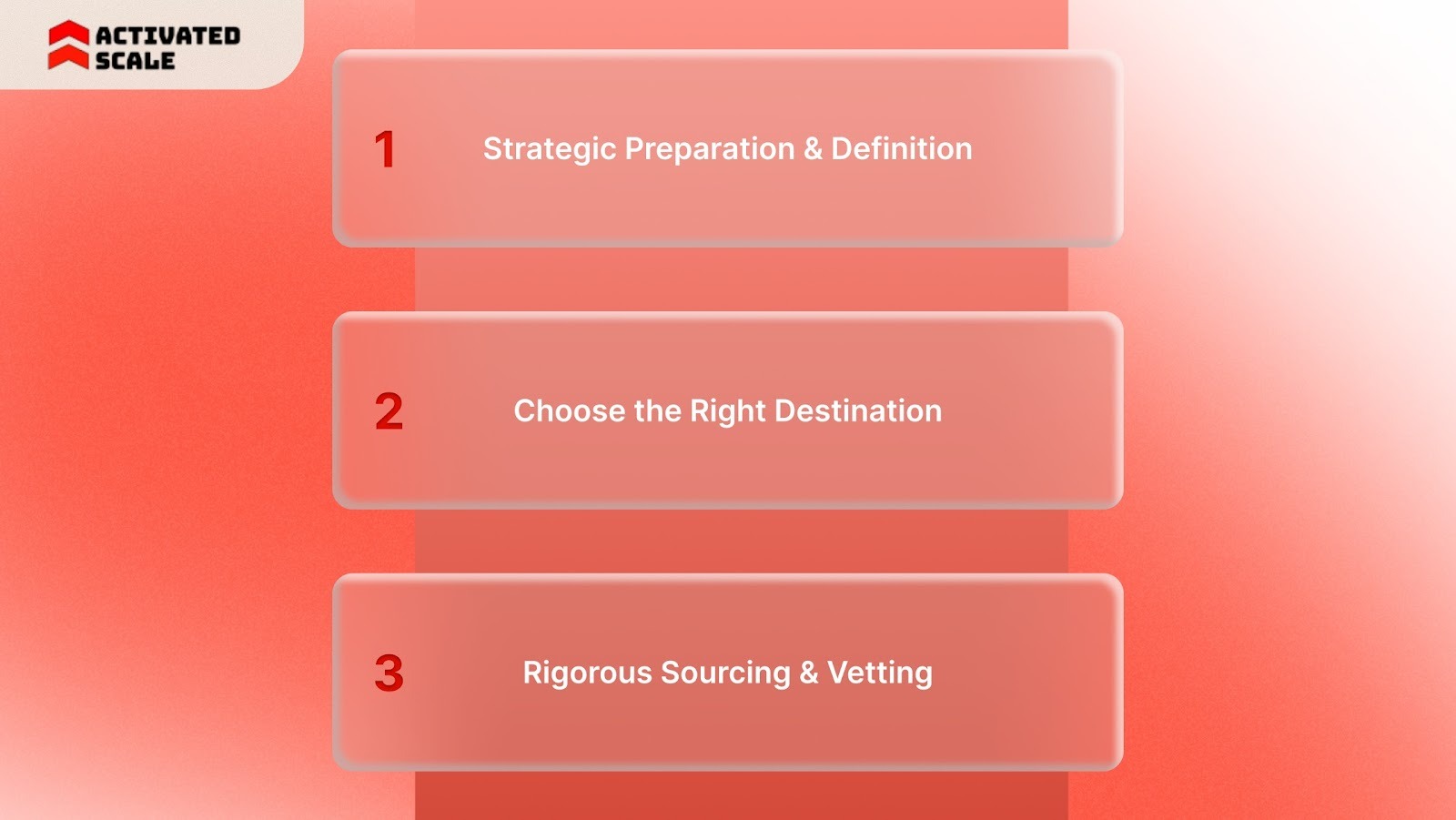
For an offshore sales team, failure is expensive. It costs you time, money, and market momentum. This guide is the detailed operational playbook used by top leaders to build their global teams with precision.
Follow it to hire offshore employees who are not just affordable, but high-impact.
Phase 1: Strategic Preparation & Definition
This first phase happens before you look at a single resume. It determines everything.
Step 1: Define the Role with Surgical Precision
Go beyond the job title "SDR" or "AE." You need a multi-layered specification.
- Core Responsibilities & Daily Tasks: Be exact. Is this role purely outbound cold calling? Handling inbound demo requests? Managing a specific territory or product line? Detail the daily workflow.
- Technical & Tool Proficiency: List required experience with your specific tech stack. For example: "3+ years in Salesforce," "proficient with Salesloft or Outreach for sequence management," "experience using Gong or Chorus for call analysis."
- Strategic Skills: Define the strategic output. Is this role focused on pipeline volume, lead qualification accuracy, or setting meetings for a specific deal size?
It is important as roughly 74% of chief sales officers think significant skill shifts are necessary to meet future revenue expectations. - Soft Skills for a Remote Setting: This is critical. Specify "exceptional written English for clear, async updates," "proven self-motivation in a remote role," and "ability to work independently for 80% of the time, with strong collaboration for 20%."
Step 2: Choose the Right Destination (Beyond Cost)
The best location is a strategic fit, not just the cheapest. Evaluate these four factors:
- Talent Pool Quality & Specialization: Which regions have a deep bench of sales talent in your industry (e.g., SaaS, B2B services)?
- Time Zone Alignment (The Nearshore Advantage): For sales roles requiring real-time collaboration, nearshoring is key. For a US company, Latin America (LATAM) offers significant overlap.
- Cultural & Communication Affinity: Look for regions with strong English proficiency and business cultures that align with your company's pace and communication style (direct, collaborative, etc.).
- Cost Framework: Understand the total cost, not just salary. Factor in agency fees (if applicable), management overhead, and technology costs.
Phase 2: Rigorous Sourcing & Vetting (Your Quality Gate)
This phase is where you filter for excellence. A rushed vetting process is the single biggest cause of offshore hiring failure.
Step 3: Build a Multi-Channel Sourcing Pipeline
Do not rely on one job board. Attack from multiple angles to access both active and passive candidates.
- Specialized Offshore Sales Staffing Agencies: Their entire business is curating high-performance sales talent in specific global hubs. This is your most efficient channel.
- LinkedIn with Advanced Boolean Search: Use precise searches combining location, title, skills, and industry keywords to find profiles directly.
- Global Sales Communities & Networks: Tap into niche online communities for sales professionals in your target regions.
Step 4: Implement a Structured, Multi-Layer Vetting Process
Each layer acts as a filter. Only the strongest candidates proceed.
- Layer 1: Portfolio & Resume Deep Dive: Look for quantified achievements, not just duties. "Increased qualified leads by 30% in 6 months" is stronger than "responsible for lead generation."
- Layer 2: Asynchronous Video Screening: Before a live interview, send a few key questions via video. This assesses initial communication clarity and professionalism on their own time.
- Layer 3: Core Sales Competency Interview: Conduct a structured interview focused on past sales scenarios. Use questions like, "Walk me through a time you handled a major objection from a prospect," or "Describe your process for researching."
- Layer 4: Role-Specific Simulation or Test: This is non-negotiable. For an SDR, give a sample company profile and contact list.
Ask them to draft a short email sequence and outline their call approach. For an AE, present a mock deal scenario and have them walk through their discovery questions and positioning. - Layer 5: Cultural & Remote-Work Fit Assessment: Have a final conversation with a team leader. Gauge their curiosity about your company, their questions about remote processes, and their self-awareness about working across cultures and time zones.
Phase 3: Operational Onboarding & Management (Your Success Engine)
Hiring is only half the battle. A weak onboarding process is a primary reason distributed teams fail. You must build a system for success.
Step 5: Execute a Structured, Two-Week Onboarding Sprint
Treat the first two weeks as a critical integration project.
- Week 1 - Foundation & Culture: Dedicate time for introductions to the entire team (not just their manager). Provide documentation on your sales process, buyer personas, and product value propositions. Train them thoroughly on all sales tech tools.
- Week 2 - Graduated Live Practice: Start with supervised tasks like listening to recorded sales calls and writing summaries. Move to drafting emails for review. End the week with role-play calls with a team member before any live prospect interaction.
Step 6: Establish Management Rhythms & Tools
Clarity prevents friction in a remote setting.
- Communication Protocol: Define primary tools (e.g., Slack for quick questions, Zoom for meetings, Customer Relationship Management (CRM) for all client updates).
Set clear expectations for response times and daily check-in formats (e.g., a daily Slack update with priorities and blockers). - Performance Management: Define 3-5 clear Key Performance Indicators (KPIs) from the start (e.g., calls made, qualified leads generated, opportunity pipeline created).
Schedule a consistent weekly 1:1 meeting focused on coaching, removing roadblocks, and reviewing metrics. - Cultural Integration: Include offshore team members in all relevant team meetings and sales celebrations. Create virtual channels for non-work interaction to build rapport.
Following this framework gets you a strong team. Mastering daily management makes them a top-performing asset. The right habits prevent them.
Also Read: Why Startups Are Embracing Fractional Sales Talent
7 Non-Negotiable Habits for Managing Your Offshore Sales Team
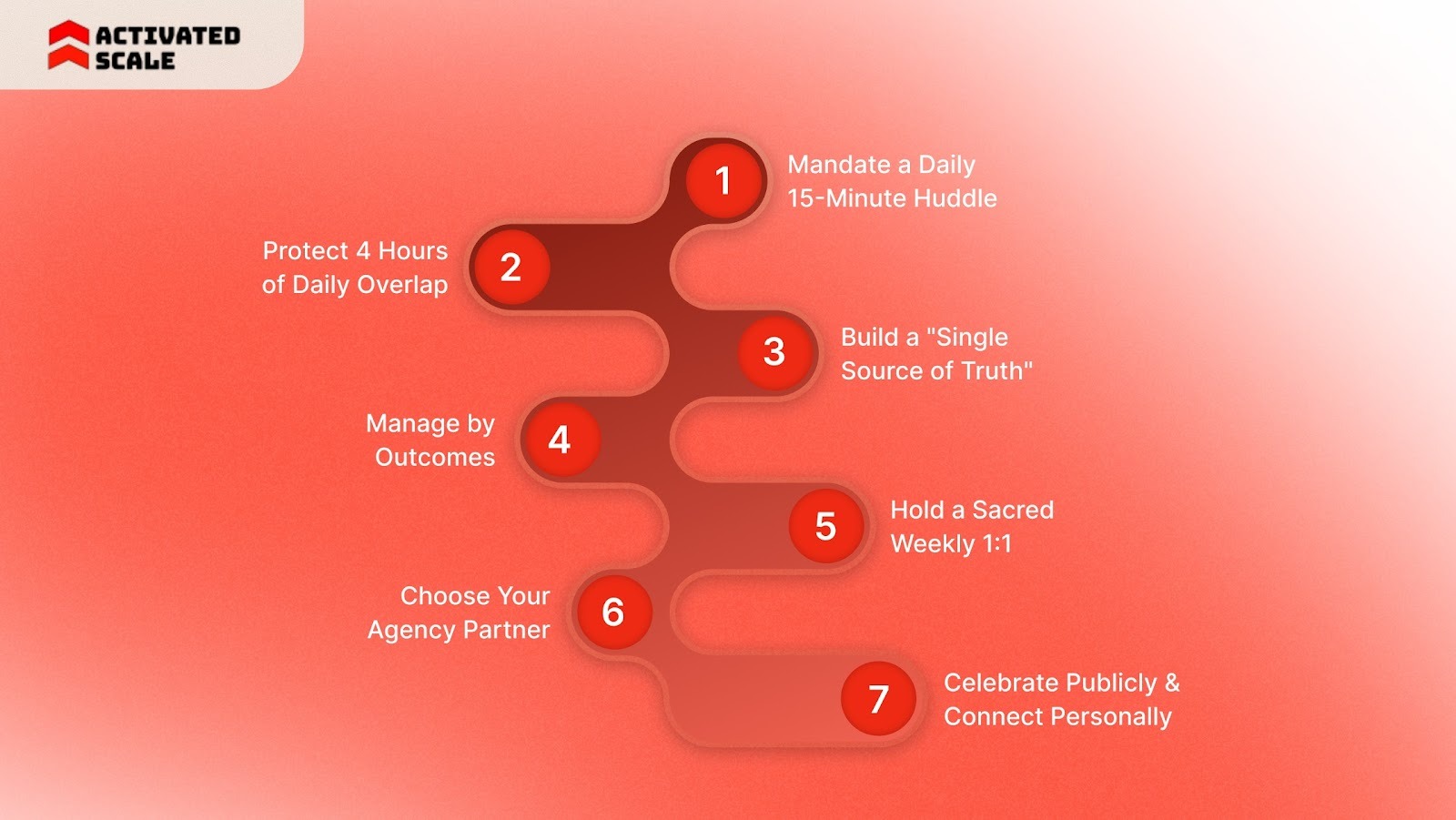
Ignore these habits at your own risk. They bridge the physical gap to create a unified, high-output team. These are the rules top sales leaders live by.
- Mandate a Daily 15-Minute Huddle: Each person shares their top priority and one blocker. This creates instant alignment. It also spotlights issues before they derail a week.
- Protect 4 Hours of Daily Overlap: Use this window for live meetings, coaching, and urgent strategy. This makes real-time work possible across time zones.
- Build a "Single Source of Truth": Document everything. Use a shared wiki for playbooks, scripts, and processes. Stop repeating answers. Direct your team to the documented guide.
- Manage by Outcomes: Track two types of metrics. Watch daily activities like calls and emails. But reward clear outcomes. Focus on qualified leads and the pipeline generated.
- Hold a Sacred Weekly 1:1: This 30-minute meeting is for coaching. Review metrics and role-play tough calls. Discuss specific prospect challenges.
- Choose Your Agency Partner: Your staffing agency is a strategic partner. Do not choose based on price alone. For leaders who value a dedicated, performance-focused approach, partnering with Activated Scale is a logical step.
- Fractional Selling: Hire experienced SDRs or Account Executives on a part-time basis to fill pipeline gaps and drive new revenue without a full-time commitment.
- Contract-to-Hire Sales Recruiting: Work with pre-vetted sales professionals on a flexible trial basis, with the option to hire them as full-time employees after proving success.
- Fractional Sales Leadership: Access seasoned VPs of Sales to build go-to-market strategies and select the right technology and tools for your business.
Want to get ahead of your competitors? Book a call with Activated Scale now.
- Celebrate Publicly and Connect Personally: Recognition is fuel. Create space for non-work chats. Share personal stories. This builds the trust and camaraderie that drives team loyalty.
The seven habits are your playbook for daily success. But even the best plays can fail if you don't anticipate the other team's moves.
You must also prepare for the common challenges of distributed work. Proactive planning here separates good teams from unbreakable ones.
What If You Face Challenges While Hiring Offshore?
You have your team and your management habits. Now, you need a defense strategy. Specific risks can undermine your offshore investment.
They are the frequent causes of failed engagements. This section gives you the exact countermeasures. Ignoring them puts your entire initiative in jeopardy.
- Solve Proactive Communication Management: Time zone differences are a fact. They only become a problem without a plan. The fix is intentional structure.
- Fix: Declare a mandatory "Core Collaboration Window" of 3-4 hours. Every team member must be online.
- Build Trust and Cultural Cohesion: Distance can breed isolation. Isolation kills team spirit and loyalty. You must manufacture the trust that happens naturally in an office.
- Fix: Start every team meeting with personal check-ins. Host a monthly virtual non-work event (like a trivia game).
- Maintain Quality and Strategic Alignment: Without effort, an offshore team can become a task-focused silo. They may lose sight of the bigger business goals. This leads to strategic drift.
- Fix: Hold a quarterly business review specifically with the offshore team. Walk through company performance, strategy shifts, and customer feedback.
At Activated Scale, we turn this plan into your reality. We are the specialized partner for sales leaders. Our reps at the Fractional Sales Leadership service provide immediate access to a dedicated, pre-vetted offshore sales team.
Conclusion
Building an elite offshore sales team is no longer an experiment. It is a proven strategy for scalable, sustainable growth. This guide has provided the complete roadmap for sales leaders: From understanding to the daily habits and risk-mitigation tactics that guarantee success.
The talent is available. Stop letting the constraints of your local talent market limit your revenue potential.
Activated Scale provides the exact partnership you need to build your team with confidence. Choose from our personalized services designed for sales leadership.
Ready to build your team with an offshore employee? Book your strategy session with Activated Scale today.
FAQs
1. What is the biggest risk when hiring offshore, and how do I avoid it?
The biggest risk is cultural and communicative misalignment, not skill. A technically perfect hire can fail if they don't integrate with your team's workflow and communication style. You avoid this by making soft skills and remote-work discipline the core of your vetting process.
2. Is offshore hiring only about cost savings?
No, this is a critical misconception. While cost efficiency is a significant benefit, the primary strategic advantages are access to specialized talent, 24/7 pipeline momentum, and unmatched scalability.
It's about gaining capabilities and operational leverage that are difficult or impossible to achieve with a local-only team.
3. What's the difference between "offshore" and "nearshore," and which is better for sales?
"Offshore" refers to any team in a different country. "Nearshore" specifically means hiring in a geographically and culturally proximate region (e.g., Latin America for a U.S. company).
For sales roles requiring real-time collaboration, nearshore is often superior. The overlapping time zones and cultural affinity facilitate live coaching, joint call reviews, and agile strategy sessions.
4. How do I ensure my company's data is secure with an offshore team?
Security requires proactive protocol. Mandate the use of company-approved, secure tools (like a Virtual private network (VPN) and virtual desktop) and provide clear data handling policies.
The most critical step for legal and compliance security is to partner with a reputable Employer of Record (EOR) that manages local legal requirements on your behalf.
The Ultimate Guide to Hiring a Salesperson!
Get the step-by-step guide to hiring, onboarding, and ensuring success!