_edi.png)

According to Salesforce's State of Sales Report, high-performing sales teams are 3.5x more likely to follow a defined sales process than underperforming teams.
That gap explains why the implementation of sales methodology often determines whether growth becomes predictable or chaotic. It's not the framework that creates results; it's consistent adoption and reinforcement.
Sales methodology implementation isn't about introducing a new script. It's about tightening qualification standards, improving deal control, and ensuring discipline in forecasting and coaching. When done correctly, methodology becomes an operational structure, not a theory.
Before we dive in
- Sales methodology implementation fails when enforcement is weak. Only a third of teams consistently follow a defined process, which limits forecast accuracy and win rates.
- Start with pipeline diagnostics, not methodology selection. Analyze conversion rates, sales cycle length, and deal slippage before choosing a framework.
- Match the methodology to real performance gaps. If the qualification is weak, fix the discovery. If forecast accuracy suffers, tighten stage exit criteria.
- Adoption depends on reinforcement. Managers must coach against defined criteria, CRM stages must reflect the framework, and pipeline reviews must align with it.
- Technology supports discipline, but leadership drives behavior. Tools enforce structure, but experienced operators ensure methodology sticks.
- Execution ownership determines success. Without consistent reinforcement, the methodology becomes documentation rather than a revenue improvement.
What a Sales Methodology Actually Means
A sales methodology defines how your team approaches selling. It's not your sales process. It's the thinking framework behind it.
While a sales process outlines stages and steps, a sales methodology shapes how reps engage buyers, qualify opportunities, handle objections, and move deals forward. It creates consistency in how your team communicates value and navigates conversations.
Strong sales methodologies guide behavior across the pipeline, from prospecting and discovery to negotiation and closing. Different stages may require different approaches, especially in complex or multi-stakeholder sales environments.
The key is alignment. The methodology you adopt should match:
- Your target customer profile
- Your average deal size and sales cycle length
- Your core KPIs (conversion rate, win rate, sales velocity)
- Your company's positioning in the market
Key Differences Between Sales Process and Sales Methodology
A sales process and a sales methodology are related but different.
How They Work Together
A sales process without a methodology creates activity without discipline. Reps move deals forward, but qualification may be weak, and forecasts become unreliable. A methodology without a process creates smart conversations but no structure. Deals lack visibility, and scaling becomes difficult.
High-performing teams align both:
- The process defines stage entry and exit criteria.
- The methodology defines what must be validated before advancing.
For example, if your methodology is MEDDIC-based, your process stage “Proposal Sent” might require confirmed metrics, identified economic buyer, and documented decision process before moving forward. That alignment is what drives predictability.
Why Standardizing Your Sales Approach Pays Off
Adopting a structured sales methodology isn't about adding theory. It's about creating predictable execution across your team. When implemented correctly, it directly impacts ramp time, deal quality, and long-term performance.
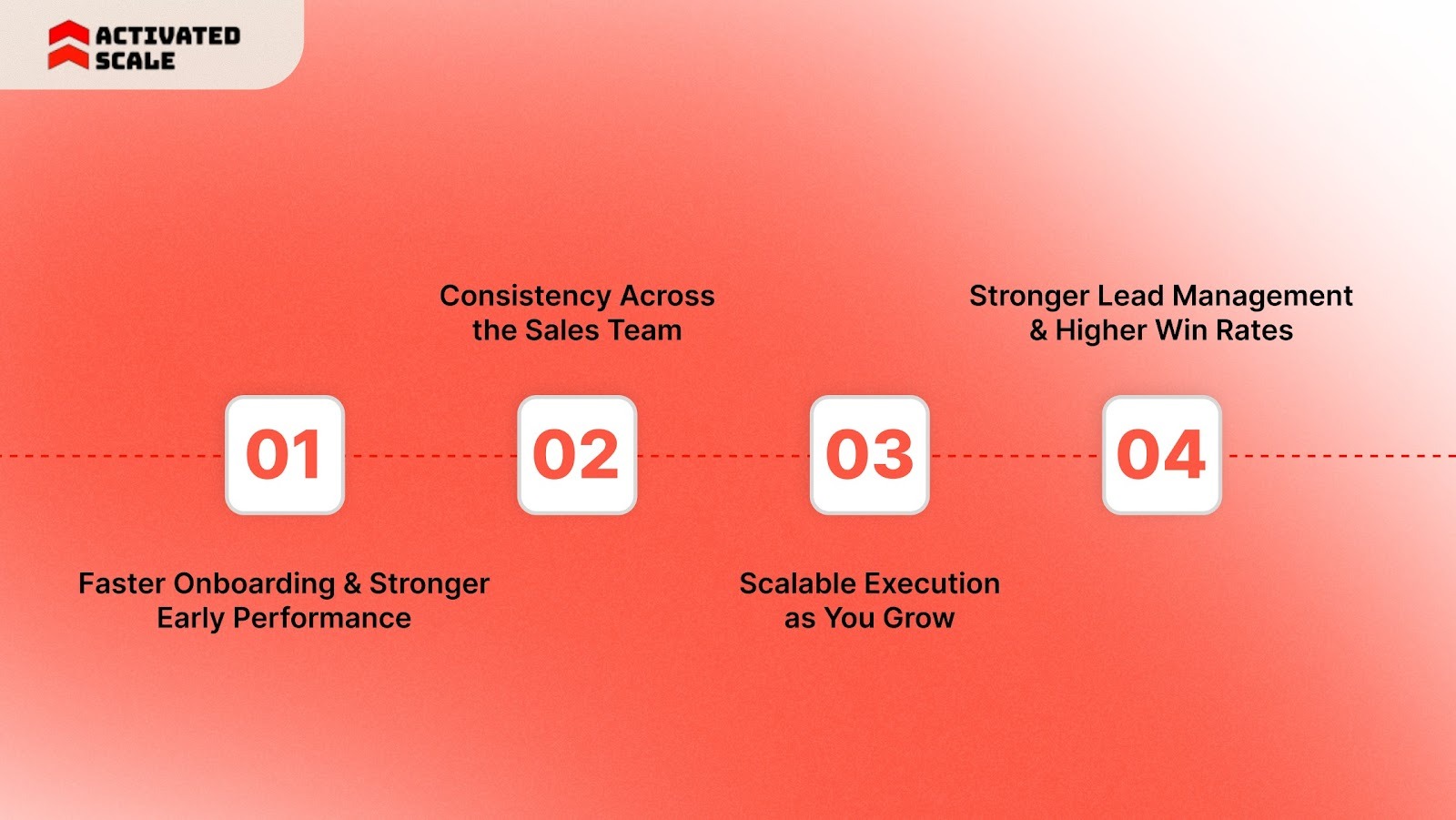
1. Faster Onboarding and Stronger Early Performance
A defined methodology gives new hires clarity from day one. Instead of guessing how to qualify, position, or close, they follow an established framework.
This reduces ramp time and helps new reps contribute to the pipeline faster. Clear expectations also make coaching more effective because managers evaluate against shared criteria.
2. Consistency Across the Sales Team
Without a common methodology, each rep develops their own style. That creates uneven messaging, inconsistent qualification standards, and unreliable forecasts.
A unified framework ensures:
- Shared discovery structure
- Clear stage definitions
- Consistent qualification criteria
- Predictable customer experience
Consistency improves data quality and forecasting accuracy.
3. Scalable Execution as You Grow
Growth exposes weak systems. When hiring accelerates, informal sales habits break down.
A standardized methodology makes it easier to:
- Replicate top-performer behavior
- Train new teams efficiently
- Expand into new territories without resetting performance
Scalability depends on repeatable execution, not individual heroics.
4. Stronger Lead Management and Higher Win Rates
A clear methodology guides how reps move opportunities through each stage. It defines what must be validated before progressing a deal, reducing the stalled pipeline and false optimism.
When reps understand how to manage objections, confirm buying intent, and secure next steps, conversion rates improve. The pipeline becomes healthier, and forecast risk decreases.
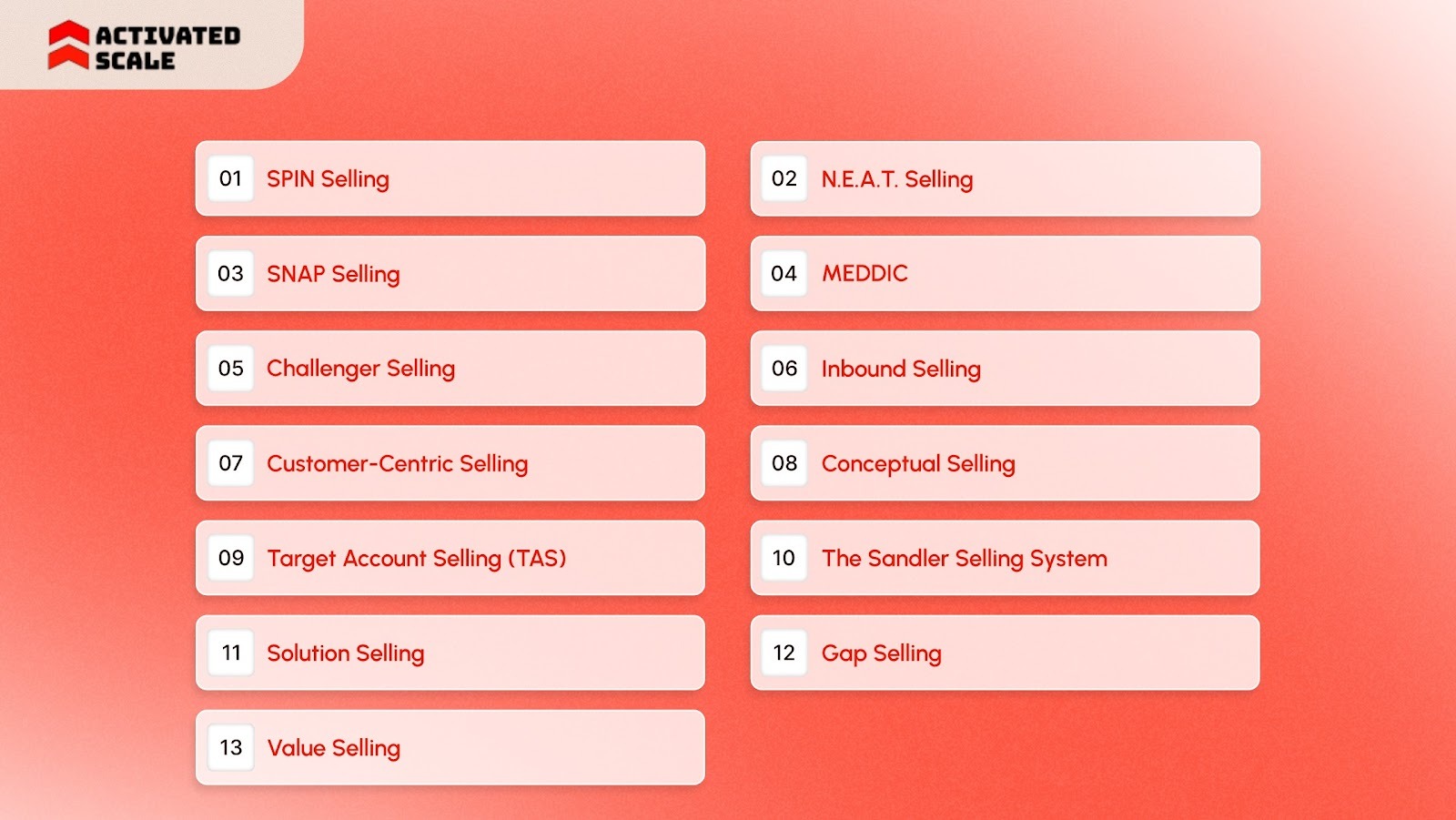
13 Sales Methodologies to Consider Before Implementation
Before focusing on implementing sales methodology, you need to understand what you're implementing. Not every framework fits every team. Some are built for enterprise qualification. Others work better for early-stage pipeline building.
Below is a straightforward breakdown of widely used methodologies and where each fits best.
1. SPIN Selling
SPIN Selling, developed by Neil Rackham, is built around structured discovery. It assumes that strong sales outcomes begin with better questions, not better pitches.
SPIN stands for:
- Situation: Understanding the prospect's current environment
- Problem: Identifying specific operational or strategic challenges
- Implication: Expanding on the consequences of those problems
- Need-Payoff: Positioning your solution as a clear, valuable resolution
Unlike transactional approaches, SPIN pushes reps to deepen conversations before introducing solutions. It works particularly well in complex B2B environments where buyers may not initially recognize the full cost of their challenges.
Strengths:
- Encourages disciplined discovery
- Builds buyer urgency through implication questioning
- Aligns naturally with consultative SaaS sales
Limitations:
- Requires strong listening skills
- Can feel mechanical if reps overscript it
Example: You’re selling a workflow automation tool. You learn that the client’s team tracks tasks manually (Situation). Delays frequently occur (Problem). These delays slow product launches and cost revenue (Implication). You show how automation prevents bottlenecks and accelerates delivery (Need-payoff).
Best fit: Mid-market or enterprise teams selling complex products with longer cycles.
2. N.E.A.T. Selling
N.E.A.T. Selling evolved from BANT-style qualification frameworks. It refines traditional qualifications by prioritizing impact and authority over surface-level budget questions.
N.E.A.T. stands for:
- Need: What core business issue must be solved?
- Economic Impact: What is the measurable financial consequence?
- Access to Authority: Are you engaging real decision-makers?
- Timeline: When must this decision happen?
Unlike early-stage discovery frameworks, N.E.A.T. becomes critical as deals mature. It ensures reps don't waste time progressing opportunities without economic justification or executive access.
Strengths:
- Improves deal qualification discipline
- Reduces late-stage deal collapse
- Forces financial alignment
Limitations:
- Can feel rigid in early exploratory conversations
- Not built for prospecting stages
Example: Instead of asking about the budget upfront, you quantify the cost of the client’s inefficiency. If inefficiencies cost $300K annually, your $50K solution becomes economically justified. You confirm executive involvement before advancing the deal.
Best fit: Revenue teams struggling with forecast accuracy or late-stage deal slippage.
3. SNAP Selling
SNAP Selling was designed for distracted, overloaded buyers. It focuses on simplicity and relevance in early-stage outreach.
SNAP stands for:
- Simple: Make communication easy to understand
- iNvaluable: Deliver undeniable value immediately
- Aligned: Connect directly to buyer priorities
- Priority: Emphasize urgency and business importance
Where many methodologies focus on deep qualification, SNAP focuses on attention and engagement. It is particularly effective in outbound-heavy environments where buyers are overwhelmed with options.
Strengths:
- Strong for prospecting
- Encourages clarity in messaging
- Reduces friction in early engagement
Limitations:
- Less structured for later-stage deal management
- Requires tight positioning discipline
Example: You send a concise outreach message: “We help logistics teams reduce delivery delays by 18%. Would it make sense to explore this?” The message is simple, valuable, aligned to priorities, and urgency-driven.
Best fit: High-volume outbound teams or early pipeline development functions.
4. MEDDIC
MEDDIC is one of the most widely adopted enterprise sales qualification frameworks. It is built around controlling complex buying processes through measurable criteria.
MEDDIC stands for:
- Metrics: Quantifiable outcomes the buyer cares about
- Economic Buyer: The person with budget authority
- Decision Criteria: How the buyer evaluates options
- Decision Process: Steps required for approval
- Identify Pain: Core business challenge
- Champion: Internal advocate driving your solution
MEDDIC is heavily data-driven. It forces reps to validate deal strength using concrete criteria rather than optimism.
Strengths:
- Improves enterprise forecasting
- Drives structured qualification
- Aligns sales with executive-level conversations
Limitations:
- Can feel heavy for SMB sales
- Requires CRM discipline to track properly
Example: You’re selling cybersecurity software. You identify the CTO as the Economic Buyer, confirm compliance requirements as Decision Criteria, map procurement steps, quantify breach risk (Metrics), and develop a security manager as your internal Champion.
Best fit: Enterprise SaaS teams or companies scaling complex multi-stakeholder deals.
5. Challenger Selling
Challenger Selling shifts the sales dynamic from reactive to insight-driven. Instead of simply responding to expressed needs, the rep introduces new perspectives that reshape the buyer's view of their problem.
The methodology is built around three core behaviors:
- Teach: Provide unique commercial insight the buyer hasn't considered
- Tailor: Adapt messaging to specific stakeholders
- Take Control: Guide the conversation confidently, especially around value and pricing
Challenger reps do not rely solely on relationship-building. They introduce constructive tension by questioning assumptions and presenting data-backed alternatives.
Strengths:
- Strong for complex B2B sales
- Elevates conversations to strategic levels
- Positions reps as advisors, not vendors
Limitations:
- Requires deep industry knowledge
- Can feel aggressive if poorly executed
Example: Instead of responding to a buyer’s request for a cheaper option, you present industry data showing their current vendor is increasing long-term operational risk, reframing the decision around strategy, not price.
Best fit: Organizations selling differentiated solutions in competitive markets where insight, not price, drives decisions.
6. Inbound Selling
Inbound Selling aligns with inbound marketing principles. Instead of cold outreach driving the process, prospects engage first through content, search, or digital channels.
Inbound selling emphasizes:
- Understanding where buyers are in their journey
- Personalizing outreach based on prior engagement
- Continuing momentum beyond the initial sale
It relies heavily on marketing-sales alignment and structured lead handoffs. The model views sales as part of a broader flywheel, where post-sale experience fuels new demand.
Strengths:
- Seamless marketing-sales alignment
- Warmer lead entry point
- Strong for SaaS and content-driven companies
Limitations:
- Dependent on a strong marketing engine
- Less effective in industries where outbound dominates
Example: A prospect downloads an eBook about AI adoption. You reference that content, ask what prompted their interest, and tailor your conversation to their specific use case instead of delivering a generic pitch.
Best fit: Companies with established inbound marketing pipelines and digital-first customer acquisition strategies.
7. Customer-Centric Selling
Customer-centric selling prioritizes long-term value over short-term transactions. It focuses on understanding the customer's broader goals, not just immediate purchase triggers.
Core principles include:
- Deep research and active listening
- Customizing solutions per buyer
- Collaborative problem-solving
- Continuous feedback integration
- Strong integration with customer success teams
This methodology extends beyond closing. It treats the sale as the beginning of a relationship, particularly in recurring revenue models.
Strengths:
- Improves retention and expansion
- Builds a strong trust foundation
- Aligns well with subscription models
Limitations:
- Can lengthen sales cycles
- Requires strong post-sale alignment
Example: Instead of upselling the highest-tier package, you recommend a phased rollout aligned to the client’s 3-year growth plan, building trust and long-term retention.
Best fit: Recurring revenue businesses and industries where long-term customer value outweighs one-time transactions.
8. Conceptual Selling
Conceptual Selling focuses on understanding how the buyer conceptualizes their problem and potential solution.
Instead of pushing product features, the rep seeks to align with
- The buyer's internal perception of the issue
- Their vision of success
- Their definition of value
This methodology emphasizes shaping and refining the buyer's "concept" of the solution during early-stage conversations.
Strengths:
- Strong for consultative environments
- Encourages strategic positioning
- Helps preempt objections
Limitations:
- Requires advanced communication skills
- Less structured for closing mechanics
Example: A buyer believes they need “reporting software.” Through discussion, you uncover that their real issue is poor cross-team communication, reshaping the solution conversation entirely.
Best fit: Solution-based software sales where customization and alignment drive differentiation.
9. Target Account Selling (TAS)
Target Account Selling prioritizes depth over volume. It focuses on identifying high-value accounts and investing resources strategically.
Key elements include:
- Rigorous account qualification
- Mapping decision-makers and influencers
- Coordinated multi-touch engagement
- Long-term account penetration strategy
Rather than working on broad pipelines, TAS focuses its efforts on accounts with the highest revenue potential and the greatest concentration of authority.
Strengths:
- Improves resource efficiency
- Increases enterprise deal probability
- Supports account-based marketing alignment
Limitations:
- Slower pipeline velocity
- Requires research investment
Example: Rather than pursuing 200 leads, your team selects 20 strategic accounts, maps decision-makers, coordinates marketing campaigns, and builds executive-level relationships across departments.
Best fit: Enterprise-focused teams running account-based selling strategies.
10. The Sandler Selling System
The Sandler Selling System redefines the traditional seller-buyer dynamic. Instead of positioning the rep as the persuader, it frames the conversation as a mutual qualification process.
Core principles include:
- Establishing upfront contracts (clear expectations for each interaction)
- Equal business stature between buyer and seller
- Open discussion of the budget and decision authority early
- No-pressure, honest qualification
The methodology encourages reps to disqualify poor-fit prospects rather than force deals forward. This reduces late-stage churn and short-term revenue that doesn't convert into long-term value.
Strengths:
- Reduces wasted pipeline time
- Improves long-term customer fit
- Builds trust through transparency
Limitations:
- Requires confidence and discipline
- Can feel counterintuitive for aggressive sales cultures
Example: Early in the process, you establish an “upfront contract”: “If we find this isn’t a fit, we’ll both agree to walk away.” This builds transparency and reduces pressure-based selling.
Best fit: Teams prioritizing sustainable growth over transactional wins.
11. Solution Selling
Solution Selling shifts the conversation from product features to business outcomes. Instead of pitching capabilities, reps diagnose problems and position tailored solutions.
The approach emphasizes:
- Deep understanding of customer pain points
- Collaborative discovery conversations
- Customizing value propositions
- Acting as a trusted advisor rather than a product presenter
This methodology works best when products are flexible or configurable. It allows sales teams to differentiate beyond price by tying offerings directly to operational or strategic impact.
Strengths:
- Increases perceived value
- Reduces feature-based competition
- Strong in consultative SaaS sales
Limitations:
- Requires thorough discovery
- Can lack structure if not supported by CRM discipline
Example: Instead of presenting all product features, you tailor your demo to directly address the client’s operational bottlenecks, showing how specific modules solve their exact challenges.
Best fit: Complex solution environments where customization drives competitive advantage.
12. Gap Selling
Gap Selling focuses on helping prospects clearly see the distance between their current state and their desired future state.
The methodology centers on:
- Diagnosing the current situation in detail
- Defining the desired business outcome
- Quantifying the cost of staying where they are
- Positioning the product as the bridge across that gap
It emphasizes the emotional and financial consequences of inaction. By clearly articulating the "gap," reps create urgency grounded in business impact.
Strengths:
- Builds strong urgency
- Aligns conversations with measurable outcomes
- Encourages strategic discovery
Limitations:
- Requires strong questioning skills
- Can be uncomfortable for reps unused to deeper business discussions
Example: You quantify that manual reporting costs the client 500 hours annually. You calculate the financial loss and position your solution as the bridge between current inefficiency and desired performance.
Best fit: Outcome-driven sales teams selling measurable ROI solutions.
13. Value Selling
Value Selling emphasizes clearly and credibly articulating return on investment. It shifts conversations away from price and toward impact.
The methodology requires reps to:
- Quantify financial outcomes (time savings, revenue lift, cost reduction)
- Align pricing with perceived value
- Tie proposals to executive-level metrics
- Defend margins with measurable justification
Value selling becomes especially important when buyers involve finance stakeholders. The conversation must move from “What does it cost?” to “What is the return?”
Strengths:
- Improves margin protection
- Supports executive conversations
- Aligns with enterprise buying criteria
Limitations:
- Requires strong financial fluency
- Depends on accurate ROI data
Example: When pricing objections arise, you present a 3-year ROI model showing cost savings and revenue gains that exceed the investment, reframing the conversation from expense to strategic return.
Best fit: Price-sensitive markets, enterprise sales, and CFO-involved deals.
Selecting a methodology is not the same as implementing it.
Each framework influences:
- Discovery structure
- Qualification standards
- CRM configuration
- Forecast accuracy
- Training programs
- Compensation alignment
Most companies fail to implement sales methodology not because they chose the wrong framework, but because they never operationalized it across processes, tools, and leadership disciplines.
Learn more about: Best Outbound Sales Tools for Software Teams in 2026
How to Roll Out a Sales Methodology Without Disrupting Performance
Implementing a sales methodology isn't about forcing a new framework onto your team. It's about strengthening weak points without breaking what already works. Execution matters more than theory.
Here's how to approach it correctly.
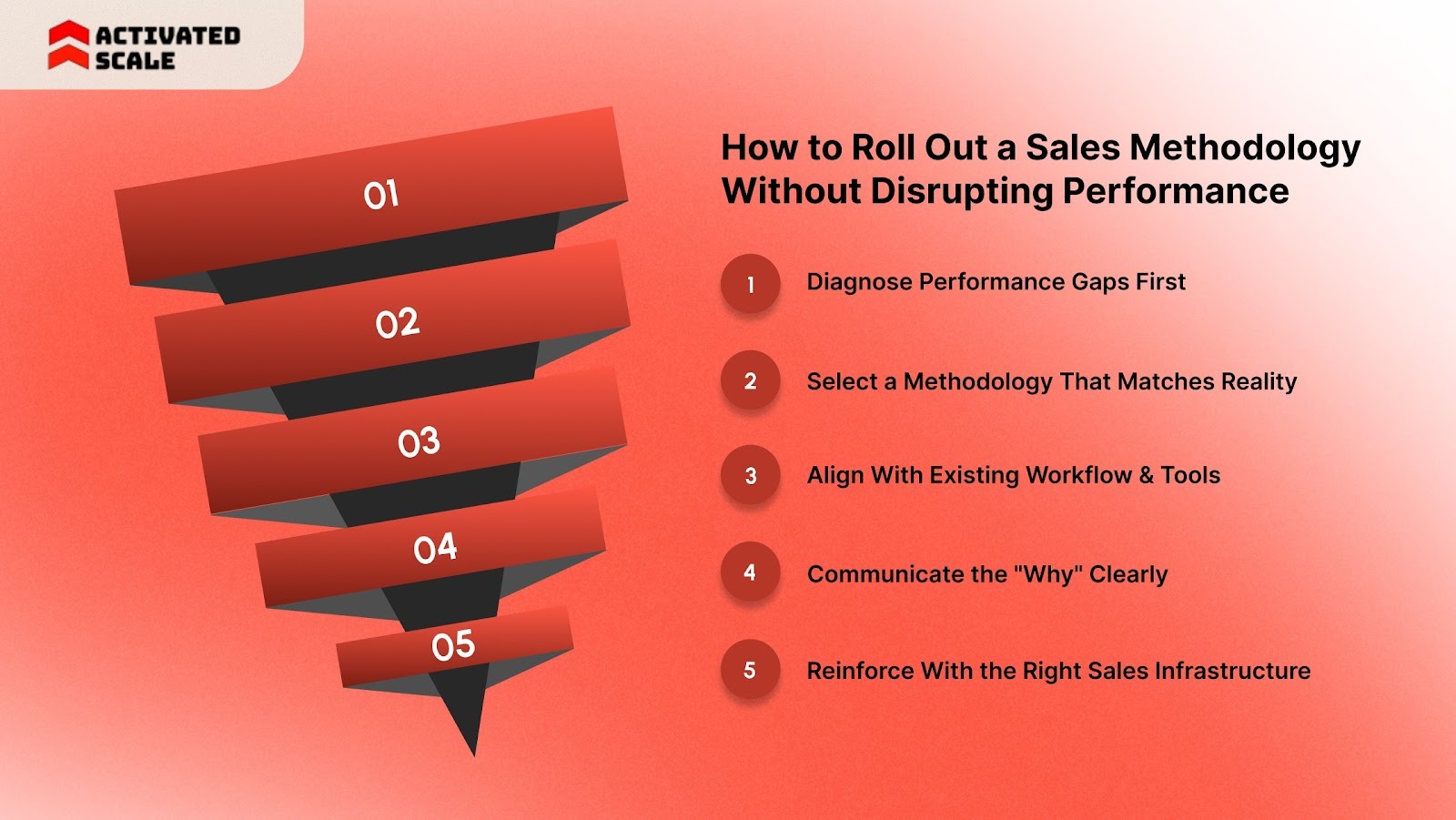
1. Diagnose Performance Gaps First
Before choosing any methodology, analyze your pipeline stage by stage.
Look at:
- Conversion rates between stages
- Average sales cycle length
- Win rates by segment
- Deal slippage patterns
Then speak with sales managers, reps, RevOps, and leadership. Numbers show friction. Conversations explain it.
A methodology should solve specific execution problems, not act as a trend-driven reset.
2. Select a Methodology That Matches Reality
Once gaps are clear, choose a methodology that addresses those specific weaknesses.
When deciding, consider three factors:
- Business objectives: Are you trying to increase win rates, improve forecast accuracy, shorten cycles, or protect margins?
- Industry complexity: Longer, multi-stakeholder B2B cycles require more structured frameworks than transactional sales.
- Buyer behavior: Choose a methodology that aligns with how your customers evaluate and make decisions.
For example:
- If the qualification is weak, adopt frameworks that strengthen discovery and deal validation, such as SPIN, N.E.A.T., or MEDDIC.
- If deal control is inconsistent, use structured opportunity management approaches like MEDDIC or Target Account Selling to map stakeholders and decision processes.
- If forecasting is unreliable, choose a methodology that enforces clear exit criteria and measurable milestones per stage.
- If differentiation is difficult in competitive markets, consider insight-led approaches like Challenger Selling.
Avoid overhauling everything at once. Preserve what works and improve what doesn’t. Sales teams adopt change faster when it feels incremental rather than disruptive.
3. Align With Existing Workflow and Tools
A methodology should integrate into how your team already operates. If it requires completely new habits without structural support, adoption will stall.
Make sure:
- Stage definitions match CRM configuration
- Exit criteria are clearly documented
- Managers reinforce methodology during pipeline reviews
- Compensation and performance metrics reflect the new process
Execution discipline determines whether the methodology sticks.
4. Communicate the "Why" Clearly
Reps won't commit to a new approach unless they understand the rationale.
Explain:
- What problem does it solves
- How does it improve win rates or deal velocity
- How it benefits them directly
Then support the rollout with structured training, live deal coaching, and ongoing reinforcement.
Methodology adoption fails when it's announced once and forgotten.
5. Reinforce With the Right Sales Infrastructure
Technology doesn't replace methodology, but it enforces it.
Choose tools that:
- Support structured qualification
- Automate stage tracking
- Provide accurate forecasting visibility
- Integrate cleanly with your CRM
If your team lacks internal leadership to manage implementation or enforce process discipline, bringing in experienced operators through flexible models, such as fractional sales leadership or contract-to-hire recruiting, can accelerate adoption without long-term hiring risk.
The goal isn't to introduce a new framework. It's to make revenue execution more predictable.
Must read: International Sales Representative Career Progression Guide
When Implementation Needs Experienced Operators
Sales methodologies don't fail because the framework is wrong. They fail when no one consistently reinforces it.
Pipeline reviews slip. Coaching becomes uneven. Stage criteria soften. Within months, the methodology exists only on slides, not in daily execution.
Activated Scale connects companies with vetted, U.S.-based sales professionals who operationalize methodology, not just advise on it. Through:
- Fractional Sales Leadership: Experienced VPs of Sales who define stage criteria, coach managers, tighten forecast discipline, and integrate methodology into daily execution.
- Contract-to-Hire Sales Recruiting: Structured hiring models that let companies validate performance and process fit before committing full-time.
- Fractional Selling (SDRs & AEs): Operators who execute within defined methodology frameworks, reinforcing standards through real deals.
The model prioritizes speed and proof:
- <7 days to connect with qualified sales talent
- 20+ hours saved per headcount in interview time
- 80% of companies retain talent beyond 8 months
- 200+ growing companies served
For teams implementing a new sales methodology, this means you don't just launch a framework; you integrate it with experienced operators who consistently enforce it.
Sales methodology works when behavior changes. Behavior changes when ownership is clear.
Conclusion
Sales methodology implementation is not a one-time initiative. It's an operational shift.
The strongest sales teams don't just choose a framework; they integrate it into coaching, forecasting, hiring, and daily execution. That's what turns methodology into measurable performance improvement.
If you're implementing or refining your sales process and want experienced operators to reinforce execution from day one, explore how Activated Scale's flexible sales leadership and contract-to-hire models can support your rollout.
Contact today to learn how to operationalize your sales methodology without long-term hiring risk.
FAQs
1. What is sales methodology implementation?
Sales methodology implementation is the process of embedding a structured selling framework into daily sales execution. It involves aligning stage definitions, coaching practices, CRM configuration, and performance metrics with the chosen methodology.
2. Why do sales methodology rollouts fail?
Most fail due to inconsistent reinforcement. Managers stop coaching against defined criteria, CRM stages remain loosely enforced, and pipeline reviews revert to old habits. Without discipline, adoption fades.
3. How long does it take to implement a sales methodology successfully?
Initial rollout can take 30–60 days, but full adoption often requires 90–180 days of reinforcement, coaching, and process refinement before measurable improvements in win rate or forecast accuracy appear.
4. Should startups use formal sales methodologies?
Yes, especially growth-stage startups. Structured methodologies improve qualification discipline, shorten sales cycles, and strengthen forecast reliability as teams scale.
5. How do you measure successful sales methodology implementation?
Key indicators include:
- Improved stage-to-stage conversion rates
- Shorter sales cycles
- Higher win rates
- Reduced deal slippage
- Increased forecast accuracy
If these metrics remain flat, adoption is likely incomplete.
6. Do you need external help to implement a sales methodology?
Not always. However, companies without experienced sales leadership often benefit from fractional or contract-based sales operators who can enforce structure and coach managers through the adoption process.
The Ultimate Guide to Hiring a Salesperson!
Get the step-by-step guide to hiring, onboarding, and ensuring success!