_edi.png)

Hiring offshore employees has become a practical way for U.S. startups to manage costs, fill talent gaps, and keep projects moving without adding full-time domestic headcount. Many early-stage teams reach a point where local hiring feels slow or out of budget, especially for support, research, or technical roles.
It’s no surprise that 70% of companies say finding skilled labor is a primary driver for offshoring. Still, the process requires structure. From choosing the right location to setting clear expectations, each step affects output and long-term stability.
This guide walks founders through the essentials to hire offshore employees confidently and build a setup that works alongside their U.S.-based team.
At A Glance
- Offshoring works best for support, admin, research, and repeatable tasks, not U.S. sales roles that rely on buyer familiarity and local context.
- Clear scopes, defined KPIs, and structured onboarding matter more than the offshore location you pick.
- Compliance steps like contracts, IP protection, and correct worker classification prevent costly mistakes later.
- The most effective setup for early-stage teams is offshore support paired with U.S.-based reps who handle revenue-facing work.
- Activated Scale helps founders quickly hire vetted U.S. SDRs, AEs, and sales leaders while offshore teams manage execution-heavy functions.
What U.S. Founders Must Know Before Offshoring

U.S. founders planning to hire offshore employees need a clear idea of which roles fit, which risks to avoid, and how different regions affect costs and output.
1. Identify the Roles That Fit Offshore Work
Founders often start offshoring by moving work that follows predictable processes or requires consistent execution rather than constant U.S. customer interaction. These roles typically adapt well and can be scaled without hurting quality.
At the same time, certain positions carry more risk when moved offshore because they require cultural fluency, buyer context, or real-time collaboration.
Functions that usually fit well offshore:
- Research, back-office operations, and administrative support
- QA, data entry, routine marketing tasks, and bookkeeping
- Customer support that follows documented workflows
Functions that often create risk offshore:
- Outbound sales and U.S. buyer-facing conversations
- Deal negotiation, enterprise demos, and account management
- Sales leadership and strategy roles
Budget considerations to note:
- Regional salary variations
- Additional costs such as tools, training, and compliance
- Competitive pay is needed to attract reliable offshore talent
Also, Check: How Business Process Outsourcing Boosts Sales Strategy.
2. Evaluate the Right Offshore Locations
Each region offers different strengths, making your choice dependent on the work required, time-zone expectations, and communication needs. Look beyond cost savings and evaluate talent quality, compatibility with U.S. communication styles, and the level of oversight needed.
Practical region-by-region breakdown:
- Philippines: Strong in customer support, admin roles, and English communication
- LATAM: Good for near-shore collaboration and same-day handoffs
- Eastern Europe: Known for engineering and technical depth
- India: Strong in technical, finance, analytics, and support roles
When time-zone proximity matters:
- Daily standups or frequent check-ins
- Roles that require rapid changes or quick edits
- Customer-related tasks that depend on U.S. hours
Key trade-offs to consider:
- Language and communication style differences
- Variation in experience levels within each region
- Higher-quality talent often requires higher compensation
Some founders prefer to keep revenue roles onshore while offshoring support tasks. Platforms like Activated Scale help them find U.S.-based sales talent without long hiring cycles.
3. Understand Legal, Tax, and Compliance Requirements
Hiring offshore requires awareness of classification rules, employment obligations, and worker protection laws in each country.
Key distinctions to understand:
- Contractor vs. employee: Level of control, schedule expectations, and responsibilities
- EOR vs. direct employment: EORs manage compliance; direct employment gives more control but adds complexity
Compliance areas to plan for:
- Payroll, tax forms, and benefits rules in the worker’s country
- Insurance requirements and data security expectations
- NDAs, IP protection clauses, and local labor laws
4. Choose Your Offshore Hiring Model
Your hiring model determines how much control, administrative work, and responsibility your team handles. Some founders want full ownership, while others prefer having compliance managed externally.
Common offshore hiring models:
- Direct hire: Long-term roles where you can manage payroll and compliance
- Third-party agency: Pre-vetted talent or teams managed by an external partner
- Employer of Record (EOR): Simplifies legal and HR requirements across countries
- Freelance marketplaces: Short-term projects or trials, not ideal for ongoing roles
Now, the next step is building a clear system for hiring and managing them effectively.
Recommended: Recruitment SaaS: Strategies, Platforms, & Top Hiring Firms.
A Step-by-Step System to Hire Offshore Employees
Hiring offshore talent becomes far easier when founders follow a structured, repeatable process instead of treating each role as a one-off search.

1. Build a Clear Job Scope and Expectations
Start with a scope that focuses on measurable results rather than broad responsibilities. Offshore talent performs best when expectations are explicit and tied to weekly or monthly outputs.
Elements to include in your JD:
- Output-based responsibilities with clear deliverables
- Required English proficiency (verbal, written, or both)
- Tools and software familiarity
- KPIs tied to productivity, accuracy, or turnaround time
2. Run a Targeted Sourcing Strategy
The best channels depend on the role’s complexity and the level of vetting needed.
Where to source reliably:
- Regional job boards with strong talent pipelines
- Pre-vetted offshore staffing firms for specialized skills
- Referral networks and role-specific communities
- U.S.-based sales talent platforms like Activated Scale, if you prefer to keep revenue roles onshore, while offshoring support tasks
3. Assess Skills With Screening System
A structured evaluation process ensures consistency and prevents over-reliance on resumes.
Key components of a strong screening system:
- Short technical or task-based tests
- Practical assignments tied to the job’s real output
- Cultural alignment indicators such as clarity, ownership, and responsiveness
- Background verification and basic security checks
4.Verify Documentation and Payment Setup
Before onboarding, confirm that documentation and payment arrangements are completed to protect IP and maintain predictable payroll cycles. Required documents often include local IDs, tax forms, NDAs, and IP transfer agreements.
Key items to check:
- Required documents: Get identification, tax details, sign confidentiality agreements, and include IP clauses
- Payment setup: Choose between Wise, Deel, Payoneer, or Remote depending on speed, compliance needs, and region-specific support
5. Create a Clear Contract and Compensation Plan
Compensation and career visibility matter more offshore because candidates often assess long-term stability when choosing U.S. employers.
Plan details to include:
- Market-rate salary ranges based on region and skill level
- Retention drivers such as tenure bonuses, training access, or consistent raises
- A defined role progression framework to set expectations early
Once the hiring is done, success depends on how well you onboard, train, and support your offshore team in daily execution.
Also Read: Benefits of Outsourced Customer Acquisition for Business Growth.
Setting Offshore Employees Up for Success
A structured setup helps offshore hires ramp quickly, stay aligned with U.S. teams, and deliver consistent output.'
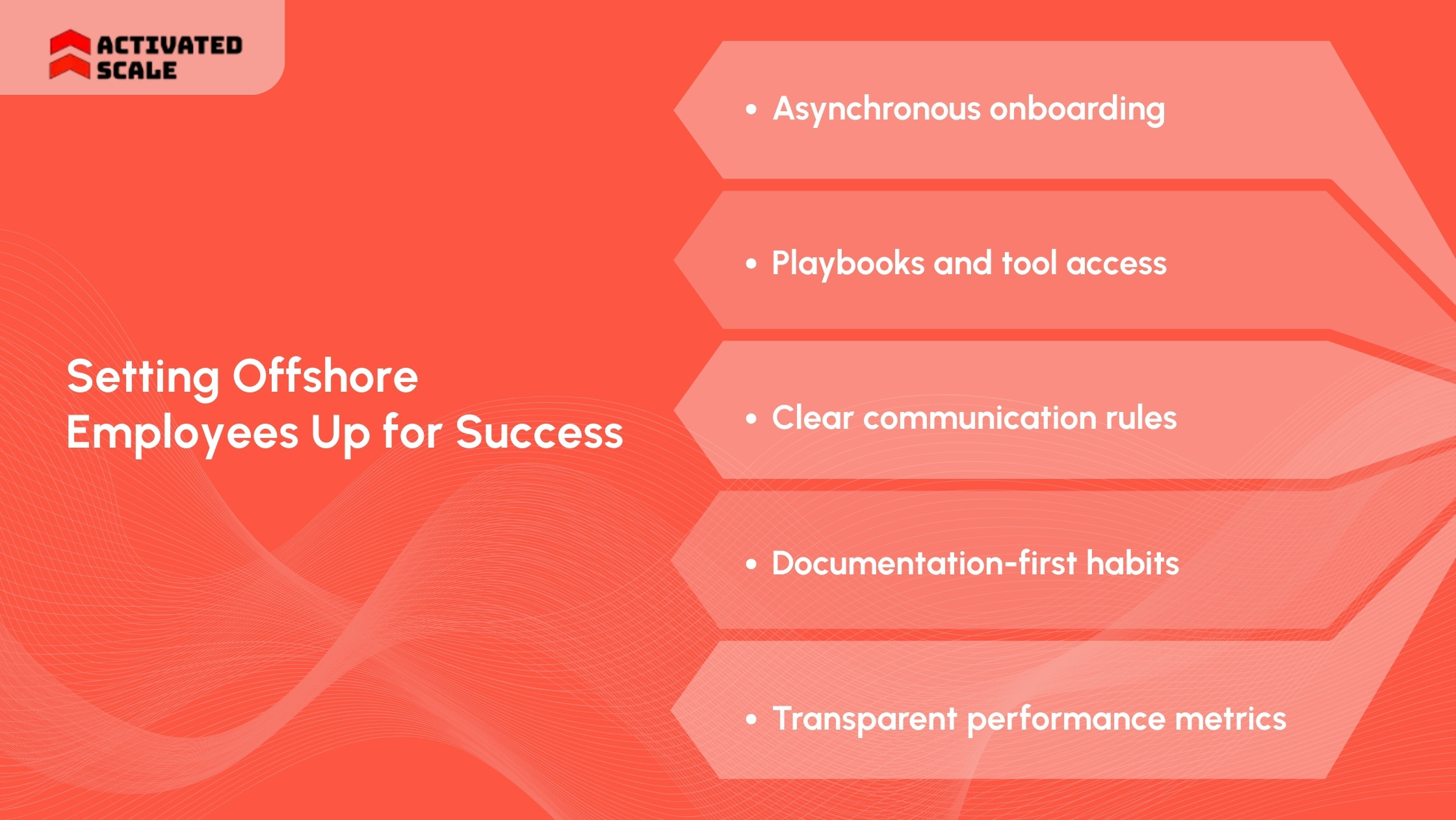
Key elements to put in place:
- Asynchronous onboarding: Provide recorded walkthroughs, documented steps, and self-paced modules so training doesn’t depend on U.S. hours.
- Playbooks and tool access: Create short SOPs, video guides, and a checklist for logins, permissions, and workspace setup.
- Clear communication rules: Define channels, meeting cadence, response expectations, and escalation paths to avoid delays.
- Documentation-first habits: Encourage written updates and task notes so information stays visible to everyone.
- Transparent performance metrics: Use weekly scorecards, simple KPIs, and periodic QA checks to keep output aligned.
Now it’s time to look at how offshore hiring aligns with your broader revenue strategy.
Recommended: Scalable Strategies for Startup Development Teams.
How Offshore Hiring Supports Your Revenue Goals
The key is knowing which functions thrive offshore and which roles require U.S.-based experience to protect pipeline quality and close rates.
Great functions to offshore in a U.S. startup:
- Customer support and ticket handling
- Administrative and back-office work
- Research and data preparation
- Billing and financial ops support
- QA and process checks
- Routine marketing production tasks
Functions that carry risk when offshored:
- U.S. sales roles that require local buyer fluency
- Outbound prospecting aimed at American decision-makers
- Revenue leadership and strategy positions
- Enterprise-level customer interactions
Why some roles must stay onshore: Certain responsibilities require close alignment with U.S. buyers, real-time collaboration, and clear communication norms. Roles that influence pipeline health, negotiation outcomes, or customer trust depend heavily on cultural familiarity and local context. That’s why sales positions are best kept onshore.
If you’re offshoring support work and want your revenue efforts to stay strong, you’ll need reliable access to proven reps who can sell confidently to American buyers.
How Activated Scale Helps You Build a Strong Sales Team
Many founders run a blended structure: offshore teams manage support work, while revenue roles stay in the U.S. to protect deal quality and customer trust. Activated Scale fits into that model by supplying U.S.-based sales talent so founders can strengthen their GTM efforts without long searches or recruiter expenses.
Startups use Activated Scale to bring in:
- SDRs who can prospect effectively in U.S. hours
- AEs who understand American buyer expectations
- Fractional VPs of Sales who shape GTM direction
- Contract-to-hire reps who can be tested before full-time conversion
Connect our team and hire vetted U.S. sales talent with confidence.
Conclusion
Offshore hiring helps founders control costs and move faster, but it only works when paired with the right structure and the right people in the right seats. Additionally, for revenue-sensitive roles, you hire people who aren’t equipped to sell to U.S. buyers or handle the pressure of an early-stage pipeline.
Many teams learn this after missed quotas or stalled deals that could have been avoided. Keeping sales roles onshore protects buyer trust and maintains your pipeline. That’s where Activated Scale helps. Our U.S.-based candidates give founders a reliable way to maintain revenue quality while running offshore operations for support work.
If you need proven U.S.-based sales talent without long hiring cycles, connect with our team to get started!
FAQ’s
1. How do I decide if an offshore hire should work U.S. hours or their local schedule?
Roles tied to internal workflows, such as research, admin, QA, and billing, can work their local hours. Roles that support customer-facing teams often perform better when aligned with partial U.S. hours to avoid bottlenecks.
2. Should early-stage startups build offshore teams before hiring their first U.S.-based sales rep?
Not usually. Early sales motion requires direct customer feedback, fast iteration, and real-time conversations with U.S. buyers. Many founders start with a U.S.-based SDR or AE to validate messaging and then add offshore support once the GTM direction is clear.
3. What’s the biggest hidden cost founders face when hiring offshore talent?
Rework. If instructions, expectations, or SOPs aren’t clear, offshore teams spend time guessing, and founders spend time correcting. Documented workflows and short async check-ins reduce much of this waste.
4. How do I maintain data security with offshore employees?
Limit access to only what each role needs, use SSO across all tools, avoid storing sensitive customer data locally, and enforce strict device policies. Many founders also use region-based access controls and require offshore teams to work through VPNs or virtual desktops.
5. What’s the right team structure if I want both offshore talent and U.S.-based sales reps?
A common pattern is to offshore support handling research, admin, and customer support, and get a U.S.-based SDR/AE owning pipeline and revenue; and a fractional VP of Sales guiding GTM.
The Ultimate Guide to Hiring a Salesperson!
Get the step-by-step guide to hiring, onboarding, and ensuring success!