_edi.png)
Running an eCommerce business demands constant attention. Sales leaders juggle countless tasks daily. You manage customer service, marketing, and fulfillment. This leaves little time for core strategy.
So, what could be a modern solution to address this challenge directly? eCommerce outsourcing provides a clear path forward. 96% of online retailers say the quality of their logistics offering is critical to closing sales, signifying why innovative outsourcing of operations can directly grow revenue.
In this way, you gain expertise and scalability without heavy investment. This blog outlines 10 key advantages of eCommerce outsourcing. These benefits help you reclaim time.
Quick Glance
- 96% of online retailers say strong logistics performance directly influences their ability to close sales.
- Over 73% of Fortune 500 companies use multi-process outsourcing to run operations efficiently.
- Around 60% of future AI tech users say they don’t yet know how to use Artificial Intelligence safely with verified data or protect sensitive information.
- Outsourcing converts major fixed costs like full-time salaries and infrastructure into flexible, pay-as-you-need operational expenses.
- Outsourced teams provide 24/7 customer support and multilingual service, improving response times and overall customer satisfaction.
What is eCommerce Outsourcing?
eCommerce outsourcing is a strategic partnership. You delegate specific business functions to external experts. These specialized partners become your extended team. They handle defined operational tasks for you.
This model covers many critical areas. Functions include customer support and digital marketing. It also includes fulfillment and back-office work. The core philosophy is intentional delegation.
Since you are assigning specialized tasks to specialists, this allows your internal team to focus on vision. They can concentrate on product strategy and core growth. eCommerce outsourcing turns fixed problems into flexible solutions.
We defined eCommerce outsourcing as building an extended team. Now, let's see its real impact on your sales growth and operational control.
Also Read: How to Outsource Marketing Services for Business Growth
The 10 Core Benefits of eCommerce Outsourcing for Businesses
This section details the transformative impact. If you skip this, you might miss a key growth lever. You could overlook a proven method to boost efficiency.
Understanding these benefits is crucial for strategic planning.
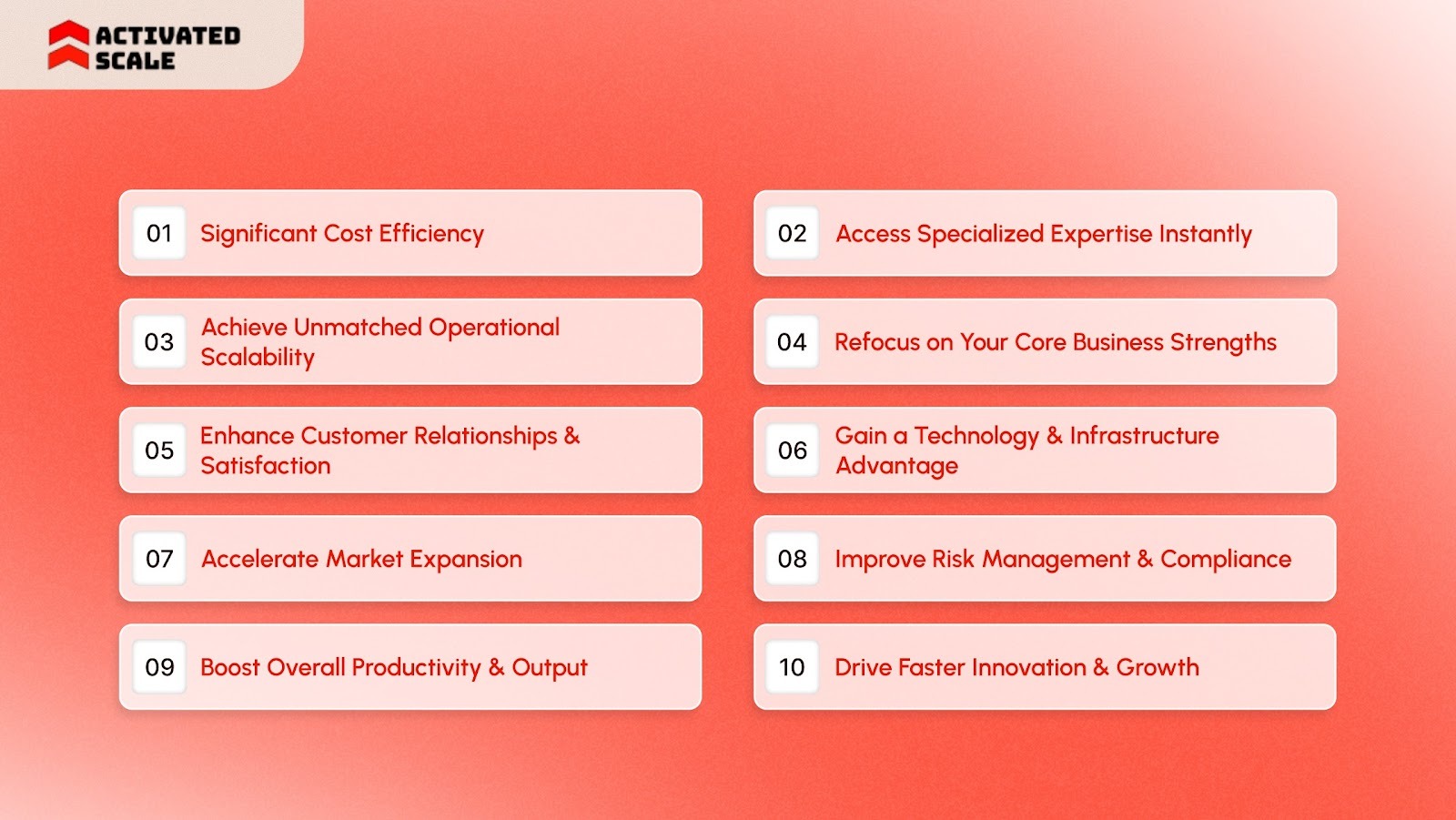
1. Significant Cost Efficiency
Outsourcing eCommerce converts fixed costs into variable ones. You avoid large investments in full-time salaries. There are no costs for employee benefits or office space.
Over 73% of Fortune 500 companies rely on multi-process outsourcing to run their operations efficiently. However, based on your needs, you can pay only for the services and scale you need.
2. Access Specialized Expertise Instantly
Building deep expertise in-house takes time and money. Recruitment and training cycles are long. eCommerce outsourcing gives you instant access to skilled professionals.
You gain access to SEO experts, 24/7 support, and PPC management. These teams use proven playbooks from day one. Your business benefits from advanced skills immediately.
Need a specialized sales leader to build your strategy? Our Fractional Sales Leadership service from Activated Scale deploys experienced VPs to design your playbook quickly.
3. Achieve Unmatched Operational Scalability
Sales velocity and customer demand are not constant. Peak seasons and promotions create surges. Traditional hiring cannot match this pace. Outsourcing partners provide elastic capacity.
You scale your support or sales development team up or down in days. This agility prevents missed opportunities and idle resources. Scaling an in-house team can take 3-6 months; outsourced teams often scale within 2-4 weeks.
4. Refocus on Your Core Business Strengths
Daily operations can trap sales leaders. You manage tickets and logistics instead of strategy. eCommerce outsourcing reclaims your most valuable asset: time.
External teams handle complex, repetitive tasks. Your internal talent focuses on high-impact work. They drive product innovation and key partnerships. This shift turns managers back into visionaries.
5. Enhance Customer Relationships & Satisfaction
Customer loyalty depends on service quality. Slow responses damage trust and sales. Outsourcing partners provide professional, always-on support. They offer 24/7 coverage and multilingual service.
Returns and issues get handled faster. This direct investment lifts key satisfaction metrics. Happy customers buy more and churn less.
6. Gain a Technology & Infrastructure Advantage
Modern sales require advanced tools. Customer Relationship Management (CRM), analytics platforms, and dialers cost heavily. Licensing and training create large upfront investments.
Around 60% of future users admit they don’t yet know how to use AI tech safely, whether that means sourcing reliable data or protecting sensitive information. So, eCommerce outsourcing can immediately give your team better data and automation.
Activated Scale's Fractional Selling service experts are equipped with the required tools and technology. Access our top-tier sales rep talent.
7. Accelerate Market Expansion
Entering new regions is complex. Local rules, language, and logistics create barriers. An outsourcing partner with regional hubs cuts through this. They provide local support and compliance knowledge.
They manage in-region fulfillment and customer service. This local presence builds trust faster. You can launch new markets in months, not years.
8. Improve Risk Management & Compliance
Data security and labor laws pose significant risks. GDPR, PCI-DSS, and employment regulations are complex. A reputable outsourcing firm assumes this burden.
They ensure full compliance in their operations. This protects your brand and reduces your legal exposure. You gain peace of mind with a professional partner.
9. Boost Overall Productivity & Output
External teams specialize in specific tasks. They execute with focused workflows and deep experience. This specialization leads to higher efficiency.
Customer inquiries are resolved quickly. Your overall business output increases without expanding your internal headcount.
10. Drive Faster Innovation & Growth
Specialized expertise improves execution. Operational agility allows rapid testing. Together, this creates a powerful engine for growth. You can reinvest savings into new initiatives.
You can pilot new sales channels with lower risk. Outsourcing removes friction, letting you innovate and scale at pace.
This list makes the strategy tangible. But in business, profit is what you're looking for. If there is less Return on Investment (ROI), the benefits mean nothing.
Also read: 5 Key Strategies: How to Sell Your Products on Social Media
How Much Does E-Commerce Outsourcing Cost?
Understanding the cost of e-commerce outsourcing is crucial for planning and investment. Costs are not a fixed price tag but vary widely based on multiple factors. A business can pay as little as $4 per hour for a data entry specialist, or invest $15,000+ per month for comprehensive agency services covering design, development, and marketing.
For a more detailed breakdown, here are the typical costs across key e-commerce functions you might outsource:
The ten benefits and costs will show you whether you can choose outsourcing for your business or not. Once you decide, you can match these functions to your specific challenges. This is where theory becomes action.
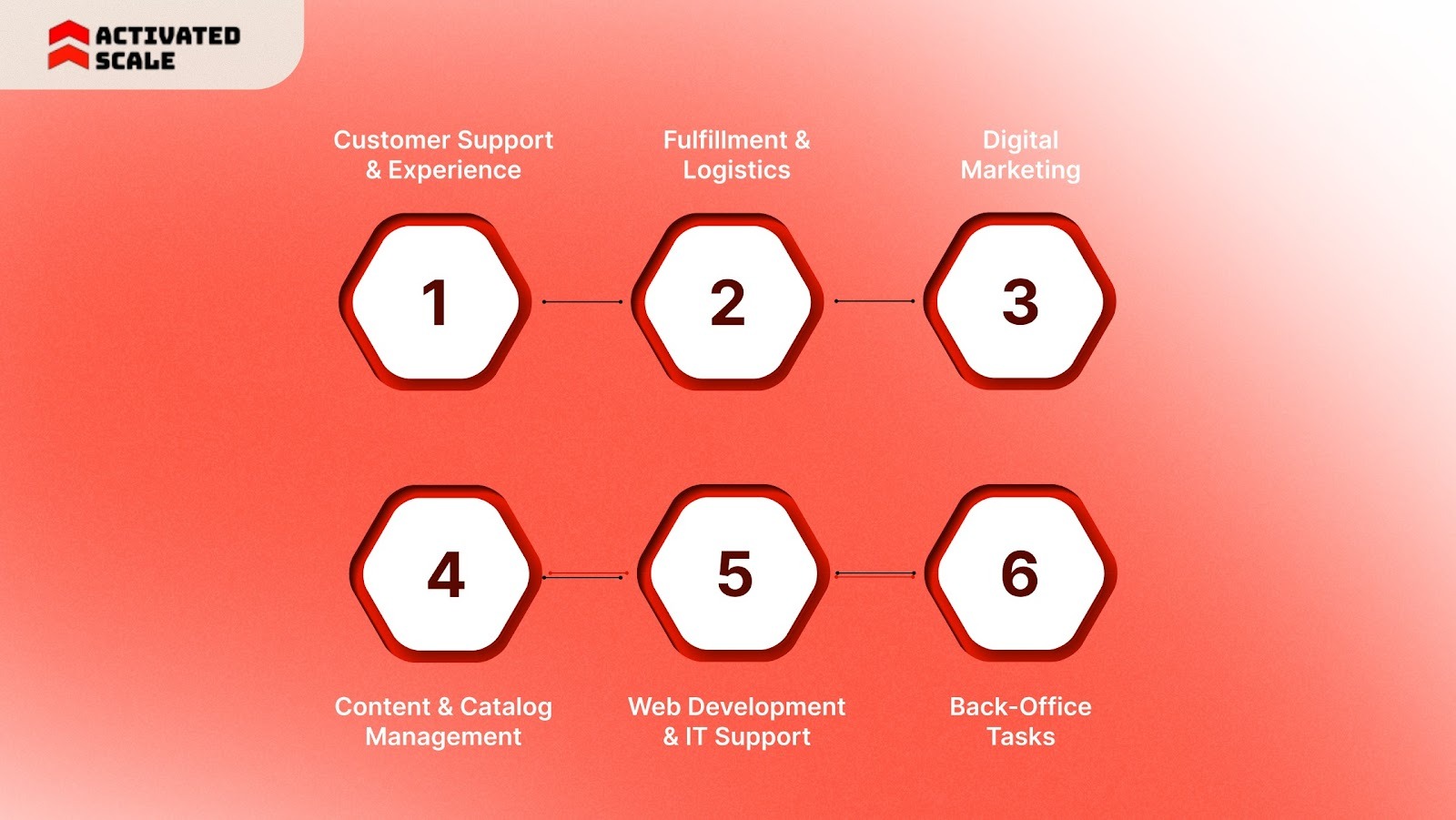
6 Key Functions You Can Outsource in eCommerce
Seeing the benefits is one thing. Knowing where to start is another. If you skip this list, you could accidentally outsource the wrong task or miss a major opportunity.
Here is the content for the key functions you can outsource section, ready for your review:
- Customer Support & Experience: This is the frontline. Teams handle inquiries, returns, and live chat. Outsourcing here directly improves satisfaction scores and frees your staff.
- Fulfillment & Logistics: Partners manage your warehouse, packing, and shipping. They handle inventory and last-mile delivery, turning logistics from a headache into a seamless process.
- Digital Marketing (SEO, PPC, Social Media): Experts run your campaigns and optimize ad spend. They manage search rankings and social engagement to drive consistent lead flow and sales.
- Content & Catalog Management: This includes product descriptions, images, and site updates. Specialists ensure your catalog is accurate, engaging, and optimized for conversions.
- Web Development & IT Support: Agencies maintain your site's health and functionality. They implement new features, fix bugs, and provide technical support to keep your store running smoothly.
- Back-Office Tasks (Data Entry, Bookkeeping): Administrative work like order processing and financial records can be delegated. This creates efficiency in operations that are necessary but not core to the sales strategy.
- Sales: In 2026, sales are no longer tied to finding leads. With so many buying resources available in the market, many founders struggle to keep their pipelines full. Also, if your top reps are focused on sales, who will handle the new strategies? Outsourcing talented reps can keep the organizational function moving overall.
Let Activated Scale's experts handle the vetting. Our Contract-to-Hire Sales Recruiting service provides you with pre-qualified professionals. You can test their fit within your specific workflows before making a full commitment.
So, you’ve seen what you can outsource. But how do you make it actually work? Strong outsourcing needs a solid process. These simple practices help transform a basic contract into a reliable growth partnership.
Your Best Practices for Outsourcing in eCommerce
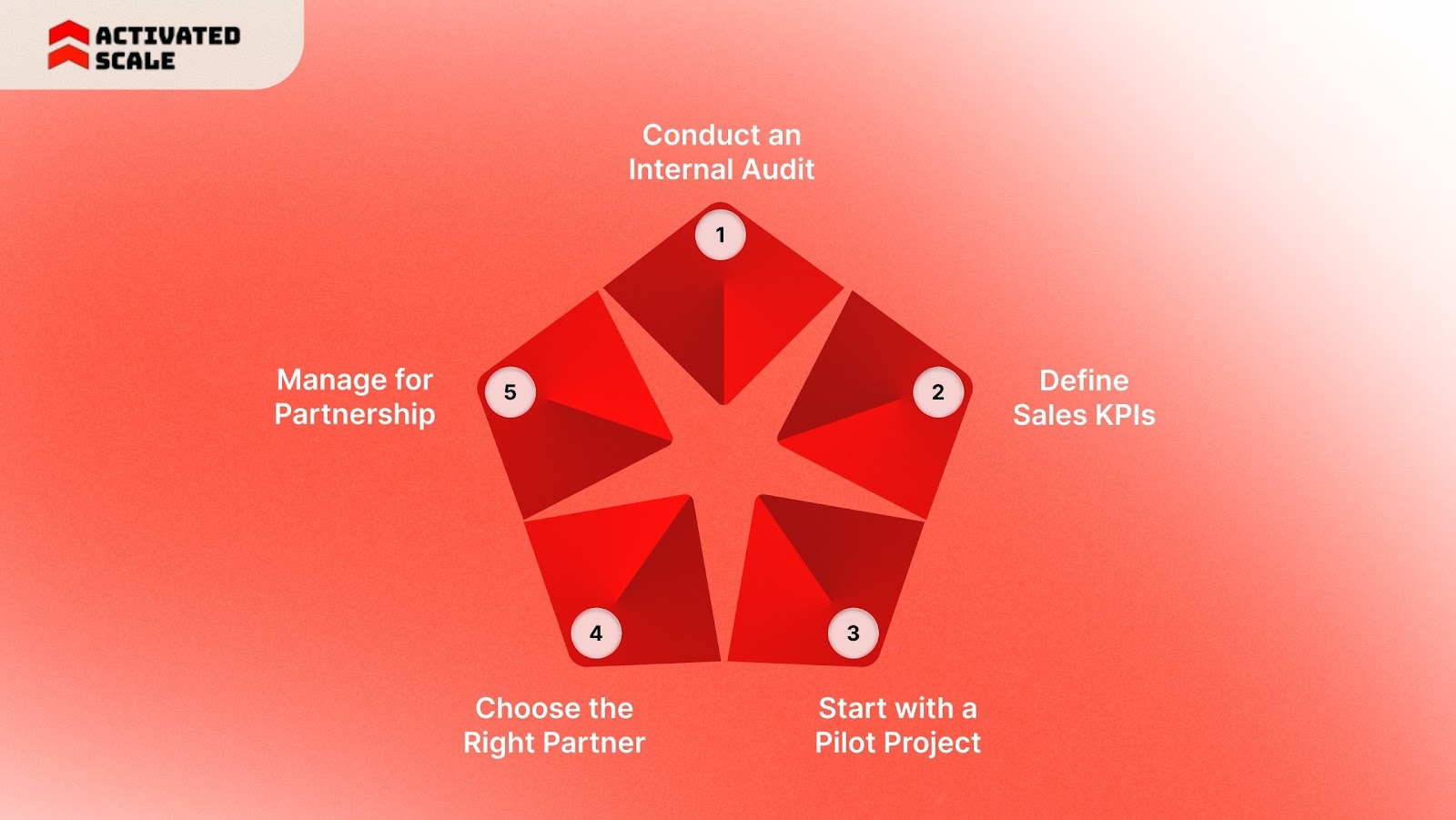
You might face misalignment, poor results, and wasted resources while eCommerce outsourcing. To protect your time and resources, this framework protects your investment.
It ensures your eCommerce outsourcing initiative drives the growth you expect. Let's build your action plan.
Step 1: Conduct an Internal Audit
Begin by looking at your own operations. Identify tasks that consume excessive time. Find processes that require skills you lack internally. Pinpoint areas with frequent errors or delays.
This audit highlights your true pain points and opportunities. It ensures you outsource for strategic impact, not just convenience.
Step 2: Define Sales Key Performance Indicators (KPIs)
Never outsource without a target. Set specific, measurable objectives for the partnership. Do you aim to reduce response time from 24 hours to 2? Do you want to cut fulfillment costs by 15%?
Define these goals upfront. Establish Key Performance Indicators (KPIs) to track progress. This creates accountability and a clear measure of success for both teams.
Step 3: Start with a Pilot Project
Do not overhaul everything at once. Choose one function or a single campaign as a test. A pilot project limits your initial risk. It allows you to evaluate the partner's work quality and communication style.
Use this phase to refine workflows before a full-scale commitment. Success here builds confidence for broader delegation.
Step 4: Choose the Right eCommerce Outsourcing Partner
This decision makes or breaks the initiative. Move beyond basic price comparisons. Evaluate partners on these critical criteria:
- Industry-Specific Experience: Seek providers with a proven track record in eCommerce. Ask for case studies or client references from similar brands.
- Data Security Protocols: This is non-negotiable. Inquire about their compliance certifications (e.g., SOC 2, ISO 27001), data handling policies, and security audits.
- Communication and Reporting Cadence: Understand their standard reporting tools and update frequency. Ensure their communication style aligns with your team's needs.
- Cultural and Operational Fit: Assess if their company culture and work ethic mesh with yours. A partner should feel like a seamless extension of your team.
- Scalability and Contract Flexibility: Confirm they can scale resources up or down as needed. Review contract terms for exit clauses and change management processes.
Transform your operations into a growth accelerator. Let's build a custom talent plan to fuel your innovation with Activated Scale's Contract-to-Hire Sales Recruiting service with the help of our sales reps.
Step 5: Manage for Partnership
After onboarding, active management is key. Schedule regular strategic reviews, not just operational check-ins. Provide feedback and be open to receiving it.
Treat the external team as an integral part of your business. This collaborative approach builds innovation and long-term mutual success.
Also Read: Top Global Sales Outsourcing Trends Shaping 2025
The Bottom Line
The case for eCommerce outsourcing is clear. It is a lever for efficiency, expertise, and growth. This goes beyond saving money on tasks. It is about reinvesting time and capital into your core vision.
The final step is decisive action. You must move from analysis to execution. Identify your single biggest operational constraint this quarter.
Activated Scale is here to solve that project with you. The most critical factor in outsourcing success is the talent executing the work, as a failed hire costs time and momentum.
Let's build your extended team with precision. Book a call with our specialists at Activated Scale.
FAQs
1. What is the biggest risk in eCommerce outsourcing, and how do I mitigate it?
The biggest risk is a misaligned partnership that fails to understand your brand or goals. Mitigate this by starting with a small pilot project.
Conduct thorough due diligence on the partner's industry experience and client references. Clearly define KPIs and communication protocols from day one.
2. How do I measure the ROI of outsourcing a function like customer support?
Track metrics directly tied to cost and quality. Key performance indicators include cost per ticket, first contact resolution rate, average handle time, and customer satisfaction (CSAT) scores.
Compare these metrics before and after outsourcing to calculate the tangible return on investment.
3. Can I outsource if my business is relatively small or just starting to scale?
Yes, outsourcing is highly effective for scaling businesses. The fractional and flexible models are designed for this. You can access expert resources for a specific function or number of hours without a full-time hire.
This allows you to punch above your weight and scale operations efficiently.
4. How do I ensure an outsourced team maintains my brand voice and quality standards?
This is managed through detailed onboarding and ongoing governance. Provide comprehensive brand guidelines, voice & tone documents, and recorded training sessions.
Establish a clear approval process for customer-facing work. Schedule regular quality assurance reviews and feedback loops to ensure consistency.
5. What's the difference between outsourcing and using a freelancer platform?
Outsourcing to a specialized agency or Business Process Outsourcing (BPO) provides a managed team with structured processes, account management, and shared infrastructure.
Freelancer platforms offer individual contributors. Outsourcing is better for ongoing, core business functions requiring reliability. Freelancers can be ideal for one-off projects.
The Ultimate Guide to Hiring a Salesperson!
Get the step-by-step guide to hiring, onboarding, and ensuring success!