_edi.png)

Hiring a marketing agency should make growth easier. For many companies, it does the opposite. Budgets get spent, activity increases, but results remain unclear. That’s not surprising.
According to a 2024 HubSpot survey, over 60% of businesses say their biggest challenge with agencies is proving ROI, not effort or output. At the same time, Gartner reports that CMOs now manage nearly 25% of total company revenue, raising the stakes of every marketing decision.
This is why knowing how to hire a marketing agency matters more than hiring one quickly. The wrong partner doesn’t just waste spend, it delays momentum. This guide breaks down how to hire a marketing company that fits your stage, goals, and internal capabilities, so marketing becomes a growth lever instead of a recurring frustration.
Before we dive into
- Hiring a marketing agency is about fit and clarity, not speed or brand names.
- Most companies hire agencies when internal teams are stretched, growth stalls, or specialized skills are missing.
- A marketing agency works best when goals, ownership, and KPIs are clearly defined upfront.
- Start with a pilot to test execution, communication, and alignment before committing long term.
- Many growing businesses use a hybrid model: lean in-house leadership with agency execution.
- When marketing and sales need to scale together, pairing agencies with flexible sales talent helps turn pipeline into revenue faster.
Why Companies Hire Marketing Agencies?
Most companies don’t hire marketing agencies because they lack ideas. They do it because execution starts breaking down as the business grows. Internal teams get stretched, priorities compete, and progress slows despite good intentions.
A marketing agency steps in to remove friction and accelerate momentum when the need is clear and expectations are defined.
Common reasons companies hire marketing agencies include:
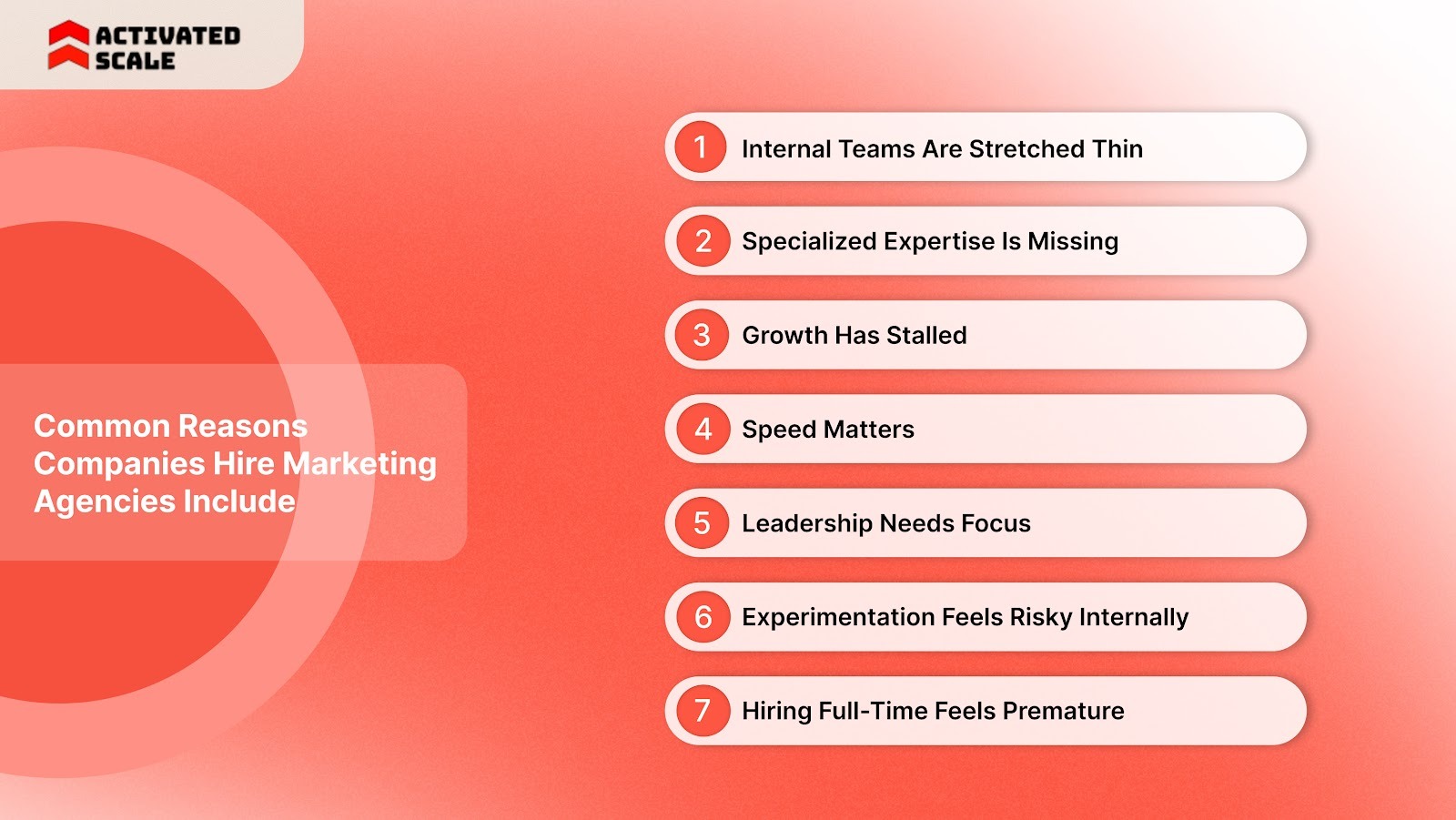
- Internal teams are stretched thin: Marketing work expands quickly across channels. Agencies provide execution capacity without adding headcount.
- Specialized expertise is missing: Skills like SEO, paid media, lifecycle marketing, or analytics often require experience that’s hard to hire quickly.
- Growth has stalled: When the pipeline or engagement plateaus, agencies bring fresh perspectives and tested playbooks to restart momentum.
- Speed matters: Agencies can launch campaigns faster than building and onboarding an in-house team.
- Leadership needs focus: Founders and executives regain time by delegating execution while staying accountable for strategy.
- Experimentation feels risky internally: Agencies help test new channels or tactics without committing long-term resources.
- Hiring full-time feels premature: Agencies act as a bridge while companies validate channels and prepare for in-house ownership.
Used intentionally, marketing agencies help teams move faster and focus on what matters most.
Situations Where Hiring a Marketing Agency Works Best?
Hiring a marketing agency works best when it solves a clear constraint. It’s most effective when you know what’s slowing growth and needs focused execution or expertise to move forward. Without that clarity, agencies often end up reacting instead of driving results.
Teams see the strongest outcomes when agency support complements internal ownership rather than replacing it.
Hiring a marketing agency makes sense when:
- You need speed: Launching campaigns or entering new channels can’t wait for hiring and onboarding cycles.
- The work requires specialized expertise: Skills like SEO, paid media, lifecycle marketing, or conversion optimization aren’t always available in-house.
- You want to test before committing: Agencies allow you to validate channels or strategies before building internal teams.
- Internal bandwidth is limited: When leaders or small teams are juggling too many priorities, agencies help maintain momentum.
- Growth has plateaued: A fresh perspective and proven playbooks can help break through stalled performance.
- Workload fluctuates: Agencies provide flexibility when demand changes month to month.
- You need execution more than strategy: If direction is clear but output is slow, agencies can close the gap.
When these conditions are met, a marketing agency becomes an accelerator rather than a distraction.
Types of Marketing Agencies in 2026
When you hire a marketing company, it’s critical to understand that agencies are not interchangeable. Each type is built to solve different problems, and choosing the wrong category often leads to poor results, even if the agency itself is competent.
Below is a practical breakdown of agency types, how they operate, what they typically offer, and what pricing usually looks like.
1. Full-Service Marketing Agencies
Full-service agencies act as an outsourced marketing department, covering strategy, execution, creative, and analytics across multiple channels.
You typically get a dedicated account team that manages planning, campaigns, reporting, and optimization. They often begin with a discovery phase or audit before building a roadmap.
Services they provide:
- Marketing strategy and planning
- SEO, paid media, content, email, social media
- Creative production (copy, design, video)
- Analytics and performance reporting
Best for:
- Companies without strong internal marketing leadership
- Businesses that want one primary partner across channels
- Teams that need both strategy and execution support
Typical pricing: $5,000–$20,000+ per month, depending on scope and complexity.
2. Digital Marketing Agencies
Digital agencies focus specifically on online growth channels and measurable acquisition. They prioritize tactics tied to traffic, leads, conversions, and revenue. Engagements are often performance-driven with regular reporting.
Services they provide:
- SEO and content marketing
- Paid search and paid social
- Email marketing and automation
- Social media management
- Conversion rate optimization
Best for:
- Growth-stage companies focused on digital acquisition
- Businesses with clear revenue goals tied to online channels
- Teams that already have a functioning website and tracking
Typical pricing: $2,500–$15,000 per month for small to midsize businesses.
3. SEO Agencies
SEO agencies specialize in long-term organic traffic growth through search engines. They audit your site, identify ranking opportunities, optimize structure and content, and build authority over time. Results compound rather than spike quickly.
Services they provide:
- Keyword research
- Technical SEO improvements
- Content optimization and strategy
- Link building
- SEO reporting and tracking
Best for:
- SaaS and content-led businesses
- Companies with longer sales cycles
- Brands investing in sustainable inbound growth
Typical pricing: $1,500–$5,000+ per month for ongoing SEO programs.
4. Paid Media (Performance Marketing) Agencies
These agencies focus on paid acquisition channels such as Google Ads, LinkedIn Ads, Meta Ads, and display advertising. They manage ad accounts, budgets, targeting, creative testing, and ongoing optimization. Performance is tracked using metrics like cost per lead, CAC, ROAS, and pipeline impact.
Services they provide:
- Paid search management
- Paid social campaigns
- Retargeting and display ads
- Budget and bid optimization
- Performance reporting
Best for:
- Companies with validated offers and funnels
- Teams ready to invest consistent ad budgets
- Businesses that need faster, measurable traction
Typical pricing: Often $1,500–$10,000+ per month, or 5–20% of ad spend.
5. Content Marketing Agencies
Content agencies focus on building authority and demand through educational and editorial assets. They manage editorial strategy, content calendars, production, optimization, and performance measurement tied to traffic, engagement, and inbound leads.
Services they provide:
- Blog writing and SEO content
- Thought leadership
- Case studies and whitepapers
- Lead magnets
- Content strategy and distribution
Best for:
- B2B companies with longer buying cycles
- Founder-led brands building credibility
- Businesses relying on inbound as a core channel
Typical pricing: $2,000–$30,000+ per month, depending on volume and depth.
6. Branding Agencies
Branding agencies focus on identity, positioning, messaging, and visual systems rather than ongoing growth execution. Engagements are usually project-based and involve research, workshops, messaging development, creative exploration, and brand system creation.
Services they provide:
- Brand strategy and positioning
- Messaging frameworks
- Visual identity and logo design
- Brand guidelines
- Creative direction
Best for:
- Companies going through a rebrand
- New products entering competitive markets
- Businesses struggling to clearly differentiate
Typical pricing: Branding projects often range from $7,000 to $150,000+, depending on scope.
7. Specialized or Niche Agencies
These agencies focus on a specific industry or function, such as B2B SaaS, healthcare, fintech, e-commerce, lifecycle marketing, or product-led growth. They bring domain expertise, benchmarks, and proven playbooks tailored to your market rather than generic marketing approaches.
Services they provide:
- Industry-specific strategy
- Channel execution aligned to niche (e.g., LinkedIn for B2B)
- Specialized analytics and reporting
- Market-aware optimization
Best for:
- Regulated or complex industries
- Companies with niche audiences
- Teams that have outgrown generalist agencies
Typical pricing: Commonly ranges from $3,000 to $30,000+ per month, depending on specialization.
When you hire a marketing company, you are not choosing between “good” and “bad” agencies. You are choosing between fit and misalignment. The right type of agency aligned to your goals, stage, and internal capabilities will always outperform the most impressive agency that doesn’t understand your context.
How to Hire the Best Marketing Agency (Step by Step)
Hiring a marketing agency is less about finding the “best” firm and more about finding the right operating partner for your goals, stage, and internal bandwidth. A strong process protects your budget, prevents misalignment, and makes expectations clear before anyone starts running campaigns.
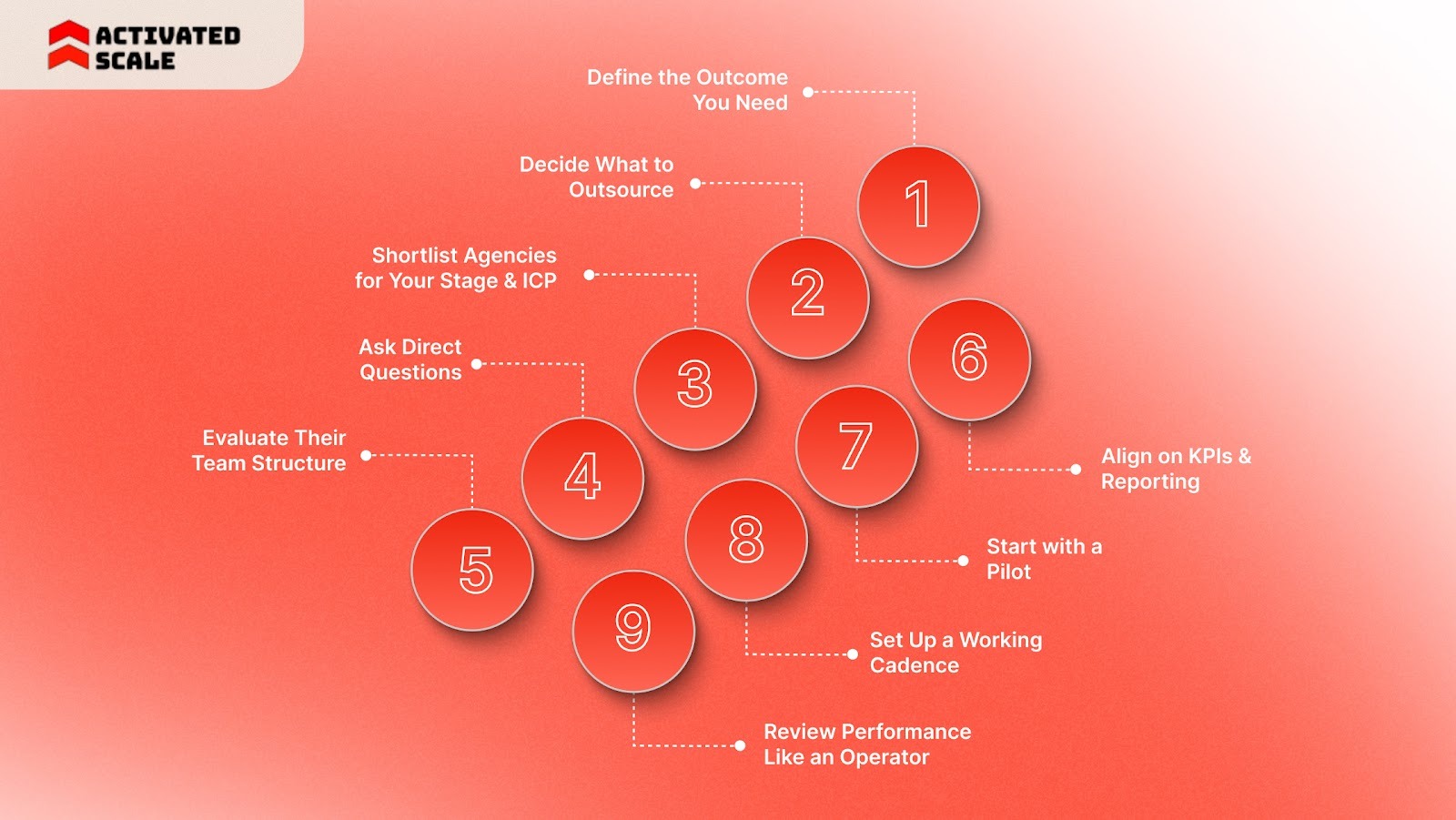
Use the steps below to hire a marketing company with confidence, and avoid the common trap of paying for activity instead of results
Step 1: Get Clear on the Outcome You’re Hiring For
Before you talk to agencies, define the problem in plain language. “We need marketing help” is too broad. Agencies perform best when the target is specific.
Clarify:
- What’s the business goal? (pipeline, revenue, activation, retention, awareness)
- What’s broken right now? (low lead quality, weak conversion, inconsistent traffic, long sales cycles)
- What has already been tried? (so you don’t pay to repeat experiments)
A useful litmus test: if you can’t define success in numbers, it’s too early to hire external help.
Step 2: Decide What You Want to Outsource (Strategy, Execution, or Both)
Many agency relationships fail because ownership is unclear. Decide upfront what role the agency plays.
Common engagement types:
- Execution-only: You own the strategy. They run delivery (ads, SEO, content production, landing pages).
- Strategy + execution: They shape direction and execute it.
- Specialist support: You keep most work in-house and bring experts for one channel (paid search, lifecycle, SEO).
Be honest about what you can handle internally. If nobody on your team can review the strategy, you’ll need an agency that can lead it.
Step 3: Shortlist Agencies That Match Your Stage and ICP
The best agency for a large enterprise often underperforms in a startup environment. You want a partner that understands your constraints.
Look for:
- Experience with your stage (early-stage, growth, scale-up)
- Familiarity with your ICP and buying cycle
- Proof they can operate in your environment (speed, lean resources, rapid iteration)
Ask for examples that look like your business, not polished brand-name logos.
Step 4: Ask Direct Questions That Reveal How They Work
Agencies can sound great in pitch mode. Your job is to understand their operating style.
Ask:
- How do you diagnose what’s holding growth back?
- What’s your first 30 days look like?
- How do you prioritize channels and experiments?
- How do you report performance and insights?
- Who does the work day-to-day?
Strong agencies answer with process, not buzzwords.
Step 5: Evaluate Their Team Structure (Not Just the Proposal)
You’re not hiring the agency brand, you’re hiring the people assigned to you.
Confirm:
- Who is your account lead, and how involved are they?
- How many accounts does each team member manage?
- What functions are in-house vs subcontracted?
- What happens if someone leaves?
A smaller team with consistent attention often beats a bigger agency where you’re one of many accounts.
Step 6: Align on KPIs, Reporting, and Ownership
This is where expectations become real. If you skip this step, you’ll end up debating subjective “progress” later.
Lock in:
Primary KPIs (business impact metrics): These measure whether marketing is contributing to real business outcomes:
- MQLs (Marketing Qualified Leads): Leads that meet your quality criteria and are likely to convert
- SQLs (Sales Qualified Leads): Leads the sales team has reviewed and accepted as worth pursuing
- CAC (Customer Acquisition Cost): How much it costs to acquire one customer through marketing and sales
- Conversion rate: The percentage of users who complete a desired action (signups, demos, purchases)
- Demos booked: Especially relevant for B2B, this tracks how many qualified prospects are entering the sales process
- Pipeline created: The total revenue value of opportunities influenced or generated by marketing
Leading indicators (early performance signals): These don’t equal revenue, but they show whether campaigns are moving in the right direction:
- CTR (Click-through rate): Indicates whether messaging and targeting are resonating
- CVR (Conversion rate): Shows whether landing pages and offers are effective
- Traffic quality and volume: Reveals whether the right audience is being reached
- Email engagement: Open rates, clicks, and replies help assess audience interest
Make sure you’re measuring outcomes, not just output volume.
Step 7: Start With a Pilot Before a Long-Term Commitment
A pilot reduces risk and makes performance easy to assess.
A good pilot has:
- A defined scope (one channel or one funnel stage)
- A clear timeline (4–8 weeks is common)
- Agreed metrics and deliverables
- A decision point (continue, adjust, or stop)
Agencies that refuse pilots often rely on long contracts to compensate for weak delivery.
Step 8: Set Up a Working Cadence That Prevents Drift
Even a great agency will struggle if communication is inconsistent.
Best practices:
- Weekly check-in with clear agendas
- Shared dashboard and centralized project tracking
- Fast feedback loops on creative and messaging
- One internal point person who owns the relationship
If you treat the agency like a side project, results will look like side-project results.
Step 9: Review Performance Like an Operator
Once work begins, judge performance based on signals, not sentiment.
Look for:
- Clear reasoning behind decisions
- Transparent reporting (good and bad)
- A testing mindset with learning loops
- Ownership of results, not excuses
The best agencies don’t just run campaigns. They help you understand what’s working and why.
If sales readiness or hiring risk is part of the picture, vetting matters. Activated Scale’s Contract-to-Hire Sales Recruiting connects you with pre-vetted, U.S.-based sales professionals, so you can test fit and performance before committing long-term.
What to Watch For When Hiring a Marketing Company
Most agency problems don’t show up after six months; they show up in the first few conversations. The challenge is knowing what signals actually matter. Beyond polished decks and confident promises, there are patterns that often predict whether an agency will help or hurt your momentum.
Paying attention to these early indicators can save time, budget, and frustration.
Watch for these warning signs when hiring a marketing company:
- Guaranteed results or unrealistic timelines: Marketing outcomes depend on many variables. Promises of fixed results or instant wins usually signal oversimplification.
- Vague answers about accountability: If an agency can’t clearly explain how success is measured or what happens when results stall, expectations will drift.
- Overemphasis on tactics instead of outcomes: Strong agencies talk about goals, constraints, and trade-offs before tools or channels.
- One-size-fits-all proposals: Generic plans suggest a limited understanding of your business, market, or stage.
- Unclear ownership and roles: Confusion around who owns strategy, approvals, and execution leads to delays and conflict.
- Limited transparency into the working team: If you can’t meet or evaluate the people doing the work, consistency becomes a risk.
- Long-term contracts with no pilot option: Lock-ins before performance is proven reduce your ability to course-correct.
- Buzzwords without substance: Heavy jargon often hides weak processes or a lack of experience.
Spotting these signs early helps you avoid partnerships that consume energy without delivering results.
In-House vs Agency: A Quick Comparison
Deciding between building an in-house marketing team and working with an agency isn’t about choosing the “better” option. It’s about choosing the model that fits your current goals, budget, and pace of growth. Each approach solves a different set of problems, and the right choice often changes as the business evolves.
The table below highlights how in-house teams and agencies compare across the factors that matter most.
Many companies use a hybrid approach, lean in-house leadership paired with agency execution, until scale and certainty justify deeper internal investment.
Also Read: How to Outsource Marketing Services for Business Growth
Final Thoughts
Hiring a marketing agency works best when expectations are clear. It’s not about handing off responsibility; it’s about bringing in the right execution partner, so your team can stay focused on growth.
If marketing execution or team bandwidth is slowing progress, choosing the right partner matters more than choosing quickly. The goal isn’t to outsource ownership, but to bring in support that helps you move forward with confidence.
When growth depends on sales and marketing working in sync, Activated Scale helps teams avoid early hiring risk by connecting them with vetted, U.S.-based sales leaders and reps who can support execution while marketing efforts scale.
Explore how Activated Scale can help you grow businesses and build revenue momentum without locking into early hires.
FAQs
How do I know if I should hire a marketing agency or build in-house?
If you need speed, specialized expertise, or short-term execution support, a marketing agency often makes sense. In-house teams are better suited for long-term ownership once strategy and channels are proven. Many growing companies use agencies as a bridge.
What should I look for when hiring a marketing company?
Focus on fit over reputation. Look for experience with companies at your stage, clear success metrics, transparent reporting, and a team structure you can trust. Avoid agencies that promise guaranteed results.
How long does it take to see results after hiring a marketing agency?
Timelines vary by channel. Paid media may show early signals within weeks, while SEO and content typically take several months. Clear goals and realistic expectations help measure progress accurately.
Should a marketing agency define my strategy or just execute it?
That depends on your internal capabilities. If you already have a clear strategy, an execution-focused agency can move faster. If not, choose an agency that can guide strategy while aligning closely with your goals.
What’s the biggest mistake companies make when hiring a marketing agency?
Hiring without clarity. Vague goals, unclear ownership, and a lack of KPIs make it hard for any agency to succeed.
How much does it cost to hire a marketing agency?
Costs vary based on scope and services. Monthly retainers can range from a few thousand dollars to significantly more, depending on complexity and channels involved.
Can a marketing agency help with sales growth as well?
Marketing agencies can support lead generation and pipeline creation, but sales execution often requires additional support. Many teams pair marketing agencies with flexible sales talent to ensure leads convert into revenue.
The Ultimate Guide to Hiring a Salesperson!
Get the step-by-step guide to hiring, onboarding, and ensuring success!