_edi.png)

Retention has officially stabilized, but the bar just got higher. Net Revenue Retention and Gross Revenue Retention plateaued after two years of decline. So the churn isn't getting worse, but it's not magically fixing itself either.
Top-performing companies do not treat churn as a late-stage issue now. They build retention into how revenue flows across teams. Most others react after the damage shows up.
The real failure starts earlier, such as a poor-fit deal, a broken handoff, low product adoption, and missed engagement signals.
By the time churn appears in your forecast, the warning signs are already visible. This blog breaks down a RevOps churn reduction strategy assessment to find those signals early and fix them before revenue slips.
Key Takeaways
- Churn risk appears early through behavioral signals like low product usage, weak engagement, and delayed onboarding milestones, not just renewal data.
- After two years of decline, both Net Revenue Retention and Gross Revenue Retention began to stabilize.
- Most churn reduction efforts fail due to misalignment across teams, not poor execution within customer success alone.
- Product data is critical for retention. Feature adoption and usage depth directly indicate customer health and churn risk.
- Regular reviews matter. Monthly signal tracking and quarterly assessments help catch issues before they impact revenue.
What is a RevOps Churn Reduction Strategy Assessment?
A RevOps Churn Reduction Strategy Assessment is a structured evaluation of how your revenue operations across marketing, sales, customer success, and support influence customer retention outcomes. It examines data flow, lifecycle ownership, handoff gaps, renewal signals, expansion readiness, and risk detection systems to identify where churn risk is being created or missed.
Unlike a standard churn review, which typically looks at historical loss metrics after customers leave, this assessment focuses on forward-looking operational drivers that shape retention before renewal decisions occur.
It is designed for SaaS founders, revenue leaders, RevOps teams, and customer success executives who want to diagnose retention breakdowns, align lifecycle accountability, and build predictable expansion and renewal performance across the revenue engine.
What Churn Looks Like in a RevOps Context
Most churn dashboards show what has already gone wrong. They do not show where it started. A RevOps churn reduction strategy assessment reframes churn as a system failure. Customer acquisition costs (CAC) remain high, increasing pressure on retention. Customers interact across multiple touchpoints before renewal.
That complexity hides churn signals across systems and teams. A few types of churn are:
- Voluntary churn: Customers cancel due to low value perception or poor experience
- Involuntary churn: Payment failures or billing issues cause revenue loss
- Early churn: Customers leave before reaching value
- Expansion churn: Existing customers reduce spend or downgrade
- Revenue churn: Total revenue lost from existing customers
- Logo churn: Number of customers who leave
Most teams list churn reasons at a surface level. That view hides how revenue leaks across stages. An assessment connects each cause to a specific breakdown in your revenue model.
The table below shows how churn signals map to lifecycle stages and what RevOps action each one should trigger:
Most churn prevention frameworks stop at identifying signal types. The real gap is connecting each signal to a specific owner and a specific action before the renewal window opens.
Also Read: What kind of Salesperson do you need?
The Real Causes of Churn Based on RevOps Analysis
Churn is preventable with proactive customer engagement, yet most companies don't act until the customer is already leaving. What matters is where these issues originate and how they connect.

A RevOps churn reduction strategy assessment shows you where revenue loss actually begins:
1. Acquisition-stage Mismatch
It starts with acquisition quality, expectation setting, and early activation. In many SaaS companies, the real retention problem is not weak renewal management. It is a weak lifecycle design.
An assessment flags Ideal Customer Profile (ICP) gaps early. It ties acquisition quality directly to retention outcomes.
2. Onboarding and Activation Failure
Look closely at handoffs such as:
- Marketing to sales
- Sales to onboarding
- Onboarding to customer success
- customer success to renewal or expansion
If customer context is lost, if use cases are not documented, or if promised outcomes are never translated into an onboarding plan, the customer experiences friction long before churn shows up in reporting.
For example, when sales closes an account without documenting the buyer’s success goal, the onboarding team starts with execution but no strategic context. The customer then spends the first few weeks repeating information instead of moving toward value.
3. Product Usage and Engagement drop
A customer should not have to wait until quarter-end to feel the product is working. Effective churn reduction strategies define what the first value looks like and measure how quickly different customer segments reach it.
This may include:
- First key workflow completed
- First report generated
- First team member invited
- First feature adopted beyond setup
- First measurable business outcome achieved
When customers miss these milestones, churn risk rises early. A RevOps-led strategy tracks those milestones by segment, not as one blended onboarding metric.
4. Pricing and Perceived Value Issues
Customers rarely leave without questioning value. Pricing and packaging shape that perception early. Misaligned pricing tiers push customers into the wrong plans.
Packaging fails to match how customers actually use the product. That gap creates friction at renewal or expansion stages. It reveals where value perception breaks down.
5. Broken Customer Journey Across Teams
Instead of treating handoff as a transfer of notes, high-performing teams document:
- The customer’s main business goal
- The expected success metric
- The first 30 to 90-day milestones
- Known risks or adoption blockers
- Who owns each next step internally
Customer success inherits accounts without full visibility. Assessment can build a continuous view of the customer lifecycle. That continuity is one of the clearest differences between reactive retention teams and proactive ones.
If your team is seeing a strong pipeline but inconsistent retention, sales talent from Activated Scale's Fractional Sales Leadership service can help build a retention-focused Go-to-Market (GTM) system.
Once you see where churn starts, random fixes stop working. You need a structured way to evaluate the system, so a step-by-step framework needs to be built.
5-Step RevOps Churn Reduction Strategy Assessment Framework for 2026
If you don’t have a structured way to reduce churn, you end up fixing isolated issues. One quarter it’s onboarding, next quarter it’s pricing, then product adoption. The problem is the lack of a system.
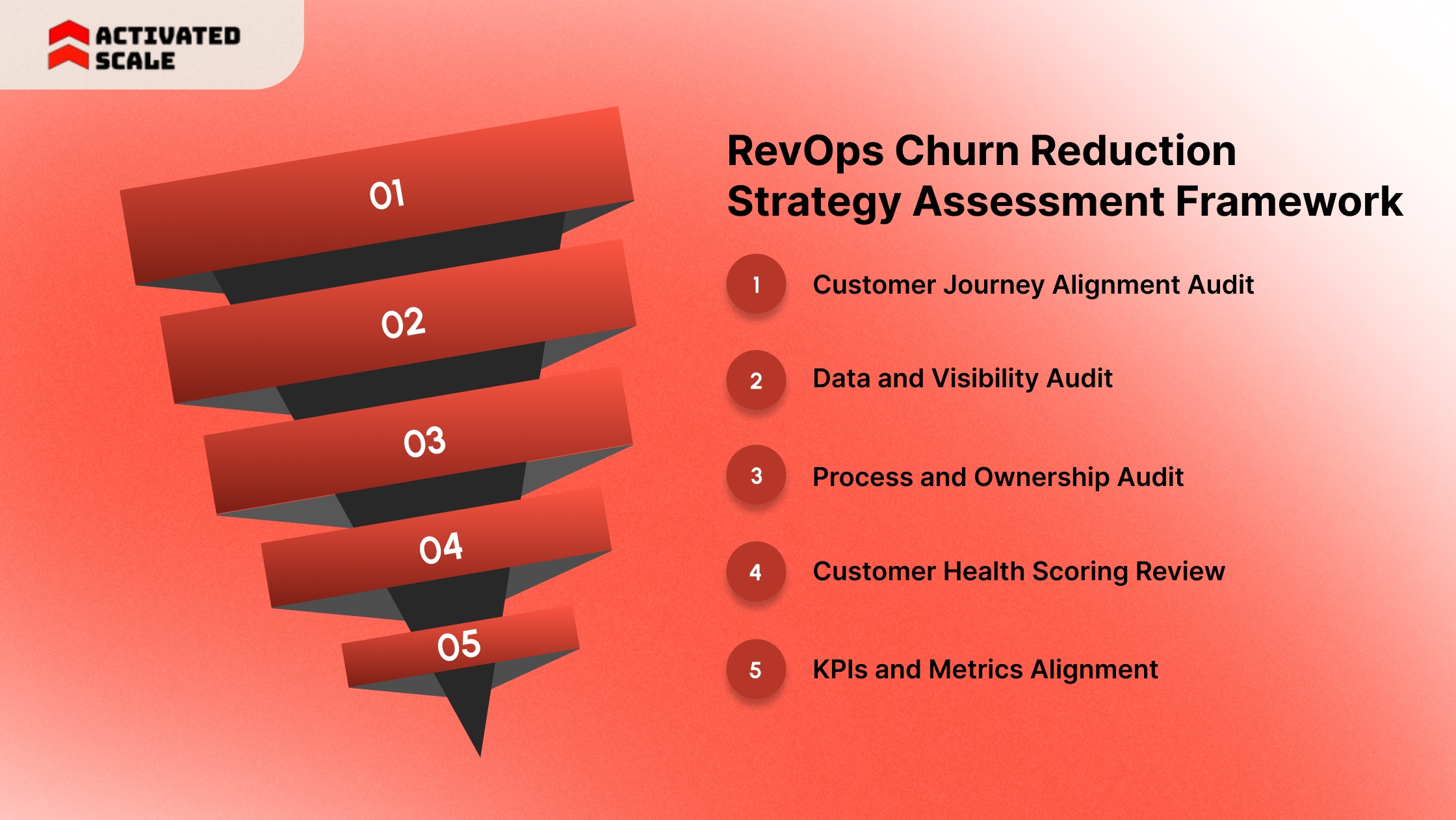
Building RevOps churn reduction strategies connects you with lifecycle stages, data visibility, and ownership so you can trace churn back to its origin:
1. Customer Journey Alignment Audit
Many churn strategies begin too late. The highest-leverage retention improvement usually happens before the contract is signed. Retention-qualified acquisition means checking whether:
- The customer matches your Ideal Customer Profile
- Expected outcomes are documented before onboarding begins
- Product capability matches the promised use case
- Stakeholders involved in the sale remain involved after activation
For example, if one acquisition channel consistently produces accounts with slower activation and lower feature adoption, the strategy should adjust targeting before scaling the pipeline from that source further.
2. Data and Visibility Audit
Customers rarely renew without reaching measurable value early. Time-to-value gaps are one of the most consistent predictors of first-cycle churn. A RevOps strategy should define:
- What “first value” looks like for each segment
- How quickly customers reach that milestone
- Which onboarding actions correlate with expansion readiness
For instance, enterprise accounts may require workflow integration before value appears, while mid-market customers may reach value through feature activation within the first few sessions. Treating both journeys the same weakens retention outcomes.
3. Process and Ownership Audit
Retention improves when ownership follows the customer instead of stopping at departmental boundaries. A RevOps churn strategy should define:
- Who owns adoption milestones
- Who responds to engagement decline
- Who manages stakeholder transitions
- Who prepares expansion readiness signals
Many companies track these signals without assigning responsibility for acting on them. That creates visibility without control. Clear lifecycle ownership allows teams to intervene before renewal conversations become recovery conversations.
4. Customer Health Scoring Review
Most teams already track a health score. The real question is whether it predicts churn early enough to trigger action. A RevOps churn reduction strategy assessment tests whether scoring inputs reflect real customer behaviour across the lifecycle, not surface-level activity.
High-confidence models usually combine signals such as:
- Product login frequency (30%): A decline over 14 to 30 days often signals disengagement risk
- Feature adoption depth (25%): Customers using only basic features show lower renewal probability
- Support ticket volume and severity (20%): Repeated unresolved issues increase exit likelihood
- Executive sponsor engagement or stakeholder changes (15%): Loss of internal champions weakens account stability
- Onboarding milestone completion (10%): Incomplete setup correlates with early churn
5. Key Performance Indicators (KPIs) and Metrics Alignment
Metrics often exist in isolation. Sales tracks bookings, and finance tracks revenue. That separation hides how decisions in one area affect outcomes in another.
You need to connect it to Lifetime Value to Customer Acquisition Cost (LTV-to-CAC), retention cohorts, and expansion trends. This alignment also forces teams to focus on long-term revenue rather than short-term wins.
Metrics Every RevOps Team Must Track for Churn Reduction
Tracking the right metrics changes how teams respond to churn. Leading indicators show what has already happened. Leading indicators show what will happen next.
Focus on a mix of both:
- Gross churn rate: Total revenue or customers lost within a period
- Net revenue retention (NRR): Revenue retained after expansion and contraction
- Expansion vs contraction: Growth within existing accounts versus revenue loss
- Customer health score: Composite signal of engagement and risk
- Product adoption metrics: Feature usage, frequency, and depth of engagement
Over time, this creates a system where churn signals are addressed earlier and more consistently across segments. Most teams already have the data. The issue is how they interpret and act on it across the lifecycle.
Download Now: RevOps Churn Assessment Checklist
A Quick Checklist of Churn Assessment for the RevOps Team
Use this quick checklist to evaluate whether your revenue operations setup is actively reducing churn or quietly contributing to it. Teams often revisit this during quarterly retention reviews.
- Do marketing, sales, and customer success share a single definition of churn risk?
- Are lifecycle ownership transitions clearly defined after handoff from sales to success?
- Can your team identify churn signals before renewal windows open?
- Is product usage data connected to CRM or success dashboards?
- Are expansion and renewal metrics tracked separately from retention metrics?
- Do customer health scores update automatically using behavioral signals?
- Are onboarding milestones tied to long-term retention outcomes?
- Can leadership see churn drivers segmented by cohort, industry, or deal size?
- Are at-risk accounts flagged early with automated alerts?
- Do compensation plans support retention, not just acquisition?
- Are support tickets influencing success workflows and renewal forecasting?
- Is there a documented intervention playbook for high-risk accounts?
- Are renewal forecasts based on usage indicators, not just pipeline assumptions?
- Do RevOps dashboards track expansion readiness alongside churn probability?
- Is churn analysis feeding back into ICP refinement and qualification criteria?
Teams that can confidently check most of these boxes usually have retention visibility built into their revenue engine rather than reacting after losses appear.
Since churn reduction isn't a one-time process, you might wanna know how often you should run a churn assessment.
How Often Should You Run a RevOps Churn Reduction Strategy Assessment?
The right cadence depends on the company stage, customer volume, and contract structure. Early warning signals appear weekly, pattern shifts emerge monthly, and structural retention gaps surface quarterly or annually.
A practical cadence guide used by teams such as RevPartners includes:
Running assessments at multiple intervals helps teams move from reactive churn reporting to continuous retention control.
Also Read: Customer Loyalty Strategies That Drive Repeat Business and Growth
Final Thoughts
Churn does not appear suddenly at renewal. It builds across decisions made in acquisition, onboarding, and product engagement. When those decisions remain disconnected, revenue loss becomes predictable.
A RevOps churn reduction strategy assessment gives you a way to trace that loss back to its source. It replaces reactive fixes with a structured approach that connects teams, data, and lifecycle ownership.
If your pipeline looks strong but revenue still falls short, the issue is execution across the lifecycle.
Activated Scale helps you fix that execution gap. Get a clear plan to reduce churn and improve revenue predictability by scheduling a call with Activated Scale.
FAQs
1. How do you identify churn risk before it shows in retention metrics?
Look at declining product usage, reduced engagement frequency, and delayed onboarding milestones. A RevOps churn reduction strategy assessment connects these signals across systems so teams can act before renewal risk becomes visible.
2. Why do churn reduction efforts fail even with strong customer success teams?
Customer success can only act on what it can see and control. When acquisition quality, onboarding, and product usage are misaligned, churn originates outside CS ownership.
Without RevOps alignment, even strong CS teams end up reacting late instead of preventing churn early.
3. How often should a churn reduction strategy be reassessed?
High-growth teams should review churn signals monthly and run a full assessment quarterly. Frequent reviews help catch early lifecycle issues, while assessments identify structural gaps across acquisition, onboarding, and engagement.
4. Can churn reduction improve revenue forecasting accuracy?
Yes. When churn drivers are identified early and controlled, revenue becomes more predictable. A RevOps churn reduction strategy assessment improves forecast reliability by reducing unexpected revenue loss from existing customers.
The Ultimate Guide to Hiring a Salesperson!
Get the step-by-step guide to hiring, onboarding, and ensuring success!