For B2B startups without a full in-house sales team, the stakes are higher. Your first external sales relationship often shapes your entire go-to-market motion. Getting the agreement right protects that investment.
This guide covers what a contract sales agency agreement is, the clauses that matter most, how to draft and execute one, and when the contract alone won't be enough to drive results.
TL;DR
- A contract sales agency agreement defines scope, compensation, and legal responsibilities for an external sales agent.
- The highest-risk clauses are commission structure, post-termination payment rights, restrictive covenants, and termination terms — all vary significantly by state.
- No measurable performance requirements means no contractual basis to exit an underperforming agent relationship.
- For early-stage B2B companies, a flexible try-before-you-commit model often beats locking into a long-term agency agreement before the sales motion is proven.
What Is a Contract Sales Agency Agreement?
A contract sales agency agreement is a legally binding document between a principal (the company) and an agent (an independent sales rep or agency) that authorizes the agent to promote and sell the principal's products or services within defined limits.
The agent doesn't buy or resell — they solicit orders on the company's behalf. Under UCC Section 2-106, a sale involves passing title from seller to buyer. A sales agent never takes title; that distinction matters legally and shapes the entire agreement structure.
Agent vs. Employee
This is the classification trap that catches many startups. According to IRS guidance, a worker is an independent contractor when the payer controls the result of the work, not how it gets done. Labels don't determine this. Behavior does.
If you dictate the agent's daily schedule, tools, scripts, and reporting cadence, you've created a misclassification risk. The DOL's 2024 final rule applies a six-factor economic-realities test that looks at control, investment, permanence, and whether the work is integral to your business.
Practical implications of the contractor relationship:
- No payroll taxes or benefits obligations
- Limited employer control over how work is performed
- Different termination rules than employment law provides
- The agent may work for multiple principals simultaneously
How This Differs from Related Agreements
| Agreement Type | Key Distinction |
|---|---|
| Sales agency agreement | Agent solicits orders; principal retains title and invoices the customer |
| Distribution agreement | Distributor buys your product and resells it independently |
| Reseller agreement | Similar to distribution, typically used in software channels |
| Commission-only employment | An employment relationship — not a contractor arrangement |
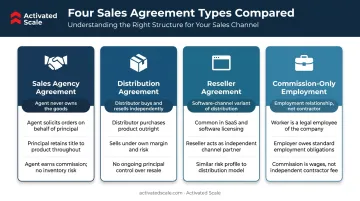
That table distinction has real legal weight. New York, Minnesota, and Massachusetts sales-rep statutes specifically exclude people who buy for their own account to resell — meaning those state protections apply to agents only, not distributors.
Key Clauses Every Contract Sales Agency Agreement Should Include
Disputes cluster around three problems: unclear compensation, undefined scope, and ambiguous exit terms. Every clause below addresses one of those. None are optional.
Relationship, Scope, and Territory
This clause does three jobs:
- Confirms independent contractor status — establishes that the agent is not an employee and operates without day-to-day employer control
- Defines covered products or services — specify exactly what the agent can sell; leaving this vague creates arguments about scope later
- Assigns territory or market segment — geography, industry vertical, company size, or some combination
The exclusivity question deserves real thought. An exclusive territory motivates the agent and rewards their investment in your market. Non-exclusive arrangements let you run multiple agents, but reduce any single agent's incentive to go deep.
For most early-stage B2B companies, exclusive arrangements work well at launch. You want the agent fully committed, not splitting attention. That said, exclusivity constrains your flexibility if the relationship underperforms.
Commission Structure and Payment Terms
Commission clauses fail when they're vague about timing. Define all of the following explicitly:
- Commission basis: Calculated on gross revenue, net revenue, or invoiced amount?
- Trigger event: When is commission "earned" — at order placement, delivery, or customer payment?
- Payment frequency: Monthly, quarterly, upon customer payment?
- Split credits: For long-cycle deals involving multiple contacts or phases, who gets credited for what?
- Incentive tiers: Separate base commission from any bonus or quota-attainment structures
Post-termination commission rights are the most litigated area in sales agency disputes. If deals were in flight when the agreement ended, does the agent earn commission on those? State law often answers this whether your contract does or not:
- New York: Earned commissions due at termination must be paid within 5 business days; noncompliance can trigger double damages
- Massachusetts: Payment required within 14 days; violations carry treble damages plus attorney fees
- Arizona: Payment required within 30 days; failure can create liability for three times unpaid commissions
- Minnesota: Commissions owed for sales made before termination or end of the notice period, regardless of shipment
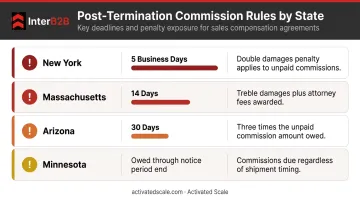
If you operate across multiple states, these rules apply to agents in those states regardless of your contract's choice-of-law clause. Get legal review.
Performance Targets and Accountability
A contract without performance requirements gives you no basis to exit a failing relationship while commissions keep accruing. Define measurable metrics from the start.
Metrics worth specifying include:
- Revenue closed per quarter
- Pipeline value generated
- Meetings or demos booked per month
- Activity benchmarks (outreach volume, call frequency)
Equally important: specify consequences for missing targets. Territory reduction, commission rate adjustment, or termination rights are all legitimate mechanisms — but only if they're in the contract.
One common drafting mistake: "best efforts" and "commercially reasonable efforts" language sounds meaningful but courts treat it inconsistently. The State Bar of Texas recommends defining what those terms actually require. Replace vague obligations with specific, measurable ones.
Confidentiality, Non-Solicitation, and Restrictive Covenants
Agents will access pricing models, customer lists, product roadmaps, and sales processes. The confidentiality clause should define:
- What counts as confidential information
- How long the obligation survives termination
- What the agent can and cannot do with that information
Non-solicitation prevents the agent from approaching your customers or employees after the contract ends. Non-compete clauses restrict them from working for direct competitors.
Both require careful drafting:
- The FTC's noncompete rule is not currently in effect following an August 2024 district court order — state law governs
- California Business and Professions Code Section 16600 voids virtually every contract restraining a person from a lawful profession; California noncompetes are essentially unenforceable
- New York standards are actively evolving through pending legislation
- Non-solicitation clauses are generally enforceable when narrowly drawn, but courts scrutinize anything that functions as a de facto noncompete
Draft these narrowly. A sweeping noncompete that covers an entire industry for two years will be challenged and may be voided entirely.
Termination and Exit Terms
Termination clauses must address three scenarios:
- For cause: Missed performance targets, confidentiality breach, misconduct — what triggers immediate termination vs. a cure period?
- Without cause: Notice period required before either party can exit (Minnesota requires 90 days written notice for covered agreements, with 60 days to cure)
- Post-termination obligations: Return of materials, cessation of brand use, handling of in-flight deals, final commission calculation
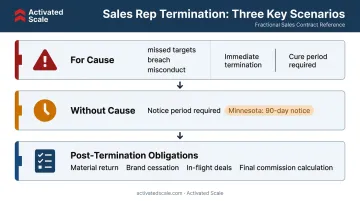
The notice period isn't just a courtesy — it affects how pending deals are handled and when final commission obligations crystallize. Don't treat this as boilerplate.
Dispute Resolution and Governing Law
Specify which state's law governs and how disputes will be resolved — negotiation, mediation, arbitration, or litigation. Companies typically prefer arbitration for speed and cost; agents sometimes prefer court proceedings where jury sympathy is possible. This is a genuine negotiating point, not a formality.
Choice of law matters because commission payment deadlines, noncompete enforceability, and contractor classification rules all vary by state. An agent operating in Massachusetts is protected by Massachusetts commission statutes regardless of whether your contract says New York law applies.
How to Draft and Execute a Contract Sales Agency Agreement
Step 1: Define Your Sales Scope and Objectives First
Before engaging a lawyer or opening a template, get internal clarity on:
- What exactly is being sold, to whom, in which geographic or industry segment
- What success looks like — revenue targets, pipeline volume, meeting metrics
- What the agent will and won't have authority to commit to on your behalf
Vague internal alignment produces vague contracts. Most of the drafting problems that create disputes later start here.
Step 2: Select and Vet the Right Sales Agent
The agent's background, existing relationships, and deal experience directly determine what territory, exclusivity, and commission terms are commercially reasonable. An agent who has never sold into enterprise accounts shouldn't be handed an enterprise-only territory.
This vetting step is where early-stage companies often cut corners. Activated Scale runs a three-stage screening process before any match is made:
- Reviews buyer experience and ACV track record
- Assesses pitch capability through a case study and video submission
- Conducts a subject matter expert interview
Only about 7% of applicants pass. For founders, that means skipping a vetting process that typically takes weeks — and still getting a better result.
Step 3: Draft with Legal Counsel
Templates provide structure, but they don't replace counsel — especially for:
- Post-termination commission rights: State law creates obligations your contract may not address
- Restrictive covenants: Enforceability varies sharply by state; a clause that works in Texas may be void in California
- Governing law and venue: These choices have real consequences when disputes arise
Legal fee models vary — hourly, flat fee, or project-based depending on the firm and scope. The investment is worth it for any agreement that will govern a meaningful sales relationship.
Step 4: Negotiate Key Terms Before Signing
The most commonly negotiated terms are commission rates, exclusivity scope, and performance benchmarks. Agents often push back on:
- Tight non-compete language
- Short post-termination commission windows
- Aggressive payment timelines
Negotiate with flexibility on lower-priority terms; hold firm on confidentiality, IP ownership, performance requirements, and termination rights.
Step 5: Establish Onboarding and Performance Review Processes
A signed contract is not a sales operation. Agents who receive no structured onboarding — no product training, no CRM access, no clarity on messaging and ICP — underperform regardless of contract quality.
Build in:
- Weeks 1-2: Company, product, and buyer education; CRM setup
- Weeks 3-6: Messaging iteration and outbound testing
- Monthly: Pipeline review against defined KPIs
- Quarterly: Formal performance assessment against contractual targets
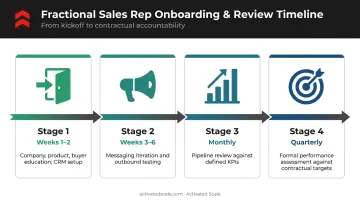
The contract defines what happens if performance fails. The operational infrastructure determines whether it succeeds.
Common Mistakes Companies Make with Contract Sales Agency Agreements
Three contract gaps create the most disputes — and all three are avoidable with upfront attention.
Using a generic template. Commission clauses that don't reflect actual deal cycles, territory definitions that are too broad or too narrow, and missing post-termination provisions are the most common dispute triggers. Startups that rush to get a rep selling tend to discover these gaps at the worst possible moment — when the relationship breaks down.
Skipping measurable performance requirements. Without defined quotas or activity benchmarks, there's no contractual basis to exit an underperforming relationship. "Best efforts" is not a performance standard — courts treat it inconsistently at best and dismiss it at worst.
Underestimating IP and confidentiality exposure. Agents who handle customer data, pricing models, or internal sales processes can carry sensitive information straight to a competitor. Most early-stage founders don't realize how valuable their customer list and pricing strategy are until a former agent proves it for them.
When a Contract Sales Agency Agreement Alone Isn't Enough
A well-drafted agreement creates legal clarity. It doesn't create sales capability.
Companies that rely solely on the contract — without investing in agent training, sales collateral, and structured oversight — frequently see poor results even when all contractual terms are met. The contract defines accountability; the operational infrastructure drives performance.
For early-stage B2B companies that haven't yet validated their ICP, messaging, or sales process, a formal long-term agency agreement may be premature. Locking into a multi-month commitment before you know what your sales motion should look like is a meaningful risk.
This is where a shorter, more flexible engagement model makes more sense in practice. Activated Scale's fractional sales model uses a standard three-month initial period. That's long enough to assess cultural fit and evaluate whether a salesperson can actually sell the product, but short enough to limit exposure if the fit isn't right.
Dresma.ai, for example, came to Activated Scale without a repeatable outbound strategy and achieved a 5x increase in meetings with qualified prospects after implementing tools and buyer-focused messaging through a fractional engagement. Tango's co-founder described the engagement as helping them "set a strategy and foundation for growth" before they had one in place.
The practical distinction: a formal agency agreement assumes you know what you're asking the agent to do. A fractional engagement model can help you figure that out first.
Frequently Asked Questions
What is a contract sales agent?
A contract sales agent is an independent professional or agency hired under a formal agreement to solicit orders for a company's products or services. They're compensated through commission or a hybrid model — not a salary — and have no claim to employee benefits or payroll status.
What are the five types of agency?
The five commonly recognized types are: general agency (broad authority to act), special agency (limited to a specific task), agency by necessity, apparent agency, and agency by ratification. Sales agency agreements typically establish either a general or special agency relationship.
What should be included in a sales agency agreement?
At minimum: party identification, scope of products and services covered, territory definition, commission structure and payment timing, performance targets, confidentiality obligations, termination conditions, and a dispute resolution mechanism specifying governing law.
How is a contract sales agent different from a full-time sales employee?
A contract agent is an independent contractor: no payroll, no benefits, and no employer control over how they do the work day-to-day. A full-time employee operates under employment law, receives benefits, and can be directed at the operational level — including how, when, and where they work.
Can a sales agency agreement be terminated early?
Yes. Most agreements include termination for cause (breach, non-performance, misconduct) and termination without cause with a required notice period. State law may impose minimum notice requirements and payment deadlines for outstanding commissions that override whatever the contract says.
Do startups need a lawyer to draft a sales agency agreement?
Templates are a reasonable starting point, but legal review is strongly recommended — particularly for post-termination commission rights, restrictive covenants, and choice of law. Errors in these areas are expensive to fix after a dispute has already started.