Introduction
Here's a pattern that plays out constantly in B2B SaaS: growth stalls, the board says "hire a CRO," and 19 months later that CRO is gone — and the revenue problems remain. According to HBR, the average CRO tenure is just 25 months, making it one of the shortest in the C-suite. For many companies, that's barely longer than a single sales cycle.
The problem usually isn't the person. It's the decision that brought them in.
Most founders conflate the CRO with a senior VP of Sales, hire too early or too late, and fail to build the organizational conditions the role needs to succeed. A mishire at this level costs more than salary. It drains momentum, destabilizes the team, and burns months of execution capacity you can't get back.
This guide covers what a CRO actually owns, the four signals that indicate readiness, what competencies to hire for, how to run the process, and a lower-risk alternative for founders who aren't quite there yet.
TLDR
- A CRO owns the full revenue engine: sales, marketing, customer success, and RevOps — not a single quota
- Hiring before a repeatable sales motion exists is one of the most expensive mistakes a SaaS startup can make
- The right time: consistent traction, proven GTM channels, and more complexity than one VP can manage
- Prioritize data-driven operators with cross-functional experience over strong individual sales performers
- Pre-scale? A fractional sales leader builds the foundation before you commit to a full-time hire
What Does a CRO Actually Do?
The title gets used loosely, so the definition matters.
A VP of Sales manages a sales team toward quota. A CRO owns the entire revenue lifecycle — from the first marketing touch to closed-won, expansion, and renewal. That scope includes field and inside sales, marketing (in many organizations), customer success, revenue operations, sales development, partnerships, and sales enablement.
The Three Core CRO Responsibilities
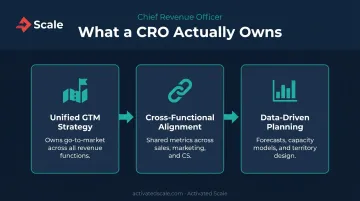
Every effective CRO executes on three fundamentals:
- Unified GTM strategy — Builds and owns the go-to-market plan across all revenue-generating functions, not just the sales pipeline
- Cross-functional alignment — Drives shared metrics and customer outcomes across sales, marketing, and CS so each team optimizes for the same goals
- Data-driven planning — Builds accurate revenue forecasts, capacity models, and territory designs tied to real business math
Who Reports to the CRO
The CRO reports directly to the CEO. Typically reporting to the CRO:
- VP of Sales
- CMO (in many org designs)
- Head of Customer Success
- RevOps leader
This structure gives one person genuine accountability for the full revenue lifecycle.
The key distinction for founders: if you're hiring someone to "run sales" with a fancier title, that's not a CRO — it's a leadership design mistake that sets up an expensive failure. A CRO without genuine cross-functional authority can't do the job, regardless of their experience.
B2B organizations that centralize revenue operations grow revenue nearly three times faster than those that don't. That advantage only materializes when someone actually owns it end-to-end.
When Is Your Startup Ready to Hire a CRO?
Readiness is about whether your organization has the conditions a CRO needs to succeed — not just whether you've crossed a revenue threshold.
Signal 1: A Repeatable Sales Motion Already Exists
A CRO's job is to scale a working motion, not invent one from scratch. According to SaaStr, most startups under $5–10M ARR need a hands-on VP of Sales to build and prove the first GTM motion. The true CRO conversation starts at $15–20M ARR for most companies, though fast-growing SaaS startups are having it closer to $10M ARR.
If no repeatable motion exists, the CRO will spend their tenure building foundational systems — work that's better suited to a VP of Sales and far cheaper to execute.
Signal 2: GTM Complexity Exceeds One Leader's Capacity
Revenue complexity is a better readiness signal than ARR alone. When you're running a product-led growth track alongside an enterprise top-down motion, or expanding into new geographies while managing multiple customer segments, no single VP can hold it all. You need one executive managing the interdependencies across every motion.
Signal 3: Growth Has Stalled Despite Strong PMF
If you have a proven ICP and product but revenue has become inconsistent quarter-over-quarter, the issue is usually structural misalignment across GTM teams. Watch for these patterns:
- Forecast accuracy below 70% consistently
- Lead-to-close rates declining despite stable top-of-funnel
- CS churn disconnected from sales commitments made during the deal
- Marketing MQL volume up, but pipeline quality down
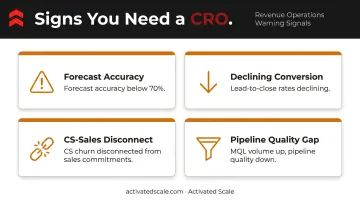
These are symptoms of fragmented revenue leadership, not product problems — and they're a CRO's core job to fix.
Signal 4: No Single Executive Owns Revenue End-to-End
When sales optimizes for short-term wins, marketing optimizes for MQL volume, and CS fights churn in a silo, every team is technically hitting their own metrics while the company misses its growth targets. The efficiency loss is real and compounds quarterly. A CRO's unified ownership is the structural fix.
The Red Flag: Reactive Hiring
The most dangerous hire is the one made in response to board pressure or a bad quarter. Before pulling the trigger, diagnose whether your org has the data systems and decision-making authority a CRO actually needs. Most CRO failures come down to company readiness, not personal capability.
What to Look for in a CRO
The right candidate profile depends on your stage and sales motion, but four competencies separate genuine CRO candidates from senior VPs of Sales with upgraded titles.
Competency 1: Data-Driven Operational Rigor
Strong CROs make decisions by the numbers. They build accurate revenue forecasts, set quota structures tied to real business math, and can tell you which specific GTM variable to adjust when a number goes off-track.
Warning sign in interviews: If a candidate can't walk through their forecasting methodology or explain how they've diagnosed a pipeline problem using data, they're not ready.
Competency 2: Cross-Functional Leadership
Sales track record alone is not enough. The candidate must have demonstrable experience leading or closely collaborating with marketing, CS, and RevOps — not just building sales teams.
Ask directly: How have you driven alignment between sales and marketing when those teams disagreed on pipeline quality? What did you measure, and what changed? The depth of their answer tells you everything.
Competency 3: GTM Talent Architecture
A CRO's two biggest drivers of growth are sales capacity and sales productivity. The best CROs think 12–18 months ahead on headcount, attract strong AEs and SDRs, and build enablement programs that ramp reps quickly. Average AE ramp time in B2B SaaS is currently 5.7 months (Bridge Group, 2024) — a CRO who systematically reduces that number accelerates revenue compounding across every quarter.
Competency 4: Stage-Matched Experience
A CRO from a 5,000-person company will often struggle at a 50-person startup. Find someone who has scaled revenue from roughly your current ARR to where you want to go — and who has built from scratch, not just managed mature systems. An internal promotion history is a useful signal of upward trajectory and genuine execution.
The profile also needs to match your sales motion — a CRO for an inbound-led business looks different from one built for enterprise outbound. Before you start the search, know which scenario applies to you:
- Scale an existing motion — more volume, tighter execution, faster ramp
- Layer in a new motion — for example, moving from PLG to enterprise sales
- Drive post-sale expansion — ownership of renewals, upsells, and NRR growth
How to Run a CRO Hiring Process
Define the Role Before You Recruit
Before writing a job description, write a role definition: what functions this person owns, what outcomes they're accountable for in the first 12–18 months, and what authority they'll have to make organizational changes. Without this document, every candidate will project their own interpretation onto the role — and misaligned expectations are how expensive hires fail on day one.
Keep the Interview Loop Tight and Move Fast
CRO candidates are in demand and won't wait through a six-round process. Limit the interview panel to four to five stakeholders: CEO, CTO or CPO, finance, and a marketing leader. Each interviewer should probe a specific dimension of fit:
- CEO: Strategic vision, cultural alignment, founder relationship
- Marketing leader: Pipeline strategy, demand gen philosophy, their view on MQL vs. pipeline quality
- Product leader: How they handle field feedback, product roadmap influence, customer insight loops
- Finance: Forecasting methodology, capacity planning, business math fluency
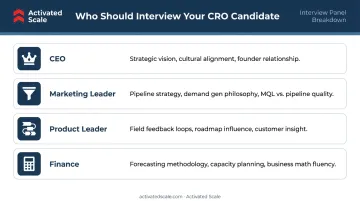
Move the finalist through within two to three weeks. A slow process tells senior candidates the company can't execute. The cost of leaving the role vacant compounds quickly.
Handle Internal Communication and Comp Deliberately
Enterprise sales is a small world. Your existing sales leaders should hear about this hire directly from you — not through the grapevine or a surprise LinkedIn post. A direct conversation before the announcement prevents the defensive posturing and quiet disengagement that derails new CRO onboarding.
On compensation: US-based CROs carry significant cost. Glassdoor data puts median total pay at $594,003. Here's how the comp typically breaks down:
- Base salary: $184,000–$320,000
- Variable compensation: $263,000–$492,000
- Equity: Common at early-stage companies, especially Series A and below
Structure the variable component around the specific outcomes you need in year one — not generic revenue targets.
Is a Fractional CRO the Right Move for Your Stage?
Many founders facing revenue stagnation assume the answer is a full-time CRO. Often, the real need is something narrower: a repeatable sales process, a defined ICP, and a functioning GTM playbook. That's exactly what a fractional revenue leader can deliver, without the cost or commitment of a permanent executive hire.
What the Cost Comparison Actually Looks Like
A full-time CRO carries median total compensation around $594,000 per year, a 4–6 month search timeline, and another 6–12 months before meaningful results materialize. A fractional VP of Sales or senior sales leader engagement runs $8,000–$15,000 per month — with placements that start in days, not months.
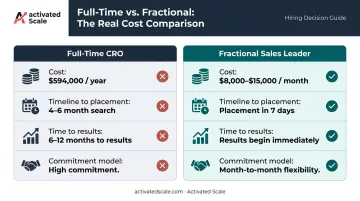
That math matters most for:
- Seed to Series A companies still building out their revenue function
- Founder-led sales teams that need part-time revenue strategy
- Post-funding startups that must show growth momentum quickly
The Try-Before-You-Buy Advantage
Activated Scale connects B2B SaaS startups with vetted, US-based fractional sales professionals — including VP of Sales-level talent — in 7 days or less. Leaders in the network have backgrounds at companies like Salesforce, Oracle, UiPath, and IBM, and work with startups on GTM strategy, sales process development, ICP definition, and playbook documentation.
Engagements run month-to-month. About 85% of Activated Scale clients convert their fractional hire to a full-time employee after the initial contract — once they've validated fit, built the foundational infrastructure, and reached the scale where a permanent executive can succeed from day one.
For example, Tango's co-founder described their fractional engagement this way: "Activated Scale got us access to a PLG-focused sales expert that helped us set a strategy and foundation for growth." That's the use case — build the foundation fractionally, then hand it to a full-time CRO who can scale it.
When you do hire a full-time CRO, they'll walk into a company with a proven process, a documented playbook, and a sales motion that already works.
Frequently Asked Questions
Why would a company hire a CRO?
Companies hire a CRO when misalignment between sales, marketing, and CS is actively costing revenue. That's usually the trigger — along with needing a single owner of the full GTM strategy instead of three leaders optimizing in silos.
How much is a CRO paid?
US-based CROs have a median total compensation of $594,003 according to Glassdoor, with base salaries ranging from $184,000–$320,000 and variable pay adding $263,000–$492,000 on top. At early-stage companies, equity is also commonly part of the package.
What is the difference between a CRO and a VP of Sales?
A VP of Sales leads the sales team with a focus on hitting quota. A CRO has broader ownership across sales, marketing, customer success, and RevOps — accountable for total topline revenue and the full customer lifecycle, not just the sales pipeline.
When is it too early to hire a CRO?
Before $5–10M ARR, most B2B SaaS companies don't have a repeatable motion to scale — so the CRO ends up doing VP of Sales work at two to three times the cost. Build the foundation first, then hire to scale it.
What does a CRO own in a B2B SaaS startup?
The CRO typically owns sales (field and inside), revenue operations, sales development, customer success, sales engineering, and often marketing — all unified under a single revenue growth strategy with direct accountability to the CEO.
Should I hire a full-time CRO or a fractional CRO?
Full-time makes sense when a repeatable motion exists and your primary challenge is scale. Fractional is the better fit for earlier-stage startups that need executive-level revenue strategy and GTM infrastructure — at a fraction of the cost and commitment.