_edi.png)
.jpg)
If you’re leading a growing company, chances are you’re spending time on work that isn’t actually moving the business forward. Customer tickets pile up. Sales ops need attention. Finance tasks drag on longer than expected.
That tension is exactly why business process outsourcing (BPO) has become a serious growth lever for modern startups and scale-ups. In fact, the global BPO market is projected to grow at nearly 10% annually through 2030 and exceed $525 billion in value, reflecting rising demand for outsourced expertise across functions like support, finance, HR, and operations
This guide explains what a business process outsourcing company actually does, how BPO works in practice, where it adds value, and how to decide if it fits your stage.
At A Glance
- A business process outsourcing company helps you delegate specific business functions to external specialists while you retain ownership of results.
- Modern BPO is about speed, flexibility, and access to experienced operators, not just cost savings.
- Commonly outsourced functions include customer support, finance, HR, IT, operations, and sales.
- BPO works best when you need fast execution, variable capacity, or specialized expertise without long hiring cycles.
- It’s less effective for roles that define core strategy, culture, or require constant internal context.
- Many growing companies use a hybrid model, keeping strategy in-house while outsourcing execution.
- For sales, flexible models like fractional or contract-to-hire talent reduce hiring risk while maintaining quality.
What Is Business Process Outsourcing?
Business Process Outsourcing is the practice of hiring an external company to handle specific operational or functional tasks that would otherwise be managed internally.
A business process outsourcing company becomes an extension of your team. They run defined workflows using their own people, processes, and tools, while you retain ownership of outcomes.
Instead of hiring full-time employees, training them, and managing overhead, you contract experts who are already set up to execute.
BPO can support both non-core functions (like payroll or customer service) and revenue-critical operations (like sales development or account management), depending on your strategy.
Business Process Outsourcing: What’s Changed and Why It Matters
Business Process Outsourcing has evolved significantly over the last decade. Modern BPO is less about handing work off and more about extending your team with specialists who can deliver quickly and adapt as your business changes. This evolution is why many founders now view BPO as a growth decision, not an operational shortcut.
Here’s what’s changed:
- From cost-cutting to value creation: BPO is no longer just about lowering expenses. Companies use it to accelerate execution, improve quality, and unlock expertise they don’t have internally.
- More specialized roles: Instead of general task support, modern BPO offers domain-specific experts in areas like sales, revenue operations, finance, and customer experience.
- Faster time-to-impact: Outsourced teams now come with proven playbooks, tools, and workflows, reducing ramp time compared to building teams from scratch.
- Flexible engagement models: Businesses can start small, scale up or down, or test roles before committing, rather than signing long-term contracts upfront.
- Higher expectations for accountability: Outcomes, KPIs, and reporting matter more than hours worked. Performance is measured by results, not activity.
- Stronger demand for local market expertise: For customer-facing and revenue roles, many companies prioritize U.S.-based or regionally aligned talent to maintain quality and trust.
This shift explains why BPO has become relevant not just for large enterprises, but also for startups that need to move fast without locking themselves into early hiring decisions.
If you’re unsure whether to hire internally or outsource, Activated Scale offers a flexible option. You can work with experienced U.S.-based sales reps and test results before making long-term hiring decisions.
Top 15 Business Process Outsourcing (BPO) Companies to Consider
Not all business process outsourcing companies serve the same type of customer. Some focus on enterprise-scale transformation, while others are better suited to startups and growth-stage companies that need flexibility.
Here are 15 widely recognized BPO providers across customer support, operations, finance, sales, and technology functions, along with how they typically operate and who they’re best suited for.
1. Accenture
Accenture is one of the largest global providers of business process outsourcing, offering services across finance, HR, procurement, customer operations, and digital transformation.
How it works: Engagements are usually long-term and highly structured, combining process redesign, technology platforms, automation, and dedicated delivery teams.
Best for: Large enterprises with complex operations, global footprints, and transformation-scale budgets.
2. Teleperformance
Teleperformance is best known for customer experience outsourcing, including customer support, technical support, and contact center operations.
How it works: They build large dedicated support teams, often operating 24/7, with performance tracked through SLAs such as response time, CSAT, and resolution rates.
Best for: Companies with high-volume customer interactions like e-commerce, fintech, marketplaces, and subscription platforms.
3. Concentrix
Concentrix focuses on customer lifecycle management, combining BPO with digital experience, analytics, and operational support.
How it works: They manage end-to-end customer journeys, including sales support, onboarding, service, retention, and back-office workflows.
Best for: Mid-sized to enterprise organizations that want structured customer experience optimization.
4. Genpact
Genpact specializes in analytics-driven process outsourcing, particularly in finance, accounting, procurement, and operations.
How it works: They embed deeply into business workflows, using automation, data modeling, and continuous improvement frameworks to optimize performance.
Best for: Organizations that prioritize process efficiency, compliance, and operational rigor.
5. TaskUs
TaskUs is a modern BPO popular with technology companies, especially in SaaS, marketplaces, fintech, and social platforms.
How it works: They provide flexible, culture-aligned teams for functions like customer support, trust & safety, content moderation, and back-office operations.
Best for: High-growth tech companies that want quality execution without traditional enterprise rigidity.
6. TTEC
TTEC focuses heavily on customer experience (CX), combining outsourced teams with CX consulting and journey optimization.
How it works: They help design customer experience strategies and then staff and manage outsourced teams to deliver on those experiences.
Best for: Brands where customer experience directly impacts retention, loyalty, and revenue.
7. Infosys BPM
Infosys BPM provides structured outsourcing across finance, procurement, HR, customer service, and operational workflows.
How it works: Engagements often combine standardized processes, automation, and offshore delivery models.
Best for: Enterprises that want large-scale, cost-efficient outsourcing with predictable delivery.
8. Wipro BPM
Wipro BPM offers technology-enabled process outsourcing across operations, IT services, and back-office support.
How it works: They integrate BPO with digital systems and automation to improve consistency and reduce manual overhead.
Best for: Organizations looking to streamline mature processes across multiple departments.
9. HCL Business Services
HCL combines BPO with digital operations and IT-enabled services, often supporting complex enterprise environments.
How it works: They deliver outsourced services across finance, operations, infrastructure, and process management, often alongside broader tech engagements.
Best for: Enterprises seeking combined operational and technology outsourcing under one partner.
10. SupportYourApp
SupportYourApp focuses primarily on customer support outsourcing for digital products and online businesses.
How it works: They recruit, train, and manage customer support teams tailored to your product, tone, and customer experience standards.
Best for: SaaS companies, apps, marketplaces, and subscription businesses that care deeply about support quality.
11. Peak Support
Peak Support positions itself as a people-first BPO with a strong focus on quality, communication, and partnership.
How it works: They provide dedicated teams for customer support and back-office functions, emphasizing training and long-term consistency.
Best for: Growing companies that want outsourced execution but don’t want to compromise on service quality.
12. Callbox
Callbox specializes in outsourced sales support, particularly B2B lead generation and appointment setting.
How it works: They operate SDR-style teams that manage outbound outreach, email campaigns, list building, and pipeline support.
Best for: B2B companies that want to accelerate pipeline creation without immediately hiring a full in-house SDR team.
13. Remote Employee
Remote Employee focuses on helping companies build offshore operational teams across a wide range of functions.
How it works: They recruit remote professionals and manage employment logistics while clients retain more direct control over day-to-day work.
Best for: Companies seeking affordable offshore talent with more individual-level involvement.
14. Acquire BPO
Acquire BPO offers broad outsourcing services across customer experience, finance, HR, and operations.
How it works: They provide structured outsourcing programs with defined service levels, reporting, and performance management.
Best for: Companies that want multi-function outsourcing under a single provider.
15. IBM Business Process Services
IBM offers enterprise-grade BPO as part of broader consulting, AI, and technology transformation initiatives.
How it works: Often embedded within large transformation projects involving systems integration, automation, and advanced analytics.
Best for: Large enterprises with complex environments and long-term transformation goals.
How to Know If Business Process Outsourcing Fits the Business?
Business Process Outsourcing works best when it solves a specific constraint, not when it’s used as a blanket solution. The decision comes down to understanding what your business needs right now versus what it should own long term.
Teams that get the most value from BPO are clear about where speed, flexibility, or expertise matter more than internal ownership, and where they don’t.
BPO makes sense when:
- Speed is critical: You need execution quickly and can’t afford long hiring or ramp cycles.
- Workload fluctuates: Demand changes month to month, making full-time hires inefficient.
- Specialized expertise is required: The role demands experience or skills your team doesn’t have yet.
- You want to reduce hiring risk: Testing a function or role before committing to full-time headcount matters.
- Outcomes matter more than process ownership: You care about results, not managing every step.
- Leadership bandwidth is limited: Founders or managers need time back for strategy, product, or growth.
BPO doesn’t work well when:
- The function defines core strategy: Product direction, pricing, or long-term vision requires internal ownership.
- Deep institutional knowledge is essential: Success depends on constant cross-functional context and nuance.
- Priorities change daily: Highly dynamic work without a clear scope can stall external teams.
- Oversight capacity is limited: BPO still requires leadership, feedback, and accountability.
- Cultural alignment is critical: Roles that shape company culture early are harder to outsource.
Used thoughtfully, BPO becomes a powerful complement to in-house teams. The key is knowing where flexibility adds leverage, and where ownership still matters most.
Common Business Functions Companies Outsource
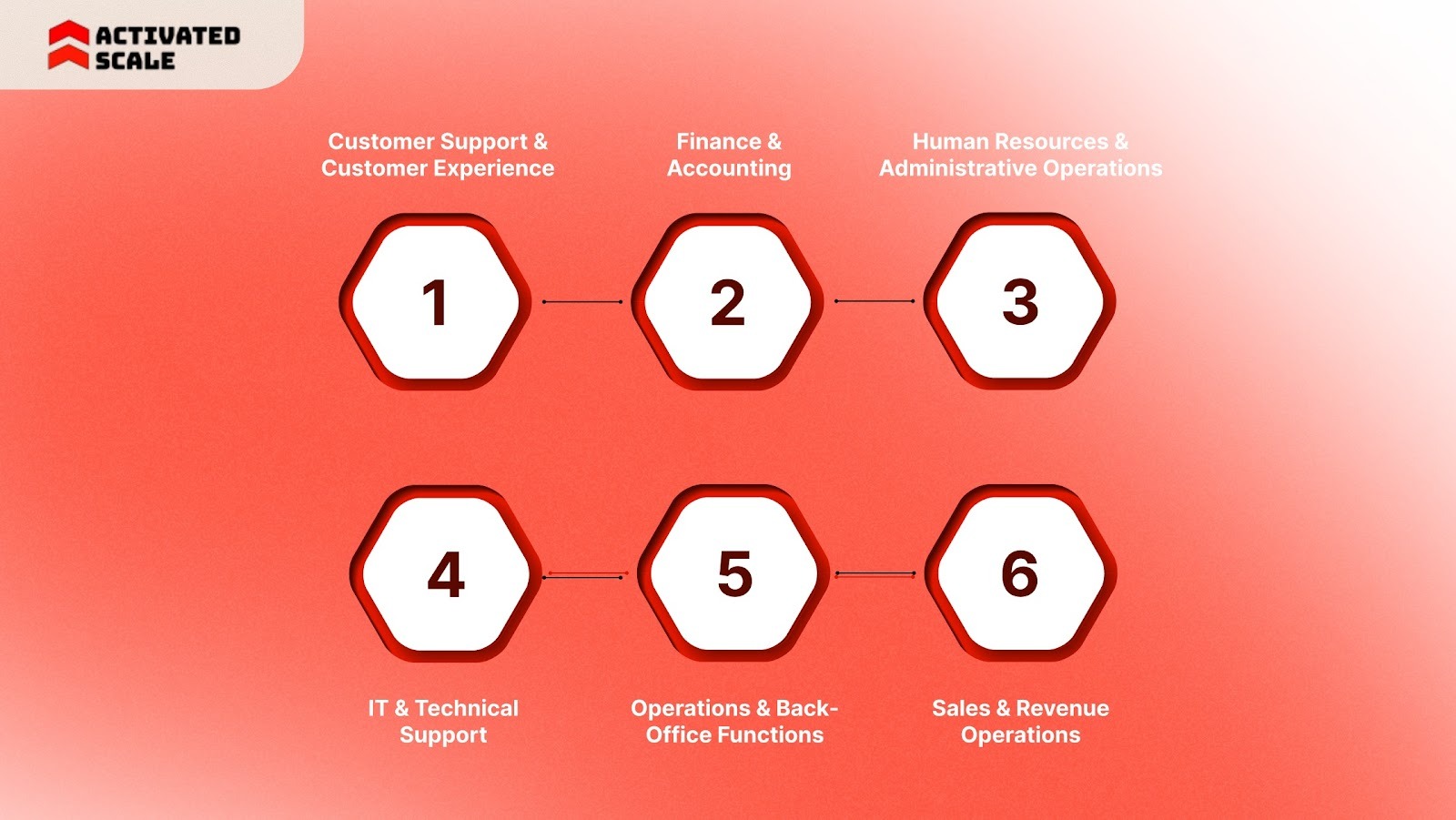
As companies grow, certain functions start consuming time and resources without directly driving strategy or differentiation. That’s usually the signal to consider outsourcing. The goal isn’t to offload responsibility, but to place execution in the hands of teams that can deliver consistently while internal leaders stay focused on growth.
Below are the most commonly outsourced business functions, along with why companies choose to hand them off and what to watch for in each case.
1. Customer Support & Customer Experience
Customer support is often one of the first functions companies outsource. Volume fluctuates, coverage expectations are high, and response times directly impact retention.
Outsourced support teams handle:
- Email, chat, and phone inquiries
- Returns, refunds, and issue resolution
- Onboarding and basic product guidance
This works best when processes are clearly documented, and service quality is measured through metrics like CSAT, response time, and resolution rates.
2. Finance & Accounting
Financial operations require accuracy and consistency, but not always full-time internal staffing at early stages.
Companies commonly outsource:
- Bookkeeping and monthly close
- Invoicing and accounts payable
- Payroll and tax preparation support
A strong BPO partner reduces errors, ensures compliance, and gives leadership clearer financial visibility without building a large internal finance team.
3. Human Resources & Administrative Operations
HR and admin work grow quietly as headcount increases. Many teams outsource this to avoid distractions and compliance risks.
Typical outsourced tasks include:
- Recruiting coordination and screening
- Benefits administration
- HR documentation and policy management
This approach helps teams stay compliant while keeping leadership focused on hiring the right people, not managing paperwork.
4. IT & Technical Support
Maintaining reliable systems is critical, but full in-house IT teams are rarely efficient for smaller or growing companies.
Outsourced IT functions often cover:
- Help desk and internal support
- Infrastructure monitoring
- Security updates and system maintenance
This ensures uptime and data protection without the cost of maintaining specialized internal staff.
5. Operations & Back-Office Functions
Back-office work keeps the business running, but it rarely needs to be built internally from day one.
Commonly outsourced operational tasks include:
- Data entry and reporting
- Order processing and compliance tracking
- Workflow documentation and process optimization
Outsourcing here improves consistency and frees internal teams from repetitive work.
6. Sales & Revenue Operations
Sales is one of the most impactful, but risky, functions to resource incorrectly. Many companies delay hiring because a mis-hire is expensive and disruptive.
BPO models now support sales through:
- Outsourced or fractional SDRs for pipeline generation
- Contract-based AEs to manage deals
- Fractional sales leaders to build GTM strategy and playbooks
When done well, this gives companies faster access to experienced sellers without locking into full-time headcount too early.
Outsourcing these functions works best when expectations, KPIs, and ownership are clearly defined. The strongest results come from treating external teams as true partners, not detached vendors.
Also read: B2B Sales Outsourcing: Definition, Benefits, Top Companies
BPO vs In-House Teams: A Quick Comparison
Choosing between a BPO partner and building an in-house team is rarely about which option is “better.” It’s about which model fits your current stage, priorities, and risk tolerance. Both approaches can work well when applied intentionally, but they solve different problems.
The comparison below highlights how BPO and in-house teams differ across the factors that matter most to growing companies.
Many teams use a hybrid approach, keeping strategic roles in-house while outsourcing execution until scale and certainty justify full-time hires.
Not sure whether building an in-house sales team or working with a BPO partner makes sense right now? Activated Scale gives you a middle ground. You can work with experienced, U.S.-based sales reps on flexible terms, so you can validate execution and results before committing to full-time hires. Explore Flexible Sales Talent.
How to Choose the Right BPO Partner?
The success of business process outsourcing depends less on the model itself and more on the partner you choose. A strong BPO partner operates like an extension of your team, while the wrong one creates friction, delays, and rework.
Before signing an agreement, take time to evaluate fit, not just pricing or promises.
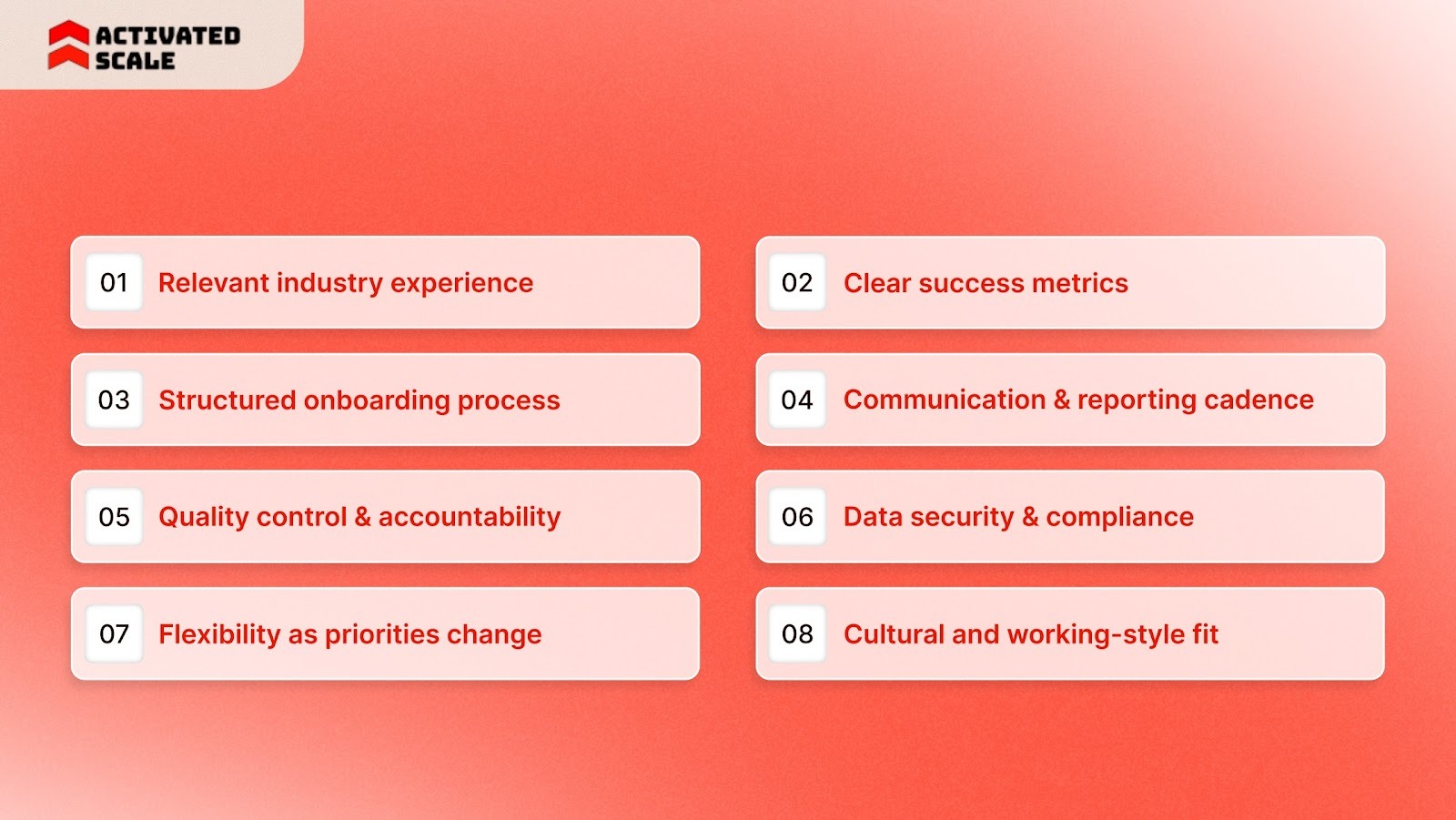
Key factors to assess when choosing a BPO partner:
- Relevant industry experience: Look for partners who understand your market, customer type, and stage of growth. Past experience reduces onboarding time and mistakes.
- Clear success metrics: A good BPO partner defines how performance will be measured. Outcomes should matter more than hours worked.
- Structured onboarding process: Ask how they learn your product, workflows, and expectations. Strong onboarding prevents early misalignment.
- Communication and reporting cadence: Regular updates, shared dashboards, and defined escalation paths keep work on track.
- Quality control and accountability: Understand how performance is reviewed and corrected when standards slip.
- Data security and compliance: Ensure the partner follows proper data protection, confidentiality, and regulatory practices.
- Flexibility as priorities change: The ability to adjust scope or scale without friction matters as your business evolves.
- Cultural and working-style fit: The best partnerships feel collaborative, not transactional.
Choosing the right BPO partner upfront saves time, protects momentum, and turns outsourcing into a long-term advantage rather than a recurring problem.
Final Thoughts
Business Process Outsourcing works best when it’s used with intent. It’s not about handing off responsibility or cutting corners. It’s about creating room for your team to focus on what truly drives growth, while experienced operators handle execution with consistency and speed.
The right BPO approach helps you move faster, reduce hiring risk, and stay flexible as priorities shift. The wrong one adds friction.
If sales execution or hiring speed is your current challenge, a traditional BPO model may not be enough. Activated Scale offers a more flexible path, connecting you with vetted, U.S.-based SDRs, AEs, and fractional sales leaders who can start delivering without long-term commitments.
Explore how Activated Scale can help you scale revenue without locking into early hires.
FAQs
What does a business process outsourcing company do?
A business process outsourcing company manages specific business functions on your behalf, such as customer support, finance, HR, operations, or sales. The work is handled by an external team using defined processes, while you retain oversight of outcomes.
Is business process outsourcing only used by large companies?
No. Many startups and growth-stage companies use BPO to access expertise quickly, stay flexible, and avoid the risk of early full-time hires. It’s especially common when speed and execution matter more than long-term ownership.
What’s the difference between BPO and hiring freelancers?
BPO provides structured teams, documented processes, and ongoing accountability. Freelancers usually offer individual contributors for short-term or project-based work. BPO works better for repeatable, operational functions that require consistency.
Can sales be outsourced through a BPO model?
Yes. Sales development, account management, and even sales leadership can be outsourced or fractionalized. The key is choosing a model that maintains quality, accountability, and alignment with your revenue goals.
What are the biggest risks of business process outsourcing?
The main risks include misalignment, inconsistent quality, and lack of context. These issues are usually caused by unclear expectations, weak onboarding, or choosing the wrong partner, not by outsourcing itself.
The Ultimate Guide to Hiring a Salesperson!
Get the step-by-step guide to hiring, onboarding, and ensuring success!