_edi.png)

Why is revenue getting harder to predict, even when your team is working harder? Because of messy Customer Relationship Management (CRM) data and endless pipeline reviews that destroy forecasts.
The result? 4 out of 5 sales and finance leaders have missed a quarterly sales forecast, and over half of them have missed it two or more times. So 2026 is a good time to take steps to better manage your business revenue.
In this guide, we'll show you exactly where sales operations create control, from cleaner data to smarter hiring plans and board-level confidence. This is a playbook for leaders who need cleaner execution, better data, and actual control over revenue.
Core Insights
- Fewer than half of Chief Sales Officers achieve their strategic goals
- Sales leaders measure operational success using metrics such as pipeline coverage, stage conversion rates, win rate, sales cycle length, and rep productivity.
- Flexible leadership models are becoming more common as startups scale. Fractional sales leaders often help companies build operational structure faster than traditional hiring timelines.
- 4 out of 5 sales and finance leaders have missed a quarterly forecast at least once
- 84% of teams using disconnected tools plan to consolidate their tech stack
What is Sales Operations?
Revenue problems rarely start with effort. They start when teams run on uneven processes, unclear data, and weak planning. Sales operations is the function that helps sales teams run with more control and less friction.
The main objective is to improve efficiency, consistency, forecasting, and revenue execution. A strong team turns scattered activity into a repeatable sales system.
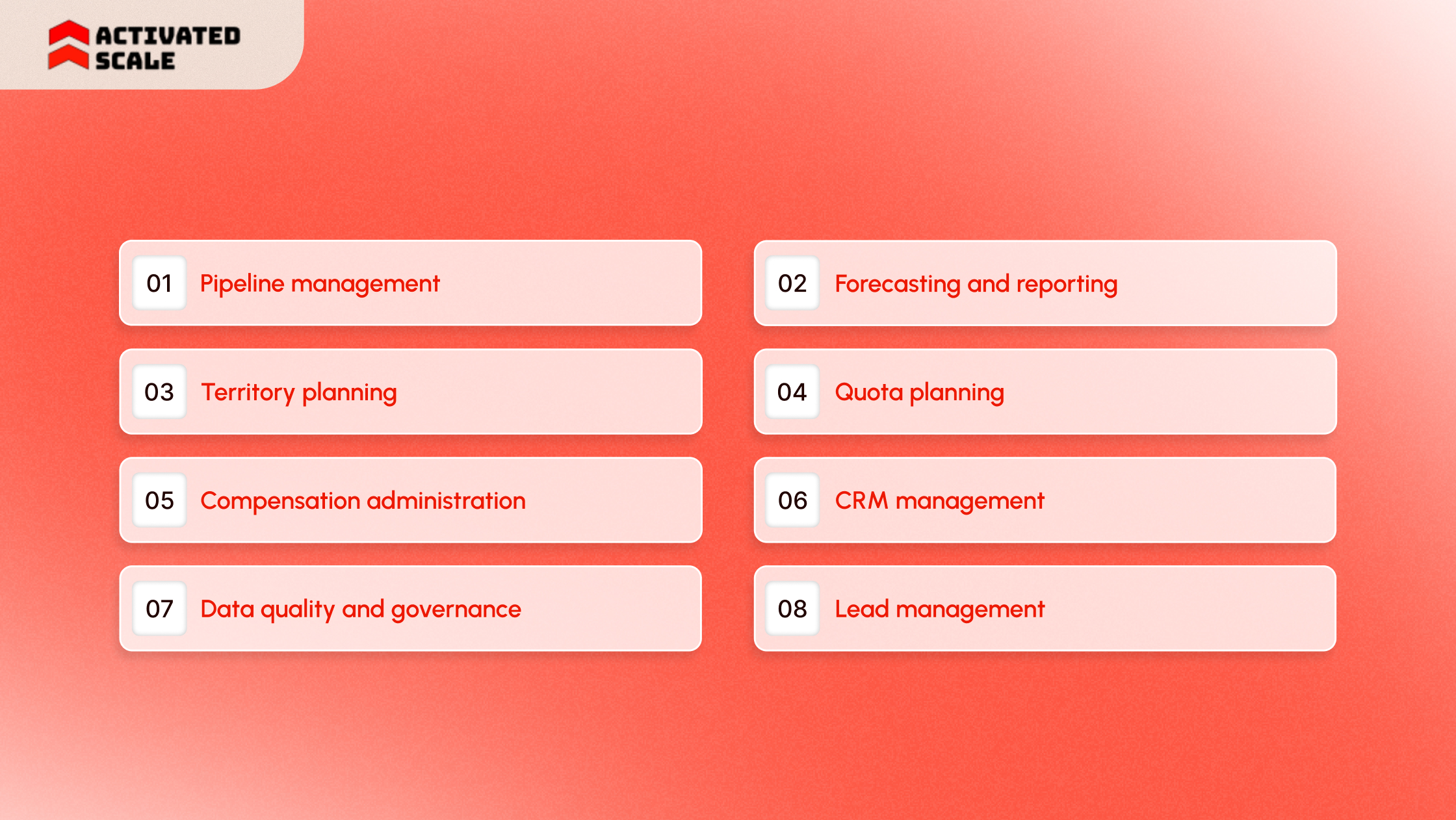
Sales operations cover a broad set of responsibilities that keep the commercial engine working. Here's what it covers:
1. Pipeline management
Sales leaders need a clear view of deal movement, stage health, and coverage. Sales operations services help define stages, exit criteria, and inspection routines. That structure makes pipeline management reviews faster and more useful.
2. Forecasting and reporting
Forecast calls fall apart when data is incomplete or the stage logic is weak. This function builds reporting systems that support better judgment. It gives leaders a cleaner view of risk, momentum, and likely outcomes.
3. Territory planning
Territory design shapes rep focus and market fairness. Poor design creates imbalance and missed revenue.
4. Quota planning
Quota design affects morale, hiring plans, and forecast quality. Targets need to reflect market reality, rep capacity, and growth goals. This function helps create quotas that teams can trust.
5. Compensation administration
Comp plans influence behavior fast. Bad plans create confusion and lead to the wrong actions. Sales operations support compensation structure, payout logic, and plan clarity.
6. CRM management
A CRM can support growth or slow every decision down. This function keeps the system usable, structured, and aligned with the sales process. That includes field design, permissions, workflows, and reporting logic.
7. Data quality and governance
Bad data damages forecasts, dashboards, and hiring plans. Good teams set clear rules for ownership, entry, and cleanup to help protect data quality before problems spread.
8. Lead management
Leads lose value when routing is slow or qualification rules stay fuzzy. This function helps define handoffs, response rules, and ownership paths. That improves speed and reduces wasted demand.
Strong functions need clear ownership. When ownership stays vague, forecasting slips, CRM rules break, and support work stalls. That is why team structure matters.
Also Read: The 7 Biggest Hurdles to Hiring Startup Sales Talent & How to Overcome Them
How to Define Sales Operations Roles and Team Structure?
A strong sales operations team usually includes leadership, management, analysis, and execution support. Each layer solves a different problem. Together, they help sales leaders run with better visibility, consistency, and control.
Below is a list of team members you will need:
1. Director / VP of Sales Operations
This is the strategic owner of the function. If this role stays weak, teams often miss the bigger planning issues.
Role
- The Director or VP of sales operations leads the function at a strategic level.
- This person connects revenue targets with planning, process, systems, and performance management.
- The role usually reports into senior sales leadership or a revenue leader.
Key responsibilities
- Sales planning and operating strategy
- Territory and account coverage design
- Quota setting and compensation planning
- Forecast process design and inspection rhythm
- Executive reporting and board-level visibility
- Cross-functional alignment with finance, marketing, and Go-to-Market (GTM) leadership
- Tool and process priorities across the sales org
Requirements
- Strong experience in strategic planning and revenue operations
- Deep knowledge of forecasting, compensation, and sales process design
- Ability to work with senior leaders and influence decisions
- Strong analytical judgment and communication skills
- Experience with CRM, dashboards, and sales planning tools
Only 45% of Chief Sales Officers (CSOs) said their organization met their primary strategic goals.
If your team lacks clear ownership of the forecast and consistently misses its goals, hire a Fractional VP of Sales through Activated Scale's Fractional Sales Leadership service. They will help you build the operating rhythm before revenue slips further.
2. Sales Operations Manager
This is the execution owner. The strategy may look right on paper, but execution breaks without this layer.
Role
- The Sales Operations Manager runs the day-to-day engine of sales operations.
- This person turns leadership goals into practical workflows, rules, and support systems.
- The role usually works closely with frontline managers and sales reps.
Key responsibilities
- Daily process execution across the sales team
- Workflow management and process improvement
- CRM process support and adoption
- Lead routing, approvals, and handoff rules
- Forecast support and pipeline review preparation
- Team support for tool usage and process questions
- Coordination with enablement, finance, and marketing teams
Requirements
- Strong project management and process design skills
- Hands-on CRM experience
- Ability to solve operational bottlenecks quickly
- Comfort working with reps, managers, and senior leaders
- Strong attention to detail and execution discipline
3. Sales Operations Analyst
This is the insight owner. Leaders can miss important trends when reporting stays shallow or inconsistent. That is why this role matters more as data volume grows.
Role
- The Sales Operations Analyst turns sales data into insight.
- This role supports forecasting, pipeline review, territory analysis, and performance reporting.
- A strong analyst helps leaders see risk early, not after the quarter closes.
Key responsibilities
- Dashboard creation and maintenance
- Sales reporting across the pipeline, conversion, and productivity
- Trend analysis and performance reviews
- Forecast support through data validation and insight
- Data audits and reporting accuracy checks
- Ad hoc analysis for sales leadership
- Metric tracking across team performance and revenue outcomes
Requirements
- Strong Excel, CRM, and BI tool skills
- Ability to read patterns and explain them clearly
- High comfort with reporting logic and data cleanup
- Strong business judgment, not just spreadsheet skills
- Clear communication with non-technical stakeholders
Not every company needs all three roles at once. A smaller team may start with one manager or one generalist. On the other hand, a growing team may add an analyst next. But, how to build a sales playbook with the right strategy with an operations team?
Also Read: A Guide To Getting Into Sales Operations
7 Sales Operations Strategies That Improve Revenue Execution
Revenue targets fail when execution stays inconsistent. Leaders often see strong activity yet weak results. Process gaps, scattered tools, and unclear ownership usually sit behind that problem.

If you create a strategy that improves sales operations:
1. Standardize Pipeline Stages
Sales operations should define clear stage criteria and exit conditions. Each stage should reflect a specific buyer signal or commitment. That structure makes pipeline inspection faster and more reliable.
Standardized stages also improve forecasting discipline. Leaders gain a clearer view of deal momentum and risk.
2. Cut Tool Sprawl
Sales teams now work across many platforms. Too many tools slow down decision-making and create fragmented data.
84% of teams that lack a unified platform are actively planning to consolidate their tools.
Tool sprawl often creates duplicate data and conflicting reports. The goal is fewer systems with clearer ownership and stronger integration.
Strong sales operations teams reduce complexity by centralizing workflows in platforms such as:
- Salesforce
- HubSpot
- Microsoft Dynamics
3. Clean CRM Rules and Ownership
Strong sales operations teams define strict CRM governance rules that include field ownership, data entry standards, and update timelines. Clear rules help protect reporting accuracy. Leaders usually enforce governance through tools such as:
- Salesforce CRM
- HubSpot CRM
- Zoho CRM
4. Build Role-Based Dashboards
Most dashboards try to serve everyone, and that usually means they help no one. Reps need pipeline and activity visibility.
Managers need conversion trends and forecast movement. Executives need revenue signals and risk indicators. Role-based dashboards reduce noise and help leaders act faster.
Common tools used in sales operations include:
- Tableau
- Power BI
- Salesforce dashboards
- Looker
5. Tighten Forecast Reviews
Forecast meetings often become long debates. The real problem is a weak inspection structure. Strong sales operations teams design a clear forecast cadence. Managers review pipeline health before leadership calls begin.
That preparation improves forecast confidence. Your teams can rely on:
- Clari
- InsightSquared
- Salesforce Forecasting
These tools help track deal confidence, pipeline risk, and revenue projections.
6. Fix Lead Handoffs
Leads lose value when handoffs stay slow or unclear. Marketing generates demand, yet sales ownership remains vague.
Sales operations should define clear routing and response rules. Fast handoffs improve conversion rates and pipeline health. Platforms that automate lead assignment and enforce response rules, including the following:
- LeanData
- Chili Piper
- HubSpot workflows
7. Align Capacity With Demand
Many revenue gaps come from a capacity imbalance. Teams either hire too slowly or overload current reps. Strong sales operations planning links hiring plans with pipeline expectations. That means tracking coverage ratios, rep ramp time, and territory size.
Many sales operations teams use:
- Anaplan
- Xactly
- Salesforce planning dashboards
Many teams struggle because strategy exists, but experienced sales leadership is missing. Activated Scale's Fractional Selling service connects startups with vetted sales talents who can build forecasting discipline and strengthen pipeline execution.
So you've built the structure. Now, how do you know it's working? That's where metrics come in; they turn strategy from theory into proof.
10 Metrics That Show Sales Operations are Working
When the board asks, "Is sales ops working?" What's your answer? If you're pointing to dashboard views or tool adoption rates, you're leaving money on the table. The real proof lies in the numbers that improve forecast accuracy.
Below are the metrics most sales leaders rely on to evaluate operational performance.
- Forecast accuracy: Measures how closely projected revenue matches actual results.
High accuracy signals disciplined pipeline management and realistic deal progression. - Pipeline coverage: Shows the ratio between pipeline value and revenue targets.
Healthy coverage helps sales leaders predict revenue with greater confidence. - Stage conversion rate: Tracks how deals move between pipeline stages.
Low conversion signals friction in qualification, messaging, or deal progression. - Sales cycle length: Measures the average time required to close a deal.
Shorter cycles often indicate stronger qualification and clearer buying signals. - Lead response time: Captures how quickly sales teams engage with new leads.
Faster response usually improves conversion and pipeline momentum. - Ramp time: Tracks how long new sales hires take to reach full productivity. Effective sales operations support shorter onboarding and faster contribution.
- Rep productivity: Measures output per sales representative, such as revenue generated or deals closed. This metric helps leaders evaluate capacity and hiring needs.
- Data completeness: Reflects the percentage of accurate and fully populated CRM records. Strong data quality improves reporting reliability and forecasting accuracy.
- Win rate: Shows the percentage of deals successfully closed. Higher win rates usually reflect better qualification and pipeline discipline.
- Average deal size: Measures the average revenue value per closed deal. This metric reveals deal quality and helps guide territory and capacity planning.
Once you're confident about strategies and metrics, your sales teams can focus on a consistent sales operations framework to convert that activity into predictable revenue.
Also Read: How to Calculate and Improve Sales Velocity for Maximum Revenue Impact
How to Build a Sales Operations Playbook?
A structured framework connects planning, systems, data governance, and performance measurement. Without that structure, sales operations become reactive rather than strategic.
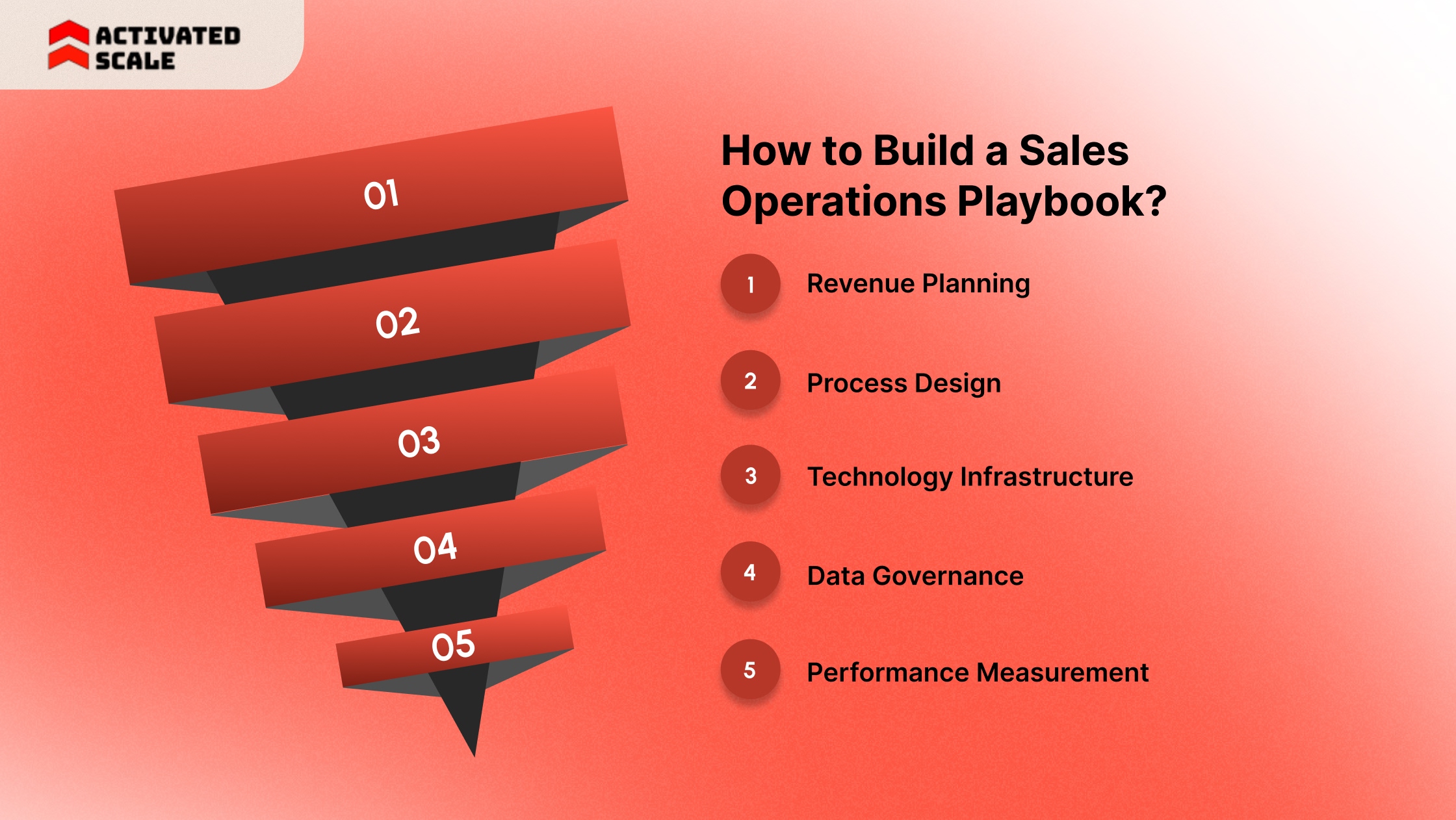
Below is a practical sales operations framework used by high-performing revenue teams:
1. Revenue Planning
Revenue planning connects business targets with sales execution. Sales leaders must determine:
- Revenue targets
- Quota allocation
- Hiring capacity
2. Process Design
Process design defines how deals move through the pipeline. This structure reduces debate during forecast reviews and helps leaders inspect pipeline quality more effectively.
A structured process helps restore predictability.
3. Technology Infrastructure
Sales teams rely on multiple systems to manage deals, leads, and reporting. Without coordination, technology quickly becomes fragmented.
A strong sales operations framework focuses on a simplified technology stack. Technology should improve visibility rather than create more operational friction.
4. Data Governance
Accurate data is the foundation of reliable forecasting and reporting. Poor CRM discipline often leads to inconsistent pipeline updates, incomplete records, and unreliable dashboards. Strong governance allows sales operations teams to produce reliable insights.
5. Performance Measurement
A framework is only effective when leaders measure results consistently. Sales operations teams track metrics that reflect operational health and revenue momentum.
Together, these indicators give leaders a clearer view of how well sales operations support revenue execution. However, numbers alone do not solve the underlying problems. Sales leaders still need experienced execution support, and Activated Scale can help with that.
Strengthening Sales Operations With Activated Scale
Activated Scale connects startups and growth-stage companies with experienced U.S.-based sales professionals who can strengthen operational systems and stabilize revenue performance. Experienced support helps sales leaders address these issues faster and with less disruption.
We provide flexible talent solutions designed for companies that need experienced sales leadership without long hiring cycles:
1.Contract-to-Hire Sales Recruiting
Companies can hire vetted sales professionals on a trial basis before making a full-time decision. This model helps leadership evaluate performance while improving pipeline execution and sales operations structure.
2.Fractional Selling
Companies can access experienced Sales Development Representatives (SDRs) and Account Executives (AEs) to fill pipeline coverage gaps. Fractional talent supports outreach and deal progression without expanding permanent headcount.
3.Fractional Sales Leadership
Startups often need strategic leadership to improve forecasting, hiring plans, and go-to-market structure. Fractional VPs of Sales help build sales operations frameworks, design compensation plans, and improve forecasting discipline.
If your team needs stronger forecasting discipline and clearer team execution, talk with Activated Scale.
Over To You
Sales operations run on momentum, which dies without leadership. Waiting months to fill a leadership gap means waiting months to fix broken forecasts, messy processes, and missed targets.
That's why the Return on Investment (ROI) of flexible leadership is so clear: Companies gain immediate operational traction without waiting months for executive hires.
Flexible leadership puts revenue expertise in place now, not later. If you're ready to build cleaner execution, Activated Scale is here to help.
To hire a fractional sales talent and build a sales operations system that drives predictable revenue, schedule a call with Activated Scale today.
Frequently Asked Questions
1. What is the difference between sales operations and revenue operations?
Sales operations focus on improving the performance and efficiency of the sales team.
It manages forecasting, pipeline management, CRM governance, and sales planning.
Revenue operations takes a broader approach by aligning marketing, sales, and customer success into one revenue strategy.
2. Which tools are commonly used in sales operations?
Sales operations teams typically manage several tools that support forecasting, reporting, and pipeline management.
Common tools include:
- CRM platforms like Salesforce or HubSpot
- forecasting tools such as Clari
- analytics platforms like Tableau or Power BI
- lead routing tools like LeanData or Chili Piper
These tools help improve pipeline visibility and sales process consistency.
3. What skills are required to succeed in sales operations?
Sales operations professionals usually combine analytical, technical, and strategic skills.
Important skills include:
- Data analysis and reporting
- CRM management
- Forecasting and pipeline analysis
- Process design and workflow automation
- Communication with sales leadership
Strong business judgment is just as important as technical ability.
4. How does sales operations improve revenue predictability?
Sales operations improve predictability by introducing structure into the sales process.
Clear pipeline stages, disciplined forecast reviews, reliable CRM data, and structured reporting all help leaders make more accurate revenue projections. Over time, these practices reduce forecast volatility and improve planning confidence.
The Ultimate Guide to Hiring a Salesperson!
Get the step-by-step guide to hiring, onboarding, and ensuring success!