Introduction
Most B2B revenue shortfalls trace back to the same root cause: an unmanaged pipeline. Deals sit in limbo, next steps are unclear, and forecasts get built on optimism instead of data.
The numbers bear this out. According to the Ebsta x Pavilion 2025 GTM Benchmark Report, 78% of sellers missed quota in 2025, up from 69% the prior year. And Gartner identifies pipeline management as one of the areas where sales operations functions perform worst.
Without a structured pipeline, you can't identify where deals stall, which reps need coaching, or what revenue to expect next quarter. Structure is what turns sales activity into predictable revenue.
This guide walks through what a B2B sales pipeline actually is, how to build one, the practices that keep it healthy, and the metrics that surface problems before they hit your number.
TL;DR
- A B2B sales pipeline tracks where every deal sits in your sales process — it's the seller's view, not the buyer's journey
- Most pipelines follow 6 stages: prospecting → qualification → discovery/demo → proposal → closing → retention
- Build yours by defining your ICP first, then mapping real deal steps into a CRM
- Key metrics: pipeline velocity, stage conversion rates, average deal size, and cycle length
- Weekly reviews and a clean pipeline (purge stalled deals) are the minimum for reliable forecasting
What Is a B2B Sales Pipeline?
A B2B sales pipeline is a visual, structured representation of where every active prospect sits in your sales process — from first contact to signed contract. It gives your team a shared framework to prioritize deals, plan next actions, and forecast revenue with real consistency.
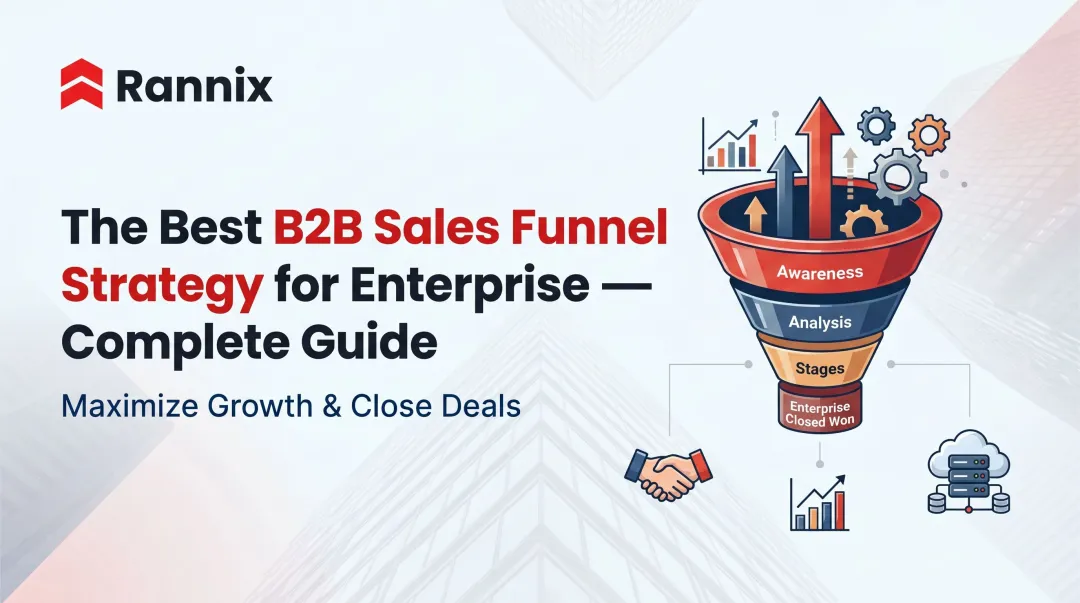
Pipeline vs. Sales Funnel
These two terms get used interchangeably, and that's a problem. They describe different things:
- Sales funnel = the buyer's journey (awareness → consideration → decision) — a marketing lens
- Sales pipeline = the seller's actions at each stage (prospecting → closing) — a revenue execution lens
Confusing them leads to misaligned teams. Marketing optimizes for the funnel; sales needs to manage the pipeline. When both teams think they're doing the same job, deals fall through the cracks. That distinction matters even more as deals grow more complex — which brings us to why B2B pipelines are in a category of their own.
Why B2B Pipelines Are Especially Complex
B2B sales involve more stakeholders, more departments, and more decision points than most teams account for:
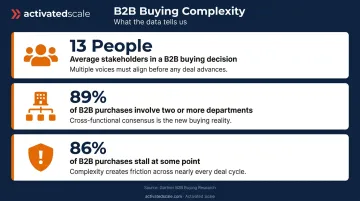
- Forrester's 2024 State of Business Buying report found an average of 13 people involved in a buying decision
- 89% of B2B purchases involve two or more departments
- 86% of B2B purchases stall at some point
Without defined pipeline stages, you have no way to know where deals stall or why — and no way to fix it systematically.
Key Stages of a B2B Sales Pipeline
The exact stage count varies by company and product complexity. Most B2B pipelines follow six core stages, each with distinct actions and exit criteria.
Prospecting and Lead Generation
This is where pipeline quality is set or destroyed. Prospecting means identifying potential buyers who fit your ideal customer profile (ICP) and reaching out through:
- Outbound channels: cold email, LinkedIn, cold calling
- Inbound channels: content, referrals, events, paid ads
Low-quality leads at this stage corrupt every stage downstream. A deal that never belonged in your pipeline wastes time at every subsequent step.
Lead Qualification
Qualification filters out prospects who aren't worth pursuing. Two widely used frameworks:
- BANT: Budget, Authority, Need, Timeline — a fast screen for fit and urgency
- MEDDIC: Metrics, Economic Buyer, Decision Criteria, Decision Process, Identify Pain, Champion — better suited for complex enterprise deals
In most B2B SaaS companies, SDRs or BDRs run discovery calls to confirm a lead is worth an AE's time before passing it forward. Once a lead clears qualification, the real conversation can begin.
Discovery and Demo
The first deep conversation. The rep's goal here is to uncover specific pain points, not walk through every feature. A common mistake is leading with a product tour before understanding what problems the prospect is trying to solve.
For product companies, the demo should connect directly to the pain identified in discovery. Prospects who don't see their problem reflected in the demo rarely advance.
Proposal and Negotiation
The proposal should be tailored to the prospect's specific needs and outcomes. Pricing should be anchored to the value the prospect gets, not just your rate card. A generic PDF rarely closes a deal.
What kills deals at this stage:
- Generic proposals that feel copy-pasted
- Caving on price before the prospect has fully committed
- Disappearing after sending the proposal and waiting for a response
Follow-up at this stage should add value: a relevant case study, a competitor comparison, or a data point. "Did you get a chance to review?" adds nothing.
Closing
Closing is where verbal commitment becomes a signed contract. Deals stall here most often because objections that existed earlier weren't addressed. If a prospect raises budget concerns during contract review, that concern existed during discovery, it just wasn't surfaced.
The fix is proactive objection-handling throughout the entire cycle, not just at the end.
Post-Sale Retention and Expansion
The pipeline shouldn't end at "closed won." Onboarding quality, proactive check-ins, and account management drive:
- Renewals that prevent churn
- Upsell and expansion opportunities that increase deal value
- Referrals that feed new prospects into the next cycle
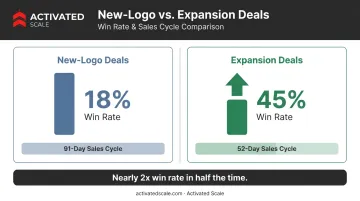
New-logo deals carry an average 18% win rate and 91-day sales cycle. Expansion opportunities, by contrast, carry a 45% win rate and a 52-day cycle. That's nearly twice the win rate in roughly half the time. The asymmetry is hard to ignore: retention isn't just a customer service function, it's a pipeline strategy.
How to Build a B2B Sales Pipeline from Scratch
Step 1: Define Your ICP First
Before naming pipeline stages or opening a CRM, identify who you're actually selling to. Analyze your closed-won deals — especially the ones that closed fastest and at the highest value. Look for patterns:
- Company size, industry, revenue, and tech stack
- Who the champion was and who the economic buyer was
- What pain triggered the purchase and how urgently they needed a solution
Without a clear ICP, every downstream pipeline step is guesswork. You'll generate leads that look right but never close.
Step 2: Map Stages to Your Actual Sales Cycle
Don't adopt a generic six-stage template without testing it against your real deals. Instead:
- Document the steps your last 10 closed-won deals actually took
- Identify the consistent checkpoints — first call, demo, proposal, legal review
- Name those as stages in your CRM
Your pipeline should reflect your process, not a textbook version of someone else's.
Step 3: Set Up a CRM
Spreadsheets work for five deals. They break down at fifteen. A CRM enables:
- Stage tracking across all active deals
- Deal age alerts for opportunities that go quiet
- Activity logging so the whole team knows what's happened on each account
- Pipeline reporting for forecasting and reviews
For early-stage B2B startups, HubSpot and Pipedrive are both well-suited starting points — both offer free or low-cost tiers and don't require a dedicated sales ops person to set up.
One warning: the Ebsta x Pavilion 2025 GTM Benchmark Report found that 44% of contacts never make it into CRM, and 26% of those missing contacts are senior decision-makers. A CRM only works if people use it.
Step 4: Assign Clear Ownership and Actions Per Stage
Each stage needs two things: a defined action and a named owner. Examples:
| Stage | Required Action | Owner |
|---|---|---|
| Prospecting | Send personalized outreach sequence | SDR/BDR |
| Qualification | Complete discovery call and score lead | SDR or AE |
| Demo | Deliver tailored demo within 5 days of qualification | AE |
| Proposal | Send proposal within 48 hours of demo | AE |
| Closing | Confirm next step before ending every call | AE |
Ambiguity at any stage creates stuck deals. If no one knows who's responsible for moving a deal forward, no one moves it.
Step 5: Staff Your Pipeline with the Right Sales Talent
This is where most early-stage B2B startups stall. You can build a perfect pipeline structure (clear ICP, mapped stages, CRM configured) and still generate no revenue because no one is executing it.
Hiring a full-time AE or SDR takes time. BDR ramp runs 3–5 months; AE ramp runs 3–12 months depending on deal complexity. A wrong hire costs more than $50,000 once you account for recruiting fees, missed deals, and severance.
Fractional sales talent solves this. Activated Scale connects early-stage B2B startups with pre-vetted fractional SDRs and AEs who can start working deals in days, not months. These professionals bring backgrounds from companies like Datadog, IBM, and Salesforce. Key details:
- Monthly retainer of $2,800–$5,000 for SDRs and AEs, depending on scope
- Contract-to-hire option available from day one
- 65% of clients convert their fractional hire to full-time after seeing real results
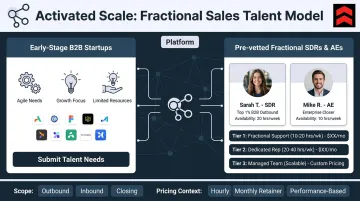
For a startup that has built the pipeline but lacks the headcount to run it, this model gets revenue moving without the risk of a permanent hire.
B2B Sales Pipeline Management Best Practices
Hold a Regular Pipeline Review Cadence
At minimum: a weekly team review and a monthly full-pipeline audit. In each review, look for:
- Deals past your average cycle length with no movement
- No activity logged in 14+ days
- Missing "next step" on any active opportunity
The weekly review catches individual deal problems. The monthly audit catches systemic issues — a stage where too many deals are clustering, or a rep whose close rate is dropping without explanation.
Keep the Pipeline Clean
A bloated pipeline with stale deals is worse than a small clean one. Zombie deals distort your forecast, making revenue look better than it is until the quarter ends.
Set explicit criteria for moving deals out of active stages:
- No response after three follow-up attempts over three weeks → move to "nurture"
- No defined next step after 30 days → review or close-lost
- Champion left the company without a replacement → pause and reassign
A cleaner pipeline also means more accurate forecasting — so you're not scrambling to explain a miss at quarter-end.
Use Omnichannel Outreach for Longer Cycles
B2B buyers don't live in one channel. Effective pipeline management means following up across email, phone, and LinkedIn — and each touchpoint should add something. A relevant case study. A stat their CFO would care about. A question that opens a new conversation.
RAIN Group's sales prospecting research found that top-performing prospectors achieve 2.7x more conversions and 1.8x more quality outcomes (meetings, conversations, demos) than average performers. The difference isn't frequency — it's relevance.
Align Sales and Marketing on Pipeline Entry Criteria
Marketing-to-sales handoff is where most pipelines quietly break down. Marketing passes MQLs that sales considers unqualified — the result is friction, wasted AE time, and deals that will never close.
Fix it by defining shared criteria for when a lead enters the pipeline:
- Minimum firmographic fit (company size, industry)
- Demonstrated intent signal (demo request, pricing page visit, event attendance)
- Decision-maker contact identified
Shared entry criteria give both teams a common language — and a cleaner dataset to forecast from.
Surface Objections Early — Not at Closing
Objections that surface during contract review almost always existed earlier — budget constraints, internal politics, competing priorities.
Train reps to ask about blockers during qualification and demo stages. "What would need to be true for this to move forward?" is a better question at the discovery stage than at the closing stage.
Critical Metrics Every B2B Sales Pipeline Needs
Pipeline Velocity
This is the single most useful compound metric for understanding pipeline health.
Formula (from Salesforce):
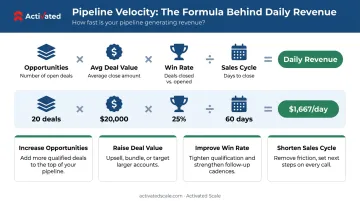
Pipeline Velocity = (Number of Opportunities × Average Deal Value × Win Rate) ÷ Length of Sales Cycle
Example: 20 deals × $20,000 average deal value × 25% win rate ÷ 60-day cycle = $1,667 in revenue per day
If velocity drops, the formula tells you exactly where to look: fewer deals entering, a declining win rate, a longer cycle, or shrinking deal sizes. Each lever has a different fix.
Stage-by-Stage Conversion Rates
Track the percentage of deals that advance from each stage to the next. A sharp drop at one specific transition is diagnostic information. For example:
- Low demo-to-proposal conversion → demo quality or qualification problem
- Low proposal-to-close conversion → pricing, objections not surfaced, or wrong stakeholders
Without stage-level data, you're solving the wrong problem.
Average Sales Cycle Length and Average Deal Size
These two metrics together determine how many deals need to enter the top of your pipeline to hit a revenue target. The 2024 B2B SaaS Benchmarks Report puts the median B2B SaaS sales cycle at 84 days — but that number masks wide variance by deal tier:
- $5K–$10K ACV: ~23 days
- $100K+ ACV: ~145 days
Track both metrics separately by deal tier, not as a single blended average.
Frequently Asked Questions
What is the difference between a B2B sales pipeline and a sales funnel?
A sales funnel describes the buyer's journey from the customer's perspective — awareness through purchase. A sales pipeline describes the seller's process: the specific actions and stages a rep takes to move a deal from first contact to closed contract. One tracks buyer behavior; the other tracks seller execution.
How many stages should a B2B sales pipeline have?
Most B2B pipelines have 5–7 stages. Salesforce's standard model lists seven. Simpler transactional sales can work with fewer; enterprise deals involving multiple stakeholders, procurement, and legal review often need more. The right number reflects your actual sales cycle, not a template.
What are the most important metrics for measuring pipeline health?
Track four metrics: pipeline velocity (opportunities × deal value × win rate ÷ cycle length), stage-by-stage conversion rates, average deal size, and average sales cycle length. Together, they pinpoint exactly where deals accelerate — and where they stall.
How do I prevent deals from stalling in my sales pipeline?
Three tactics work consistently:
- Run weekly pipeline reviews and flag any deal with no activity in 14+ days
- Surface objections during qualification and discovery — not at the close
- End every sales interaction with a confirmed, specific next step
How long is a typical B2B sales cycle?
The median B2B SaaS sales cycle was approximately 84 days in 2024, but cycle length varies significantly by deal size — from 23 days for deals under $10K ACV to 145 days for deals above $100K. Decision-maker count and product complexity drive most of that variance.
How can a B2B startup build a pipeline without a full sales team?
Define your ICP and pipeline stages first, then set up a CRM before deals accumulate. For execution, fractional sales talent — like the SDRs and AEs available through Activated Scale — lets founders plug in experienced closers quickly, without the cost or ramp time of a full-time hire.