
Introduction
Deciding to outsource your sales function is one thing. Managing that team effectively is an entirely different skill set, and most founders underestimate the gap between the two.
The most common failure mode isn't bad talent. It's treating outsourced sales as a "set it and forget it" solution: hand over a prospect list, check back in six weeks, wonder why the pipeline is empty.
McKinsey's review of over 100 vendor contracts found that more than 75% lacked exhaustive KPIs and reporting processes — and that weak contract governance erodes sourcing value by 9% of annual revenues. Outsourced sales fails for the same reason.
The good news: the fix is structural, not complicated. This article covers the specific practices: goal-setting, onboarding, communication cadence, tech visibility, and pitfall avoidance. Each one separates high-performing outsourced sales engagements from costly ones.
Key Takeaways
- Define KPIs and a shared performance agreement before the engagement starts — not after week three.
- Onboard outsourced reps with the same rigor you'd apply to a full-time hire: ICP documentation, messaging, objection handling.
- Run weekly syncs and bi-weekly KPI reviews to keep fractional reps accountable and progress visible.
- Treat two consecutive weeks of missed leading indicators as a signal to diagnose the process — not the person.
Set Clear Goals and Metrics Before Day One
The single most common reason outsourced sales engagements underperform isn't the quality of the reps — it's the absence of a shared definition of success. Without agreed metrics upfront, you optimize for different things. The outsourced team books calls. You expected pipeline. Neither side is technically wrong, but the engagement produces nothing useful.
The Metrics That Actually Matter
For B2B outsourced sales, these are the core KPIs to define before anyone makes a single outreach:
- Qualified meetings booked per month — define "qualified" in writing against your ICP before outreach starts
- Pipeline created (dollar value): tracks revenue potential, not just activity volume
- Lead-to-meeting conversion rate: reveals list quality and messaging fit early
- Sales cycle length so both sides set realistic revenue timing expectations
- Closed-won revenue — the lagging indicator everything else feeds into
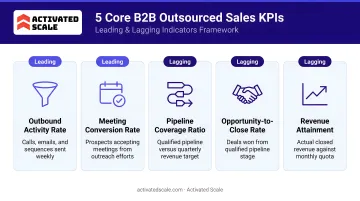
According to Gartner, leading indicators should be quantifiable seller behaviors — outreach volume, connect rates, meetings created — while lagging indicators report prior-period outcomes like revenue. Both matter. Outsourced teams should be accountable to both, not just results after 90 days.
Quota Benchmarking by ACV
Don't set flat targets without context. The Bridge Group's 2024 SaaS AE benchmark, drawn from 170+ B2B SaaS companies, shows that AEs selling in the $250K+ ACV band carry quotas nearly 2.5x higher than those selling sub-$25K ACV deals. The right target for your outsourced team depends heavily on your deal size and sales motion.
Put It in Writing
Document goals in a Statement of Work (SOW) addendum before launch. Your SOW should define:
- What gets measured and how it's calculated
- Reporting frequency and format
- Escalation paths when targets are missed
- What constitutes a "qualified lead" in ICP terms — in writing, not verbally
Activated Scale formalizes this from day one. Each engagement begins with an SOW that sets clear monthly metrics — fractional SDRs are benchmarked to 10–15 qualified meetings per month by month three.
Account Executives are measured on meetings booked, demos run, and new revenue generated. That clarity on both sides is what makes accountability possible.
Onboard Your Outsourced Sales Team Like a Full-Time Hire
Here's a misconception that costs companies weeks of pipeline: outsourced reps "come ready to sell." Even experienced professionals with backgrounds at Salesforce, Oracle, or Zendesk need structured onboarding to understand your specific product, buyers, and messaging. Skipping this step is a leading cause of poor performance in weeks two through six.
Salesforce's 2026 State of Sales report — based on 4,050 sales professionals — found 52% of reps say traditional enablement materials don't provide the skills they need, and 40% cite manager lack of time as an enablement obstacle. That's an internal team problem. With outsourced teams, the risk compounds.
What a Strong Onboarding Package Looks Like
Before your outsourced rep makes their first outreach, they should have:
- Product/solution overview with key differentiators
- ICP and buyer persona documentation (in writing, not just a verbal briefing)
- Sample call recordings or demo examples
- Competitive positioning and objection handling guide
- Approved email and call script frameworks
- CRM access, field definitions, and data entry standards
The Ramp Timeline to Set Internally
Plan for a three-phase ramp — not a 30-day revenue sprint:
- Days 1–15: Onboarding and knowledge transfer — company context, buyer motivations, acquisition channels
- Days 16–45: Messaging iteration — testing outbound sequences, refining based on response data
- Days 45+: Full outbound execution — meeting booking and pipeline acceleration
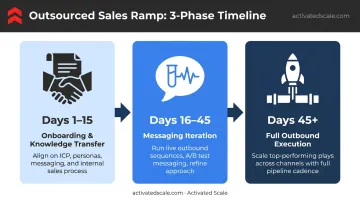
How you structure week one largely determines which phase of this ramp your rep reaches by day 45 — and how quickly.
Kickoff Week Structure
The first week should include a live kickoff session covering:
- Your product and core use cases
- Your ICP: company size, buyer title, pain points, and disqualification criteria
- Your competitive landscape and common objections
- How success will be measured and reported
Bring your founder or revenue lead. The outsourced rep needs real context, and written materials only go so far without live Q&A.
Establish Communication and Accountability Rhythms
Without a structured communication cadence, outsourced teams drift. There's nothing pushing them to surface blockers, recalibrate messaging, or flag list quality issues. By the time founders notice, weeks of pipeline have already evaporated.
HBR research on remote teams found that the most effective distributed teams communicate in concentrated, high-quality bursts rather than constant low-level monitoring. That's the right model for outsourced sales: focused touchpoints, not daily check-ins.
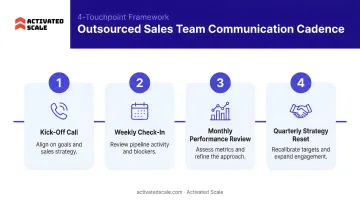
A Practical Communication Framework
| Touchpoint | Frequency | What to Cover |
|---|---|---|
| Pipeline sync | Weekly (30 min) | Meetings booked, blockers, messaging feedback |
| KPI review | Bi-weekly | Performance vs. targets, leading indicators |
| Shared channel | Ongoing (Slack/Teams) | Real-time updates, quick approvals |
| Formal review | Monthly | Lagging indicators, engagement health, next-month priorities |
Accountability Without Micromanagement
Manage to outcomes, then inspect leading indicators when outcomes miss target. Reviewing pipeline and meetings booked on a weekly cadence is appropriate oversight. Monitoring daily call logs at a granular level erodes trust without improving performance.
The reporting structure Activated Scale builds into its engagements reflects this: fractional sales professionals report weekly, monthly, and quarterly results to the founder — structured enough to create a paper trail, not so granular it turns into surveillance.
A solid weekly report covers four things:
- Key activities completed (outreach volume, meetings held)
- Current pipeline status and movement
- Top blockers and dependencies
- Priorities for the coming week
This surfaces problems before month-end, when they're much harder to fix.
Integrate Technology and Data for Shared Visibility
Data silos are one of the fastest ways to lose control of an outsourced sales engagement. When the outsourced team tracks activity in a separate spreadsheet or vendor-owned CRM, you have no reliable view of pipeline health, lead status, or conversion data.
The numbers make this concrete. Salesforce's 2026 State of Sales report found:
- 51% of sales leaders say tech silos delay or limit their initiatives
- 46% of sales professionals say data-quality issues hurt sales performance
- 84% of teams without a consolidated platform plan to consolidate
Minimum Tech Stack Requirements
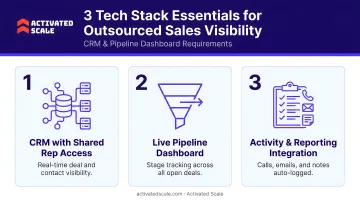
Aim for a single source of truth, not a complex integration project. Three things cover most use cases:
- Shared CRM access — your outsourced team works in your CRM, not theirs. Even view-only founder access matters for real-time visibility.
- Defined deal stages and required fields — tell the team exactly what to log and when. Ambiguous data entry standards produce useless data.
- Pipeline dashboard — a simple view showing meetings booked, deals by stage, and conversion rates without requiring a manual report.
Protecting Data Integrity
Getting the tech stack right is only half the equation. The other half is making sure data governance is spelled out in the contract before the engagement starts:
- What data the outsourced team is required to capture
- How records are maintained and deduplicated
- What happens to CRM data if the engagement ends
Both HubSpot and Salesforce offer granular permission settings that let you give outsourced reps exactly the access they need, with nothing extra. Duplicate record prevention and data hygiene rules should be configured before day one. Cleaning up a polluted CRM after the fact costs far more time than setting standards upfront.
Common Pitfalls to Avoid When Managing Outsourced Sales Teams
Pitfall 1: Treating Outsourcing as Hands-Off
The most successful outsourced engagements involve active oversight from the internal team. Founders who disappear for six weeks expecting a revenue report aren't managing an engagement — they're hoping one runs itself. Weekly involvement from someone who knows the product, the buyers, and the competitive landscape isn't optional. It's what makes the rep effective.
Pitfall 2: Failing to Control Messaging
Gartner's 2025 survey of 632 B2B buyers found 69% report inconsistencies between vendor website information and what sellers tell them — and 73% actively avoid suppliers that send irrelevant outreach. When outsourced reps improvise positioning, those statistics become your problem.
The fix is a living messaging document: approved email templates, call frameworks, and competitive responses that the team references, updates, and gets feedback on regularly. Not a PDF that lives in a shared drive unopened.
Pitfall 3: Waiting Too Long to Address Underperformance
Two consecutive weeks of missed leading indicators — not just lagging metrics — is a signal to diagnose, not wait on. Have the conversation structured around process first: Is the list quality right? Is the ICP too broad? Is the messaging getting responses?
Only after ruling out process issues should you evaluate individual execution. HBR's research on management dynamics shows that how managers respond can actually reinforce underperformance — not just the rep's own capability.
Activated Scale's try-before-you-buy model is built for exactly this scenario. The initial contract period, typically three months, gives you enough time to assess both sales execution and cultural fit. If the match isn't working, Activated Scale will rematch you with a new professional from their network at no additional cost.
The financial structure keeps the exit clean: no W2 overhead, no long-term commitment, and no conversion fee unless you decide to hire the rep full-time.
Frequently Asked Questions
What is the 10-3-1 sales rule?
The 10-3-1 rule is an informal prospecting heuristic: for every 10 prospects contacted, roughly 3 will engage meaningfully, and 1 will convert into a qualified opportunity. It's useful for planning outreach volume against pipeline targets, but treat it as a rough planning tool rather than a verified benchmark — no major research firm has validated the exact ratios.
How do you manage an outsourced sales team effectively?
Set clear KPIs and a written SOW before launch, run structured onboarding, maintain weekly syncs and bi-weekly performance reviews, require the team to work in your CRM, and treat the engagement as a managed revenue function — not a vendor at arm's length. Active oversight from the internal team is non-negotiable.
What KPIs should I track for an outsourced sales team?
Track both leading indicators (outreach volume, connect rates, meetings booked) and lagging indicators (pipeline value, sales cycle length, closed-won revenue). You need both — leading metrics tell you what's happening now, lagging metrics confirm whether it's working.
How long does it take for an outsourced sales team to show results?
Plan for a three-phase ramp: month one is onboarding and message calibration, month two is pipeline building, and month three is when measurable output typically emerges. Don't judge the engagement on closed revenue alone in the first 60 days — B2B sales cycles don't move that fast.
What's the difference between outsourced sales and fractional sales?
Outsourced sales means engaging a third-party agency to run a sales function on your behalf. Fractional sales means hiring individual experienced professionals part-time — typically 15–20 hours per week — who work directly as an extension of your team. Fractional models offer deeper integration and a clearer path to full-time conversion.
How often should you meet with your outsourced sales team?
A minimum of weekly check-ins for pipeline and blocker review, plus bi-weekly or monthly KPI reviews. Less frequent communication is one of the most consistent causes of misalignment — gaps between meetings let small problems become expensive ones.