
Introduction
You've got a product that solves a real problem. Early customers are happy. But growth has stalled because there's no repeatable way to sell — and building a sales team from scratch feels expensive, slow, and genuinely risky.
That's the reality for most B2B SaaS founders. Without a structured inside sales team, you end up trading your own time for revenue — and that doesn't scale.
This guide covers exactly what it takes to move from founder-led selling to a functioning team: the right roles, the sales process to define before you hire, the tools your reps need, and how to coach and retain people once they're on board. It's written for early-stage teams, not enterprise organizations with dedicated sales ops and unlimited budget.
TLDR
- Inside sales teams sell remotely via phone, email, and video: lower cost and faster to scale than field sales
- Start with three roles: SDRs to prospect, AEs to close, and a manager to coach and track performance
- Define your ICP and document your process before scaling headcount
- Build your core stack from day one: CRM, sales engagement platform, and a prospecting tool
- Fractional or contract-to-hire models let early-stage teams de-risk their first sales hire
Why Inside Sales Is the Right Model for B2B SaaS Startups
B2B buyers have changed how they purchase — and inside sales fits that shift directly. McKinsey's 2022 research on hybrid B2B sales found that two-thirds of B2B buyers prefer remote human interactions or digital self-service across the buying journey. If your buyer prefers a 30-minute video call over an in-person meeting, defaulting to field sales isn't a strategy — it's friction.
The coverage math also works heavily in favor of inside sales. McKinsey found that remote reps can reach 4x as many accounts in the same time as traditional field reps, and that hybrid sales models generate up to 50% more revenue than purely traditional approaches.
For capital-efficient startups, three advantages stand out:
- No travel overhead — reps cover multiple geographies and verticals from a single location
- Shorter feedback loops — more calls per day means faster iteration on messaging and objection handling
- Digital-first buyers — SaaS buyers are already comfortable with video demos, e-signatures, and async follow-up
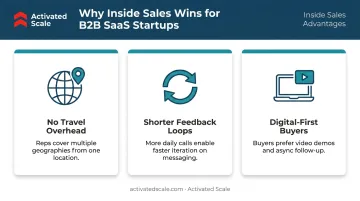
Put those three together, and a small inside sales team can generate serious pipeline across multiple market segments — long before you'd have enough budget to put even one traveling enterprise AE in the field.
The Core Roles Every Inside Sales Team Needs
Most early-stage teams make the same structural mistake : they hire a "salesperson" and expect that person to prospect, qualify, demo, and close simultaneously. In practice, that creates a generalist who does everything poorly and nothing consistently.
The Three Foundational Roles
| Role | Primary Responsibility | Key Output |
|---|---|---|
| SDR (Sales Development Rep) | Outbound prospecting and lead qualification | Qualified meetings booked |
| AE (Account Executive) | Discovery calls, demos, and closing | Closed revenue |
| Inside Sales Manager | Strategy, coaching, and performance tracking | Team productivity and quota attainment |
Mixing these roles creates confusion. When an AE is also expected to prospect, prospecting stops the moment pipeline looks healthy , and then dries up three months later.
Which Role to Hire First
For most early-stage companies, hire an SDR first. The logic: an AE without pipeline is just an expensive calendar with no meetings on it.
The exception is when you have strong inbound demand or deal sizes above $30K ACV. In those scenarios, an experienced full-cycle AE who can prospect and close is often the better first hire, since the deal economics justify the higher cost per rep.
Once you've established that first hire and pipeline starts flowing, the next layer is protecting the revenue you've already won. That's where Customer Success Managers come in. CSMs protect net revenue retention and surface upsell opportunities once your customer base is large enough to make churn a real revenue risk.
How to Hire Inside Sales Talent That Actually Performs
Define the Role Before You Write the Job Description
The SDR who excels running 80 outbound touches per day targeting SMB buyers is a completely different hire from the enterprise AE managing 6-month sales cycles with multiple stakeholders. Before posting anything, nail down:
- Your ICP (Ideal Customer Profile) — the specific buyer title, company size, and industry
- Average deal size and expected sales cycle length
- Whether the role is outbound-heavy, inbound-heavy, or full-cycle
What to Screen For Beyond the Resume
Coachability and resilience matter more than a polished LinkedIn profile. In a phone screen, you can assess both quickly:
- Communication clarity — can they explain your product back to you after a 2-minute pitch?
- Reaction to rejection — ask directly: "Tell me about a deal you lost and what you'd do differently"
- Prior buyer experience — have they sold to a similar persona at a similar deal size?
The common advice to "hire for attitude, train for skills" holds up. In inside sales specifically, attitude means one thing: tolerating daily rejection without checking out.
Compensation Structure for Early-Stage Companies
Current benchmarks from Betts Recruiting's 2025 tech compensation data show entry-level SDR base salaries running $55K–$70K, with OTE varying based on geography and experience. Bridge Group's 2024 AE benchmark report puts median SaaS AE OTE at $190K with a 53:47 base-to-variable split.
For early-stage teams without the budget for top-of-market packages, uncapped commission is a powerful retention lever. A rep who knows there's no ceiling on variable pay will self-select for high performance.
De-Risking the First Hire
Committing to a full-time hire before you have a proven sales motion is the most expensive mistake early-stage founders make. A bad SDR hire can cost over $35,000 once you account for recruiting time, lost pipeline, and the months it takes to identify and exit the wrong person.
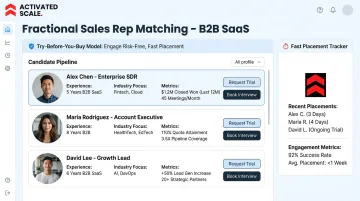
The fractional model addresses this risk directly. Rather than betting on a full-time hire, you bring on a rep under a short-term contract, validate their fit against your actual pipeline, and convert only when they've earned it.
Activated Scale connects B2B SaaS startups with experienced fractional sales reps — SDRs, AEs, and VP-level talent — typically within 7 days. The try-before-you-buy structure means 65% of clients convert their fractional rep to a full-time hire after seeing results in the field. Client outcomes include:
- Dresma.ai: 5x increase in meetings with sales-qualified prospects
- Flock Homes: 14 new meetings booked per month on average
Building Your Inside Sales Process and Setting Goals
Document the Process Before You Scale
This is the single most important infrastructure decision you'll make before hiring more than one rep. Without a documented process, every rep invents their own approach — and results become impossible to replicate or improve.
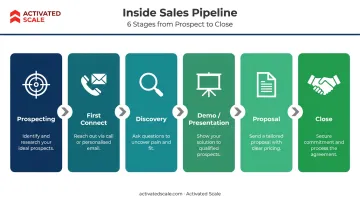
The key stages to define:
- Prospecting — How reps identify and prioritize target accounts
- First connect — The opening call or email approach
- Discovery — The questions that qualify budget, authority, need, and timeline
- Demo/presentation — What gets shown, to whom, and in what order
- Proposal — How pricing is presented and scoped
- Close — The sequence of steps from verbal yes to signed contract
KPIs That Actually Tell You Something
Avoid tracking metrics that feel productive but don't reveal where deals break down. Focus on:
- Daily outbound activity (calls + emails sent) — measures effort and process compliance
- Connect rate — reveals whether your list quality and timing are on target
- Meeting set rate — shows whether your messaging is landing
- Opportunity conversion rate — identifies if discovery is qualifying correctly
- Average deal size — tracks whether you're selling to the right ICP
Salesforce's 2024 State of Sales report found that reps spend only 30% of their workweek actually selling — process, tooling, and admin overhead account for the rest. Tracking activity KPIs early helps you identify where that time is going.
Build a Sales Playbook
A playbook is a living document that captures your best-performing call openers, objection responses, discovery questions, and email sequences. It shortens ramp time for new hires: instead of figuring out what works through trial and error, they start with what's already proven.
Keep it practical: a Google Doc with 5 sections beats an elaborate Notion database that nobody updates.
Pipeline Review Cadence
Hold a weekly 1:1 with each rep and a separate team pipeline call. The 1:1 is for coaching; the pipeline call is for deal visibility. Both are essential. Skip either one and deals start stalling before you have a chance to intervene.
Essential Tools to Equip Your Inside Sales Team
Don't over-invest in tools before your process is proven. Start with three categories:
The Non-Negotiable Stack
| Tool Category | Purpose | When to Add |
|---|---|---|
| CRM | Track every interaction and own pipeline visibility | Day one |
| Sales engagement platform | Manage outreach sequences and follow-up discipline | Day one |
| Prospecting/data tool | Build accurate contact lists targeted to your ICP | Day one |
When evaluating tools as an early-stage company, prioritize:
- Native integrations between the three core tools
- Minimal admin setup required
- Ability to scale without re-platforming
Call Recording: The Underrated Coaching Asset
Recording and reviewing sales calls is one of the fastest ways to identify what's working and coach reps toward better behavior.
Managers who only review dashboards miss the specific moments that explain why deals are dying: the wrong response to a pricing objection, the demo that runs 15 minutes too long, the close attempt that comes before the prospect is ready.
Tools like Gong and Chorus make this practical without adding overhead. They:
- Capture calls automatically and flag key moments
- Let managers add inline coaching notes without scheduling a separate meeting
- Build a searchable library of real objection responses your whole team can reference
Pair this with a weekly 1:1 where you review one call together, and you have a coaching system that gets sharper with every rep, every quarter.
Onboarding, Coaching, and Retaining Your Inside Sales Reps
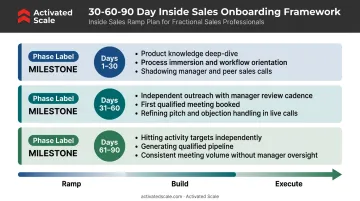
The 30-60-90 Day Onboarding Framework
Skipping structured onboarding is one of the top reasons early hires fail. A practical framework:
- Days 1–30: Product knowledge, process immersion, shadowing calls, first outreach under guidance
- Days 31–60: Running independent outreach with manager review; first meeting booked
- Days 61–90: Hitting activity targets independently; producing pipeline without daily prompting
By day 90, if a rep can't generate activity-level output consistently, the problem is the onboarding, not the rep.
Coaching vs. Managing Metrics
There's a meaningful difference between reviewing a dashboard and actually coaching a rep. Managers who live in the CRM can tell you that connect rate dropped last week. They can't tell you why without listening to calls.
A productive weekly 1:1 looks like this:
- Review the rep's pipeline and activity numbers (5 minutes)
- Listen to one recorded call together and discuss one specific moment to improve (15 minutes)
- Set one focus area for the coming week (5 minutes)
That's 25 minutes. Done consistently, it compounds into real skill improvement over a quarter.
Retention: What Actually Drives Turnover
Salesforce's 2024 data found that 64% of sales professionals would leave their current role for a similar one with better pay, and lack of career advancement was cited as the top reason for considering a change. Average sales staff turnover sits at 18% — which means you'll likely replace roughly one in five reps per year.
Retention levers that work at the early stage:
- Clear progression paths (SDR → AE, AE → Senior AE or team lead)
- Public recognition of wins — not just closed deals, but strong calls and creative outreach
- Competitive base + uncapped variable comp
Burnout is an underrated retention risk. High call volumes and daily rejection grind people down faster than most managers expect. Treat morale as a standing agenda item — not a reactive conversation when someone's already halfway out the door.
Practical ways to reduce burnout pressure:
- Rotate outreach channels so reps aren't cold-calling all day, every day
- Celebrate activity milestones, not just closed deals
- Check in on energy and engagement weekly, before problems surface
Frequently Asked Questions
How to build an inside sales team?
Define your ICP and target roles first, then hire SDRs and AEs in the right sequence. Build a documented sales process with clear KPIs before scaling headcount, equip the team with a CRM and engagement tools, and invest in structured onboarding and weekly coaching from day one.
What are the 5 C's in selling?
The 5 C's are Connect, Convince, Collaborate, Close, and Continue (retain and upsell). Inside sales reps use this framework to guide a buyer from first outreach through discovery, deal structuring, closing, and post-sale expansion.
What is the difference between inside sales and outside sales?
Inside sales reps sell remotely via phone, email, and video. Outside sales reps travel to meet buyers in person. Inside sales is more cost-effective and faster to scale, making it the default model for SaaS and technology companies with digital-first buyers.
How long does it take to build an inside sales team from scratch?
Plan for 90 days to hire and onboard, another 60–90 days for reps to ramp to full productivity, and roughly 6–12 months to reach a consistently measurable team. Fractional or contract-to-hire approaches (like those available through Activated Scale) can cut that ramp to 30–45 days.
What metrics should I track for my inside sales team?
Start with daily outbound activity (calls + emails), connect rate, meeting set rate, and quota attainment. Add pipeline conversion by stage and average deal size as your sample size grows. In the first 90 days, activity metrics tell you far more than closed-deal data will.
When should a startup hire its first inside sales rep?
Hire only after completing some founder-led sales that prove your pitch and ICP work — typically 3–5 repeatable closed deals. The new hire needs a process to follow, not a blank slate to invent from scratch.