Introduction
Most MSPs reach $1M–$2M in revenue the same way: great work, happy clients, and steady referrals. That engine runs well — right up until it stalls.
According to Kaseya's 2024 MSP Benchmark Survey, acquiring new customers was the top challenge for 36% of MSPs in 2024, up from 24% the year prior. The number one barrier cited by executives? A lack of a dedicated sales rep.
Outsourced sales is how many MSPs break through that ceiling—building a proactive revenue engine without the full cost and commitment of a new full-time hire. Getting it right, though, requires more than handing off a call list to an outside team.
What makes MSP sales particularly unforgiving is this: every prospect on your list is already paying another provider. You're not filling a gap—you're displacing an incumbent. That dynamic shapes every strategy choice you make.
This guide covers what MSP outsourced sales actually means, how to know if you're ready, which strategies work, and how to choose between a fully outsourced firm, a fractional rep, or an in-house hire.
TL;DR
- Referral-driven growth hits a ceiling; outsourced sales creates a repeatable, proactive pipeline
- Readiness requires revenue stability, cold-deal closing ability, and basic CRM processes
- Three models to consider: outsourced prospecting firms, fractional sales reps, and in-house hires, each with distinct cost and risk profiles
- Key strategies include outbound prospecting, pipeline nurturing, and account-based targeting
- Expect 6–12 months to closed deals; track leading indicators (meetings, pipeline value) while you wait
What Is MSP Outsourced Sales?
Outsourced sales means delegating part or all of your sales function—prospecting, appointment-setting, pipeline management, or closing—to an external partner rather than building that capability entirely in-house.
What outsourced sales is NOT:
- A passive revenue source you can ignore after signing a contract
- A replacement for your own closing capability
- A guarantee of new clients within 30 days
The MSP still owns the pipeline, follows up after every appointment, and closes the deal. An outsourced partner generates opportunities—the MSP converts them.
Two Categories of MSP Outsourced Sales
1. Outsourced prospecting / SDR services Top-of-funnel only. A team makes calls, sends emails, books appointments, and hands them off to you. You close.
2. Fractional sales reps An experienced sales professional who works part-time for your MSP, often handling both prospecting and closing. SDR services suit MSPs that already have a closer but need a full pipeline; fractional reps fit better when you need someone to own the full sales cycle.
Signs Your MSP Is Ready to Outsource Sales
Outsourcing sales before you're ready wastes money. These four indicators tell you whether it's the right move now.
You Have Stable Recurring Revenue
CRN reports that MSPs below the $5M top-line revenue mark often rely on owner-led sales, and owner-led sales at that scale can stall growth. Committing to an outsourced sales retainer before the business has predictable MRR is a cash flow risk.
The question isn't just "can I afford month one?" It's: can I sustain this for 12 months if the first quarter produces zero closed deals? That's the real budget test.
You Can Actually Close Cold Appointments
Referral-sourced and cold-sourced appointments are not the same. A referral arrives 70–80% sold. A cold prospect shows up skeptical, mid-contract with another provider, and needing a reason to care.
If you've never closed a cold deal before, outsourced leads will go to waste. Before outsourcing, validate that your closing process works with at least a few cold-sourced wins.
You Have a CRM and Follow-Up Process
An outsourced partner will generate leads that may not close for 12–18 months. If those contacts aren't tracked, tagged by contract renewal date, and followed up with systematically, the investment is lost.
Minimum requirements before outsourcing:
- An active CRM with pipeline stages defined
- A documented lead handoff process
- A follow-up SLA (who does what, and when)
You Understand the Displacement Cycle
Kaseya's 2024 survey data shows 26% of MSPs have more than half their client base on one-year subscription contracts, with another 24% on month-to-month arrangements. That means your prospect's timing matters as much as your pitch.
Most cold prospects won't switch immediately. A realistic outsourced sales program builds pipeline for 6–12 months before producing closed deals. MSPs that don't understand this dynamic tend to fire their outsourced partner at month three, right before the pipeline would have converted.
Key Outsourced Sales Strategies for MSPs
Outbound Prospecting Campaigns
Outbound is the most direct way to build an MSP pipeline from scratch. Unlike most B2B markets, you don't need to create awareness—every prospect already buys IT services. You just need to reach them at the right moment.
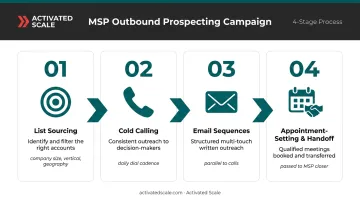
A typical outsourced outbound campaign includes:
- List sourcing by target company size, vertical, and geography
- Cold calling with a consistent daily dial cadence
- Email sequences running in parallel with calls
- Appointment-setting and handoff to the MSP closer
The data on outbound still supports phone-first outreach. RAIN Group's prospecting research found that 69% of buyers accepted a phone call from a new provider in the prior 12 months. Phone works — but it requires volume.
Salesloft's 2023 data found SDRs averaged a 2.8% email reply rate across 570M interactions. Email alone needs a large, well-targeted list to produce appointments at any reliable pace.
Set benchmarks with your outsourced partner upfront. Ask for appointments-per-month expectations, not just "activity" metrics.
Pipeline Nurturing as a Long-Term Strategy
The first appointment isn't where MSP sales are won. Most cold prospects aren't switching providers this month—they're locked into contracts and won't evaluate alternatives until their renewal window opens.
The outsourced partner's job is to systematically manage that waiting period:
- Tag each prospect in the CRM with their estimated contract renewal date
- Schedule check-in calls 90–120 days before that window
- Run light email sequences in the interim to stay visible
- Flag any prospect whose situation changes (staff turnover, IT incident, pricing complaint)
MSPs that skip this step tend to cancel their outsourced program around month four. Those that invest in it typically start seeing qualified pipeline materialize between months 9 and 12.
Account-Based Targeting
Once your nurture process is running, the next lever is precision: account-based targeting (ABT) means building a named list of ideal-fit companies and focusing outreach exclusively on them, rather than calling broad, loosely qualified lists.
Before briefing an outsourced partner, lock down your ICP across four dimensions:
- Target employee count range (e.g., 25–150 employees)
- Industry verticals where you have existing clients and credibility
- Geography you can realistically service
- Current IT setup signals (specific tools, compliance requirements, on-prem vs. cloud mix)
Narrower targeting produces better conversations. A rep calling 200 exactly-right companies will outperform one calling 2,000 loosely qualified ones on both appointment rate and appointment quality.
In-House vs. Outsourced vs. Fractional Sales: Choosing the Right Model
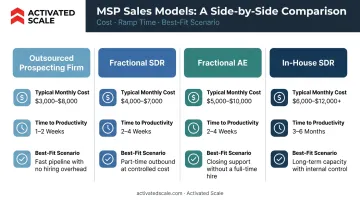
Comparison at a Glance
| Model | Typical Monthly Cost | Time to Productivity | Best Fit |
|---|---|---|---|
| Outsourced prospecting firm | ~$10,000+/month | 30–60 days | $2M+ ARR, needs top-of-funnel volume |
| Fractional sales rep (SDR) | $3,500–$4,500/month + commission | 30–45 days | $1M–$3M ARR, needs flexible capacity |
| Fractional AE | $4,500–$7,500/month + commission | 30–45 days | MSPs needing both prospecting and closing |
| In-house SDR | $60K base + $85K OTE (per RepVue 2026) + benefits | 60–90 days | $5M+ ARR, validated process |
Fully Outsourced Prospecting Firms
These firms provide a turnkey calling and email team, proven outbound process, and dedicated appointment-setters. You don't recruit, manage day-to-day activity, or worry about ramp.
The tradeoffs:
- High monthly cost—SalesRoads, for example, lists full SDR appointment-setting starting at $9,950 for four weeks
- Lower personalization; the team works across multiple clients
- You still need an internal closer
Best fit: MSPs at $2M+ in ARR that need pipeline volume and have a proven closing process in place.
Fractional Sales Reps
A fractional rep works part-time for your MSP—typically 15–20 hours per week—often covering both prospecting and parts of the sales cycle. The model sits between an outsourced vendor and a full-time hire.
Activated Scale operates directly in this space, connecting MSPs and tech companies with vetted fractional sales professionals (SDRs, AEs, and VPs of Sales) on a try-before-you-buy basis. Engagements are month-to-month with no long-term commitment, and 85% of clients convert their fractional rep to a full-time hire after the initial contract.
Pricing reflects that flexibility: fractional SDRs start at $3,500–$4,500/month plus commission; fractional AEs run $4,500–$7,500/month plus commission.
The time-to-start is fast—typically 7 days or less. By month three, most clients are booking 10–15 qualified meetings per month.
Key benefits of the fractional model:
- Lower monthly cost than a fully outsourced firm for equivalent coverage
- Faster ramp than an in-house hire
- Option to convert to full-time once fit is validated
- No recruiting burden or severance risk
In-House Hiring
Hiring a full-time SDR or AE makes sense once the MSP has a validated sales process, consistent pipeline, and enough revenue to absorb the full cost of a dedicated headcount.
The real cost goes well beyond base salary. A US SDR carries a median OTE of $85,000 (per RepVue), plus benefits, tools, management time, and a 60–90 day ramp. SDR turnover compounds the risk: only 55% hit annual quota, meaning the wrong hire can cost 6–12 months of salary before you start over.
Decision Guide
| Your situation | Recommended model |
|---|---|
| Under $2M ARR, owner still closing deals | Fractional rep (SDR or AE) |
| $2M–$5M ARR, need pipeline volume, have a closer | Outsourced prospecting firm |
| $5M+ ARR, validated process, need scale | In-house hire + outsourced for overflow |
| Process not yet proven, budget tight | Fractional rep with month-to-month terms |
How to Build a Winning Sales Process for an Outsourced Team
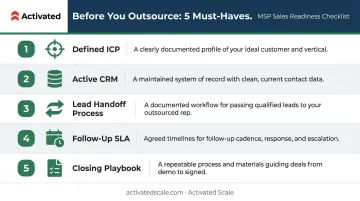
An outsourced partner is only as effective as the process they inherit. Before engaging anyone—fractional rep or outsourced firm—have these five elements documented:
- Defined ICP — employee count, vertical, geography, IT environment signals
- Active CRM — pipeline stages built out, not just installed (ConnectWise PSA, Datto Autotask, and Kaseya BMS all support external partner integrations)
- Lead handoff process — written document specifying what information transfers with each appointment and who owns follow-up
- Follow-up SLA — how quickly the MSP team responds to each appointment, and what happens if a prospect goes cold
- Closing playbook — your discovery questions, objection handling, and proposal process. The outsourced partner fills the top of funnel; the MSP owns everything below the first meeting
The most common failure mode: an MSP gets appointments but doesn't follow up consistently, then blames the outsourced partner for poor ROI. The appointments were there. The process below them wasn't.
That infrastructure gap shows up in the data. Kaseya's research found that 47% of MSP executives rank CRM as a top PSA feature and 75% say tool integration is a primary time-saving measure — confirming how central CRM infrastructure is to a functioning sales motion.
Metrics to Track for Outsourced MSP Sales Success
The Five Metrics That Matter
| Metric | What it tells you |
|---|---|
| MRR added | Direct revenue impact of the outsourced program |
| Customer Acquisition Cost (CAC) | Total program cost divided by new clients won |
| Pipeline value by stage | Leading indicator of future closed revenue |
| Appointment-to-close rate | Whether your closing process is working |
| Average sales cycle length | How long displacement actually takes in your market |
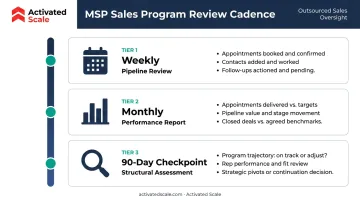
Review Cadence
- Weekly: Pipeline review with the outsourced partner—appointments set, contacts added, follow-up actions
- Monthly: Performance report comparing appointments, pipeline value, and any closed deals against targets
- 90-day checkpoint: Honest assessment of whether the program is on track or needs structural adjustment
The ROI Timeline Reality
Most outsourced MSP sales programs take 6–12 months to produce closed-deal ROI. That's not a failure of the program—it's the displacement cycle at work. Prospects are mid-contract, evaluating at renewal, and taking their time.
In the interim, measure leading indicators:
- Appointments booked per month (target: 8–15 depending on model)
- Pipeline value built at each stage
- Number of active renewal-window opportunities in CRM
Canceling at month three is a common mistake. That's typically when the pipeline is filling up, not when it converts — and pulling out early means losing the groundwork already laid.
Frequently Asked Questions
What is MSP outsourcing?
MSP outsourcing means delegating specific business functions—such as sales, marketing, NOC/SOC, or help desk—to external partners. In this guide, the focus is on outsourcing the MSP's own sales activities, not the managed IT services they deliver to clients.
What does an MSP sales job description typically include?
An MSP salesperson handles prospecting for new clients, qualifying leads, presenting managed IT solutions, handling objections, and closing contracts. In smaller MSPs, one person often covers both SDR (prospecting) and AE (closing) functions.
How much does outsourced MSP sales typically cost?
Costs vary significantly by model. Fully outsourced prospecting firms typically start at $10,000/month or more. Fractional SDRs through platforms like Activated Scale range from $3,500–$4,500/month plus commission, while fractional AEs run $4,500–$7,500/month plus commission.
How long does it take to see ROI from outsourced MSP sales?
Most MSPs see their first closed deals from an outsourced program at the 6–12 month mark, driven by the displacement cycle—prospects are locked into existing contracts and evaluate alternatives at renewal. Pipeline activity typically starts within 60–90 days; closed revenue follows once those contract cycles turn over.
What's the difference between outsourced sales and fractional sales for MSPs?
Outsourced prospecting firms provide an SDR team focused on top-of-funnel activity: calling, emailing, and booking appointments. Fractional sales reps work part-time and typically cover both prospecting and closing—functioning more like a part-time hire than an external vendor.
When should an MSP outsource rather than hire in-house?
Outsourcing fits best when budget is tight, the sales process isn't yet validated, or speed to market matters. In-house hiring makes more sense once ARR exceeds $5M and a repeatable sales process is in place.