

The conversation around outsourcing medical sales has historically defaulted to cost savings. That framing undersells the real advantage. The more compelling case is about pipeline velocity, clinical market access, and the ability to test go-to-market assumptions without betting six figures on a single hire.
This article breaks down the three specific, measurable advantages of outsourcing medical sales representatives, when each matters most, and what separates high-performing outsourced engagements from ones that stall.
TL;DR
- Outsourcing skips slow internal hiring and gives you immediate access to reps with existing clinical networks and therapeutic credibility
- Core advantages include faster pipeline activation, specialized healthcare expertise, and a flexible cost structure with lower financial risk
- Skipping outsourcing during a launch or expansion creates hiring gaps that stall revenue and fundraising
- Maximum value requires structured onboarding, clear KPIs, and integrating outsourced reps fully into your team
- The try-before-you-hire model lets companies validate rep performance before committing to full-time headcount
What Is Outsourcing Medical Sales Representatives?
Outsourcing medical sales representatives means engaging third-party sales professionals — rather than direct-hire employees — to manage outreach, relationship-building, and deal-closing with healthcare buyers. Those buyers include physicians, hospital administrators, IDN procurement teams, and specialty practice owners.
The model applies across several common scenarios:
- Product launches where speed to first clinical conversation matters
- New territory or specialty expansion where a company lacks existing relationships
- Pipeline development during hiring gaps between departures and replacement hires
- Ongoing go-to-market execution for companies that don't yet have — or don't need — a full internal sales function
Platforms like Activated Scale apply this model through fractional arrangements — matching health tech and medical companies with pre-vetted sales professionals for engagements ranging from SDR-level prospecting to full-cycle account executive work.
The distinction worth making: outsourcing is a revenue generation strategy, not a stopgap for open headcount. Companies use it to build consistent pipeline while retaining the flexibility to scale coverage up or down without long-term hiring commitments.
Key Advantages of Outsourcing Medical Sales Representatives
The three advantages below are evaluated on operational and commercial impact: time-to-revenue, cost efficiency, hiring risk, and pipeline quality. Which matters most depends on your company stage, product complexity, and how clearly you've defined the target market.
Advantage 1: Faster Time to Market and Pipeline Activation
Medical sales outsourcing compresses the time between deciding to sell and having active conversations with qualified healthcare buyers.
General hiring benchmarks put the average time-to-fill at 44 median days for non-executive roles — and that's just from job posting to accepted offer. Add onboarding, product training, and the months required for a new rep to establish clinical relationships from scratch, and you're looking at a very long runway before the first meaningful pipeline contribution.
Outsourced reps operate differently:
- They arrive with pre-existing relationships in target therapeutic areas or provider segments
- They understand clinical workflows and buyer language without needing extended training
- They can be deployed into specific territories or specialties immediately
- Contract sales teams can go live in as few as three weeks after engagement
KPIs most affected: time-to-first-qualified-meeting, pipeline build rate, days-to-revenue from market entry, sales cycle length.
Through Activated Scale's model, fractional sales professionals are matched and connected in 7 days or less — sometimes within 48 hours. Ramp time is approximately two weeks, compared to 90 days or more for a typical full-time hire. By the 45-day mark, most clients are generating 10–15 qualified meetings per month.
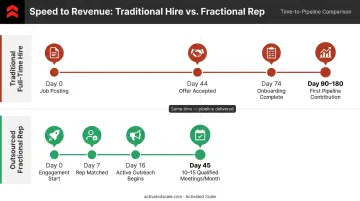
This advantage is most pronounced during new product launches, geographic expansion, or for seed-to-Series A companies that can't absorb a three-to-six month hiring cycle before generating revenue.
Advantage 2: Access to Specialized Expertise and Established Clinical Networks
Medical sales isn't generic B2B selling. Reps need therapeutic credibility, familiarity with clinical decision-making processes, and existing trust with gatekeepers — procurement managers, practice administrators, and specialty physicians who have little patience for reps who don't understand their world.
The numbers back this up. According to Veeva's 1Q 2024 Pulse Field Trends Report, U.S. HCP access has fallen to 45%, and 50% of accessible providers now meet with three or fewer biopharma companies. An inexperienced rep without pre-existing relationships isn't just slower — they may not get in the door at all.
Outsourced reps with five to ten years of specialty-area experience bring advantages that take years to build internally:
- Established relationships with key accounts in target therapeutic areas
- Familiarity with clinical language and evidence-based conversation frameworks
- Ability to navigate procurement processes, formulary reviews, and IDN buying structures
- Awareness of compliance requirements (OIG, PhRMA, AdvaMed) before ever entering an account
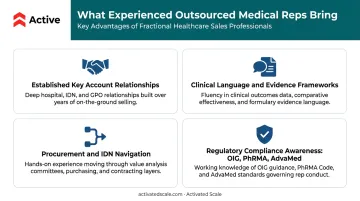
Activated Scale's vetting process specifically screens for healthcare buyer experience, requiring candidates to demonstrate prior success selling to hospitals, private practices, or healthcare organizations — not just general B2B selling credentials. Fractional roles have covered everything from intra-hospital patient transport optimization to Voice AI platforms for healthcare call centers.
KPIs most affected: qualified meeting rate, account penetration in target specialties, deal win rate, sales cycle length in clinical environments.
Companies entering a new therapeutic area, targeting hospital systems, or selling into specialty practices — where clinical credibility is a prerequisite for getting a first meeting — benefit most from this advantage.
Advantage 3: Lower-Risk Cost Structure and Built-In Scalability
Outsourcing converts the large fixed cost of full-time sales headcount into a variable, performance-linked engagement.
The financial picture for a full-time medical sales hire is significant. MedReps' 2024 salary data puts average total compensation for medical sales professionals at approximately $194,500 — including roughly $110,100 in base salary and $84,400 in commissions and bonuses. That's before benefits, a car allowance, equipment, training, and management overhead. A wrong hire on a $100,000 base salary costs approximately $35,750 in just three months (salary, benefits, tools, and training), with an additional $20,000 if a staffing agency was involved.
The fractional model changes the math:
| Cost Component | Full-Time Hire | Fractional Model |
|---|---|---|
| Monthly cost | $8,000–$16,000+ loaded | $3,500–$7,500 retainer + commission |
| Benefits | ~25% of base | $0 |
| Recruiter/agency fee | $20,000+ | $0 |
| Severance/offboarding | Variable | $0 |
| Minimum commitment | 12+ months (practical) | Month-to-month |
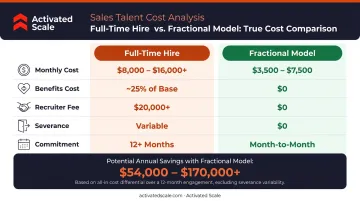
Activated Scale's fractional model runs on monthly retainers: $3,500–$4,500/month for SDRs, $4,500–$7,500/month for Account Executives, and $8,000–$15,000/month for VP-level roles — all plus commission. Companies pay for active selling capacity without the overhead of a full employee.
The contract-to-hire path adds another layer of risk reduction. After a standard three-month contract period, companies can convert high-performing reps to full-time employment. 65% of Activated Scale clients choose to convert their fractional rep to a full-time employee after seeing results — validating both performance and cultural fit before making a permanent commitment.
KPIs most affected: cost per qualified meeting, customer acquisition cost, sales team overhead as a percentage of revenue, time-to-break-even on sales headcount.
This structure is especially valuable for early-stage companies managing burn rate, organizations entering uncertain new markets, and teams dealing with launch-driven demand spikes where adding permanent headcount is hard to justify.
What Happens When Medical Companies Go In-House Too Early
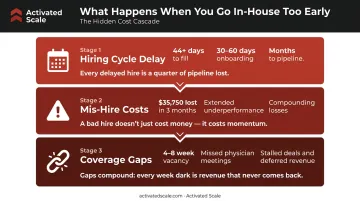
Attempting to build a full in-house medical sales team before validating go-to-market fit creates a predictable chain of problems.
The sequence typically looks like this:
- Hiring cycle eats months — 44+ days to fill a role, another 30–60 days to onboard, then months before the rep generates meaningful pipeline
- Mis-hires are expensive and hard to catch early — founders without sales hiring experience often keep underperforming reps longer than they should, compounding losses
- Coverage gaps cause real revenue damage — a 4–8 week vacancy means dozens of missed physician or procurement meetings, stalled deals, and deferred revenue that creates pressure on growth targets and fundraising
There's also a compliance dimension that often gets overlooked. Medical sales operates under a strict set of regulatory requirements: FDA promotional guidelines, OIG anti-kickback guidance, and PhRMA/AdvaMed interaction standards. An inexperienced rep who doesn't know these frameworks creates real exposure.
The DOJ reported that False Claims Act settlements and judgments exceeded $2.9 billion in FY2024. That's the financial reality when promotional conduct goes wrong.
Trained outsourced professionals working through established platforms are already oriented to these requirements. You're not just buying sales capacity — you're buying reps who won't create regulatory exposure on day one.
How to Get the Most Value from Outsourced Medical Sales Reps
Outsourcing works when it's treated as a structured engagement, not a delegation. Three conditions separate high-performing outsourced arrangements from ones that underdeliver:
1. Set clear territory and account goals from day one Outsourced reps perform best when they know exactly which specialties, geographies, or account types to prioritize. Ambiguity at the start costs weeks of misdirected effort.
2. Run regular performance reviews against agreed KPIs Monthly reviews against metrics like qualified meeting rate, pipeline volume, and deal progression keep engagements on track and surface problems before they compound.
3. Treat field insights as strategic input Outsourced reps in clinical environments hear objections, competitive intelligence, and buyer sentiment that your internal team often doesn't. Building a feedback loop from the field into product positioning and sales strategy is one of the most underused advantages of the model.
Where most outsourced efforts break down: onboarding
Even experienced reps need product-specific training, CRM access, approved messaging frameworks, and clarity on buyer personas before engaging accounts. Skipping this step and assuming a seasoned rep will figure it out produces slow starts and frustrated clients.
Activated Scale addresses this with a defined ramp sequence: a two-week onboarding phase covering product knowledge, buyer personas, and CRM setup, followed by active outreach from day 16 onward. Clients are matched with a fractional sales professional in 7 days or less.
That means revenue-generating activity can begin within three to four weeks of engagement — ahead of any traditional hiring timeline. For health tech companies that need to move quickly, the contract-to-hire model offers a low-risk path to test fit before committing to a full-time hire.
Conclusion
The core case for outsourcing medical sales reps comes down to a few compounding advantages: faster pipeline activation, access to clinical expertise and established networks, and a cost model that keeps headcount flexible before you've locked in your go-to-market approach.
These advantages grow stronger when outsourcing is treated as a managed, ongoing practice rather than a stopgap. Reps who receive proper onboarding, clear performance standards, and real integration into field feedback loops reliably outperform those dropped into accounts cold.
For medical and health tech companies that can't afford a six-month hiring cycle before generating revenue, outsourcing is a market access decision. Speed to revenue matters, and the right fractional rep can compress that timeline significantly.
Frequently Asked Questions
What types of medical sales activities can be outsourced?
Most of the sales cycle can be outsourced: lead generation, outreach, appointment setting, territory management, product demos, and key account relationship building. Companies can outsource a specific part of the cycle or the entire commercial function, depending on their stage and internal capacity.
How quickly can an outsourced medical sales rep start generating results?
Experienced reps with existing healthcare networks can begin outreach within days of onboarding. Through Activated Scale's model, active outreach typically starts between days 16 and 45, with most clients reaching 10–15 qualified meetings per month by the end of month two.
Is outsourcing medical sales reps cost-effective for early-stage companies?
It's particularly well-suited for early-stage companies. Fractional arrangements eliminate the loaded costs of full-time headcount (salary, benefits, training, severance) and let companies pay for active selling capacity month-to-month — making burn rate far easier to manage while building pipeline.
What is the difference between a fractional medical sales rep and a fully outsourced sales team?
A fractional rep works on a defined scope for one company — ideal for early-stage coverage or targeted pipeline development. A fully outsourced team through a contract sales organization (CSO) provides a complete commercial function including management, CRM, and reporting. The right model depends on company stage and sales volume.
How do you maintain brand and messaging consistency with outsourced medical sales reps?
Consistency requires structured onboarding (product training, approved messaging, buyer personas), shared CRM access, and regular check-ins. Reps who are integrated into the team rather than managed at arm's length maintain brand standards as reliably as internal hires.
When should a company transition from outsourced to in-house medical sales reps?
The transition makes sense once a company has validated its go-to-market motion, achieved repeatable pipeline metrics, and can justify the fully loaded cost of full-time headcount. Many companies skip the cold hire entirely by converting high-performing fractional reps — Activated Scale's contract-to-hire model is built specifically for this path.