_edi.png)

Sales leaders know that protecting valuable assets like client relationships and market insights is essential for staying competitive. But how do you manage this while working with independent reps? Contractor non-compete agreements are necessary when working with independent contractors to secure these assets.
These agreements are designed to prevent contractors from using the knowledge gained during their engagement to benefit competitors. That's why nearly 30 million U.S. workers are bound by non-compete agreements.
A contractor's departure shouldn’t mean an immediate transfer of value to a competitor. Also, how does it help you as an employer?
In this blog, we’ll discuss how, as an owner, you can personalize non-compete agreements to U.S. state-specific laws.
Highlights of the Blog:
- 30 million U.S. workers are bound by non-compete agreements, highlighting their widespread use across industries.
- Non-compete agreements help protect client relationships, proprietary sales strategies, and intellectual property when working with independent contractors.
- The key components of a non-compete include duration, geographic scope, and industry restrictions, with enforceability depending on the reasonableness of these terms.
- A surprising 74% of U.S. employers still use non-competes, despite mounting legal risks.
- Alternatives like Non-Solicitation Agreements, Non-Disclosure Agreements, and Garden Leave provide similar protections while avoiding some of the downsides of non-competes.
What Do You Understand By a Non-Compete Agreement (NCA)?
Essentially, a contractor non-compete is a clause that limits an independent contractor's future work options. For a set period and in a specific location, they agree not to work for a direct competitor or start a similar business of their own.
This ensures that when the contractor finishes their work with your company, they cannot immediately use the gained knowledge to benefit your competitor directly.
Without an NCA, contractors could take sensitive information with them, leaving your business vulnerable. However, remember that they must be reasonable and not overly restrictive to avoid being deemed unenforceable in court.
Now, the real question becomes: Why do employers continue to adopt these restrictive clauses despite growing legal scrutiny? We'll explore exactly why these covenants remain so prominent in sales and enterprise settings.
Also Read: Marketing for Startups: Insights for a Low-Cost, High Impact Marketing Plan
Why Employers Use Non‑Compete Covenants?
What would happen if a top sales contractor left with your entire playbook and client list next week? Shivers run down every sales leader’s spine just imagining that. This is exactly "why" sales founders and enterprise leaders turn to NCA as a defensive strategy.
However, that's not the only reason. The advantages go far beyond simple loyalty.
- A non‑compete clause limits the risk that this insight will be walked across to a direct competitor.
- Sales depend on relationship-building techniques. A well‑scoped non‑compete helps prevent the contractor from turning that relationship to a rival immediately after leaving your team.
- In many sales organizations, processes, technology implementation, and playbooks are proprietary assets. Employers use non‑competes to reduce the chances that contractors reuse those assets elsewhere.
- If a contractor departs and joins a competitor immediately, the return on that investment evaporates. A non‑compete helps protect that investment.
- Embedding a contractor non‑compete agreement helps align contractor behavior with the company’s long‑term interests and reduces leakage of investment.
We understand the challenges sales leaders face in safeguarding client relationships and proprietary knowledge. Choose Fractional Sales Leadership from Activated Scale and bring on a seasoned VP of Sales who will help with the Go-to-Market (GTM) strategy.
These non-compete agreements are commonly used to outline the specific terms of employment. Knowing how to structure them properly can help you protect your business without overstepping legal boundaries.
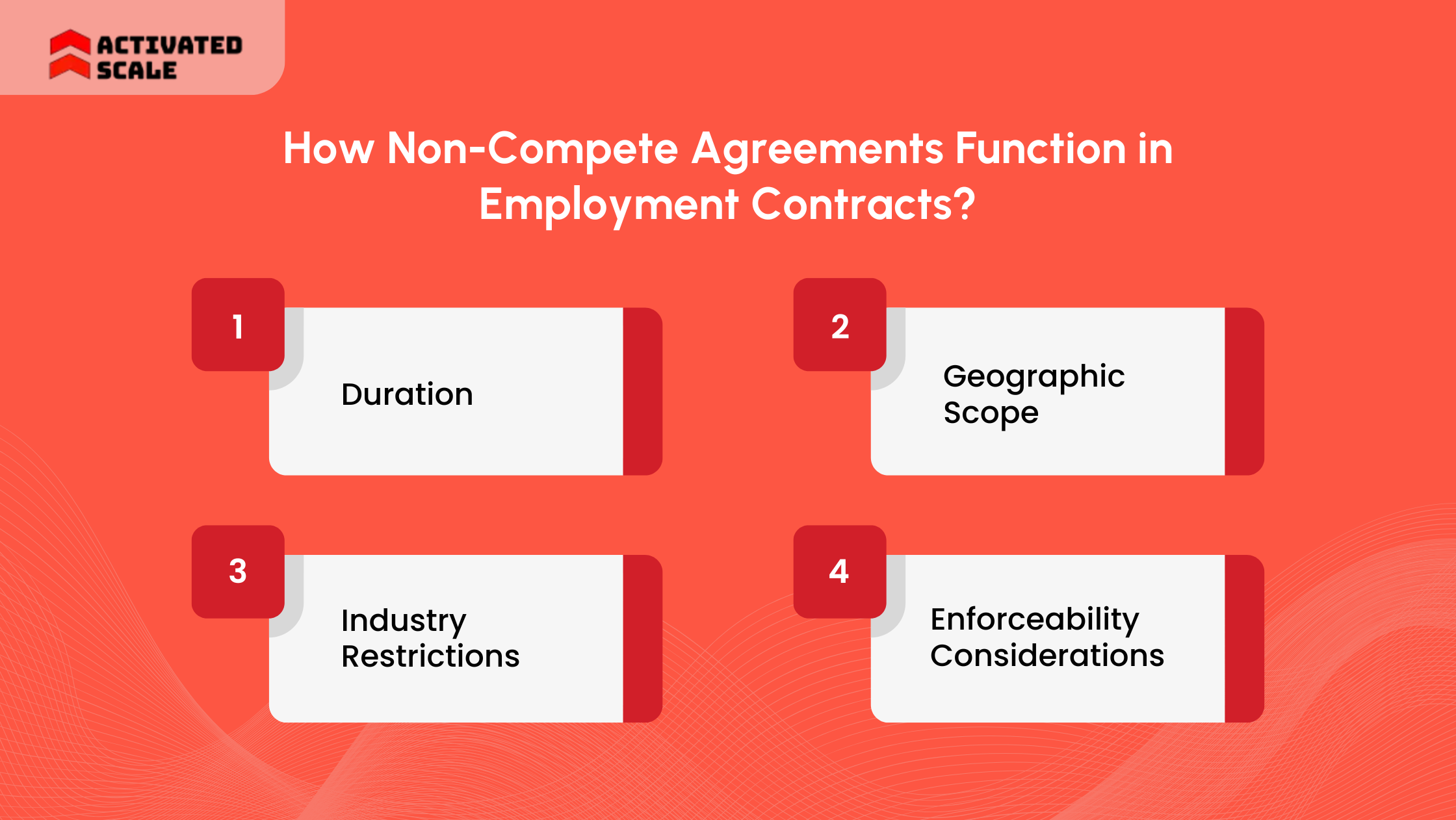
How Non-Compete Agreements Function in Employment Contracts?
Let's be honest: Most owners just slip the non-compete into the standard offer packet, hoping it never has to be used. However, we need to look under the hood.
It's a legal landmine carefully wired with three key components: Scope, geography, and duration.
1. Duration
The duration of the non-compete agreement is one of the most important factors in determining its enforceability. Typically, the restriction period lasts anywhere from 6 months to 2 years.
Shorter durations are more likely to be upheld by courts, while longer restrictions may be viewed as unreasonable.
2. Geographic Scope
The geographic scope of the agreement defines the area in which the individual is restricted from competing. This could range from a specific city or state to a broader region.
For example, a regional sales leader may be restricted from working in the same market but not across the country. The geographic scope should ensure that the restriction is not overly broad.
3. Industry Restrictions
This component defines the types of businesses or roles that are off-limits to the individual after leaving the company. In sales, this may include any direct competition within the same product category or service offering.
4. Enforceability Considerations
To be enforceable, the terms of the non-compete agreement must be reasonable. Courts will examine factors to ensure they are not too restrictive.
Non-compete agreements typically work when an employee resigns, is terminated, or retires. 74% of U.S. employers are still using non-compete agreements, even as the legal risks against them grow.
However, due to their restrictiveness, many employers feel it is redundant to use them. So, what is wrong with these contracts?
Read Also: Steps to Build and Train a Successful SDR Team
Is There Any Problem with Non-Competes?
Many founders confessed that they've used non-competes for years without a second thought. They're just part of the standard hiring packet, right? But now, with the legal ground, owners are forced to ask a more fundamental question.

"Are we relying on a broken system?" Here’s a closer look at some of the primary issues with non-compete clauses.
1. Legal Challenges
In states like California, non-competes are largely unenforceable. Even in states where they are allowed, non-competes often face legal scrutiny.
Courts may rule them invalid if they are not considered “reasonable”. This makes the proper crafting of non-competes essential to avoid expensive legal disputes.
2. Restricting Talent Mobility
Non-compete clauses can be restrictive for contractors, limiting their ability to pursue new opportunities within their industry or region. For high-level sales professionals who value mobility, these agreements may feel like a barrier to their career advancement.
This can lead to dissatisfaction and even prompt contractors to challenge the agreement in court or refuse to sign it altogether.
3. Risk of Overuse
Using non-competes too liberally can harm your company’s reputation, especially if the clauses are perceived as too restrictive or unfair. When contractors feel like they’re being unfairly bound, it can lead to resentment and a loss of trust.
This can hurt talent acquisition and retention efforts, particularly as workers become more aware of their rights in different states.
4. Economic Impact
Restrictive non-competes may also stifle innovation. As sales talent professionals are kept from moving freely across companies, they can’t share new ideas or bring fresh perspectives.
For industries that excel in innovation, this can lead to a slower pace of development.
While non-competes are meant to protect your business, it’s crucial to balance protection with fairness to avoid these pitfalls.
Looking for more flexible ways to protect your business without restrictive non-compete clauses? At Activated Scale, we specialize in providing sales reps from the Contract-to-Hire Sales Recruiting Service. Their expertise helps you bring success.
Since the challenges are present, sales leaders choose alternatives to non-compete agreements. In some cases, alternative agreements might provide the protection you need without the restrictive impact of a non-compete.
What are the Available Alternatives to Non-Compete Agreements in the U.S.?
So, if we're rethinking the classic non-compete, what do we put in its place? The good news is, letting go of that blunt instrument forces us to build a better, stronger company.
In fact, the Organization for Economic Co‑operation and Development (OECD) states that restrictive covenants such as non‑solicitation and non‑dealing clauses reduce job mobility. This, in turn, limits innovation and productivity growth.
We can protect what matters without building walls, by building loyalty instead of demanding it. Here are some alternatives you can try:
These alternatives can be just as effective as non-compete agreements in protecting your business without the adverse effects.
Read Also: Hire SDR: How to Find the Best Sales Development Representatives
Wrapping Up
Contractor non-compete agreements are a mixed blessing. They can protect your business, but also alienate your best people.
The key is balance. If you focus on legal clauses, you can still retain the best reps. This is about building a foundation of mutual respect and security that actually holds up in court.
Need an expert sales rep for crafting non-compete agreements or exploring more flexible alternatives? Contact us today to discuss how Activated Scale can help you secure your business with our customized services.
FAQs
1. Can non-compete agreements apply to independent contractors?
Yes, non-compete agreements can be applied to independent contractors, but the terms and enforceability vary. It's important to personalize the agreement specifically to independent contractors to ensure it's reasonable.
2. Are non-compete agreements enforceable in every state?
No, non-compete agreements are not enforceable in every state. For example, California generally prohibits non-compete clauses, while other states may enforce them under specific conditions.
Always check the local laws before drafting such agreements.
3. What happens if a non-compete agreement is deemed unenforceable?
If a non-compete agreement is considered unenforceable, the employee may not be bound by its terms. However, employers can still protect their business with other agreements, like non-disclosure or non-solicitation agreements.
4. Can I use a non-compete agreement with employees at any level?
Non-compete agreements are typically more common for high-level employees or contractors with access to sensitive company information. Using non-competes with lower-level employees may be difficult to enforce and could lead to legal challenges.
The Ultimate Guide to Hiring a Salesperson!
Get the step-by-step guide to hiring, onboarding, and ensuring success!