_edi.png)

Customer churn rarely starts with a single failure. It builds slowly through missed signals, inconsistent onboarding, and unclear ownership of renewals. Many SaaS startups invest heavily in acquiring customers but lack the operational structure to retain and grow them. As revenue scales, this gap makes forecasting unreliable and expansion harder to plan.
Customer success operations solve this by bringing structure, visibility, and accountability to the post-sale journey. It connects customer data, defines repeatable processes, and helps teams act before risks turn into lost revenue.
This guide explains how startups can build customer success operations from the ground up and turn retention into a predictable growth driver.
Core Insights
- Customer success operations turn retention into a predictable growth driver: CS Ops gives startups visibility into customer health, renewal risk, and expansion opportunities, helping leadership forecast revenue with confidence.
- Most SaaS startups need CS Ops between $3M and $10M in ARR: This is the stage when manual tracking breaks down, renewals increase, and leadership needs structured forecasting and lifecycle management.
- Health scoring and renewal forecasting are the foundation of CS Ops: Clear health models and renewal pipelines help teams identify churn risk early and prioritize the right accounts for intervention and growth.
- The CS Ops tech stack should evolve gradually with company growth: Startups begin with CRM and spreadsheets, then add customer success platforms, automation, and analytics tools as customer volume and revenue scale.
- Flexible hiring models help startups build CS Ops faster with lower risk: Platforms like Activated Scale give startups access to vetted, U.S.-based talent who can implement customer success operations without early full-time hiring commitments.
What Are Customer Success Operations?
Customer success operations (CS Ops) is the function that builds the structure behind how customer success teams retain and grow revenue. It focuses on systems, data, and processes that help teams manage customers consistently at scale.
While customer success managers work directly with customers, CS Ops ensures they have accurate health data, clear workflows, and reliable forecasts.
CS Ops Vs Customer Success Vs Support
These functions serve different roles but depend on each other to protect revenue:
- Customer success: Owns onboarding, adoption, renewals, and expansion conversations
- Customer support: Resolves technical issues, answers product questions, and handles reactive requests
- Customer success operations: Builds health scores, manages success platforms, creates renewal forecasts, and tracks performance
Customer success drives outcomes. Support solves problems. CS Ops enables both by creating structure and visibility.
Who Owns CS Ops In Startups?
In early-stage startups, CS Ops rarely begins as a dedicated role. Ownership typically sits with existing leaders who need visibility into retention.
Common ownership progression:
- Early stage (founder-led or <$5M ARR): Founder, head of customer success, or revenue leader manages reporting and tooling
- Growth stage ($5M–$15M ARR): Dedicated CS Ops manager or analyst is hired
- Scale stage: CS Ops becomes part of a broader revenue operations team
This role usually reports to the VP of customer success or VP of revenue operations. Its purpose is to build repeatable systems that make retention measurable, predictable, and scalable.
Why CS Ops Matters For U.S. SaaS Startups in 2026
For SaaS startups, growth does not come only from closing new customers. It comes from keeping existing ones, expanding their accounts, and forecasting revenue accurately. Customer success operations makes this possible by giving teams visibility into customer health, renewal timelines, and expansion opportunities.
It also helps teams track renewal risk, monitor engagement trends, and improve forecasting accuracy. This allows leaders to predict revenue more reliably and intervene early when accounts show signs of churn.
Strong CS Ops directly improves three core outcomes:
- Higher retention: Health scores and renewal workflows help teams identify at-risk accounts before they churn
- Expansion ARR growth: Usage and engagement data reveal upsell opportunities at the right time
- Faster time-to-value: Structured onboarding and milestone tracking help customers see results sooner
Without this operational layer, customer success becomes reactive. Teams rely on memory, spreadsheets, or inconsistent check-ins, which creates blind spots.
The financial impact of this gap is significant. Consider a SaaS startup with $8 million in annual recurring revenue and 15 percent annual churn. That equals $1.2 million in lost revenue each year. If better health monitoring and renewal processes reduce churn to 10 percent, the company retains an additional $400,000 annually. Over a few years, this difference compounds and directly affects valuation.
Lack of CS Ops also makes forecasting unreliable. Leaders cannot confidently predict renewals, which makes hiring, budgeting, and investor planning more difficult.
Customer success operations bring structure and predictability, turning retention into a measurable and manageable growth driver rather than a source of uncertainty.
Must read: What Affects Sales Training Costs and How To Plan
Core Responsibilities And Org Model
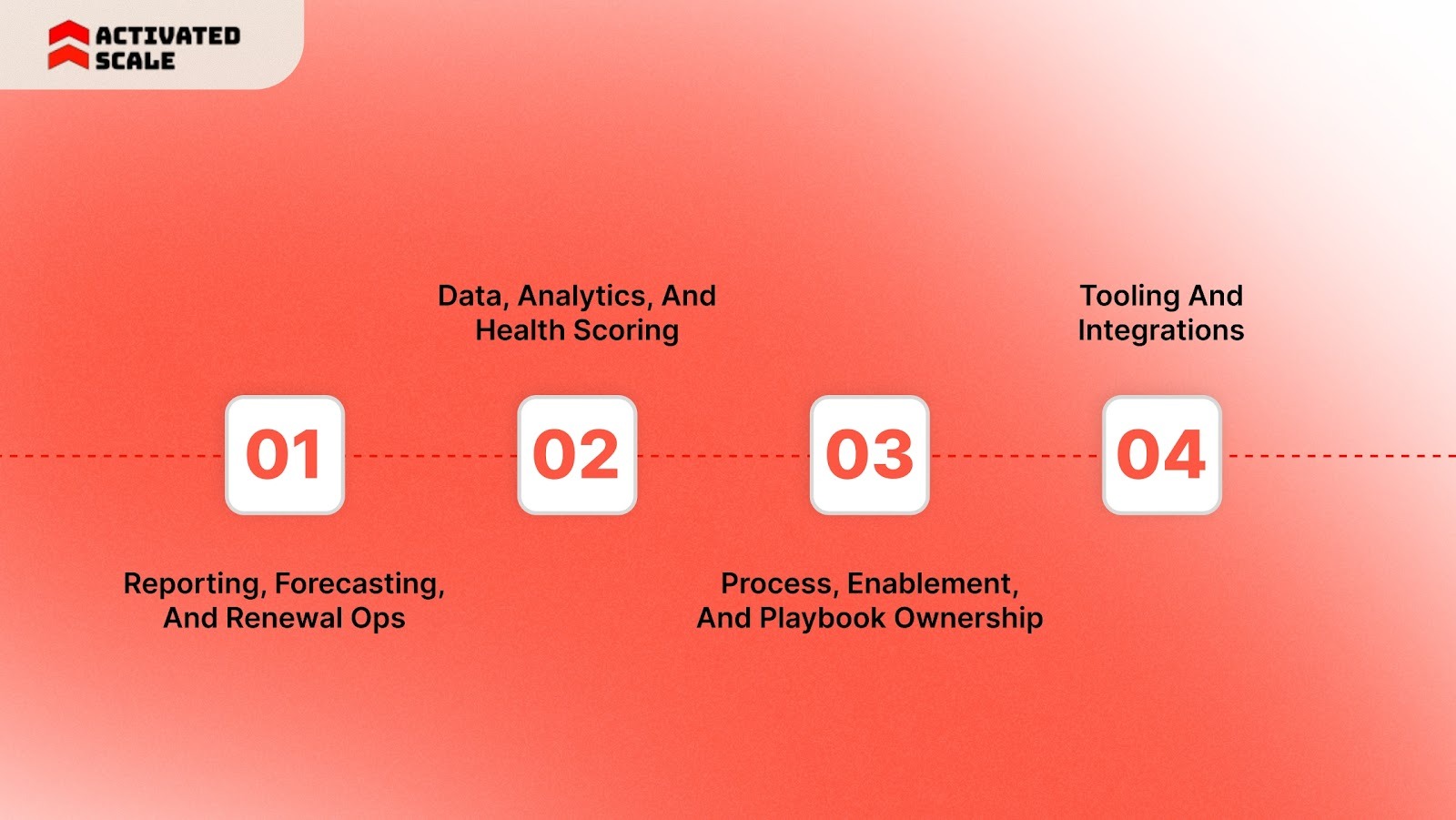
Customer success operations connect customer data, renewal workflows, and internal processes so retention and expansion become predictable. In startups, this function turns scattered activities into structured systems leaders can trust.
Reporting, Forecasting, And Renewal Ops
One of the primary responsibilities of CS Ops is building accurate renewal forecasts and giving leadership clear visibility into retention risk. This includes maintaining renewal pipelines, tracking contract dates, and flagging accounts that need attention.
Typical deliverables include:
- Renewal forecast dashboards updated weekly
- At-risk account reports with owner assignments
- Expansion and contraction tracking
- Monthly and quarterly retention reporting
Example renewal forecast view:
This structure helps teams intervene early instead of reacting after churn happens.
Data, Analytics, And Health Scoring
CS Ops defines how customer health is measured. Health scores combine multiple signals into a single number that shows renewal likelihood.
Example health score formula:
- Product usage: 40%
- Feature adoption: 25%
- Support tickets: 15%
- Engagement (meetings, emails): 20%
Health score thresholds example:
This allows teams to prioritize the right accounts at the right time.
Process, Enablement, And Playbook Ownership
CS Ops ensures customer success teams follow consistent processes. This improves efficiency and reduces dependency on individual team members.
Typical ownership includes:
- Onboarding workflows → documented by CS Ops, executed by CSMs
- Renewal process → defined by CS Ops, owned by CSMs and leadership
- Customer lifecycle stages → defined and maintained by CS Ops
- Reporting definitions → owned and maintained by CS Ops
These playbooks make performance repeatable as the team grows.
Tooling And Integrations
CS Ops manages the technology stack that supports customer success.
Example CS Ops tech stack:
This mirrors how many startups approach operational gaps during growth. Instead of overbuilding internally, they bring in experienced specialists to implement structure quickly.
Many SaaS companies use platforms like Activated Scale to access vetted, U.S.-based fractional operators who can build forecasting, reporting, and customer success infrastructure while leadership stays focused on scaling revenue.
Learn more about: How to Hire Overseas Contractors Compliantly in 2026
The CS Ops Tech Stack By Maturity
Customer success operations technology evolves as a SaaS startup grows. Early teams need visibility without complexity.
As revenue scales, the focus shifts to automation, accuracy, and deeper insights. The goal is to add tools only when operational gaps appear, not before.
Seed Stage: Build Visibility With Lightweight Tools
At the seed stage, most startups can manage customer success operations using simple, low-cost tools. The priority is tracking customers, renewal dates, and engagement in one place.
Typical stack:
These tools work well until manual updates slow the team down or forecasting becomes unreliable.
Growth Stage: Add Dedicated CS And Data Infrastructure
As startups pass $5M–$15M in ARR, customer volume and revenue risk increase. This is when dedicated customer success platforms and analytics tools become necessary.
Typical stack:
This stage improves health scoring, forecasting, and operational efficiency.
Scale Stage: Integrate Automation And Predictive Intelligence
At scale, customer success operations become deeply integrated with revenue operations. The focus shifts to automation and predictive insights.
Typical stack additions:
Many startups introduce these capabilities gradually by bringing in experienced operators who can design and implement the right stack without overbuilding early.
This ensures the tech stack supports growth instead of becoming a costly and underused system.
How To Implement The Right CS Ops Stack Without Slowing Growth

Knowing which tools to use is only part of the challenge. The harder part is implementing them correctly without disrupting customer relationships or overwhelming the team.
Many SaaS startups introduce new systems too late, when churn has already increased, or too early, when the team lacks the data and processes to use them effectively.
Customer success operations typically evolves in three implementation phases:
- Foundation phase: Clean CRM data, define customer lifecycle stages, and track renewal dates
- Structure phase: Implement a customer success platform, build health scores, and automate alerts
- Optimization phase: Integrate product data, improve forecasting accuracy, and align with revenue operations
Each phase requires both technical setup and operational design. Tools alone do not improve retention. They need clear ownership, defined workflows, and consistent reporting.
This is why many startups avoid building CS Ops entirely on their own in the early stages. Instead, they bring in experienced operators to design the system, implement the stack, and train the team.
This mirrors how companies handle other specialized growth functions. Rather than stretching leadership bandwidth thin, they rely on flexible, experienced talent.
Platforms like Activated Scale allow startups to access vetted, U.S.-based fractional operators who can implement customer success infrastructure efficiently, while founders and revenue leaders stay focused on acquiring and growing customers.
The 6-Step CS Ops Playbook for Startups in 2026
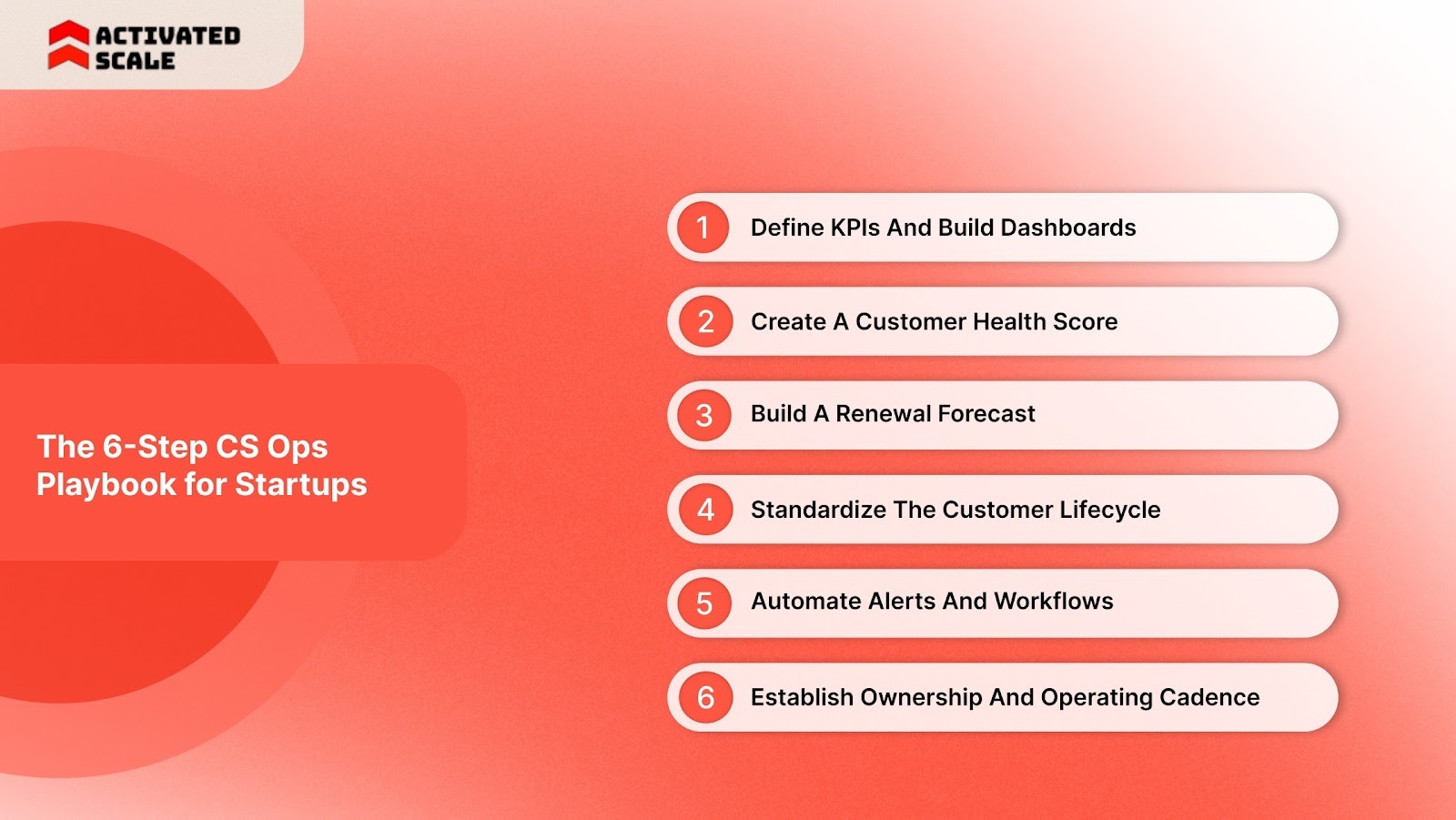
Building customer success operations does not require a large team. Most SaaS startups can implement the foundation within 60 to 90 days if ownership and timelines are clear. The goal is to create visibility into retention, standardize workflows, and give leadership reliable forecasts.
Step 1: Define KPIs And Build Dashboards (Timeline: 2 Weeks, Owner: CS Ops Or Revenue Leader)
Start by defining the metrics that reflect customer health and revenue retention. These typically include gross churn, net revenue retention, renewal rate, and expansion ARR. Build a simple dashboard using your CRM and reporting tool so leadership can review performance weekly.
Sample pseudocode for monthly churn rate:
monthly_churn_rate = churned_mrr / starting_mrr
This establishes a baseline and highlights early retention risks.
Step 2: Create A Customer Health Score (Timeline: 2 Weeks, Owner: CS Ops)
Health scores help teams prioritize accounts that need attention. Combine product usage, engagement, and support activity into a single score. Start simple and refine over time.
Example pseudocode:
health_score = (usage_score * 0.4) +
(engagement_score * 0.3) +
(support_score * 0.3)
Assign ownership so customer success managers review at-risk accounts weekly.
Step 3: Build A Renewal Forecast (Timeline: 3 Weeks, Owner: CS Ops + Customer Success Leader)
Create a renewal pipeline showing contract value, renewal date, and risk level. This improves revenue predictability and prevents last-minute surprises.
Example renewal rate calculation:
renewal_rate = renewed_arr / total_arr_up_for_renewal
Leadership can now see future retention trends.
Step 4: Standardize The Customer Lifecycle (Timeline: 3 Weeks, Owner: CS Ops)
Define lifecycle stages such as onboarding, adoption, renewal, and expansion.
Document exit criteria for each stage so customer success managers follow a consistent process. This reduces onboarding delays and improves time-to-value.
Step 5: Automate Alerts And Workflows (Timeline: 2–4 Weeks, Owner: CS Ops + Technical Resource)
Introduce automation to reduce manual tracking. For example, create alerts when health scores drop or when renewals approach.
Example expansion ARR calculation:
expansion_arr = upgraded_arr - original_arr
Automation ensures no opportunities or risks are missed.
Step 6: Establish Ownership And Operating Cadence (Timeline: Ongoing, Owner: CS Leadership)
Define clear accountability and meeting rhythms. Most startups implement:
- Weekly risk review meetings
- Monthly retention reporting
- Quarterly forecast reviews
Many startups accelerate this process by bringing in experienced CS Ops specialists who have built these systems before. This allows the company to implement best practices faster and avoid costly trial-and-error while scaling retention.
KPIs And Dashboards Every CS Ops Team Must Track
Customer success operations exist to make retention measurable and predictable. Without clear KPIs and structured dashboards, teams cannot see risk early or measure improvement.
The right metrics help leadership understand revenue stability, customer health, and expansion potential.
Core CS Ops KPIs:
These metrics should be reviewed weekly by customer success leaders and monthly by executive teams.
How Activated Scale Helps Startups Build Customer Success Operations Faster
Building customer success operations requires specialized skills in reporting, forecasting, systems design, and revenue alignment. Most early and growth-stage SaaS startups need this expertise, but hiring a full-time CS Ops leader too early can create cost, timing, and hiring risk. The function is critical, yet the workload may not initially support a permanent role.
This is where Activated Scale plays a direct role. Activated Scale connects startups with vetted, U.S.-based sales and revenue professionals who can implement the operational foundation behind customer success. Instead of delaying CS Ops or overcommitting to a full-time hire, founders can bring in experienced operators who build the structure, validate the impact, and support growth.
Activated Scale supports customer success operations through flexible hiring models:
- Contract-to-Hire Recruiting: Activated Scale helps startups deploy experienced operators who can build renewal dashboards, forecasting systems, and lifecycle workflows. Companies can evaluate real performance first and transition to full-time once the role proves essential.
- Fractional SDR And AE Support For Expansion: Activated Scale provides fractional SDRs and AEs who partner with customer success teams to re-engage dormant accounts, support upsell conversations, and maintain expansion pipeline. This ensures opportunities identified through CS Ops translate into measurable revenue.
- Fractional Sales Leadership And Revenue Alignment: Activated Scale connects startups with experienced sales leaders who align sales and customer success operations, improve forecast accuracy, and define clear ownership across the customer lifecycle. This creates consistency across acquisition, retention, and expansion.
This approach reflects how modern SaaS companies scale operational functions. Instead of slowing growth while searching for full-time hires, they use Activated Scale to implement customer success operations with proven talent, reduce hiring risk, and build a scalable retention engine while leadership stays focused on growing the business.
Conclusion
Customer success operations bring structure to retention, visibility to customer health, and accuracy to renewal forecasting. Done right, it reduces preventable churn, improves expansion consistency, and gives leadership confidence in future revenue. Instead of reacting to surprises, teams can plan ahead, prioritize the right accounts, and protect long-term growth.
Activated Scale helps startups build this operational foundation by connecting them with vetted, U.S.-based revenue professionals who understand how retention, expansion, and forecasting work together. Through contract-to-hire and fractional models, companies can implement dashboards, renewal processes, and forecasting systems without committing to a full-time hire too early.
Connect with Activated Scale to explore how flexible, proven talent can help you implement customer success operations and scale with confidence.
FAQs
1. When should a startup hire customer success operations?
Most SaaS startups hire customer success operations when customer count, ARR, and renewals increase beyond what manual tracking can handle. This typically happens between $3M and $10M in ARR, when forecasting and retention visibility become critical.
2. What does a customer success operations manager actually do?
A customer success operations manager builds renewal forecasts, creates health score models, manages success tools, and produces retention reports. Their role is to give leadership clear visibility into customer health and future revenue.
3. How does CS Ops improve net revenue retention?
CS Ops improves net revenue retention by identifying churn risks early, tracking expansion opportunities, and ensuring customer success teams act at the right time. This prevents avoidable losses and supports consistent account growth.
4. Can small SaaS teams build CS Ops without hiring full-time?
Yes. Many early-stage startups begin with fractional operators or existing revenue leaders managing CS Ops. This allows them to implement structure and validate impact before committing to a permanent hire.
5. What tools are required to start customer success operations?
Most teams begin with a CRM, reporting dashboard, and customer data tracking. As they grow, they add customer success platforms, automation tools, and data warehouses to improve forecasting and efficiency.
6. How long does it take to implement customer success operations?
Most startups can build the core CS Ops foundation within 60 to 90 days. This includes defining KPIs, creating health scores, building renewal forecasts, and establishing reporting workflows.
The Ultimate Guide to Hiring a Salesperson!
Get the step-by-step guide to hiring, onboarding, and ensuring success!