_edi.png)
Startups rarely struggle to attract attention. The real challenge arises later, when interest fails to translate into a consistent pipeline. Marketing teams increase traffic through ads, SEO, and content, yet sales teams often question the quality of leads and the readiness of deals.
The gap usually stems from the absence of a clear demand-generation strategy that connects marketing activity to how B2B buyers actually evaluate solutions. Research highlights how wide this gap can be.
Studies show that only about 13 percent of marketing-qualified leads convert into sales-qualified opportunities, exposing a large gap between lead volume and pipeline impact.
Buyer behaviour partly explains the problem. Much of the research, comparison, and internal discussion happens before prospects ever speak with a sales team. Marketing, therefore, carries a larger role in educating and building trust earlier in the journey.
This blog explains what separates effective demand generation strategies from campaigns that create activity but fail to produce a reliable revenue pipeline.
Key Takeaways
- A demand generation strategy builds buyer awareness and trust before lead capture, which improves sales readiness and pipeline quality.
- ICP clarity and buying-trigger mapping help marketing campaigns reach prospects at the right moment in their decision-making process.
- Authority-building through research, insights, and educational content positions companies as credible vendors during early-stage buyer research.
- Sales and marketing alignment is essential because shared metrics, such as opportunity creation and pipeline contribution, reduce wasted leads.
- Execution capacity matters. Experienced SDRs, AEs, and fractional sales leaders help convert marketing demand into real revenue opportunities.
What Is a Demand Generation Strategy and Why Founders Care About It
A demand generation strategy defines how a company attracts the right audience, builds trust, and moves prospects toward qualified sales conversations. It focuses on shaping buyer intent throughout the purchase journey rather than simply collecting contact details via forms.
Founders pay close attention to demand generation because early-stage revenue depends on a predictable pipeline.
Traffic alone does not create deals. A strong pipeline forms only when prospects clearly understand their problem, see a credible solution, and enter conversations with genuine buying intent.
Difference Between Demand Generation and Lead Generation
Demand generation builds interest before buyers share their contact information. Lead generation captures that interest once prospects begin evaluating solutions. Both functions support the revenue engine but operate at different stages of the buyer readiness cycle.
Demand generation focuses on education and category awareness. Lead generation converts engaged prospects into identifiable contacts through demos, webinars, or gated resources.
Key differences include:
- Demand generation builds early market interest: Educational reports, expert insights, and category discussions help buyers recognise a problem worth solving
- Lead generation captures evaluation stage buyers: Demo requests, event registrations, and gated content identify prospects already exploring vendors
- Demand generation improves funnel efficiency: Buyers enter conversations with context rather than needing basic education
Where Demand Generation Fits in the B2B Revenue Funnel
Demand generation operates across the early and middle stages of the revenue funnel. During this phase, buyers define problems, research solutions, and shortlist vendors before speaking with sales teams.
Prospects rely on several information sources at this stage:
- Problem awareness: Industry research and thought leadership highlight emerging challenges
- Solution exploration: Buyers learn about different technologies and approaches
- Vendor consideration: Consistent insights position a company as a credible option during early evaluation
Why SaaS Companies Invest in Demand Generation Early
SaaS companies depend on a predictable pipeline to support recurring revenue growth. Demand generation attracts buyers already researching problems within the product category, which increases the likelihood of meaningful conversations.
Early investment delivers several benefits:
- Stronger pipeline consistency: Marketing attracts buyers with active research intent
- Faster sales cycles: Prospects enter discussions with a clear understanding of the problem
- Higher category credibility: Educational insights establish industry authority
- Greater SDR productivity: Sales teams focus on qualified opportunities rather than cold awareness building
For example, an analytics SaaS company may publish benchmark reports measuring data maturity across industries. Leaders researching those insights often return when evaluating analytics platforms, placing the company directly on the shortlist.
Signals That Your Demand Generation Strategy Is Broken
Demand generation failures rarely appear in marketing dashboards. They become visible through operational patterns across marketing and sales.
Common warning signals include:
- Traffic increases, but the pipeline remains stagnant: Marketing campaigns attract attention but do not translate into qualified opportunities.
- Sales teams ignore marketing leads: SDRs prioritise outbound prospecting because inbound leads lack urgency or clear intent.
- Long discovery calls with little momentum: Sales representatives spend large portions of calls explaining basic industry problems rather than discussing product value.
- Marketing campaigns drive engagement but yield few demos: Content attracts readers but fails to move prospects toward the evaluation stage.
When these symptoms appear, the issue usually lies in weak buyer education rather than insufficient marketing activity.
Also Read: Best Practices for Outsourced SDR Success
Why Many Demand Generation Strategies Fail
Have you seen how companies can run marketing campaigns for months, bring in steady website traffic, and still struggle to build a reliable pipeline? It is common to see new leads appear in the CRM every week, while sales teams say that only a few of them turn into real buying conversations.
Many people download content or join webinars simply to learn, not because they are ready to purchase. Sales teams then spend time following up with contacts who have no clear problem or timeline.
This shows how marketing activity creates attention but does not align with real buying intent. Interest grows, but the pipeline remains inconsistent.
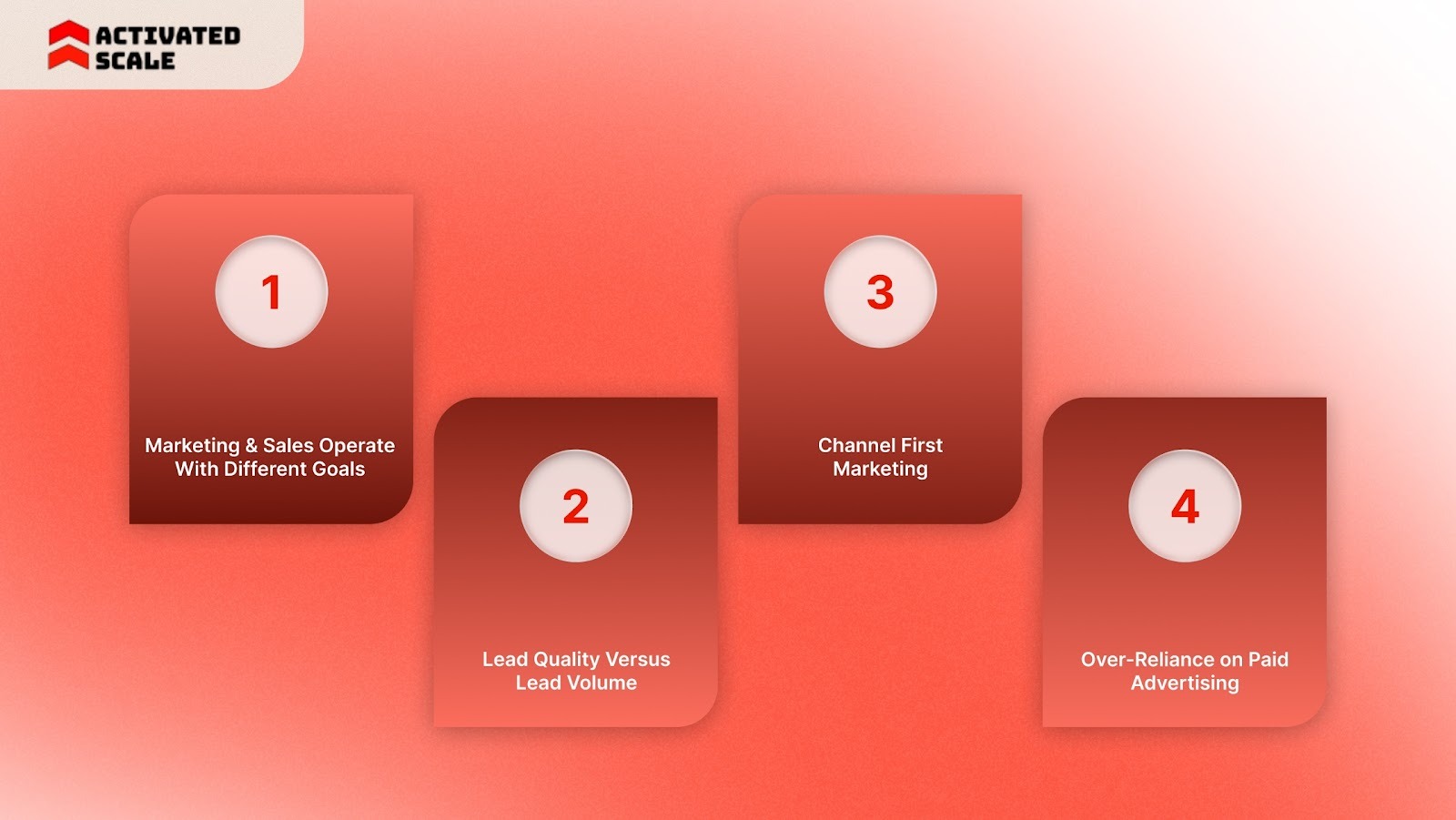
1. Marketing and Sales Operate With Different Goals
Marketing teams often measure success through traffic, downloads, or form submissions. Sales teams measure success through opportunities and closed revenue. When these goals differ, pipeline quality suffers.
A marketing team may run a campaign promoting an industry report and generate thousands of downloads. Many of those contacts may be researchers, students, or consultants rather than potential buyers. Sales teams then spend time filtering contacts that never convert.
Typical signs of this gap include:
- Marketing celebrates high lead numbers while opportunities remain low
- Sales teams stop trusting inbound leads and rely more on outbound outreach
- CRM databases grow quickly, but pipeline growth stays flat
Aligning both teams around shared metrics, such as sales-accepted leads and opportunity creation, helps close this gap.
2. Lead Quality Versus Lead Volume
Another common problem arises when marketing focuses on lead volume rather than buyer intent.
For example, a SaaS HR platform may offer free HR templates. The resource attracts thousands of downloads because it is useful. Yet only a small percentage of those contacts represent HR leaders evaluating new HR software.
This often leads to:
- Large lead lists with little sales engagement
- SDR teams are spending time qualifying contacts who are not ready to buy
- High marketing activity but low opportunity conversion
Demand generation performs better when campaigns attract buyers already researching a specific problem.
3. Channel First Marketing
Some teams choose marketing channels before understanding how buyers actually research solutions. Campaigns launch on popular platforms even if decision makers rarely use them during evaluation.
A developer tools company may invest heavily in ads while developers rely more on technical communities or peer recommendations.
This approach often produces visibility without meaningful demand.
4. Over-Reliance on Paid Advertising
Paid advertising can generate quick traffic, making it appealing to early-stage startups. The problem arises when ads become the primary source of revenue.
Costs rise, performance fluctuates, and lead flow drops as soon as spending slows. Demand generation works better when paid campaigns support long-term assets, such as research reports, educational webinars, and expert insights, which build credibility over time.
Companies that combine authority building with targeted outreach often maintain more stable pipeline growth than those relying solely on paid campaigns.
Turning that interest into qualified sales conversations still requires experienced execution. Activated Scale connects startups with vetted US-based SDRs, AEs, and fractional sales leaders who help convert demand into a real pipeline.
Also Read: Understanding and Reducing Customer Acquisition Costs (CAC)
How to Build a Demand Generation Strategy That Creates Pipeline
A demand generation strategy works only when it connects marketing activity with how buyers research and evaluate solutions. Many companies run campaigns, publish content, and generate leads without building a structured path that moves prospects toward qualified opportunities.
The steps below focus on actions that directly influence pipeline quality and sales readiness.
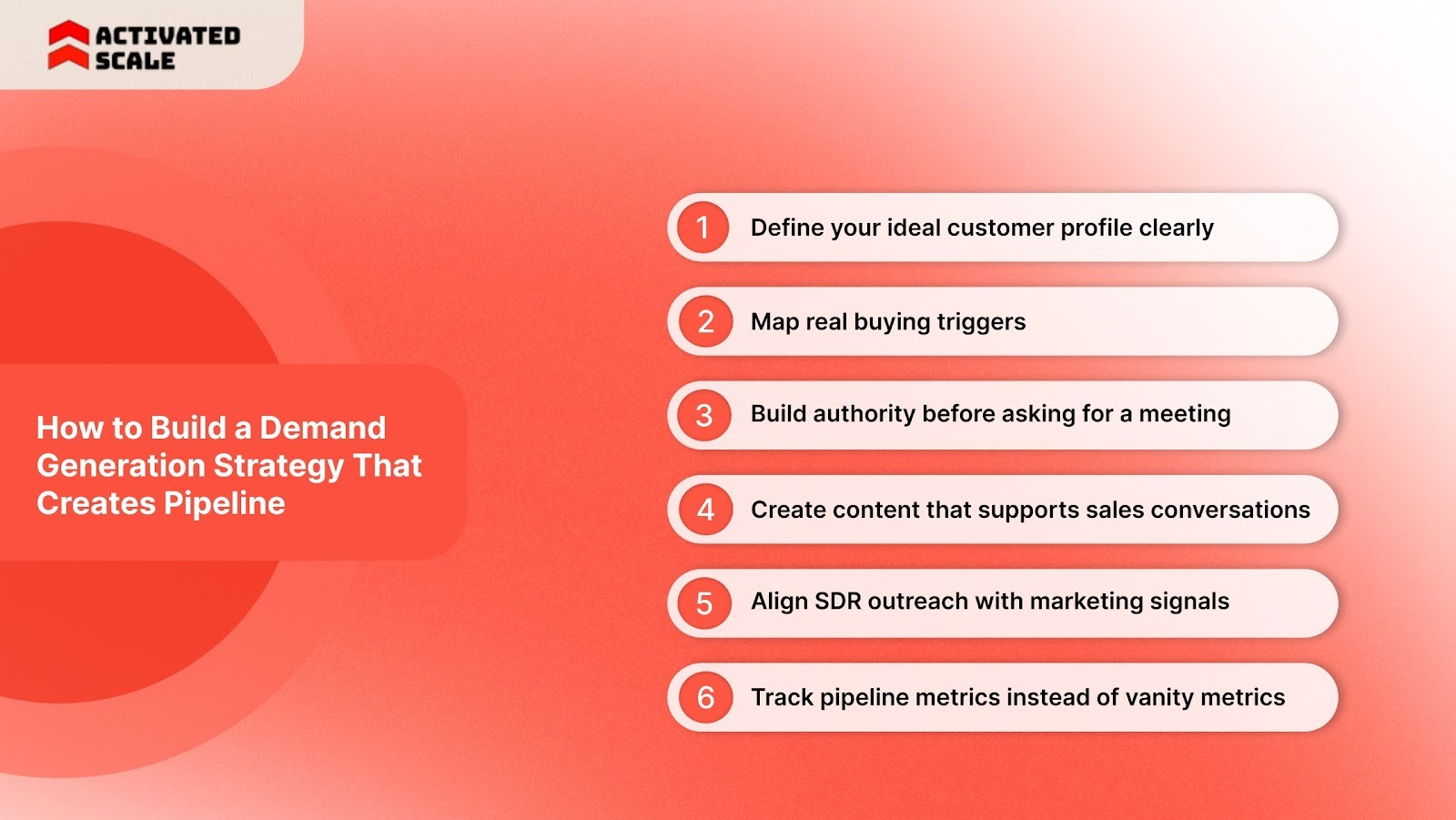
Step 1: Define your ideal customer profile clearly
A demand generation strategy begins with a precise definition of the companies most likely to benefit from the product. Without a clear ideal customer profile, marketing campaigns attract broad audiences that rarely convert into sales conversations.
An effective ICP combines firmographic, behavioural, and operational signals that indicate genuine purchase potential.
Important elements usually include:
- Company attributes: Industry, revenue range, employee count, and geographic market
- Operational triggers: Rapid hiring, funding announcements, product expansion, or infrastructure changes
- Decision makers: Roles responsible for purchasing or evaluating the product category
- Technology environment: Tools already used that signal compatibility or integration needs
For example, a data security startup targeting mid-market SaaS companies may prioritise organisations that handle large customer datasets and are subject to compliance requirements. Campaigns then focus on security leaders within those companies rather than broad technology audiences.
A clear ICP definition improves campaign targeting, increases lead quality, and reduces time spent qualifying irrelevant contacts.
Step 2: Map real buying triggers
Demand rarely appears randomly. Buyers begin researching solutions when a specific operational problem or business change creates urgency.
Mapping those triggers helps marketing campaigns reach prospects when interest begins.
Common buying triggers include:
- Regulatory changes: New compliance requirements force companies to review their systems
- Operational inefficiencies: Teams struggle with manual workflows or scaling issues
- Technology shifts: Organisations replace outdated systems with modern alternatives
- Company growth events: Funding rounds, expansion into new markets, or rapid hiring
Consider a payroll SaaS company targeting high-growth startups. When a company raises funding and expands its workforce, payroll complexity increases quickly. Marketing content addressing global payroll compliance becomes immediately relevant during that stage.
Demand generation strategies work best when campaigns align with these real decision moments rather than general industry awareness.
Step 3: Build authority before asking for a meeting
Buyers rarely trust vendors they encounter for the first time during a sales pitch. Authority must develop earlier through useful insights and credible information.
Companies that establish expertise attract prospects already familiar with their perspective on the problem.
Authority building often includes several types of content:
For example, a fintech infrastructure platform may publish a yearly report analysing payment failure rates across industries. Finance leaders who reference that research begin to associate the company with expertise in payment reliability.
Authority built through insights often leads prospects to approach the company voluntarily when they begin vendor evaluations.
Step 4: Create content that supports sales conversations
Many marketing teams produce content designed to attract website traffic. Demand generation content serves a different purpose. It prepares prospects for meaningful discussions with sales teams.
Content aligned with sales conversations addresses specific evaluation questions.
Common examples include:
- Problem diagnosis articles: Explain why the issue occurs and what operational risks it creates
- Use case explanations: Show how companies solve the problem in different environments
- Implementation discussions: Clarify deployment timelines, technical requirements, and operational impact
- Comparison resources: Explain differences between approaches or competing categories
A CRM automation platform might publish detailed breakdowns of how revenue teams automate lead routing or pipeline forecasting. Sales representatives can then reference these resources during discovery calls to reinforce credibility.
Content that mirrors sales conversations shortens evaluation time and increases buyer confidence.
Step 5: Align SDR outreach with marketing signals
Marketing campaigns often attract early interest while SDR teams focus on outbound prospecting. When both efforts operate independently, many opportunities remain unnoticed.
Demand generation improves when SDR outreach responds to behavioural signals from marketing engagement.
Examples of useful signals include:
- Repeated visits to pricing or solution pages: Signals strong evaluation intent
- Downloads of technical documentation: Indicates deeper product interest
- Attendance at product webinars: Shows willingness to invest time in learning about the solution
- Engagement with industry reports or research studies: Suggests early-stage category exploration
When SDR teams follow up with prospects who show these signals, outreach becomes more relevant and timely.
For instance, if a prospect downloads a benchmarking report on sales productivity, an SDR may follow up with a discussion about improving pipeline visibility. The outreach references the same topic the prospect already explored.
This alignment increases the probability of meaningful conversations.
Step 6: Track pipeline metrics instead of vanity metrics
Demand generation success should be measured through pipeline outcomes rather than surface-level activity metrics. Traffic numbers and download counts often look impressive yet reveal little about their impact on revenue.
Revenue-focused metrics provide clearer insight into marketing performance.
These metrics help revenue teams evaluate whether demand generation programs attract buyers with genuine purchase intent.
For example, if webinar registrations increase but sales accepted leads remain flat, the campaign may be attracting an audience outside the target market. Adjusting content topics or targeting parameters can correct the issue.
Tracking pipeline outcomes rather than engagement metrics ensures demand generation strategies remain closely connected to revenue growth.
Also Read: Sales Ops Tools to Enhance ROI and Productivity in 2026
Channels That Actually Work for B2B Demand Generation in 2026
Effective demand generation channels do more than attract attention. They influence how buyers think about a problem before they speak with a vendor. In B2B markets, decision makers often spend weeks researching options, comparing approaches, and discussing solutions internally.
The channels that work best are those that provide useful insight during the research process rather than simply promoting products.
Several channels consistently produce strong demand signals when used strategically.
- Founder-led LinkedIn content: Buyers increasingly evaluate vendors by observing leadership perspectives. When founders share lessons from product development, market trends, or customer challenges, they build credibility with decision makers who follow industry voices.
- SEO content for buying intent: Articles addressing solution comparisons, implementation questions, or operational challenges capture prospects already researching vendors. This type of content attracts visitors closer to a purchasing decision.
- Webinars and live demos: Interactive sessions help prospects understand how a product solves real problems. They also reveal which attendees are actively evaluating solutions.
- Partner ecosystems and co-marketing: Collaborations with complementary platforms expose a product to audiences that already trust the partner brand.
- Outbound SDR campaigns: Outreach becomes far more effective when it references content prospects recently engaged with.
- Community-driven growth: Professional communities, industry groups, and user forums allow companies to contribute insights where buyers naturally exchange recommendations.
Where Fractional Sales Talent Strengthens Demand Generation
Demand generation creates awareness and interest. Pipeline grows only when someone converts that interest into real sales conversations. Many startups generate strong engagement through content, SEO, or paid campaigns, but lack the sales capacity to follow up quickly and consistently.
Activated Scale helps close this gap by giving startups access to experienced US-based sales talent without requiring immediate full-time hires.
- Fractional Sales Leadership: Senior revenue operators help define qualification criteria, structure pipeline stages, and align marketing activity with revenue goals
- Fractional SDR and AE Support: Experienced reps engage inbound leads, run outbound sequences, and convert demand into qualified meetings
- Contract to Hire Recruiting: Startups can validate revenue leadership or sales hires before committing to full-time roles
This model helps startups maintain momentum in demand generation while gradually building the right sales structure. Instead of waiting months to hire, teams gain immediate execution and turn marketing interest into consistent pipeline growth.
Turning Demand Into Real Pipeline
Demand generation works when marketing activity connects with sales execution. Traffic, downloads, and event registrations can show interest, but the pipeline grows only when that interest turns into real conversations with qualified buyers. Many startups attract attention yet struggle to convert it into meetings because small sales teams cannot consistently follow up.
Instead of rushing to hire an entire sales team, bring in the right expertise when demand begins to build. Activated Scale connects startups with experienced SDRs, AEs, and fractional sales leaders who help turn interest into a qualified pipeline. Explore how Activated Scale can support your demand generation strategy.
FAQs
Q: What is the biggest mistake companies make with demand generation?
A: Many teams focus on generating large volumes of leads instead of attracting buyers with genuine intent. This creates impressive marketing numbers but weak pipeline quality because sales teams spend time filtering contacts rather than progressing deals.
Q: How do founders know if demand generation is actually working?
A: Early signals appear through stronger discovery conversations, faster follow-ups from SDR teams, and a growing number of leads turning into opportunities. When pipeline quality improves, sales teams spend less time educating prospects and more time discussing solutions.
Q: Should startups prioritise inbound demand or outbound prospecting?
A: Both approaches work best together. Demand generation creates awareness and trust, while outbound prospecting activates that interest by starting conversations with the right accounts at the right moment.
Q: How does thought leadership influence demand generation?
A: Consistent insights from founders or product leaders shape how buyers understand a problem. Over time, this credibility makes the company more likely to appear on vendor shortlists when prospects begin evaluating solutions.
Q: Why do some demand generation campaigns attract the wrong audience?
A: This often happens when targeting is too broad or content addresses general industry topics instead of specific operational problems. Campaigns perform better when messaging speaks directly to the challenges faced by the ideal customer profile.
The Ultimate Guide to Hiring a Salesperson!
Get the step-by-step guide to hiring, onboarding, and ensuring success!