_edi.png)

Fractional hiring is growing fast as companies seek senior-level talent without the long-term cost of full-time employment. Currently, 25% of U.S. businesses have adopted some form of fractional hiring, and estimates suggest that will rise to 35% by 2025.
Since 2020, fractional roles, especially at the executive level, have seen a 57% increase in adoption.
For startups and scale-ups, this model offers an opportunity: access to leadership expertise, learner hiring, faster scaling, and strategic flexibility.
This article will explain what fractional hiring means today, compare it with traditional models, examine its benefits and challenges, and show how your business can use it as a growth lever.
Key Takeaways
- Fractional hiring means engaging senior professionals part-time, giving businesses access to top talent without full-time commitments.
- It differs from freelancing and consulting by offering deeper integration and accountability at leadership levels.
- Startups and scale-ups benefit most, gaining senior expertise without long-term hiring risks or costs.
- Popular roles include fractional VPs of Sales, CMOs, and CFOs, with emerging demand for CTOs and People Leaders.
- Platforms like Activated Scale simplify adoption, connecting companies with vetted U.S.-based fractional talent ready to drive growth.
What is Fractional Hiring? Defining the Modern Workforce Revolution
Fractional hiring is a workforce model where businesses engage experienced professionals, often executives or specialists, on a part-time, contract, or project basis instead of committing to full-time roles.
Unlike traditional employment, fractional professionals dedicate a set portion of their time to multiple companies, allowing startups and scale-ups to access high-level expertise without paying full salaries and benefits.
The Evolution from Traditional Hiring to Fractional Models
Traditional hiring focused on full-time roles with long onboarding cycles and higher costs. Over the past decade, rising labor costs, remote work, and the gig economy have accelerated demand for flexible models.
Fractional hiring builds on these shifts, offering businesses targeted expertise without long-term financial strain.
Legal Classification and Compliance Considerations
Fractional hires are typically classified as independent contractors or consultants, which means businesses must comply with labor laws such as the IRS’s contractor guidelines and state-specific rules (e.g., California’s AB5).
Proper contracts covering scope, hours, and IP rights are essential to avoid misclassification risks.
Also Read: Understanding Fractional Employment: What You Need To Know
Fractional Hiring vs. Traditional Employment Models: A Strategic Comparison
Choosing between fractional hires, full-time employees, freelancers, or consultants depends on a company’s stage, budget, and goals. Each model has strengths, but understanding the differences ensures smarter talent decisions.
Fractional Hiring vs. Full-Time Employment
- Fractional Hiring: Access senior-level expertise at a fraction of the cost; no long-term salary or benefits.
- Full-Time Employment: Provides stability and deeper integration but comes with high overhead, onboarding time, and less flexibility.
Fractional Professionals vs. Freelancers: Beyond the Surface Differences
- Fractional Professionals: Usually executives or specialists who embed into teams, align with company goals, and provide ongoing strategy.
- Freelancers: Often task-focused, working on short projects with limited integration into long-term business strategy.
Fractional Executives vs. Consultants: Commitment and Integration Levels
- Fractional Executives: Operate as part of the leadership team, accountable for outcomes and day-to-day decisions.
- Consultants: Advise from the outside, offering insights without hands-on ownership of execution.
When Each Model Makes Strategic Sense
- Startups: Benefit most from fractional executives to bridge expertise gaps affordably.
- Enterprises: Prefer full-time hires for continuity and scale.
- Project-based needs: Freelancers are best suited.
- Specialized advice: Consultants add value when expertise is needed but execution remains internal.
Fractional hiring strikes a balance between flexibility and accountability, making it ideal for growth-focused companies.
Platforms like Activated Scale make this possible by connecting startups with vetted U.S.-based fractional sales leaders who can step in right away.
Also Read: Understanding the Benefits and Hiring Process of a Fractional Business Manager
Strategic Benefits for High-Growth Businesses
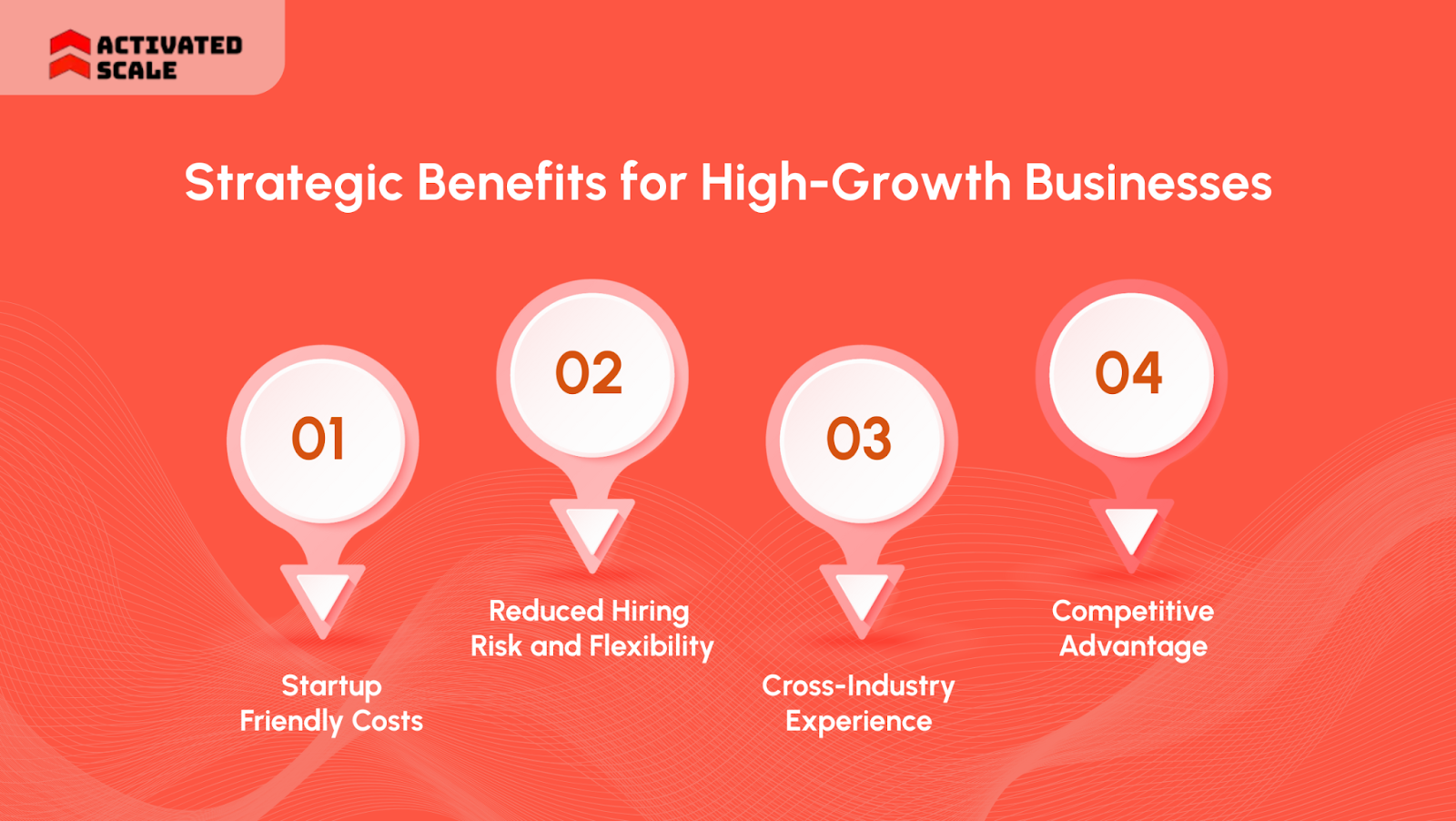
Fractional hiring is particularly powerful for startups and scale-ups where resources are tight but ambitions are high.
It provides a way to access seasoned professionals without slowing momentum or draining budgets.
Access to Executive-Level Expertise at Startup-Friendly Costs
Instead of waiting until they can afford a full-time VP or C-level hire, businesses can bring in fractional leaders immediately. This means startups can act on proven strategies earlier and avoid costly trial and error.
Reduced Hiring Risk and Flexibility for Scaling Operations
- No long-term salary or benefits commitments.
- Easier to adjust the level of engagement as the company grows.
- Ability to “test-drive” leaders before extending full-time offers.
Fresh Perspectives and Cross-Industry Experience
Fractional professionals often work across industries and markets, bringing diverse insights. This cross-pollination helps companies challenge assumptions and adopt strategies that have already succeeded elsewhere.
Speed to Market and Competitive Advantage
With fractional executives in place, companies can build playbooks, refine processes, and launch faster. Accessing proven expertise early translates into shorter go-to-market timelines and stronger positioning against competitors.
For high-growth businesses, fractional hiring is not just cost-effective—it’s a growth multiplier.
Also Read: Understanding the Benefits and Cons of Fractional Management in Modern Business
Popular Fractional Roles Driving Business Transformation
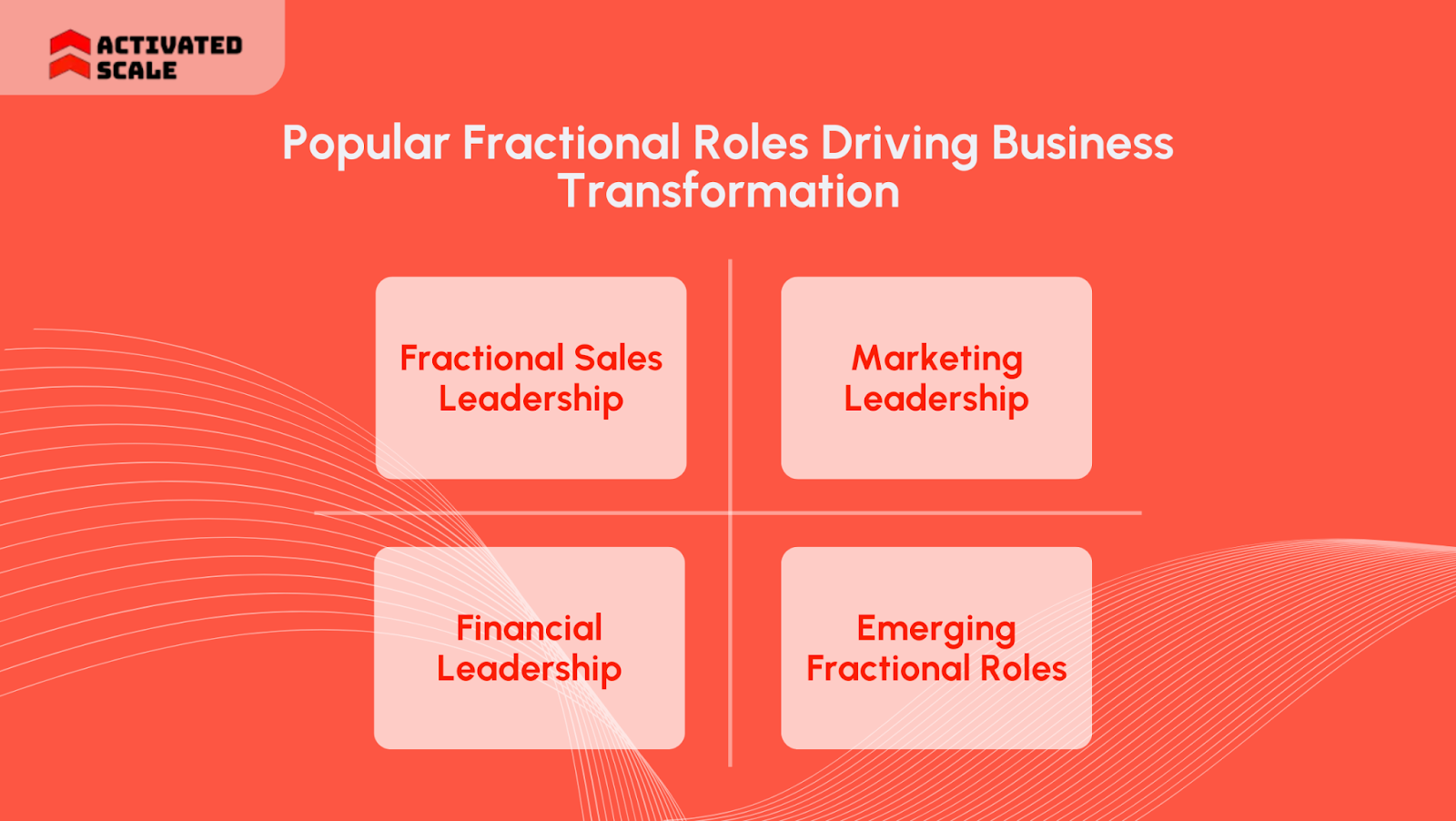
Fractional hiring isn’t limited to one function; it’s reshaping leadership across sales, marketing, finance, and even emerging disciplines. These roles allow businesses to access senior expertise exactly where it’s needed most.
Fractional Sales Leadership (VP of Sales, Sales Directors)
Impact on Pipeline Growth and Revenue Generation - Fractional sales leaders build go-to-market strategies, design sales playbooks, and establish repeatable processes. They accelerate revenue by ensuring SDRs, AEs, and partnerships are aligned.
Fractional Marketing Leadership (CMO, Marketing Directors)
Brand Strategy and Customer Acquisition Excellence- Fractional CMOs refine positioning, oversee campaigns, and implement demand-generation strategies—helping startups punch above their weight in crowded markets.
Fractional Financial Leadership (CFO, Finance Directors)
Cash Flow Management and Strategic Financial Planning- Fractional CFOs bring financial discipline, help with forecasting, and guide fundraising rounds, reducing risk and building investor confidence.
Emerging Fractional Roles (CTO, CHO, Operations Directors)
Fractional CTOs manage tech roadmaps, CHOs shape people strategies, and Operations Directors streamline processes, expanding the reach of the fractional model beyond traditional executive functions.
Many startups can’t afford all these roles at once.
Activated Scale bridges the gap by offering access to fractional VPs of Sales and other leaders who deliver measurable impact without the full-time price tag.
Also Read: Fractional Sales Director: Business Growth and Benefits
How Fractional Hiring Accelerates Startup and Scale-Up Growth
Startups often struggle to balance limited budgets with the need for seasoned leadership. Fractional hiring helps bridge this gap, providing expertise that matches enterprise needs without the enterprise price tag.
Bridging the Gap Between Startup Budgets and Enterprise Needs
Fractional leaders give startups access to high-level strategies at a fraction of the cost. This allows young companies to compete with larger players earlier in their journey.
Supporting Critical Growth Milestones and Funding Rounds
Fractional CFOs and sales leaders play crucial roles in preparing financial models, investor decks, and revenue forecasts that build credibility with investors. Their experience often makes the difference in securing funding.
Building Scalable Processes and Systems
Fractional executives establish repeatable systems, whether in sales, marketing, or operations, that allow companies to grow smoothly rather than scrambling to fix broken processes later.
Preparing for Full-Time Leadership Transitions
Fractional hires often act as bridge-builders, preparing teams and structures so the eventual full-time hire can succeed immediately.
Also Read: Fractional Sales Teams for Unlocking Growth
The Fractional Hiring Process: From Strategy to Success
Adopting fractional hiring works best when approached with intention. Businesses need a clear framework—from identifying needs to onboarding talent—to maximize results.
Identifying When Fractional Hiring is the Right Solution
Companies should ask:
- Do we need senior expertise but can’t afford full-time costs?
- Is the business entering a growth phase or preparing for fundraising?
- Are existing teams struggling without leadership direction?
If the answer is yes, fractional hiring is often the right path.
Finding and Vetting Fractional Professionals
- Specialized Platforms vs. Traditional Recruiting
- Platforms like Activated Scale provide access to vetted, U.S.-based sales professionals.
- Traditional recruiters can take longer and may not specialize in fractional roles.
Structuring Engagements for Success
- Contract Models: Define part-time hours, project scope, or milestone-based agreements.
- Pricing Models: Typically, monthly retainers or hourly rates.
- Legal Considerations: Ensure compliance with IRS contractor rules and state labor laws.
Integration and Onboarding Best Practices
- Provide access to systems and context from day one.
- Align fractional leaders with company OKRs.
- Encourage regular check-ins to build trust with full-time staff.
Also Read: Understanding the Role and Impact of Hiring a Fractional VP of Sales
Measuring Success: KPIs and ROI Tracking for Fractional Hires
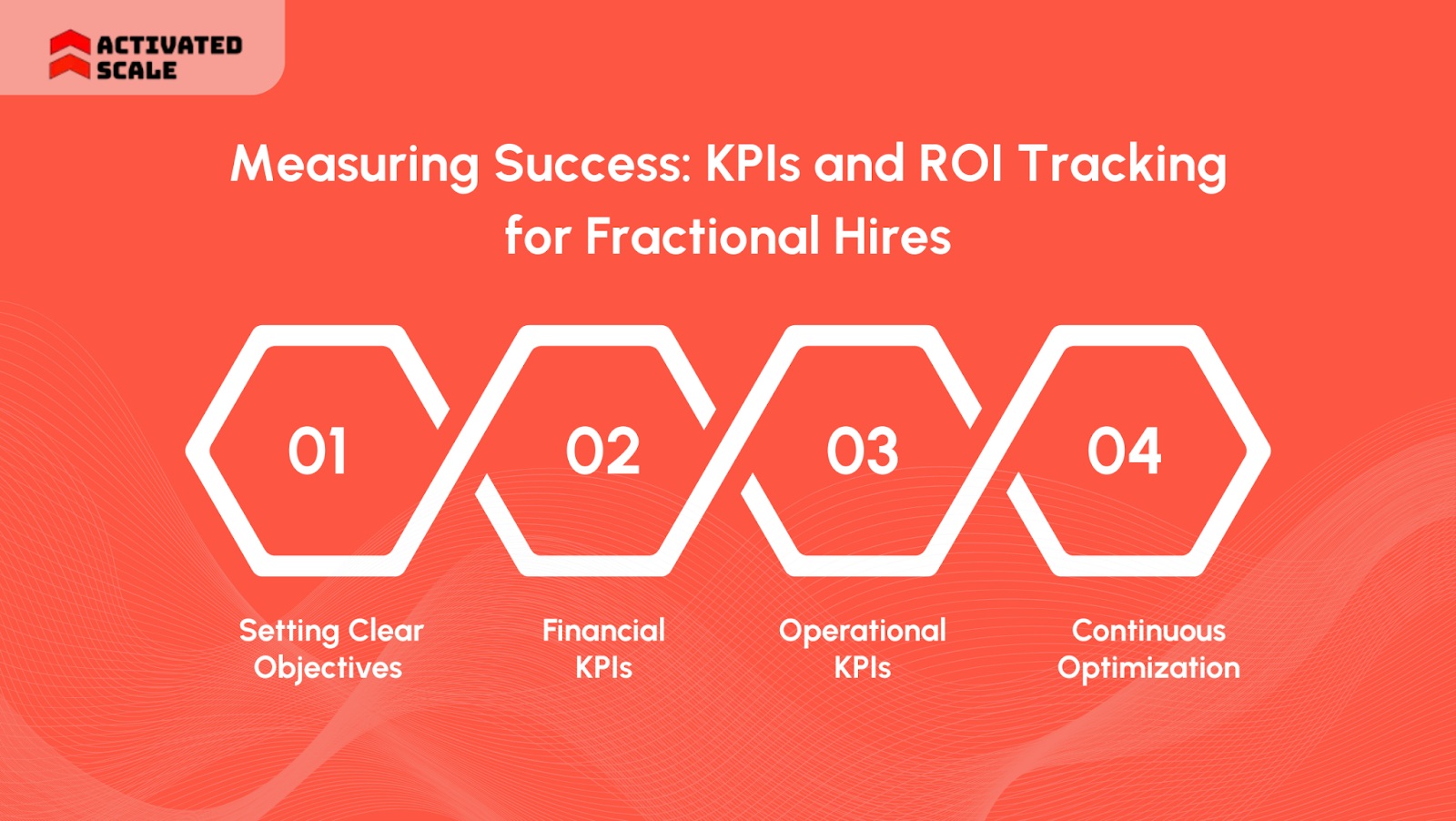
To get the most from fractional hiring, businesses must measure outcomes, not just activity. Tracking the right KPIs ensures the investment delivers tangible value.
Setting Clear Objectives and Success Metrics
Before engagement, define what success looks like, whether it’s increasing qualified leads, improving financial forecasting, or reducing customer acquisition costs.
Financial KPIs: Revenue Growth, Cost Savings, and ROI Calculations
- Revenue Growth: New pipeline or closed deals tied to fractional sales leaders.
- Cost Savings: Lower payroll compared to full-time hires.
- ROI Calculations: Compare engagement costs against generated revenue or secured funding.
Operational KPIs: Productivity, Efficiency, and Process Improvements
- Process efficiency gains (e.g., shorter sales cycles).
- Team productivity increases when guided by experienced leadership.
- Improved CRM and reporting hygiene.
Long-term Impact Assessment and Continuous Optimization
- Evaluate whether fractional roles helped the business scale sustainably.
- Assess if the company is now ready for full-time leadership transitions.
- Continue refining roles and expectations based on performance data.
Also Read: How to Measure Sales Success in Fractional Teams
Overcoming Common Challenges and Maximizing Fractional Hiring Success
While fractional hiring offers clear advantages, it comes with challenges that businesses must proactively manage to ensure success.
Managing Remote and Part-Time Team Integration
Fractional professionals may not always be in the office or available full-time. To avoid disconnects:
- Use collaboration tools like Slack, Asana, or Notion.
- Schedule regular check-ins to maintain visibility.
- Assign clear ownership of projects and outcomes.
Ensuring Continuity and Knowledge Transfer
Fractional hires may eventually transition out. Documenting processes, recording learnings, and ensuring smooth handovers help protect institutional knowledge.
Compliance and Legal Risk Management
Misclassification of workers is a risk. Businesses should:
- Use detailed contracts.
- Follow IRS guidelines for independent contractors.
- Seek legal review when structuring agreements.
Building Long-Term Relationships with Fractional Professionals
Treat fractional hires as part of the team, not temporary outsiders. When trusted and respected, they often stay engaged longer and deliver greater impact.
Conclusion
Fractional hiring is no longer just a cost-saving tactic; it’s a growth strategy. By giving startups and scale-ups access to executive-level expertise without the full-time burden, it helps companies move faster, scale smarter, and stay competitive.
When budgets are tight but ambitions are big, businesses need more than advice; they need embedded leaders who deliver impact from day one. That’s exactly what Activated Scale makes possible.
Meet Activated Scale
Activated Scale is a U.S.-based sales talent marketplace connecting startups with vetted fractional and contract-to-hire professionals. Instead of long hiring cycles or risky full-time commitments, companies gain instant access to proven talent.
Services Offered
- Contract-to-Hire Sales Recruiting: Try talent before committing to full-time.
- Fractional Selling: Engage SDRs and AEs part-time to fill sales gaps.
- Fractional Sales Leadership: Access experienced VPs of Sales for GTM strategy and execution.
- Marketplace Access: Choose from vetted SDRs, AEs, and Sales Leaders ready to contribute immediately.
If you’re ready to accelerate growth without overextending resources,
Frequently Asked Questions
1. What is fractional hiring?
Fractional hiring is engaging experienced professionals part-time or on contract, instead of full-time employment.
2. How is fractional hiring different from freelancing?
Fractional professionals embed within teams and drive strategy, while freelancers usually handle task-based projects.
3. Do fractional hires work only with startups?
No. While popular with startups and scale-ups, mid-sized firms also use fractional executives for specialized expertise.
4. What roles are most common in fractional hiring?
Sales leaders, CMOs, and CFOs are in the highest demand, with emerging roles like CTOs and CHOs growing.
5. Is fractional hiring cost-effective?
Yes. Businesses pay only for a portion of the time, making executive-level expertise affordable without long-term salary commitments.
6. Are fractional hires legally considered employees?
Usually not, they are classified as independent contractors, so proper contracts are required.
7. Can fractional professionals become full-time hires?
Yes. Many businesses transition successful fractional leaders into permanent roles after proving fit.
The Ultimate Guide to Hiring a Salesperson!
Get the step-by-step guide to hiring, onboarding, and ensuring success!