_edi.png)

Revenue execution often falters not because teams aren't working hard, but because leadership and operational alignment are weak.
Research shows that 65% of sales and marketing professionals struggle with leadership misalignment, which creates friction in execution and slows revenue growth. Effective revenue leaders bridge these gaps by aligning teams, processes, and outcomes.
When companies lack this leadership, growth can stagnate despite strong products and demand. A fractional Chief Revenue Officer (CRO) fills that gap, bringing experienced leadership on a flexible basis to drive strategy, alignment, and execution without the commitment of a full-time hire.
TL;DR
- A fractional CRO provides senior revenue leadership on a part-time or contract basis, focusing on alignment across sales, marketing, and revenue operations.
- This role is most effective when companies have traction but lack clarity around revenue ownership, forecasting, or execution discipline.
- Fractional CROs help diagnose pipeline issues, define revenue strategy, and establish consistent operating cadence across teams.
- The model reduces risk by allowing companies to validate leadership impact before committing to a full-time executive hire.
- Fractional CROs are often used during transitions such as early GTM build-out, stalled growth, or misalignment between sales and marketing.
What a Fractional Chief Revenue Officer Does
A Fractional Chief Revenue Officer (CRO) is a senior revenue leader who works with a company on a part-time or contract basis. Their responsibility is to design and execute a revenue strategy that drives sustainable growth.
Unlike advisory roles, a fractional CRO takes direct ownership of revenue execution. They align sales, marketing, and customer success around shared goals and clear priorities, ensuring teams operate consistently and with accountability.
Fractional CROs can be engaged on a short- or long-term basis, depending on the company's stage. Their value comes from experience, speed, and the ability to improve revenue performance without requiring an immediate full-time executive hire.
Key Benefits of Hiring a Fractional CRO
A fractional Chief Revenue Officer provides companies with senior revenue leadership without requiring a full-time commitment too early. The benefits are most visible in execution quality, speed, and decision clarity.
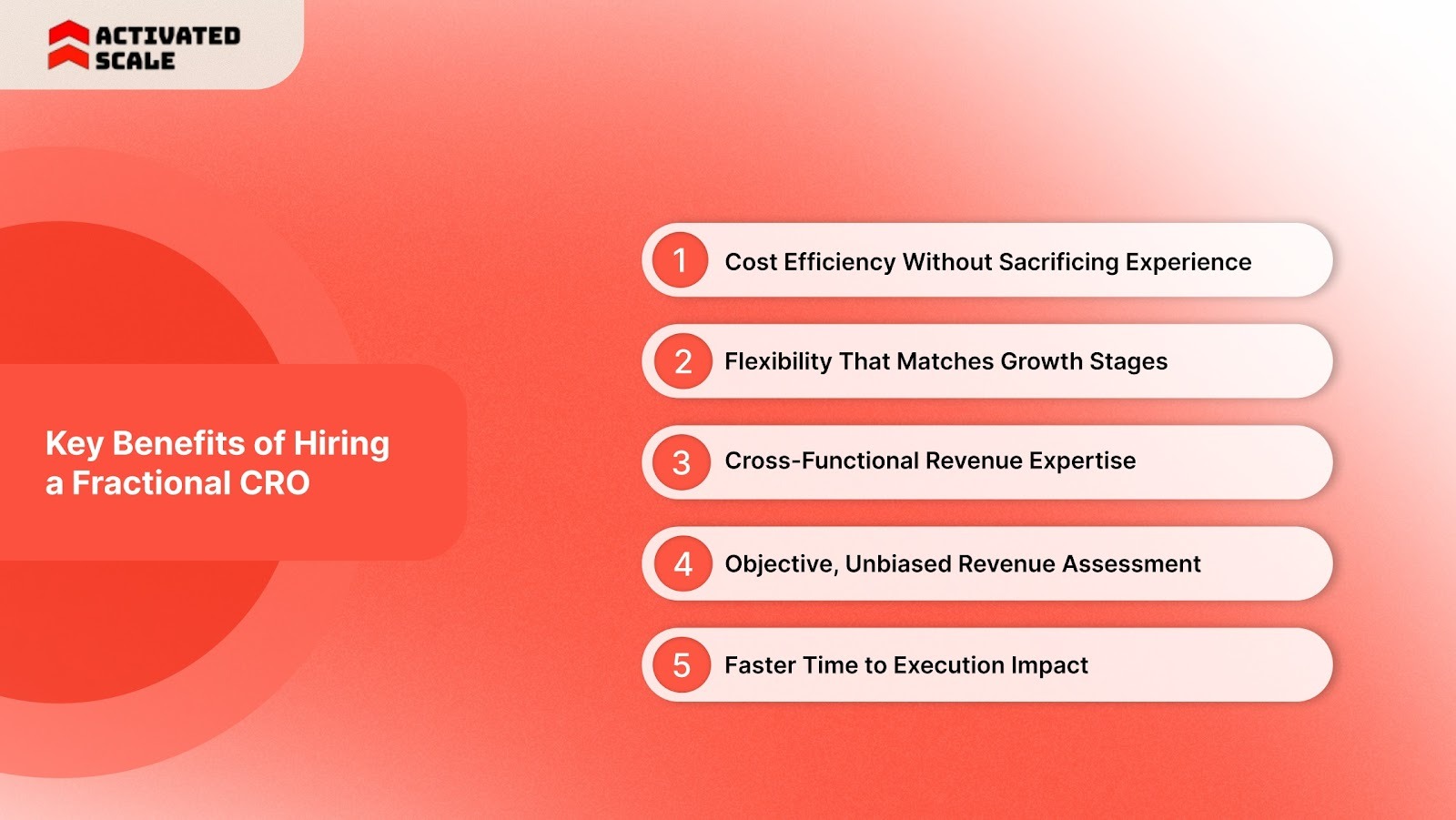
Cost Efficiency Without Sacrificing Experience
Hiring a full-time CRO can be expensive and unnecessary when the revenue model is still taking shape. A fractional CRO provides leadership depth at a lower cost, allowing companies to invest where impact is immediate.
- Avoids full executive compensation before role clarity
- Aligns spending with current revenue complexity
Flexibility That Matches Growth Stages
Fractional CROs can be engaged for defined initiatives or for ongoing oversight. This allows companies to scale leadership involvement as needed rather than hiring ahead of certainty.
- Short-term or long-term engagement options
- Adjust scope as revenue priorities evolve
Cross-Functional Revenue Expertise
Most fractional CROs have led sales, marketing, and customer success teams. This background helps them spot breakdowns across the entire revenue lifecycle.
- Experience across multiple GTM motions
- Familiarity with different growth stages and markets
Objective, Unbiased Revenue Assessment
Operating outside internal structures allows fractional CROs to assess revenue execution without bias. They focus on what's working, what's broken, and what needs to change.
- Clear evaluation of the sales process and handoffs
- Recommendations grounded in outcomes, not opinions
Faster Time to Execution Impact
Fractional CROs are typically brought in to address specific challenges. They prioritize high-impact issues and begin driving improvements without long onboarding cycles.
- Minimal ramp time
- Faster return compared to full-time executive hiring
Also read: Top 10 Recruiting Firms in the US 2026
The Role of a Fractional CRO in Revenue Strategy and Execution
A fractional Chief Revenue Officer (CRO) provides senior revenue leadership focused on aligning strategy with execution. Instead of owning a single function, the role spans sales, marketing, and customer success to ensure revenue growth is intentional and repeatable.
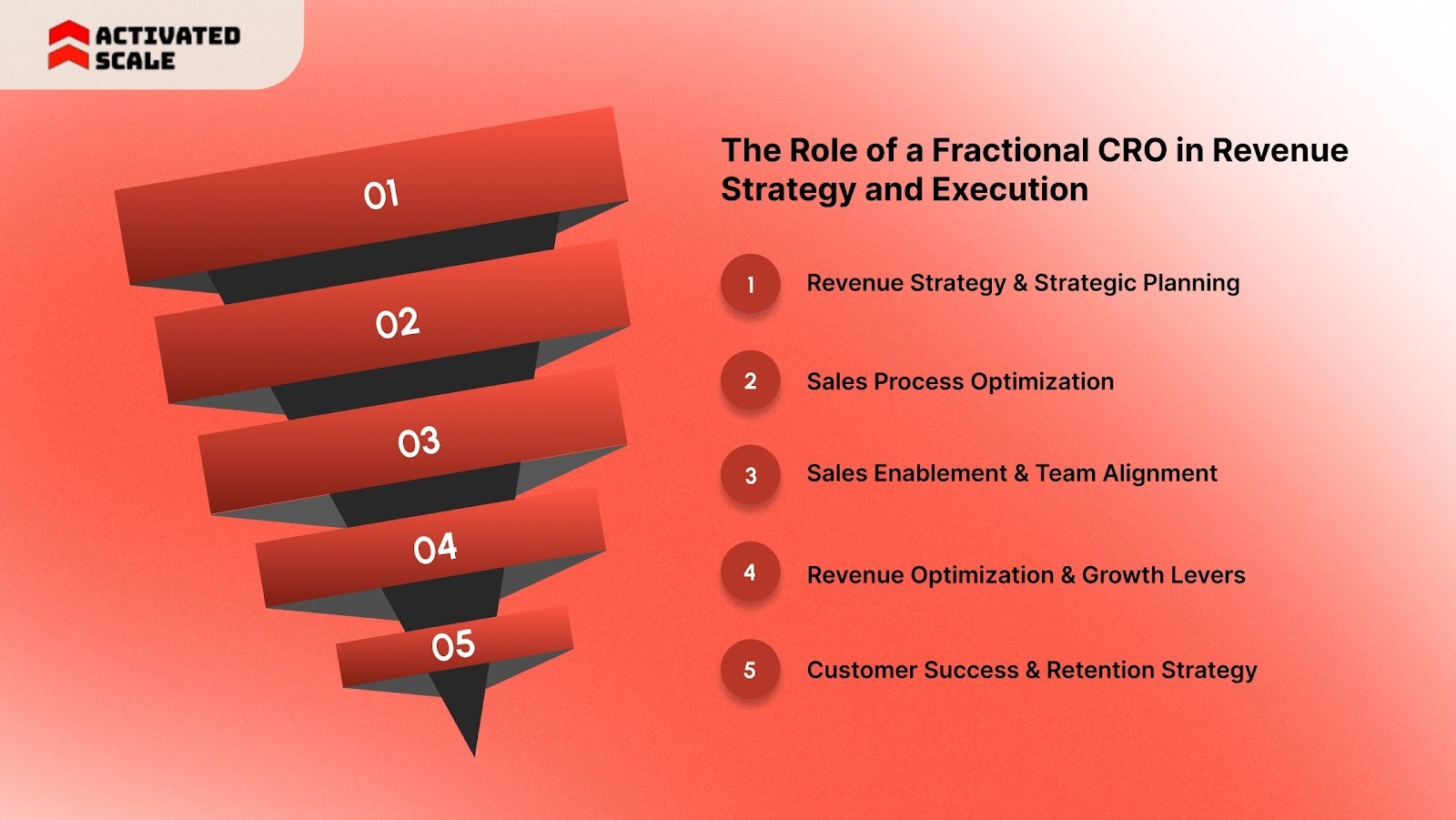
Revenue Strategy and Strategic Planning
A fractional CRO is responsible for defining how revenue is generated and scaled. They assess the current state of the business and build a revenue strategy aligned with company goals.
This work typically includes:
- Reviewing the sales pipeline and conversion flow
- Defining pricing strategy and packaging logic
- Segmenting customers based on value and growth potential
- Clarifying go-to-market focus and sales motion
The outcome is a clear revenue plan that connects targets to execution, rather than isolated initiatives across teams.
Sales Process Optimization
Execution breaks down most often inside the sales process. A fractional CRO evaluates how deals move through the funnel and identifies where momentum is lost.
Their focus includes:
- Identifying bottlenecks in qualification and deal progression
- Standardizing stages, criteria, and handoffs
- Improving forecasting accuracy and pipeline hygiene
By tightening these processes, teams spend less time reacting and more time closing the right deals.
Sales Enablement and Team Alignment
Fractional CROs also own sales enablement at a structural level. Their role is not just to motivate teams, but to equip them to execute consistently.
This includes:
- Defining a clear sales cycle and performance metrics
- Aligning sales and marketing around shared definitions
- Improving onboarding, messaging, and deal execution standards
Strong enablement reduces variability across reps and improves overall sales productivity.
Revenue Optimization and Growth Levers
Beyond new acquisitions, fractional CROs focus on improving the performance of existing revenue streams.
They analyze:
- Pricing effectiveness and discounting patterns
- Expansion and upsell opportunities
- Customer lifetime value and retention drivers
These insights help teams grow revenue more efficiently, without relying solely on increasing lead volume.
Customer Success and Retention Strategy
Revenue leadership doesn't stop at the close. Fractional CROs ensure customer success is part of the revenue system.
Their work often involves:
- Defining customer journeys and retention programs
- Improving post-sale alignment between teams
- Creating structured upsell and expansion paths
By strengthening customer success, they protect recurring revenue and support long-term growth.
The value of a fractional CRO lies in experienced ownership without premature commitment. Companies gain senior-level guidance to stabilize revenue strategy and execution while maintaining flexibility as the business evolves.
This is often why founders turn to platforms like Activated Scale. Instead of hiring a full-time CRO too early, they use flexible models to bring in proven revenue leaders, test impact, and decide on long-term structure once the role is clearly defined.
The approach mirrors how strong revenue teams scale: validate execution first, then commit with clarity.
Learn more about: International Sales Representative Career Progression Guide
Hiring the Right Fractional CRO: A Practical Approach
Hiring a fractional Chief Revenue Officer works best when it's treated as a focused execution decision, not a long hiring process. The goal is clarity, speed, and low risk.
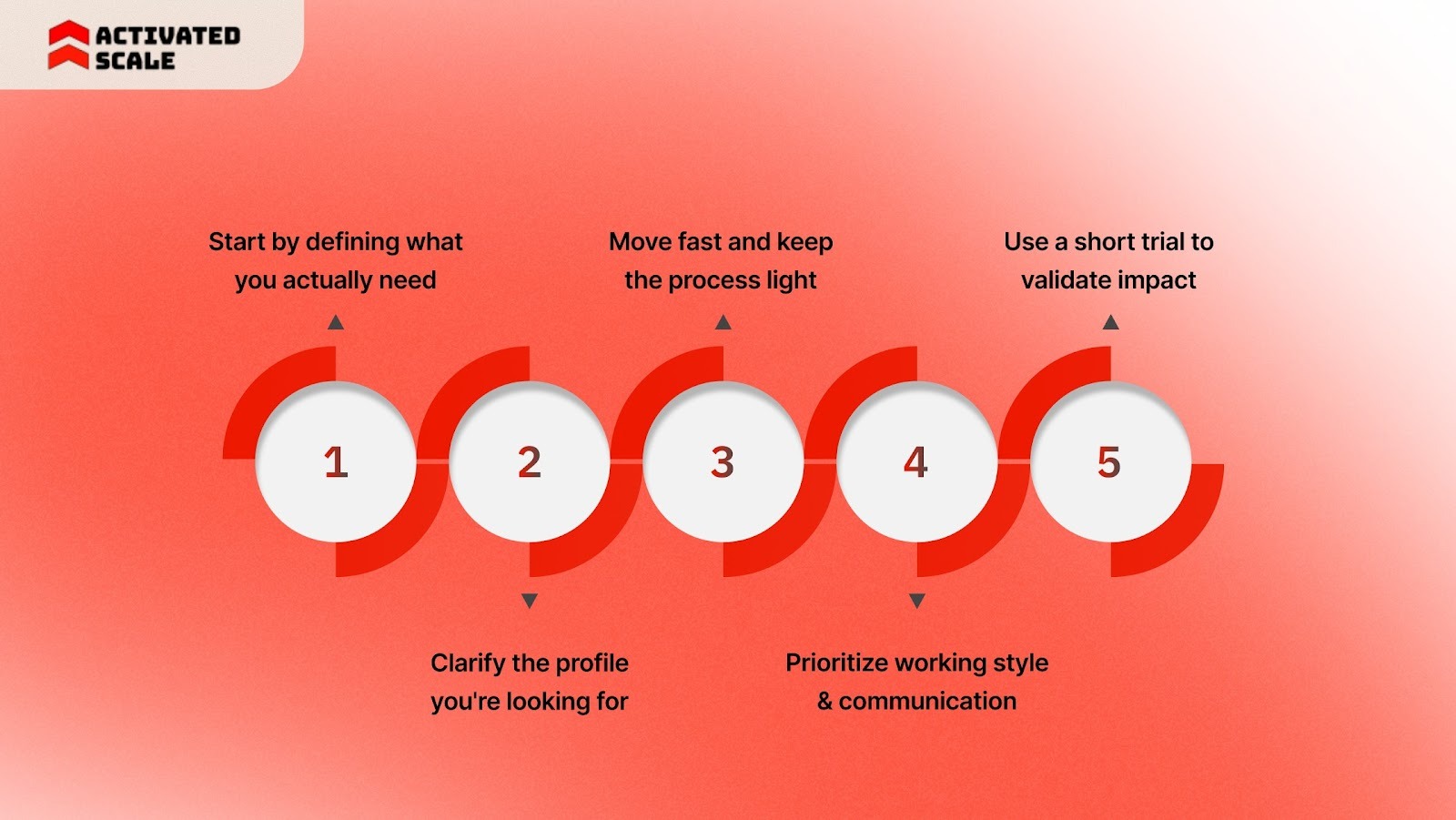
Start by defining what you actually need.
Before looking for a CRO, be clear on your revenue goals, target market, sales motion, and growth expectations. If these fundamentals aren't defined, you may need broader revenue support rather than CRO-level leadership alone. Knowing this upfront prevents misalignment later.
Clarify the profile you're looking for.
A strong fractional CRO should have relevant experience in similar markets and growth stages. Look for a track record in revenue strategy, sales execution, pipeline management, and team leadership. Context matters more than title history.
Move fast and keep the process light.
This is a part-time, low-risk engagement. One or two conversations are usually enough to assess fit. Many strong CROs are visible through their content or network, which is often a signal of their ability to sell and lead.
Prioritize working style and communication.
Cultural fit matters. You need someone who communicates clearly, adapts quickly, and collaborates well with your existing team. A strong working relationship is critical at this level.
Use a short trial to validate impact.
A 4–8 week trial is often enough to see how the CRO thinks, leads, and executes. Pay attention to how they diagnose problems, propose solutions, and position your business. How they sell to you is often the best indicator of how they'll represent your company.
Many teams follow this approach by leveraging flexible models from Activated Scale, such as fractional sales leadership or contract-to-hire structures, to validate CRO impact before making longer-term commitments.
When Revenue Needs Ownership, Not More Activity
A fractional CRO isn't brought in to increase activity. They're brought in to restore ownership where revenue execution has become fragmented.
When the right CRO is in place, teams stop debating numbers and start fixing systems. Forecasts become more reliable. Sales motions become clearer. Decisions become grounded in reality rather than in pressure.
Many founders reach a point where revenue challenges are obvious, but hiring full-time leadership still feels premature.
If you're evaluating where leadership gaps are costing you momentum, let's connect to explore how a fractional revenue leader can strengthen execution and align your teams.
FAQs
1. What does a fractional CRO actually do?
A fractional CRO owns revenue strategy and execution across sales, marketing, and operations. They focus on alignment, forecasting, pipeline health, and repeatable growth systems rather than day-to-day selling.
2. When should a company consider a fractional CRO?
When revenue growth stalls, forecasting becomes unreliable, or sales and marketing operate in silos. Fractional CROs are especially useful during early scale, GTM changes, or leadership transitions.
3. How is a fractional CRO different from a VP of Sales?
A VP of Sales typically owns only sales execution. A CRO owns the entire revenue system, including sales, marketing alignment, pricing, forecasting, and customer expansion.
4. How long does it take to see impact from a fractional CRO?
Most teams achieve early clarity within 30–60 days through better diagnostics, clearer priorities, and improved execution cadence. Measurable impact usually follows as systems stabilize.
5. Is a fractional CRO a long-term solution?
It depends on the company's stage. Some teams transition to full-time CROs once the role is clearly defined. Others continue with fractional leadership as long as execution remains effective.
The Ultimate Guide to Hiring a Salesperson!
Get the step-by-step guide to hiring, onboarding, and ensuring success!