_edi.png)

Hiring talent is one of the largest investments a company makes, often before revenue from that hire is realized. According to the Society for Human Resource Management (SHRM), the average cost per hire in the United States is around $5,475 in 2025, and executive or specialized hires can exceed $35,879 due to longer search cycles and higher complexity.
For sales teams, the impact is even sharper. A slow or wrong hire doesn't just increase costs; it delays pipeline, learning, and growth. That’s why companies are rethinking how they work with top recruiters, weighing traditional recruitment firms against newer, more flexible hiring models.
Before we dive in:
- Traditional recruitment firms focus on long-term placements and deep searches, while modern hiring models prioritise speed, flexibility, and execution-first outcomes.
- Traditional recruiters often require longer hiring cycles and upfront commitment, whereas modern models allow teams to test talent before hiring full time.
- Delays or mis-hires in sales roles directly impact pipeline, revenue, and market learning, making faster, lower-risk hiring essential.
- Fractional and contract-to-hire approaches let companies validate performance, ICP fit, and execution before scaling headcount.
- Executive or confidential hires still suit traditional firms, while revenue teams benefit more from flexible, execution-driven hiring models.
- By enabling short-cycle testing with experienced, U.S.-based sales talent, Activated Scale helps companies hire smarter without locking into long-term commitments too early.
Traditional Recruiters vs Modern Hiring Models
Startups routinely face the same choice: lean on a traditional recruiter, build an RPO/TA function, or use a marketplace/fractional model (or a mix). Here’s how those options actually differ in practice, and which situations each best serves.
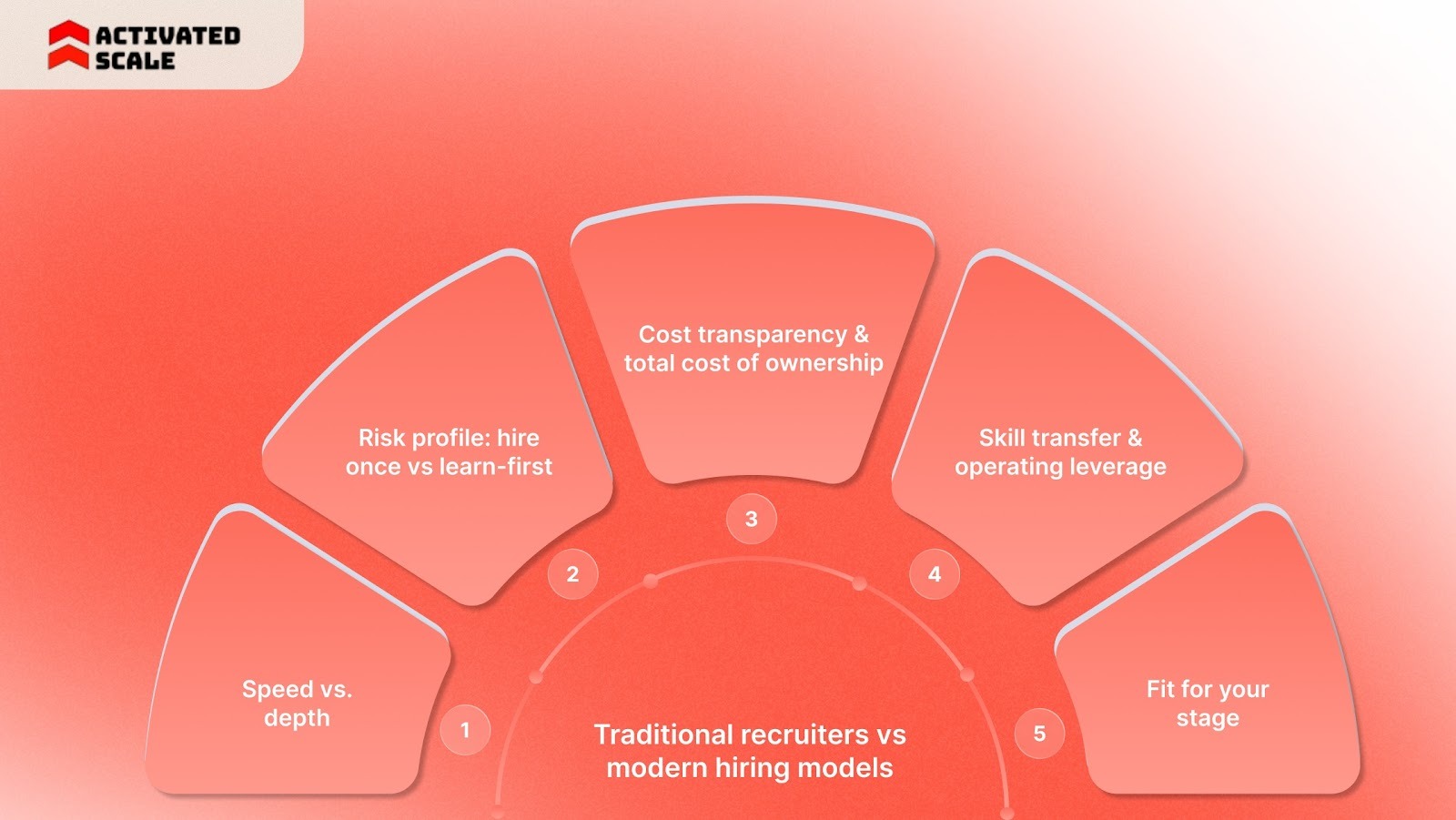
1) Speed vs. depth
- Traditional recruiters often deliver depth (niche networks, high-touch search) but at a slower pace: searches can take weeks to months.
- Marketplaces/fractional models prioritize speed; you can test roles and get people engaging in days or a few weeks, which matters when time-to-revenue is critical. Evidence: marketplace comparisons show time-to-hire dropping from months to 1–2 weeks in many cases.
When you need validated execution quickly (e.g., test an outbound motion), speed beats perfect fit.
2) Risk profile: hire once vs learn-first
- Traditional search is hire-first: you commit and hope the person fits long term. That increases mis-hire risk and the cost of being wrong.
- Modern models (marketplaces + fractional leadership + contract-to-hire) let you “learn before you commit”: run short-cycle experiments and convert when you see repeatable results. Industry writeups on fractional sales & talent marketplaces highlight this learning-first advantage.
If mis-hires are expensive for you (they usually are for startups), prefer a learn-first model.
3) Cost transparency and total cost of ownership
- Traditional agencies can be opaque: success fees, retained searches, and unexpected replacement costs add up.
- Marketplaces and RPO often offer clearer pricing and predictable monthly costs; RPOs also show measurable reductions in cost-per-hire and time-to-fill when used strategically. Staffing industry research and RPO analyzes point to measurable ROI for the right use cases.
If you need predictable hiring spend tied to outcomes, marketplaces or RPOs are easier to budget for.
4) Skill transfer and operating leverage
- Traditional recruiters fill roles; they don’t always leave you with repeatable hiring systems.
- RPO or fractional leaders can embed process: playbooks, scorecards, ramp plans. Fractional sales leaders in particular accelerate operating maturity because they arrive with playbooks and leave you with repeatable motions.
If you want to level up hiring capability (not just one hire), invest in RPO/fractional talent who codify how you hire and ramp.
5) Fit for your stage (practical rule of thumb)
- Pre-product/early revenue: Marketplace/fractional + short experiments, validate ICPs and messaging before committing headcount.
- Scaling (consistent, high-volume hiring): RPO or embedded TA, process and throughput matter; RPOs drive efficiency at scale.
- One-off senior hire (critical exec): Traditional retained search or boutique executive search, depth and confidentiality are often worth the premium.
10 Leading Recruitment Firms Shaping Hiring in the US (2026)
Choosing a recruitment partner isn’t just about brand recognition. It’s about how well a firm understands your hiring context, adapts to your pace, and delivers candidates who actually perform after day one. The firms below stand out in different ways, through flexibility, scale, specialization, or execution quality.
Here’s a closer look at some of the top recruiters in the US to consider in 2026.
1. Activated Scale
Founded: 2021
Location: Evanston, Illinois, USA
Activated Scale represents a modern shift in how companies approach sales hiring. Rather than operating like a traditional recruitment agency, it functions as a sales talent marketplace that prioritizes execution speed and flexibility. Companies can engage experienced, US-based sales professionals, SDRs, AEs, or sales leaders on a fractional or contract-to-hire basis, allowing them to validate real performance before committing to full-time headcount. This approach is particularly effective for startups and growth-stage teams refining their go-to-market motion, where learning cycles and adaptability matter more than static org charts.
What stands out:
- Emphasis on live execution instead of resume-based hiring
- Flexible engagement models aligned with GTM experimentation
- Talent vetted specifically for startup and scale-up environments
- Strong fit for teams pre- or mid-product–market fit
- Designed to reduce hiring risk without slowing momentum
2. Robert Half
Founded: 1948
Location: Menlo Park, California
Robert Half is one of the most established recruitment firms in the US, with a long-standing reputation built on consistency and scale. The firm operates across accounting, finance, technology, and administrative functions, supporting both temporary and permanent hiring needs. Its strength lies in its ability to access structured, compliance-heavy hiring environments, making it a dependable option for organizations that value predictability, process, and breadth of coverage across multiple roles or departments.
What stands out:
- Deep experience in regulated and skills-sensitive hiring
- Ability to support multi-role hiring across departments
- Strong internal processes for candidate screening and placement
- Well-suited for companies prioritizing stability over speed
3. Kelly Services
Founded: 1946
Location: Troy, Michigan
Kelly Services has played a foundational role in shaping the modern staffing industry and continues to evolve alongside workforce changes. The firm is especially well known for its work in education, healthcare, and public services, where hiring needs often intersect with policy, compliance, and long-term workforce planning. Kelly’s approach goes beyond filling immediate roles, often helping organizations rethink how talent is sourced, deployed, and retained over time.
What stands out:
- Strong presence in public-sector and mission-driven organizations
- Experience managing workforce transitions at scale
- Focus on long-term talent sustainability
- Useful for organizations facing skills shortages or labor shifts
4. Adecco
Founded: 1990
US Location: Jacksonville, Florida
Adecco brings operational scale and infrastructure to recruitment, supporting companies that need access to talent across regions and job types. With hundreds of locations throughout the US, the firm is built to handle volume hiring efficiently while maintaining standardized processes. Beyond recruitment, Adecco also supports payroll, workforce management, and career transition services, reducing administrative complexity for internal teams.
What stands out:
- Strong geographic coverage across the US
- Capable of supporting large, distributed workforces
- Integrated services beyond recruitment alone
- Practical choice for volume or multi-location hiring
5. Korn Ferry
Founded: 1969
Location: Los Angeles, California
Korn Ferry operates at the intersection of executive search and organizational consulting. Rather than focusing solely on filling roles, the firm works closely with leadership teams to clarify responsibilities, design structures, and align talent strategy with long-term business objectives. This makes Korn Ferry particularly relevant for organizations undergoing transformation, leadership changes, or strategic realignment.
What stands out:
- Strong focus on leadership and executive roles
- Integration of talent strategy with organizational design
- Hands-on advisory approach beyond hiring
- Well-suited for complex transformation phases
6. Randstad
Founded: 1960
US Presence: Nationwide
Randstad combines global scale with a flexible approach to hiring in the US market. The firm supports a wide range of hiring models, from temporary and permanent staffing to in-house recruitment solutions. Its adaptability makes it a reliable partner for companies operating in dynamic environments where workforce needs shift frequently due to growth, seasonality, or market expansion.
What stands out:
- Ability to support multiple hiring frameworks
- Strong balance between global reach and local execution
- Useful for companies scaling or entering new markets
- Broad industry coverage without rigid engagement models
7. SCM Talent Group
Founded: 2004
Location: Asheville, North Carolina
SCM Talent Group is a specialist recruiting firm focused exclusively on supply chain and operations roles. Unlike generalist recruiters, its value comes from deep domain expertise and an understanding of how supply chain leadership directly impacts business performance. The firm works closely with clients to understand operational complexity, leadership expectations, and long-term organizational goals.
What stands out:
- Narrow focus on supply chain and operations leadership
- Strong understanding of role complexity and impact
- Precision-driven recruiting rather than high volume
- Ideal for organizations where supply chain is mission-critical
8. Kforce
Founded: 1962
Location: Tampa, Florida
Kforce has built a strong reputation in technology and finance recruitment, serving a large share of Fortune 500 companies. What differentiates the firm is its emphasis on post-placement success, ensuring that hires integrate effectively and perform as expected. This long-term orientation makes Kforce a dependable partner for organizations that value continuity and performance beyond the hiring decision.
What stands out:
- Specialization in tech and finance roles
- Structured post-placement support
- Strong performance and satisfaction metrics
- Trusted by large, established enterprises
9. Manpower
Founded: 1948
Location: Milwaukee, Wisconsin
Manpower is one of the most recognizable names in global staffing, with decades of experience adapting to how work evolves. The firm positions itself as a workforce partner rather than a transactional recruiter, offering guidance on workforce planning, labor trends, and operational flexibility alongside traditional staffing services.
What stands out:
- Long-standing experience across economic cycles
- Focus on workforce strategy, not just hiring
- Strong support for large-scale organizational change
- Suitable for companies managing labor transformation
10. Aerotek
Founded: 1983 | Location: Hanover, Maryland
Aerotek specializes in recruitment for construction, manufacturing, and industrial sectors, where hiring accuracy directly affects productivity, safety, and output. The firm’s approach is rooted in understanding operational realities rather than relying solely on job descriptions, which has helped it build long-term client relationships in labor-intensive industries.
What stands out:
- Deep focus on industrial and skilled labor roles
- Strong alignment between candidate capability and job demands
- High placement and retention outcomes
- Reliable partner for operationally critical hiring
Learn more about: The New Rules for Recruiting Salespeople for 2026
How a Strong Recruitment Firm Actually Supports Your Business
Hiring takes more than posting a role and reviewing resumes. It pulls time, focus, and budget away from teams that already have full plates.
For small and growing businesses, building and maintaining an in-house recruitment function often isn’t practical. Results aren’t guaranteed, timelines can stretch, and internal teams end up juggling hiring alongside their primary responsibilities.
A good recruitment firm helps reduce that pressure by bringing structure, speed, and expertise to the hiring process.
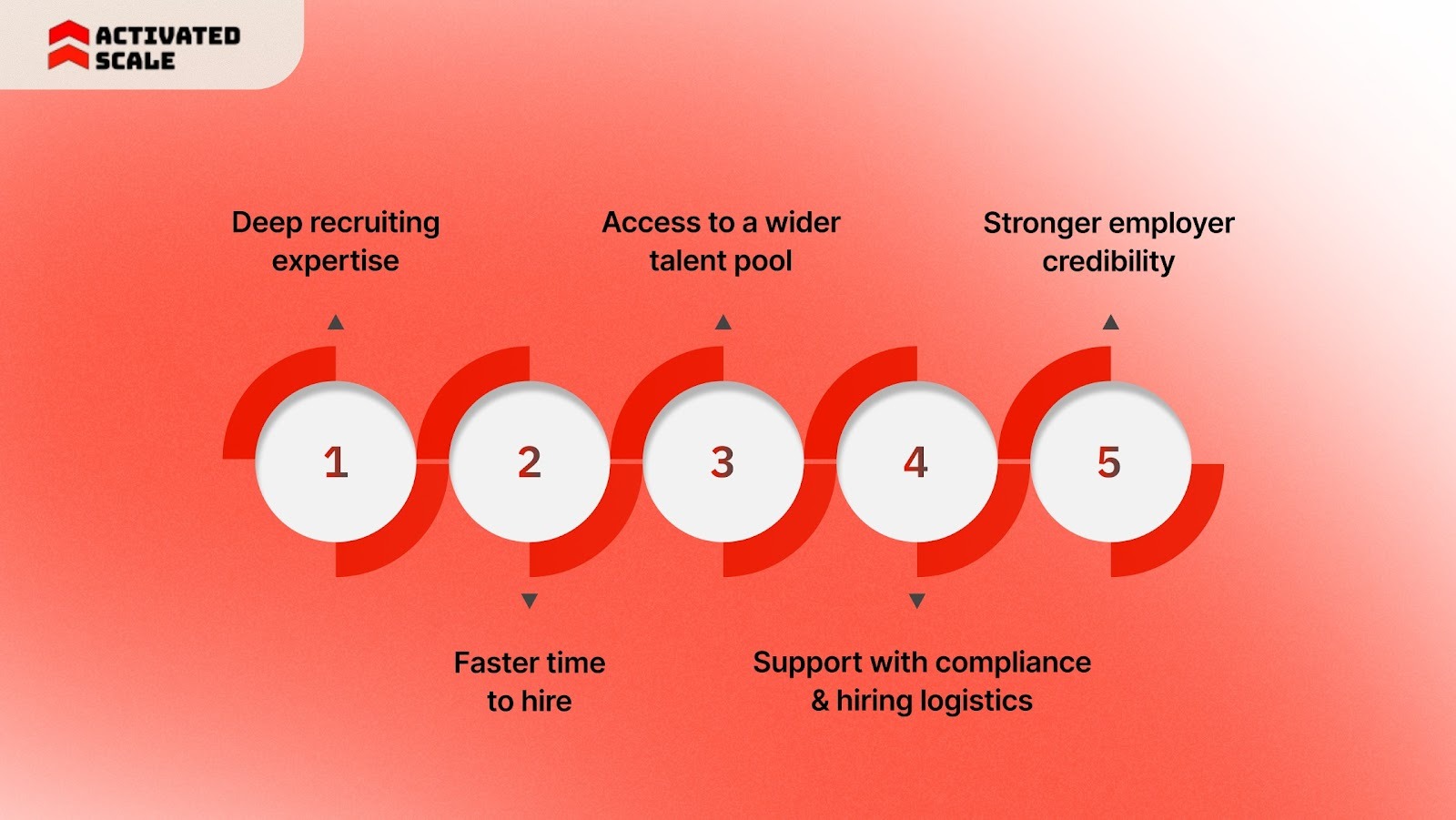
Deep recruiting expertise
Experienced recruitment firms specialize in sourcing, screening, and evaluating candidates every day. This means fewer unqualified interviews, better shortlists, and decisions based on proven hiring patterns, not guesswork.
Faster time to hire
Recruitment firms already have access to active and passive candidates. Instead of starting from scratch, they can surface relevant talent quickly, helping businesses fill roles faster without sacrificing quality.
Access to a wider talent pool
A strong recruiting partner expands your reach beyond local or immediate networks. Whether you’re hiring for niche skills or competitive roles, firms help you tap into broader markets and target the right candidate segments.
Support with compliance and hiring logistics
From documentation to employment requirements, recruitment firms help ensure the hiring process stays compliant. This reduces risk and removes administrative burden from internal teams.
Stronger employer credibility
Partnering with a reputable recruitment firm can also elevate how candidates perceive your brand. Top talent is more likely to engage when opportunities are presented through trusted recruiters with established credibility.
What Makes a Recruitment Firm Worth Partnering With
Handing off hiring to a recruitment firm can save time, but choosing the right firm makes a much bigger difference. A good recruitment partner doesn’t just fill roles; they help you hire people who actually stick and perform.
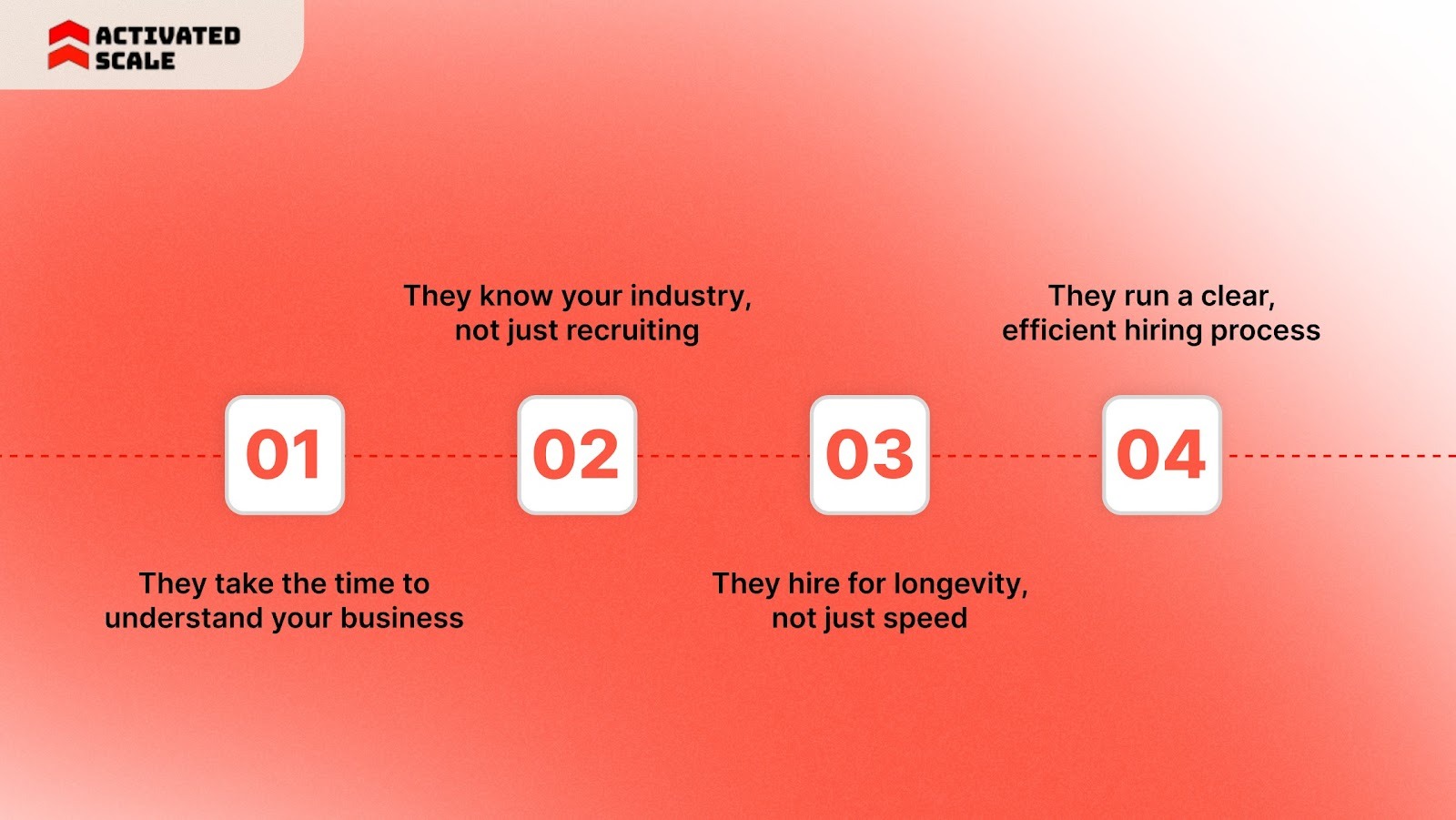
Here are the qualities that separate strong recruitment firms from the rest:
They take the time to understand your business
A good recruitment firm doesn’t jump straight into sourcing. They invest time in understanding your company’s goals, culture, team structure, and what success looks like in the role. This context is what helps them find candidates who fit beyond just the job description.
They know your industry, not just recruiting
Industry expertise shows up in the questions they ask. Strong recruiters understand your market, common hiring challenges, and the type of talent that succeeds in your space. They don’t rely on generic hiring tactics; they tailor their approach based on real-world experience.
They hire for longevity, not just speed
Retention matters. A firm that consistently places candidates who stay and grow is doing something right. Low retention is often a sign of rushed placements or poor role alignment. Good recruiters optimize for long-term success, not just quick wins.
They run a clear, efficient hiring process
Effective recruitment firms keep things simple and structured. Their process is transparent, well-communicated, and easy to work with, with no unnecessary steps and no confusion. You know what’s happening, what comes next, and why.
These qualities set the baseline for what a strong recruitment partner should offer. Firms that consistently deliver on these fronts tend to stand out year after year, especially as hiring demands evolve.
In the next section, we’ll take a closer look at some of the top recruiting firms in the US for 2026, firms that reflect these qualities and are trusted by companies to hire effectively in a competitive market.
Also read: Direct Sourcing Strategies to Recruit Top Talent
Final Thoughts
Choosing between traditional recruiters and modern hiring models isn’t about which is “better.” It’s about fit for your stage, speed, and risk tolerance. Traditional recruiters still play an important role for long-term, senior, or highly specialized hires. But for revenue-critical roles, where timing, execution, and iteration matter, modern, flexible models offer a clear advantage.
Sales hiring is especially unforgiving. A delayed or misaligned hire doesn’t just slow growth; it stalls pipeline and learning. That’s why more startups are moving away from long hiring cycles and toward short-cycle, execution-first sales hiring.
This is where Activated Scale stands out. By enabling teams to work with experienced, U.S.-based sales professionals on a fractional or contract-to-hire basis, Activated Scale helps companies validate fit and performance before making long-term commitments.
Connect with Activated Scale to build your sales team with confidence.
FAQs
1. Are traditional recruitment firms still relevant in 2026?
Yes. They remain valuable for executive search, confidential hires, and highly specialized long-term roles.
2. Why are startups shifting toward modern hiring models?
Modern models reduce time-to-hire, lower risk, and allow teams to test performance before committing fully.
3. Is this approach suitable only for startups?
No. Growth-stage and even mid-market companies use flexible sales hiring to expand into new markets or launch new GTM motions.
4. How does Activated Scale differ from a traditional recruiter?
Activated Scale focuses on execution-first sales hiring, allowing teams to work with vetted sales talent before committing to permanent roles.
5. What types of sales roles can be hired through Activated Scale?
Teams can hire SDRs, account executives, and fractional VPs of sales, all U.S.-based and experienced in B2B sales.
The Ultimate Guide to Hiring a Salesperson!
Get the step-by-step guide to hiring, onboarding, and ensuring success!