_edi.png)

Revenue teams capture huge volumes of data from CRM activity, emails, calls, marketing engagement, and customer interactions. The challenge is not the lack of data but the difficulty of turning it into clear revenue signals.
Revenue intelligence addresses this problem by analyzing sales activity and buyer behavior using artificial intelligence to identify patterns that influence pipeline outcomes.
Organizations adopting revenue intelligence platforms typically improve forecasting accuracy by 10–20% compared with traditional forecasting approaches, as AI models analyze pipeline signals, buyer engagement, and deal progression.
This guide explains what revenue intelligence is, how it works, its role in revenue operations, and how companies can implement it effectively.
Key Takeaways
- Revenue intelligence turns sales interactions into actionable insights, helping leaders detect deal risks and prioritize high intent opportunities.
- The system analyzes signals across CRM activity, conversations, and buyer engagement, giving revenue teams a clearer view of pipeline health.
- Organizations use revenue intelligence for forecasting, pipeline monitoring, sales coaching, and identifying expansion opportunities.
- Successful implementation requires integrating data sources and training teams to respond to deal signals effectively.
- Execution remains critical because insights must translate into outreach, follow-ups, and opportunity management to influence revenue outcomes.
What Is Revenue Intelligence and Why It Matters
Revenue intelligence refers to the process of collecting and analyzing sales data to uncover trends, opportunities, and risks that affect revenue performance.
Instead of looking only at past performance, revenue intelligence analyzes ongoing customer interactions and pipeline activity to generate forward-looking insights.
In simple terms, it answers important questions such as:
- Which deals are most likely to close
- Which opportunities are at risk
- Which prospects show strong buying signals
- Where revenue forecasts may be inaccurate
Traditional CRM reporting focuses on historical data such as closed deals and activity logs. Revenue intelligence goes further by analyzing sales interactions like calls, emails, and meetings to predict outcomes and recommend actions.
For sales leaders, this visibility changes how pipeline decisions are made.
Why revenue intelligence is gaining attention
Several trends have increased the importance of revenue intelligence.
- B2B sales cycles have become longer and more complex
- Buying decisions involve multiple stakeholders
- Sales teams use many disconnected tools
- Forecast accuracy is harder to maintain
Revenue intelligence platforms connect these data sources and convert them into insights that help revenue teams make faster and more informed decisions.
Also Read: Scaling Revenue Operations for Growing Scaleups
How Revenue Intelligence Actually Works
Revenue intelligence connects the data created during everyday sales activity and converts it into insights that help teams understand deal momentum.
Instead of relying only on manual CRM updates, it analyzes real interactions such as emails, meetings, calls, and engagement signals to detect patterns that influence revenue outcomes.
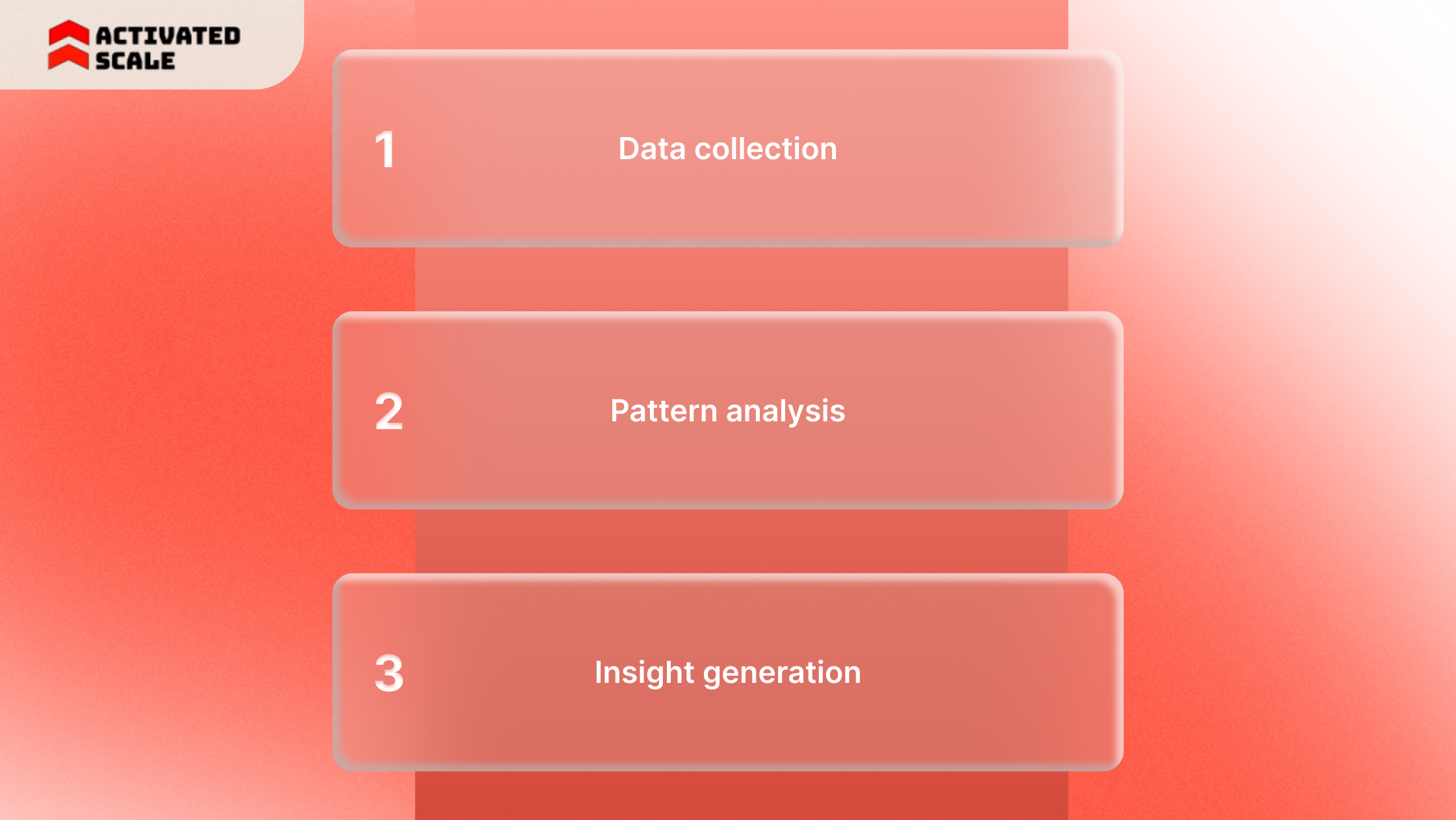
The process typically follows three steps.
1. Data collection
Revenue intelligence platforms automatically capture activity from tools used across the sales process. This includes CRM records, email conversations, meeting calendars, call transcripts, and marketing engagement.
Capturing this information creates a detailed timeline of how each opportunity progresses.
2. Pattern analysis
Artificial intelligence analyzes activity across many deals to identify patterns associated with successful outcomes. It evaluates signals such as stakeholder involvement, meeting frequency, response rates, and deal progression speed.
These patterns help predict whether an opportunity is gaining momentum or beginning to stall.
3. Insight generation
The platform converts these patterns into clear signals for revenue teams. It highlights deal health, forecasts potential revenue, and surfaces opportunities that need attention so teams can act earlier in the sales cycle.
Example:
If multiple decision makers join product demos and consistently respond to emails, the system recognizes strong engagement and predicts a higher chance of closing. If responses are slow and meetings stop, the deal may be flagged as at risk.
Also Read: How SDR Marketing Drives Success for Your Business in 2026
How to Implement Revenue Intelligence in Your Organization
Implementing revenue intelligence requires both technology adoption and process alignment across revenue teams.
Step 1: Audit revenue data sources
Start by identifying the systems where revenue-related data exists. Most companies generate data across several platforms.
Typical sources include:
- CRM systems
- Marketing automation platforms
- Customer success tools
- Email and communication systems
Understanding where customer interaction data lives is essential before building a revenue intelligence framework.
Step 2: Consolidate data across systems
Revenue intelligence works best when these systems are connected. Integrating CRM, marketing engagement, conversation data, and product usage signals creates a unified view of customer interactions.
Companies commonly integrate:
- CRM pipeline data
- Sales call transcripts and emails
- Marketing engagement signals
- Product usage analytics
This unified data layer allows revenue intelligence platforms to analyze deal activity more accurately.
Step 3: Define key revenue metrics
Once data is connected, teams must define the metrics used to evaluate pipeline performance.
Important metrics often include:
- Pipeline coverage
- Opportunity win rate
- Sales cycle length
- Deal conversion rates
Tracking these metrics helps leadership teams measure whether revenue intelligence improves sales outcomes.
Step 4: Train teams to use insights
Technology alone does not improve results. Sales teams must incorporate insights into their daily workflows. Training should focus on interpreting deal signals, prioritizing high intent prospects, and responding quickly to pipeline risks.
Step 5: Continuously refine workflows
Revenue intelligence systems improve over time as more sales data becomes available. Companies should regularly review pipeline metrics
Revenue Intelligence vs Sales Analytics vs RevOps
Many revenue teams use multiple data and operations frameworks simultaneously. Sales analytics, revenue intelligence, and RevOps often overlap, yet each serves a different purpose in the revenue engine.
Understanding the distinction helps leaders decide how to use each approach effectively.
In practice, these functions complement each other. Sales analytics shows what has already happened, revenue intelligence highlights what is likely to happen next, and RevOps ensures teams act on those insights across the entire revenue organization.
This is where execution becomes critical, because insights only create value when teams can respond quickly and move opportunities forward. Platforms like Activated Scale support this by connecting startups with experienced SDRs, AEs, and fractional sales leaders who can translate revenue signals into structured pipeline execution.
Revenue Intelligence vs Business Intelligence
Revenue intelligence and business intelligence often appear similar, yet they serve different operational purposes. Business intelligence focuses on analyzing historical business data across departments such as finance, marketing, and operations.
Revenue intelligence concentrates on live sales activity, buyer engagement signals, and pipeline health to guide revenue decisions.
Industry adoption is accelerating. Market research estimates the global revenue intelligence platform market will grow from about $4.9 billion in 2025 to roughly $18.6 billion by 2033, driven by demand for AI-powered pipeline visibility and forecasting tools.
Key Differences:
Business intelligence helps leadership understand what happened across the business. Revenue intelligence helps revenue teams understand what is happening inside active deals and what actions can improve outcomes.
How Revenue Intelligence Improves Sales Performance
Companies adopt revenue intelligence to strengthen several core areas of sales performance. Instead of relying on fragmented reports or manual updates, teams gain a clearer view of how deals progress and where revenue risks appear.

1. Better pipeline visibility
Revenue intelligence provides a real-time view of deal activity. Sales leaders can track engagement signals, such as meetings, email responses, and stakeholder participation, to determine whether opportunities are progressing or slowing.
This visibility helps managers identify stalled deals early rather than discovering problems during end of quarter reviews.
2. More accurate forecasts
Revenue forecasting is difficult when pipeline data relies only on manual CRM updates. Revenue intelligence analyzes activity signals and historical deal patterns to estimate the probability of closing. These insights give leadership teams a more reliable picture of expected revenue and reduce forecast surprises.
3. Improved sales coaching
Conversation intelligence tools review sales calls, demos, and email exchanges to highlight patterns that influence outcomes. Managers can study how successful deals unfold and use those insights to coach representatives more effectively during training sessions or pipeline reviews.
4. Faster deal cycles
When sales teams detect risks early, such as declining engagement or missing stakeholders, they can intervene before opportunities stall. Early intervention helps maintain momentum and often shortens the overall sales cycle.
5. Better alignment across revenue teams
Revenue intelligence connects data from sales, marketing, and customer success systems. With shared visibility into pipeline activity, teams can coordinate outreach, customer engagement, and expansion strategies more effectively.
Also Read: Understanding the Process and Methods of Sales Forecasting
Revenue Intelligence Platforms and Tools
Revenue intelligence platforms do not all solve the same problem. Some focus on forecast accuracy and pipeline inspection. Others focus more on conversation signals, rep execution, or account-level visibility. The right choice depends on the operating gap you need to fix.
What leading platforms are built to do
A few common categories stand out in the market.
How to choose the right tool
Start with the business problem, not the vendor shortlist.
Use this filter:
- Choose a forecasting first platform if board calls, commit accuracy, and pipeline inspection are your biggest issues. Clari and Gong are often evaluated here.
- Choose a CRM-native option if your team already runs heavily in Salesforce and wants tighter workflow continuity. Salesforce positions Revenue Intelligence around pipeline visibility, account health, and AI insights inside Sales Cloud.
- Choose a data capture-first platform if the primary issue is missing activity data or weak account mapping. People.ai emphasizes structured and unstructured revenue data tied to AI workflows.
A practical buying lens
Before buying, ask these questions:
- Does the tool improve forecast calls or just create another dashboard?
- Can it connect buyer activity to deal risk in a way managers can act on?
- Will reps and managers use it weekly?
- Does it reduce manual inspection work for RevOps and frontline leaders?
Those questions usually expose the difference between a useful revenue intelligence platform and an expensive analytics layer.
Real Use Cases of Revenue Intelligence
Revenue intelligence supports several practical use cases that help revenue teams manage pipeline performance and improve decision-making.
1. Pipeline health monitoring
Sales leaders need a clear view of whether their pipeline can support upcoming revenue targets. Revenue intelligence dashboards track deal progression, engagement levels, and pipeline coverage so leaders can evaluate whether enough qualified opportunities exist.
Typical pipeline indicators include:
- Deal progression across pipeline stages
- Engagement from decision makers
- Activity frequency, such as meetings or calls
- Potential bottlenecks in the sales process
2. Deal risk detection
Some opportunities appear healthy in CRM records but quietly lose momentum. Revenue intelligence analyzes interaction patterns to identify early warning signals.
Examples include:
- Lack of participation from decision makers
- Declining email response rates
- Fewer scheduled meetings or follow-ups
- Long gaps between sales interactions
These signals help sales teams intervene before deals drop out of the pipeline.
3. Sales coaching
Conversation intelligence enables managers to analyze how successful representatives conduct calls and handle objections. These insights help improve training and sales messaging.
4. Revenue forecasting
Finance and revenue leaders depend on accurate forecasts to plan hiring, marketing budgets, and product investments. Revenue intelligence platforms use deal signals and historical patterns to estimate closing probability and produce more reliable forecasts.
5. Customer expansion opportunities
Revenue intelligence can also reveal opportunities for upselling or cross-selling. By analyzing product usage patterns, customer engagement, and support interactions, teams can identify accounts likely to expand their usage.
Revenue Intelligence Metrics Every Leader Should Track
To measure the impact of revenue intelligence, leaders monitor several core performance indicators that reveal pipeline strength and revenue predictability.

1. Pipeline coverage
Pipeline coverage assesses whether the value of active opportunities is sufficient to meet upcoming revenue targets. A strong pipeline coverage ratio indicates that sales teams have sufficient opportunities to meet their goals.
2. Forecast accuracy
Forecast accuracy compares predicted revenue with actual results. Revenue intelligence improves this metric by analyzing deal engagement signals rather than relying solely on manual CRM estimates.
3. Win rate
Win rate represents the percentage of opportunities that convert into closed deals. Monitoring this metric helps teams evaluate whether improved insights lead to better sales execution.
4. Sales cycle length
Sales cycle length measures how long it takes to convert prospects into customers. Shorter cycles often indicate stronger buyer engagement and effective deal management.
5. Customer lifetime value
Customer lifetime value reflects the total revenue expected from a customer relationship. Understanding this metric helps companies prioritize high-value accounts and expansion opportunities.
How to Overcome Challenges with Revenue Intelligence
Revenue intelligence often underperforms for a simple reason: the system reflects the quality of your inputs. If CRM fields are incomplete, call data is disconnected, or managers use different forecast rules, the platform will surface noise instead of insight
Fix the data foundation first
Revenue intelligence works best when sales activity, pipeline updates, and customer interactions feed into the same operating model.
Focus on these fixes first:
- Tighten CRM hygiene: Require close dates, deal values, next steps, and stage definitions to be updated before forecast reviews. Example: A deal should not move to a proposal unless pricing, stakeholders, and timeline are logged.
- Connect activity data to pipeline data: Bring meeting, email, and call signals into the same view as opportunity records. This helps managers spot deals with strong CRM updates but weak buyer engagement.
- Standardize forecast rules: Define what counts as commit, upside, pipeline risk, and slipped deals. Revenue intelligence becomes far more useful when every manager applies the same criteria.
- Use the platform inside weekly operating rhythms: Add it to pipeline reviews, deal inspections, and forecast calls. If the tool is only opened at quarter's end, adoption drops and data quality follows.
Watch for the common failure points
Most teams struggle in the same places:
Gartner reports that 69% of sales operations leaders say forecasting is harder than it was three years ago. That is a strong signal that revenue intelligence needs process discipline, not just software.
When Startups Need Revenue Expertise but Not a Full Team
Many startups reach a stage where revenue insights become clearer, yet the internal team lacks the experience or bandwidth to act on them consistently. Hiring a full-time sales or revenue leader at this point can feel risky because the revenue model is still taking shape and priorities continue to evolve.
A flexible approach allows companies to bring in experienced operators without locking into permanent hires too early. Activated Scale helps startups access senior sales professionals to guide revenue strategy and execution at this stage.
This support can include:
1. Fractional sales leadership
Experienced leaders help define pipeline management practices, forecast reviews, and sales processes that bring structure to growing teams.
2. Contract-to-hire recruiting
Startups can work with proven sales professionals before deciding whether to make a full-time hire.
SDRs and account executives help manage outreach, follow-ups, and opportunity progression when pipeline activity increases.
This model allows startups to strengthen revenue execution while keeping hiring decisions flexible.
Conclusion
Revenue intelligence helps companies understand how deals progress, where pipeline risks appear, and which opportunities deserve attention. Platforms such as Gong, Clari, and Salesforce Revenue Intelligence analyze sales conversations, CRM activity, and buyer engagement to surface signals that improve forecasting and pipeline visibility.
Yet tools alone do not move deals forward. Insights must translate into timely outreach, follow-ups, and sales conversations. Many growing companies reach a point where revenue signals exist, but execution capacity is limited.
Activated Scale supports that transition by connecting companies with vetted US-based sales professionals in under a week. With more than 200 companies served and most placements lasting more than eight months, the focus remains on demonstrating impact before long-term commitments.
If your team is building or refining its revenue strategy, explore how Activated Scale can support your next stage of growth.
FAQs
Q: How is revenue intelligence different from a traditional CRM system?
A: CRM systems mainly store customer records and track pipeline stages entered by sales reps. Revenue intelligence analyzes the interactions behind those records, including calls, emails, and meetings. This helps identify patterns that influence deal outcomes and provides predictive insights beyond basic reporting.
Q: Can revenue intelligence improve sales coaching and team performance?
A: Yes. Revenue intelligence tools analyze sales conversations and communication patterns to highlight behaviors linked to successful deals. Managers can use these insights to refine messaging, address skill gaps, and guide reps during pipeline reviews.
Q: What types of companies benefit most from revenue intelligence?
A: B2B companies with complex sales cycles gain the most value because deals involve multiple stakeholders and longer evaluation periods. SaaS companies and enterprise technology firms often use revenue intelligence to improve pipeline visibility and forecasting.
Q: Does revenue intelligence replace revenue operations or sales management?
A: No. Revenue intelligence provides insights that support better decisions, while RevOps and sales leaders still manage processes, tools, and team execution.
Q: What challenges appear when implementing revenue intelligence?
A: The main challenge is connecting data from different systems, such as CRM, email platforms, marketing tools, and product analytics. Teams also need clear processes, so insights translate into real sales actions.
The Ultimate Guide to Hiring a Salesperson!
Get the step-by-step guide to hiring, onboarding, and ensuring success!