_edi.png)

As scaleups grow, revenue complexity grows faster than headcount. Sales volumes increase, marketing channels multiply, and customer success expands, but the systems connecting them often don't keep pace.
That's where revenue operations for scaleups become critical. Without a structured RevOps model, teams rely on disconnected tools, inconsistent metrics, and manual coordination. Forecasts become harder to trust. Execution slows. Decisions lag behind growth.
Scaling RevOps isn't about adding more dashboards or processes. It's about creating a shared operating system that aligns sales, marketing, and customer success around the same revenue goals, data, and execution standards.
Core Insights
- Revenue operations becomes critical at the scaleup stage when growth creates coordination issues across sales, marketing, and customer success.
- RevOps aligns teams around shared goals, consistent metrics, and standardized handoffs, reducing friction in execution as complexity increases.
- Scaleups need RevOps when forecasts become unreliable, reporting becomes manual, and teams optimize locally rather than for revenue outcomes.
- A scalable RevOps framework includes clear ownership, unified funnel definitions, centralized data, aligned tooling, and a consistent operating cadence.
- RevOps implementation works best when tackled step by step, starting with ownership and process clarity before automation.
- The right RevOps metrics focus on forecast accuracy, pipeline health, velocity, retention, and process adoption, not vanity activity.
Why Revenue Operations Matters for Growing Scaleups
Scaleups don't lose momentum because demand slows. They lose it because coordination breaks.
As teams grow, sales, marketing, and customer success start making decisions in isolation. Metrics don't line up. Forecasts drift. Execution depends more on heroics than process. What worked in earlier stages no longer holds up.
Revenue operations for scaleups exist to fix this. RevOps creates a single operating layer across the revenue lifecycle, enabling teams to share definitions, data, and execution standards. Pipeline, conversion, and retention are viewed as one system, not separate functions.
At scale, complexity is unavoidable. RevOps prevents that complexity from turning into chaos by making revenue execution consistent, measurable, and easier to manage as volume increases.
Signals Your Scaleup Needs a RevOps Model
Scaleups usually don't realize they need RevOps until execution starts slipping in specific, repeatable ways.
Common signals include:
- Forecasts are changing late in the quarter because pipeline stages and probabilities aren't applied consistently.
- Lead and customer handoffs are breaking down due to a lack of context among marketing, sales, and post-sale teams.
- Manual reporting and spreadsheet fixes are becoming part of weekly leadership reviews.
- Conflicting metrics across teams, where each function reports success, but revenue outcomes don't align.
- New segments or motions are added without structure, forcing teams to rely on intuition instead of process.
When these issues stack up, the problem isn't effort or demand. It's the absence of a shared operating model. RevOps becomes necessary to simplify execution, not complicate it.
Also read: Best Sales Strategies and Examples for Success
Core Components of a Scalable RevOps Framework
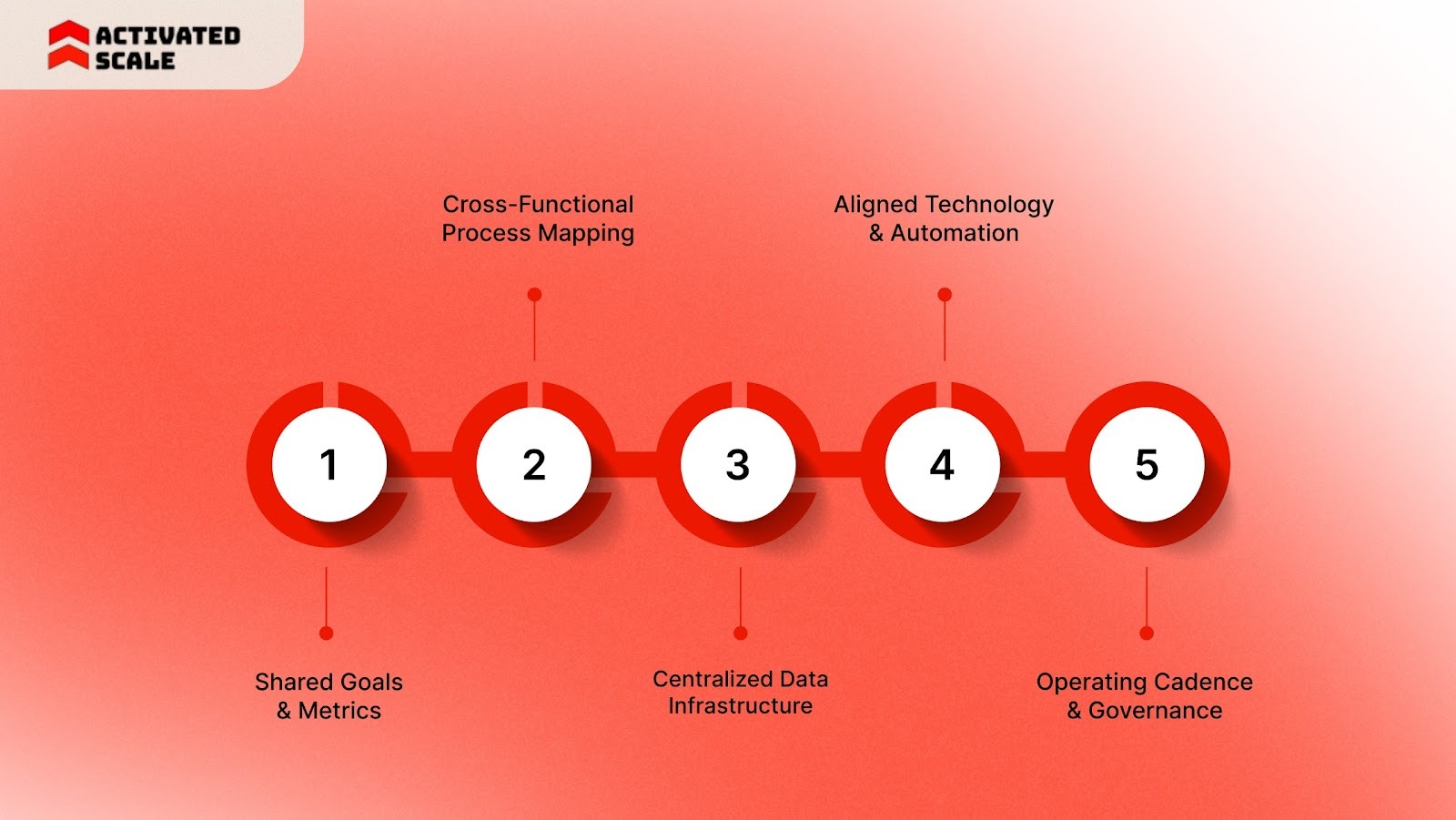
A scalable RevOps framework isn't built on tools or dashboards. It’s built on a small set of structural components that remove ambiguity as the business grows.
Shared Goals and Metrics
RevOps starts by aligning teams on one definition of success. Sales, marketing, and customer success must measure performance using the same revenue outcomes, not team-specific proxies. This eliminates conflicting reports and keeps execution focused on impact rather than activity.
Cross-Functional Process Mapping
Every revenue touchpoint needs a defined owner and handoff. Mapping the end-to-end customer lifecycle, from first touch to renewal, exposes gaps that slow deals or damage retention. Scaleups use this to standardize how work moves, even as volume increases.
Centralized Data Infrastructure
A scalable RevOps model depends on a single source of truth for revenue data. When pipeline, bookings, and retention live in different systems or formats, decision-making slows. Centralized data makes performance visible and comparable across teams.
Aligned Technology and Automation
Tools should support the process, not dictate it. Scaleups align their tech stack around agreed workflows and automate repeatable actions like routing, updates, and reporting. This reduces manual work without adding complexity.
Operating Cadence and Governance
RevOps only works when reviewed consistently. Regular forecasting, pipeline reviews, and cross-functional check-ins create accountability and prevent small issues from compounding. Governance keeps the system relevant as the business evolves.
Learn more about: Guide to Hiring Overseas Employees in 2026
Step-by-Step RevOps Scaling Blueprint for Scaleups
Scaling RevOps isn't about rolling out a framework all at once. It's about removing the biggest sources of friction in the right order so execution improves as complexity increases.
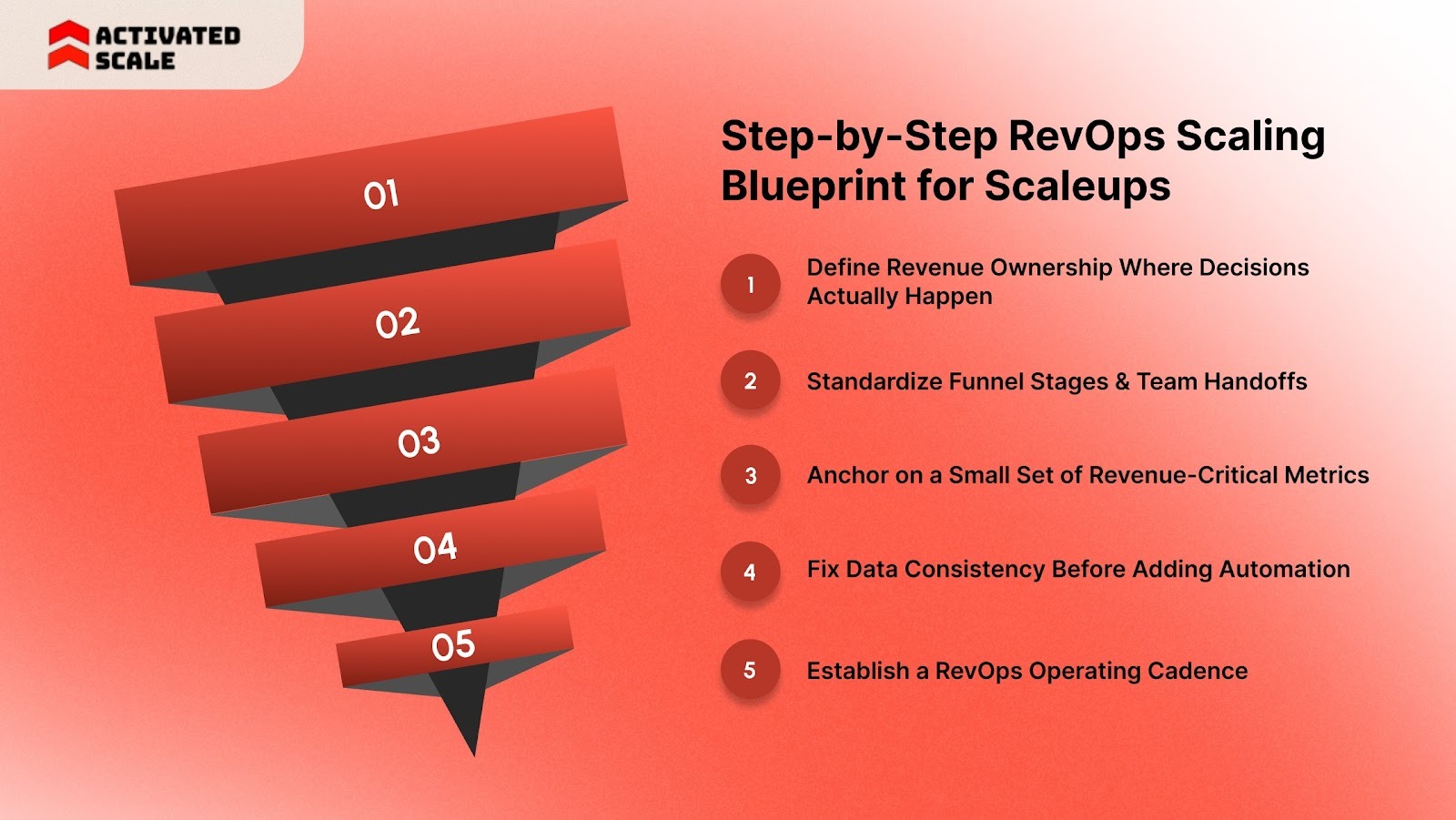
1. Define Revenue Ownership Where Decisions Actually Happen
RevOps breaks down when responsibility is implied instead of explicit. Start by clarifying who owns key decisions across the revenue lifecycle, pipeline creation, deal progression, forecasting, renewals, and expansion.
This isn't about job titles. It's about decision rights. When ownership is clear, issues surface faster and don't bounce between teams.
2. Standardize Funnel Stages and Team Handoffs
Most scaleups suffer from "almost aligned" funnels. Marketing, sales, and customer success use similar language but apply it differently.
RevOps requires shared definitions for stages, entry and exit criteria, and handoff expectations. This reduces dropped context, improves conversion analysis, and makes forecasts more reliable because deals mean the same thing everywhere.
3. Anchor on a Small Set of Revenue-Critical Metrics
Too many metrics slow down decisions. RevOps works when teams align around a short list of metrics that connect activity to outcomes, such as pipeline coverage, conversion rates, forecast accuracy, and retention.
These metrics should be reviewed together, not in isolation. The goal is to understand how one part of the system affects another, not to optimize silos.
4. Fix Data Consistency Before Adding Automation
Automation doesn't solve messy data; it amplifies it. Before building workflows or reports, ensure revenue data follows consistent rules and lives in a single source of truth.
Once the data is clean and trusted, automation can eliminate manual work and accelerate execution. Until then, it usually adds noise.
5. Establish a RevOps Operating Cadence
RevOps only creates value if it's actively used. This requires a regular cadence, forecast reviews, pipeline inspections, and cross-functional check-ins, where teams act on shared data.
This cadence is what keeps RevOps from becoming a reporting function and turns it into an execution engine.
Many scaleups understand what needs to change but lack the leadership bandwidth to implement it consistently. That is how Activated Scale fits into RevOps scaling.
Activated Scale helps scaleups move through this blueprint by providing:
- Fractional Sales Leadership to own RevOps execution and align teams during growth.
- Contract-to-Hire Sales Recruiting to test RevOps or revenue leadership impact before committing full-time.
- Fractional Selling to maintain pipeline discipline while processes and systems are being standardized.
This allows scaleups to progress through RevOps implementation with momentum, without locking into structure before it's proven.
RevOps Metrics That Scale With Your Business
As scaleups grow, the problem isn't a lack of data; it's knowing which numbers actually explain performance. RevOps metrics should help leaders understand why revenue behaves the way it does, not just what happened last quarter.
The most useful metrics scale with complexity and remain stable even as teams, segments, and motions expand.
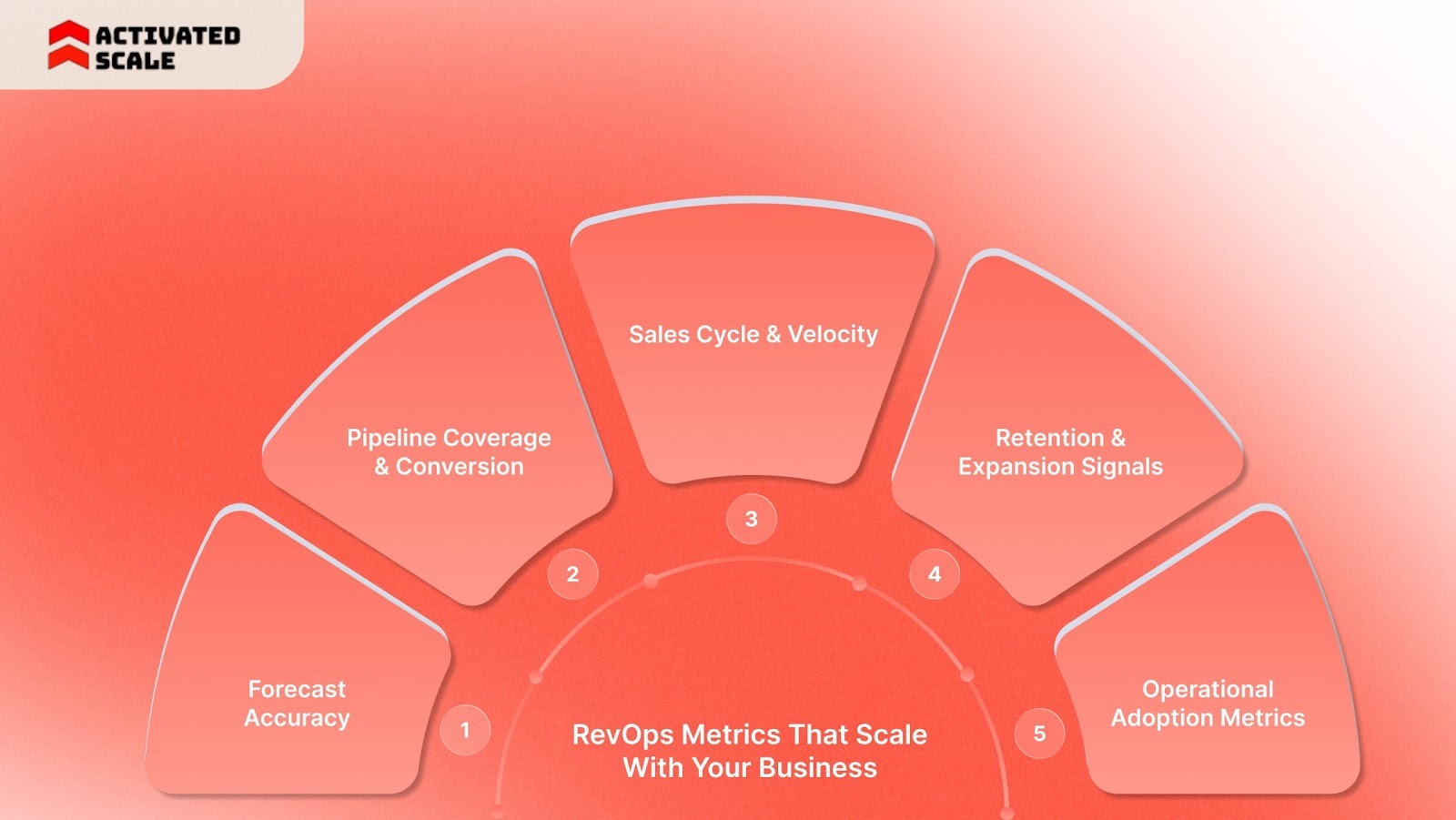
Forecast Accuracy
Forecast accuracy is one of the clearest indicators of RevOps health. Large swings late in the quarter usually signal inconsistent pipeline definitions, weak stage criteria, or poor handoffs between teams. Improving forecast accuracy builds confidence in planning, hiring, and board-level decisions.
Pipeline Coverage and Conversion
Pipeline volume alone isn't enough. Scaleups need to track pipeline coverage against revenue targets and understand how conversion changes by segment, deal size, and motion. RevOps uses this data to identify where execution breaks, not just where volume exists.
Sales Cycle and Velocity
As deal complexity increases, sales cycles tend to stretch. RevOps monitors cycle length and pipeline velocity together to surface friction in qualification, approvals, or buyer alignment. These metrics help teams focus on removing bottlenecks instead of pushing more leads into the funnel.
Retention and Expansion Signals
Revenue operations don't stop at close. Net retention, churn drivers, and expansion timing reveal whether growth is sustainable. RevOps connects post-sale data back to acquisition and qualification decisions, helping scaleups improve the quality of long-term revenue.
Operational Adoption Metrics
The process only works if it's used. Metrics such as stage compliance, handoff completion, lead response time, and CRM hygiene indicate whether RevOps standards are being followed. These signals often explain downstream performance issues before revenue is impacted.
When tracked together, these metrics give scaleups a clear view of execution health across the full revenue lifecycle. The goal isn't more reporting; it's faster, more confident decisions as complexity increases.
Conclusion
Scaling revenue isn't just about increasing output; it's about increasing coordination. As scaleups add teams, segments, and motions, the cost of misalignment grows quickly.
Revenue operations provides the operating system that keeps growth predictable. It replaces guesswork with shared definitions, disconnected tools with trusted data, and reactive decisions with clear ownership.
The scaleups that succeed with RevOps don't chase perfection. They focus on clarity, iterate as they grow, and invest in execution support when internal bandwidth runs thin. Flexible leadership and execution models can help teams move faster without locking into structure too early.
If you're exploring how revenue operations fits into your next growth phase, visit the Activated Scale website to see how experienced revenue operators help scaleups turn RevOps strategy into measurable outcomes.
FAQs
1. What is revenue operations for scaleups?
Revenue operations for scaleups is a cross-functional operating model that aligns sales, marketing, and customer success around shared revenue goals, metrics, and processes as complexity increases.
2. When should a scaleup invest in RevOps?
Scaleups typically need RevOps when forecasts become unreliable, reporting requires manual effort, or handoffs between teams begin to break down due to growth.
3. How is RevOps different from sales operations?
Sales operations focus mainly on sales efficiency. RevOps spans the entire revenue lifecycle, integrating pre-sale, sales, and post-sale execution into a single system.
4. What metrics matter most for scaling RevOps?
Key metrics include forecast accuracy, pipeline coverage and conversion, sales cycle velocity, retention and expansion, and process adoption indicators like stage compliance.
5. Can scaleups implement RevOps without hiring full-time leaders?
Yes. Many scaleups use fractional or contract-to-hire revenue leadership to design and run RevOps before committing to permanent roles, reducing risk while maintaining momentum.
The Ultimate Guide to Hiring a Salesperson!
Get the step-by-step guide to hiring, onboarding, and ensuring success!