_edi.png)

Many teams still treat attribution reporting as optional. They argue that pipeline dashboards, CRM activity logs, and campaign metrics already show what the team needs. Yet those numbers often describe effort rather than revenue impact.
A campaign may generate hundreds of leads, though only a handful ever influence closed deals. Attribution reporting helps address that gap by directly linking marketing activity, sales engagement, and buyer behavior to revenue outcomes.
The shift toward revenue operations is already pushing companies to rethink how revenue data is measured. Gartner predicts that by 2026, 75% of the highest-growth companies will adopt a revenue operations model, largely to improve visibility across marketing, sales, and customer success data.
Analyst research also shows that organizations using structured RevOps frameworks often experience stronger growth and profitability once revenue data becomes unified.
This blog explains how revenue operations attribution reporting works and how growth teams turn attribution insights into better pipeline decisions.
Key Takeaways
- Revenue operations attribution reporting links marketing, sales, and product interactions to actual revenue outcomes, helping teams see which actions influence pipeline and closed deals.
- Accurate attribution depends on integrated revenue systems such as CRM, marketing automation, product analytics, and revenue intelligence tools.
- Multi-touch and weighted attribution models provide a clearer view of the buyer journey than single-touch models.
- Attribution insights reveal which channels, outreach patterns, and buyer behaviors generate a qualified pipeline.
- Startups often need experienced sales operators to apply these insights across the pipeline and drive revenue growth.
What Is Revenue Operations Attribution Reporting
Revenue operations attribution reporting tracks the sequence of buyer interactions that occur before a deal closes and assigns revenue influence to those interactions. Instead of evaluating marketing campaigns or sales activities in isolation, this reporting reconstructs the full path to revenue.
This matters because modern B2B purchases involve multiple stakeholders, extended research periods, and interactions across different channels before a vendor is selected.
Attribution reporting allows revenue teams to understand how those interactions combine to create pipeline momentum.
Example Of Revenue Attribution In Practice
Consider a SaaS cybersecurity company selling a compliance automation platform.
The deal path might look like this:
- A security leader discovers a blog post through organic search
- The same company downloads a compliance checklist from a LinkedIn campaign
- An SDR sends a targeted outreach email referencing the checklist
- Two stakeholders attend a product demo
- A free product trial begins
- The deal moves to proposal and eventually closes
Traditional reporting might credit the demo request or last marketing interaction. Revenue attribution reporting maps the entire sequence and evaluates the influence of each step.
RevOps teams use this type of analysis to identify patterns across multiple deals.
Also Read: Scaling Revenue Operations for Growing Scaleups
What Attribution Reporting Actually Measures
Attribution reporting focuses on interactions that change the probability of revenue rather than simply counting engagement.

A typical revenue attribution system tracks signals across three layers of the funnel.
1. Pipeline Creation Signals
These signals explain how opportunities enter the pipeline.
Revenue teams examine patterns such as:
- Marketing channels consistently produce qualified opportunities
- Content assets downloaded by accounts that later convert to pipeline
- Product trials that occur before SDR outreach
Example:
A SaaS analytics company analyzes 100 closed deals and discovers that nearly half of them began with product documentation visits rather than marketing campaigns. RevOps then prioritizes documentation SEO and developer-focused content.
2. Pipeline Acceleration Signals
These signals show which interactions move deals from early evaluation into serious buying stages.
Key indicators include:
- Discovery calls that lead to technical evaluation
- SDR sequences that convert cold outreach into meetings
- Multi-stakeholder engagement within the same account
Example:
A B2B fintech startup notices that deals progress faster when both a finance leader and an operations manager attend the demo. RevOps updates qualification criteria to encourage multi-stakeholder participation early.
3. Revenue Conversion Signals
These signals appear shortly before deals close and often indicate strong buying intent.
Revenue teams typically analyze:
- Product trial usage depth before the proposal stage
- Security or compliance documentation requests
- Pricing discussions involving multiple stakeholders
Example:
A SaaS company observes that deals where the buyer requests integration documentation before the proposal stage have a significantly higher close rate. Sales teams begin proactively sharing integration resources during technical calls.
The Difference Between Basic Reporting And Attribution Reporting
Most companies already track sales and marketing performance. The difference lies in how that data is interpreted.
Attribution reporting allows revenue leaders to answer operational questions such as
- Which marketing channels create opportunities that actually close.
- Which sales interactions appear in successful deal paths.
- Which buyer behaviors indicate strong purchase intent.
Also Read: Understanding and Measuring Sales Effectiveness Metrics
Which Attribution Models Do Revenue Teams Use Today
Revenue attribution models determine how credit is assigned to interactions across the buyer journey. Each model answers a different operational question.

Revenue operations teams often compare multiple models to evaluate the pipeline from different angles.
1. First Touch Attribution
First-touch attribution assigns full credit for revenue to the interaction that first introduced the buyer to the company. Revenue teams rely on this model to understand where demand originates.
Typical use case:
A developer discovers an API platform through a technical blog post. Months later, the company purchases the platform after a product trial and sales evaluation.
First touch attribution credits the blog post because it initiated the relationship.
Operational insight:
This model helps marketing leaders identify
- Channels generating early demand
- Search topics attracting high-intent buyers
- Referral sources bringing qualified accounts
2. Last Touch Attribution
Last touch attribution assigns revenue credit to the final interaction before conversion. This model focuses on the event that triggered the buyer to take action.
Example:
An account interacts with several marketing assets over a six-month period. The buyer finally books a demo after receiving a targeted SDR email.
Last touch attribution assigns the deal credit to the outreach email.
Operational insight:
Revenue teams use this model to evaluate
- Demo request triggers
- Bottom funnel campaigns
- Late-stage engagement activities
The limitation is clear. Earlier interactions that built interest remain invisible.
3. Multi-Touch Attribution
Multi-touch attribution distributes credit across multiple interactions that influenced the deal.
This approach reflects how modern buying decisions unfold across research, evaluation, and stakeholder discussions.
For example:
A buyer journey may include
- LinkedIn ad interaction
- Webinar attendance
- SDR outreach email
- Product demo
- Trial activation
In a linear multi-touch model, each interaction could receive equal credit for the final conversion.
Operational insight:
Multi-touch analysis helps revenue teams identify patterns such as
- Combinations of marketing and sales actions appearing in successful deals
- Content types that consistently support pipeline development
- Product experiences that accelerate evaluation
4. Weighted Attribution Models
Weighted attribution models assign different levels of credit based on how influential each interaction appears to be in successful deal paths.
These models attempt to reflect the real influence of specific stages in the buying process.
Example:
A SaaS company reviewing 200 closed deals may find that three interactions consistently appear
- Educational content before initial outreach
- Discovery calls involving multiple stakeholders
- Product trials during evaluation
Weighted attribution models assign higher credit to these interactions, helping revenue teams prioritize activities that consistently influence revenue.
When these patterns become clear, startups often need experienced sales operators who can replicate what works. Activated Scale helps founders quickly access vetted U.S.-based SDRs, AEs, and fractional sales leaders without committing to full-time hires.
This allows teams to build a repeatable, data-driven sales process faster, reduce ramp time, and avoid costly early GTM hiring mistakes.
Also Read: How to Scale Sales Without Full-Time Hires
What Data Powers Revenue Operations Attribution Reporting
Revenue attribution reporting works only when data from multiple revenue systems is connected. Marketing platforms track early engagement. CRM systems track pipeline progression.
Product analytics reveal how buyers interact with the product during evaluation. When these systems share data, RevOps teams can connect every interaction in the buying journey to the revenue it influences.
Core Systems That Feed Attribution Reporting
Attribution reporting relies on a small group of systems that capture different stages of the revenue lifecycle.
Each system contributes signals that help RevOps teams reconstruct the buyer journey.
Core Attribution Signals RevOps Teams Analyze
Revenue attribution models focus on signals that appear consistently across successful deals. These signals usually fall into three categories.
Pipeline Creation Signals
These signals reveal how opportunities first enter the pipeline.
Examples include:
- Original lead source
- Campaign interaction before opportunity creation
- Inbound demo request events
These insights help revenue teams identify which channels consistently generate a qualified pipeline.
Sales Engagement Signals
Sales activity often determines whether early interest turns into qualified opportunities.
Common signals include:
- SDR outreach responses
- Discovery call completion
- Meeting participation by multiple stakeholders
- Product demo attendance
These interactions indicate how sales engagement influences pipeline progression.
Buyer Intent Signals
Buyer behavior often reveals strong purchase intent before a deal reaches late stages.
Signals commonly analyzed include:
- Repeated visits to pricing or product pages
- Requests for integration or security documentation
- Product trial activity
- Multiple users accessing the product within the same account
When these signals appear together, they often correlate with deals that move toward proposal and negotiation.
Why Attribution Accuracy Often Fails
Many organizations attempt to produce attribution reports but struggle to deliver reliable insights. The issue usually lies in how revenue data is captured and structured.
The most common causes include:
Revenue attribution reporting becomes reliable only when data across these systems is structured consistently and integrated into a unified revenue operations framework.
How Startups Can Implement Revenue Operations Attribution Reporting
Revenue attribution reporting does not require a large RevOps team or complex enterprise infrastructure. Startups can build an effective framework by focusing on clear revenue questions, structured data connections, and dashboards that translate activity into revenue insight.
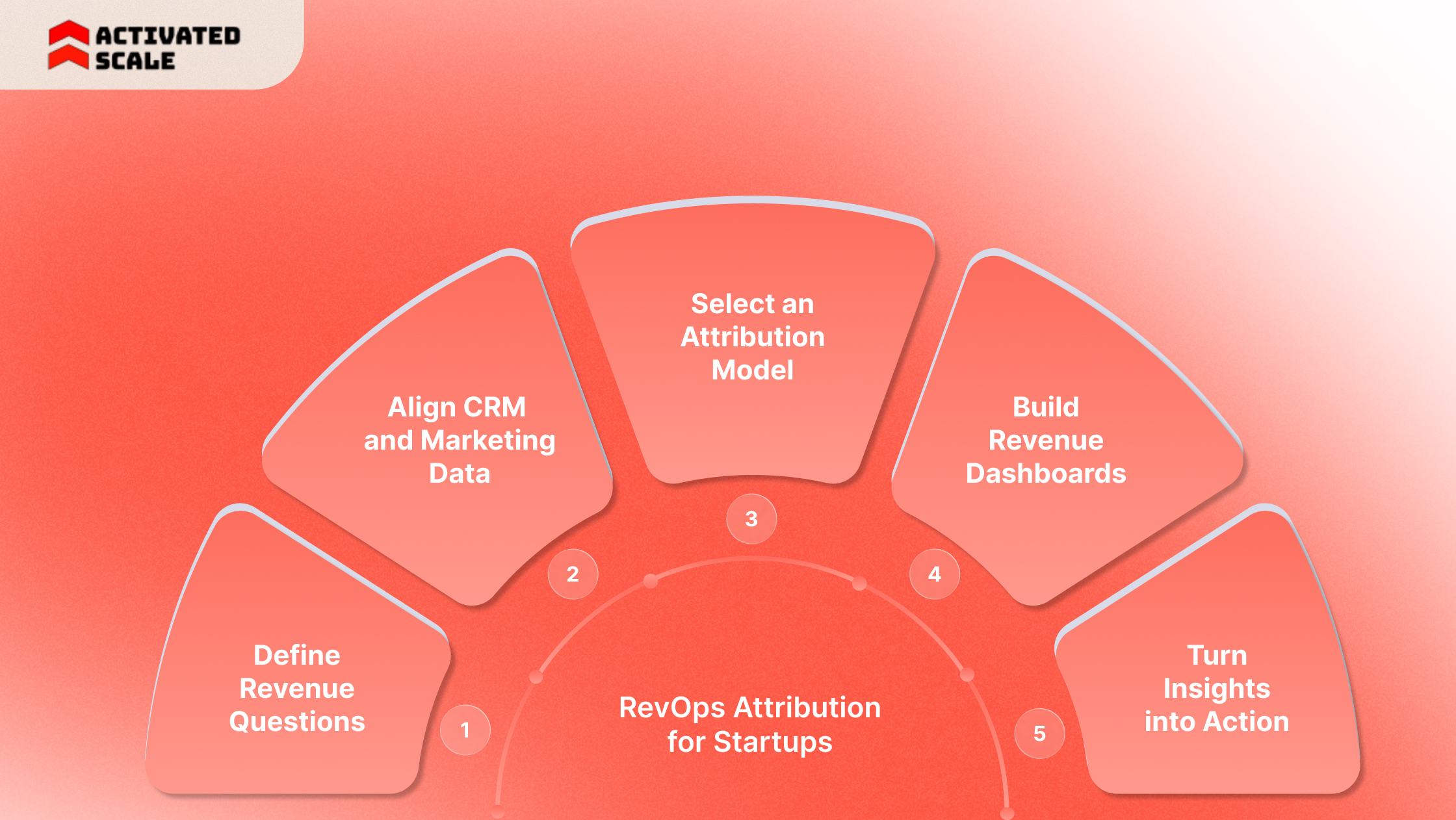
The objective is straightforward. Connect buyer interactions across marketing, sales, and product engagement to the revenue those interactions influence.
Step 1: Define the revenue questions
Every attribution framework begins with a clear set of revenue questions. These questions determine which signals RevOps teams track and how attribution reports are structured.
Typical revenue questions include:
- Which acquisition channels generate a qualified pipeline?
- Which SDR activities convert leads into meetings?
- Which buyer signals appear before deals progress to the proposal stage?
- Which campaign interactions appear in closed deals?
- Which sales activities accelerate deal progression?
These questions help teams focus attribution analysis on revenue impact rather than general activity metrics.
Step 2: Align CRM and marketing data
Revenue attribution becomes possible only when marketing engagement and sales activity share the same data structure. Many startups store this information across separate systems, which results in fragmented reporting.
Key data connections include:
- Campaign interactions linked to contact records.
- Contact records linked to opportunity accounts.
- Opportunity stage movement tied to revenue value.
- Sales activities connected to opportunity timelines.
- Product engagement signals linked to account records.
Once these connections exist, RevOps teams can reconstruct the sequence of interactions that influenced each deal.
Step 3: Select an attribution model
Early-stage companies typically start with simpler attribution models that provide basic visibility into revenue.
Common starting models include:
- First-touch attribution to understand demand-generation sources.
- Multi-touch attribution to track the full buyer journey.
As revenue operations mature, teams often introduce weighted attribution models that assign credit based on the influence of different stages.
Examples include:
- Time decay models that give greater credit to later interactions
- U-shaped models that emphasize demand creation and opportunity creation
- W-shaped models that credit awareness, opportunity creation, and closing stages
Step 4: Build revenue dashboards
After attribution models are configured, revenue teams build dashboards that connect activity signals to pipeline and revenue outcomes.
Effective attribution dashboards typically track:
- Pipeline value by acquisition channel.
- Revenue attributed to marketing campaigns.
- Opportunity creation is influenced by SDR outreach.
- Deal stage progression across the funnel.
- Buyer engagement signals during evaluation.
These dashboards allow revenue leaders to analyze how the pipeline develops and which interactions consistently influence deal outcomes.
Step 5: Translate insights into action
Attribution reporting becomes valuable only when insights influence strategy. Revenue teams use attribution findings to adjust marketing investment, refine sales execution, and improve pipeline quality.
Common actions include:
- Shift marketing budgets toward channels that generate a qualified pipeline.
- Refine SDR outreach strategies based on successful engagement patterns.
- Improve demo qualification frameworks to increase conversion rates.
At this stage, startups often expand their sales capacity. Activated Scale helps companies accelerate this transition. Instead of spending months searching for full-time hires, founders can work with vetted U.S. based SDRs, AEs, and fractional sales leaders who already understand how to build a pipeline and close deals.
Common Attribution Reporting Mistakes That Distort Revenue Data
Revenue attribution reporting is meant to clarify how deals progress across marketing and sales interactions. Many teams still struggle to trust their attribution reports. The problem often lies in how attribution models are applied and how revenue data is interpreted.
The following mistakes frequently distort revenue attribution insights.
1. Relying On A Single Attribution Model
Many organizations use a single attribution model across all revenue analysis. This approach oversimplifies the process of buying decisions.
Single-touch models assign all credit to one interaction. In reality, B2B buyer journeys involve multiple interactions across marketing content, sales conversations, and product evaluation before revenue is generated.
When attribution credit is assigned to only one interaction, other influential activities become invisible.
Common problems created by single-model attribution
- Early marketing campaigns appear ineffective even when they initiated buyer interest
- Sales conversations that shaped the deal receive no recognition
- Mid-funnel activities, such as webinars or demos, appear unimportant
- Budget allocation shifts toward the interaction that simply occurred last
The result is often distorted decision-making.
Revenue operations teams often analyze multiple attribution views to understand how interactions influence different stages of the pipeline.
2. Ignoring Sales Activity Influence
Many attribution systems focus heavily on marketing campaigns while overlooking sales execution. This creates a partial view of revenue influence.
Marketing attribution tools frequently track advertising clicks, email engagement, and website activity. Sales engagement signals are sometimes missing from the attribution framework.
Examples of overlooked sales interactions include
- SDR prospecting emails or cold outreach
- Discovery calls that qualify accounts
- Technical demos with buying committees
- follow-up meetings during the evaluation stages
These interactions often play a major role in converting early interest into a qualified pipeline.
When sales engagement signals are absent, attribution reports may suggest that marketing channels drive deals independently. In reality, marketing creates demand and sales converts that demand into revenue.
3. Overloading Dashboards With Metrics
Revenue attribution dashboards often become overloaded with metrics. Teams attempt to track every interaction across marketing and sales systems.
While comprehensive reporting may appear useful, excessive metrics create confusion.
Common issues with overloaded attribution dashboards include:
- Dozens of campaign performance reports with conflicting insights
- Multiple attribution models produce different conclusions
- Activity metrics presented alongside revenue metrics without context
These dashboards make it difficult for leaders to identify which signals actually influence revenue outcomes.
A clearer attribution framework focuses on a smaller set of revenue indicators.
Turning Attribution Insights Into Scalable Revenue Execution
Revenue attribution reporting reveals which activities drive pipeline and closed deals. The challenge comes next. Many startups still struggle to quickly find experienced sales professionals, build a repeatable sales process, and avoid costly early GTM hiring mistakes.
Activated Scale helps solve this gap by connecting startups with vetted U.S.-based SDRs, AEs, and fractional sales leaders who can contribute immediately without requiring long-term hiring commitments.
This helps teams reduce ramp time, scale pipeline generation faster, and apply proven sales motions with lower hiring risk.
1. Contract To Hire Sales Recruiting
Hiring the wrong sales professional early can slow pipeline development and delay revenue growth. Activated Scale offers contract-to-hire recruiting, allowing startups to work with experienced sales professionals on a flexible basis before making full-time hiring decisions.
2. Fractional SDRs And Account Executives
Startups often need immediate help with prospecting, outreach, and managing early deals, but may not yet require full-time sales headcount. Activated Scale provides fractional SDRs and AEs who can support pipeline generation and deal management while the company builds its long-term sales team.
3. Fractional Sales Leadership
As the pipeline grows, founders often need experienced guidance to structure their sales motion. We connect startups with fractional VPs of Sales who help design go-to-market strategies, build sales playbooks, establish pipeline processes, and select the right sales tools for scalable revenue growth.
Conclusion
Revenue attribution reporting helps revenue teams move beyond surface-level metrics and understand what actually drives pipeline and closed deals. When marketing engagement, sales activity, and product signals connect inside a RevOps framework, leaders gain clear visibility into the interactions that influence revenue outcomes.
This clarity allows startups to refine their go-to-market motion, prioritize high-intent opportunities, and invest in activities that consistently move deals forward. The next step is execution.
With Activated Scale, you can apply these insights more quickly using experienced U.S.-based SDRs, AEs, and fractional sales leaders who can build pipelines and close deals without long hiring cycles. Explore how Activated Scale can help strengthen your revenue team.
FAQs
Q: How often should revenue attribution models be reviewed or updated?
A: Attribution models should be reviewed regularly as sales motions evolve. Many revenue teams reassess attribution models every quarter to reflect new marketing channels, sales strategies, or product engagement signals. Regular updates help maintain accuracy as the buying journey changes.
Q: Can attribution reporting work for startups with small datasets?
A: Yes. Early-stage startups can begin with basic attribution models such as first-touch or multi-touch reporting using CRM and marketing automation data. Even limited datasets can reveal early patterns in pipeline creation and buyer engagement.
Q: What role does product usage data play in revenue attribution reporting?
A: Product engagement often acts as a strong buying signal in modern SaaS sales cycles. Trial activation, feature usage, and multi-user engagement within an account can indicate serious buyer intent and help revenue teams understand which product experiences influence deals.
Q: How does revenue attribution reporting support revenue forecasting?
A: Attribution reporting helps leaders identify interactions that consistently appear in successful deals. When these patterns are recognized, forecasting models can factor in those signals to estimate deal probability and pipeline health more accurately.
Q: What is the difference between marketing attribution and revenue attribution?
A: Marketing attribution measures how campaigns influence lead generation and engagement. Revenue attribution extends further by linking marketing, sales, and product interactions to pipeline progression and closed revenue, giving leadership a full view of the revenue journey.
The Ultimate Guide to Hiring a Salesperson!
Get the step-by-step guide to hiring, onboarding, and ensuring success!