_edi.png)

Forecast calls feel harder every quarter. You might have noticed the pipeline looks healthy, yet revenue slips at the end of the month. Marketing and sales collaborate on only 3 of 15 commercial activities.
Most teams solve this problem by doing more outreach or making more hires. However, they soon find that only a growth audit strategy reveals pipeline leaks before scaling activity.
So you need to learn how to perform that audit and diagnose revenue blockers early. This blog focuses on sales leaders who own revenue predictability, so you can handle forecasts and executive expectations every quarter.
Key Takeaways
- Revenue problems often come from system gaps rather than effort gaps
- A growth audit strategy links pipeline behavior to real buyer intent
- Sales and marketing typically collaborate on only 3 out of 15 revenue activities, creating handoff friction and pipeline confusion
- Only a small fraction of sales teams achieve 90% forecast accuracy, showing structural pipeline issues
- 72% of sellers feel overwhelmed by role complexity, which increases inconsistency in qualification and deal progression
What is a Growth Audit Strategy?
Revenue teams track activity across multiple tools, yet clarity stays low. Dashboards exist in Customer Relationship Management (CRM), marketing automation, and finance systems. However, leaders still debate why pipeline converts unevenly.
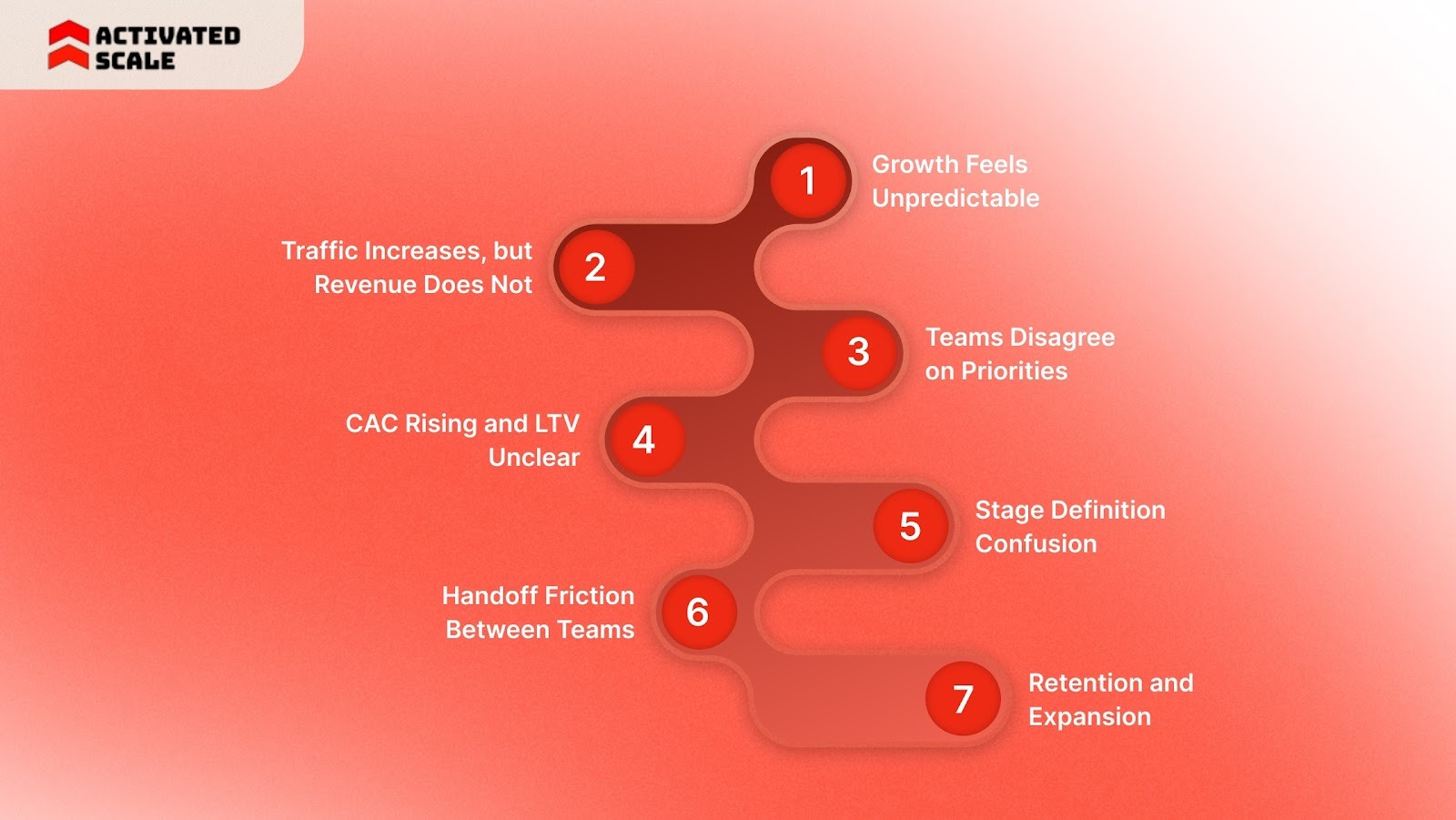
A growth audit strategy helps identify the moment scaling stops working and guessing begins. Your company needs a growth audit because:
1. Growth Feels Unpredictable
One month, your team closes strong, and the next month collapses without warning. So, managers have relied on gut checks during pipeline reviews.
Reps also move deals forward using different qualification standards, so the commit categories stop meaning anything.
2. Traffic Increases, but Revenue Does Not
Marketing reports strong lead volume and engagement, but the leadership team debates lead quality instead of diagnosing funnel friction. The organization scales acquisition while the middle of the funnel remains broken.
3. Teams Disagree on Priorities
Sales are bringing better leads. The marketing team is making faster follow-ups. While each team works toward growth, the definition of growth does not remain the same for each team.
4. Customer Acquisition Cost (CAC) Rising and Lifetime Value (LTV) Unclear
CAC is the cost to acquire a customer, while LTV is the total revenue that the customer generates before leaving. CAC climbs every quarter, yet LTV remains unpredictable.
Finance cannot model payback periods confidently. That's why hiring decisions become risky because unit economics remain uncertain.
5. Stage Definition Confusion
Pipeline stages exist, but entry rules differ across managers. Deals sit in forecast categories without consistent proof. Leadership loses trust in weekly commit numbers.
6. Handoff Friction Between Teams
Account executives restart discovery conversations after the Sales Development Representatives (SDRs) team meetings. That's when buyers slow down their decisions, and conversion drops after initial interest.
7. Retention and Expansion
Closed deals do not guarantee lasting revenue. Activation delays and weak adoption reduce expansion opportunities. Customer success teams react instead of guiding outcomes. The audit studies repeat usage patterns and expansion triggers.
So you can apply a structured method like the growth audit framework to prioritize and act.
72% of sellers feel overwhelmed by the number of skills required for their role. Because without a clear execution path, insights stay theoretical, and pipeline behavior stays unchanged.
Also Read: Why You Should Hire Fractional Sales Talent
Step-by-Step Growth Audit Framework
No kind of insight matters unless teams act on it consistently. High-performing sales teams rely on defined operating rhythms rather than ad hoc reviews.
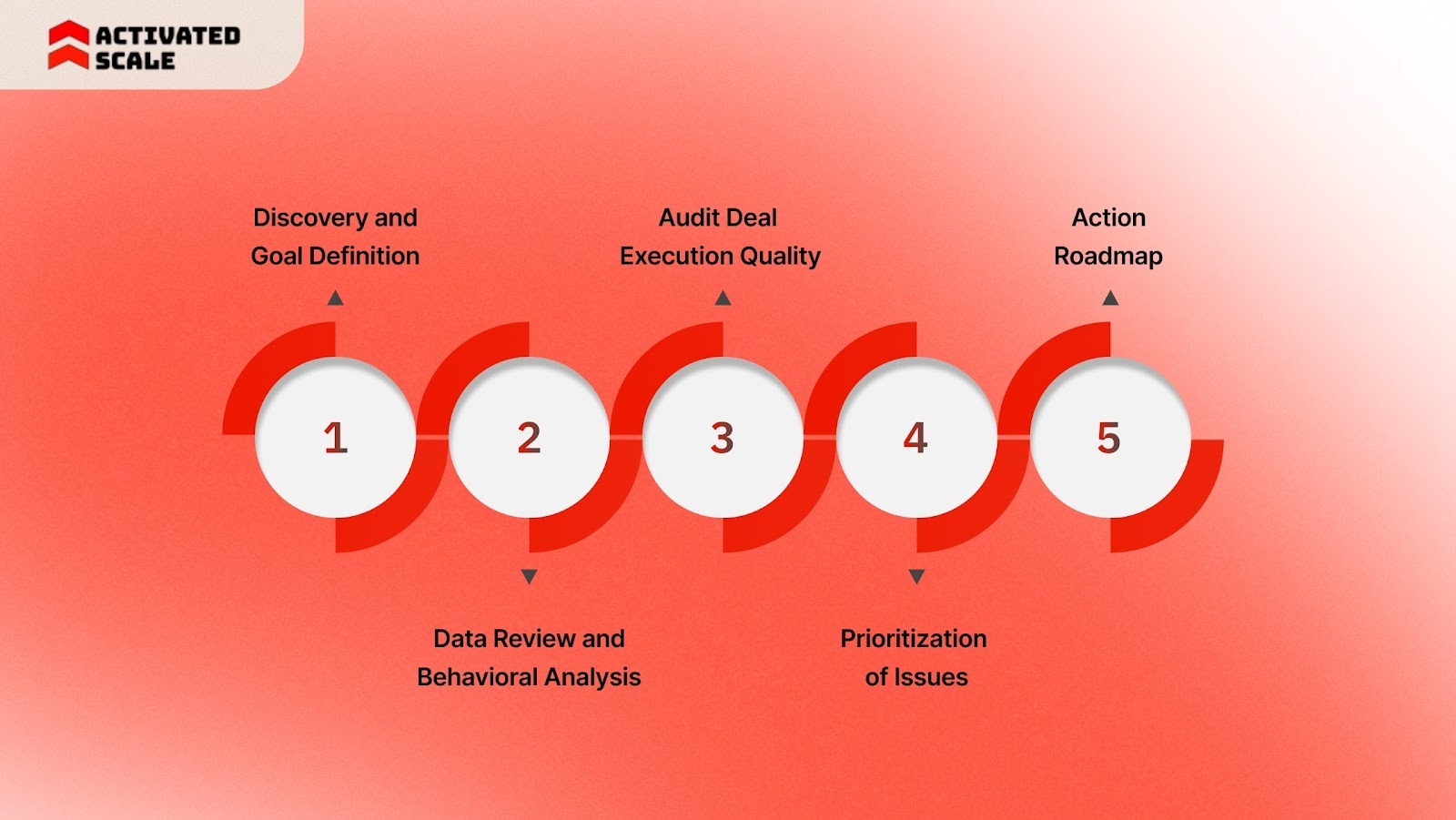
Here's how you can connect findings to measurable changes.
Step 1: Discovery and Goal Definition
Leadership aligns on revenue targets and planning assumptions. Define expected deal size, target segments, and pipeline coverage ratio.
Review hiring plans against realistic ramp timelines. This step prevents analysis based on unclear or conflicting goals.
Step 2: Data Review and Behavioral Analysis
Export stage conversions, sales cycle length, and cohort performance from the CRM. Compare the new logo and expansion deals separately. Examine how different sources progress through the pipeline.
Step 3: Audit Deal Execution Quality
Fewer than 7% of sales teams reach forecast accuracy above 90%. So, compare qualification standards across SDRs and account executives.
Validate forecast categories against actual buyer commitments. The review links conversation behavior with numeric trends.
Step 4: Prioritization of Issues
Score each blocker by revenue impact and implementation effort. Separate structural issues from coaching opportunities. Focus first on problems that affect multiple pipeline stages. Leaders avoid spending time on visible but low-impact friction.
Step 5: Action Roadmap
Build a 30, 60, and 90-day plan tied to defined metrics. Assign clear ownership across sales, marketing, and customer success. Schedule review checkpoints to confirm behavior changes.
Unclear pipeline behavior slows hiring decisions and forecast confidence. Talk to Activated Scale about Fractional Sales Leadership to maintain momentum while building a repeatable revenue system, with their expertise.
Leaders often respond after numbers decline instead of preventing the decline. However, you can gain more value by applying the strategy before the pressure escalates.
When Should You Run a Growth Audit?
Strategy is about timing as much as it is about action. Reviews that happen after the fact explain the past; reviews that happen before the fact protect the future.
That is why a growth audit delivers maximum value precisely when it's used to vet decisions before they impact the bottom line.
Run the audit in these situations:
- Before hiring more reps, run the review because new hires will multiply existing pipeline flaws and extend ramp time.
- After a revenue plateau, act early because more activity cannot fix structural growth blockers.
- Before increasing marketing spend, evaluate first because additional leads will enter a funnel that already loses momentum mid-stage.
- Before entering a new market, review early because the current qualification model rarely fits a different buyer type.
- After repeated forecast misses, investigate quickly, as shifting commit numbers show decisions rely on judgment instead of evidence.
Preparation determines whether the audit produces clarity or confusion. Before starting a growth audit strategy, don't forget to align inputs and expectations.
Read Also: Using AI Tools for Effective Lead Generation
How to Prepare for a Growth Audit?
There are two types of audit meetings. In one, leaders spend the first hour debating whether the data is right. In the other, they spend that hour acting on what the data reveals. The difference is simple: Preparation.
To ensure teams agree on facts before analysis begins, follow these steps:
- Gather analytics: Export pipeline stages, conversion rates, deal size, and sales cycle length from the CRM. Include both new business and expansion cohorts to compare behavior patterns.
- Align stakeholders: Bring sales, marketing, and customer success leaders into one planning session. Agree on qualification language, ownership rules, and handoff expectations.
- Define growth goals: Document revenue targets, segment priorities, and hiring plans for the next period. The audit evaluates performance against these shared objectives.
- Identify Key Performance Indicators (KPIs): Select a focused metric set such as win rate, sales pipeline coverage, and retention.
Your audit will fail if leaders disagree on pipeline definitions. Reps from Activated Scale’s Fractional Selling service can help you align goals, metrics, and ownership before execution begins.
Over To You
A strategic review should lead to decisions, not another report. Most teams already have dashboards and activity tracking. What they lack is experienced guidance and someone to interpret the patterns and help them act with confidence.
Activated Scale works with B2B sales organizations that need clarity before scaling revenue. Hiring fractional sales reps will help you to evaluate pipeline structure, qualification rules, and execution gaps.
It is a practical action plan built by leaders who have built revenue engines before. If forecast confidence is slipping or hiring feels risky, address the system first.
Book a call with Activated Scale. Run a growth audit strategy with leaders who don't just analyze revenue, they build it.
FAQs
1. How long does a strategic growth audit usually take?
Most reviews run between two and four weeks, depending on data availability. The first week focuses on alignment and data validation. The remaining time converts findings into an execution roadmap.
2. Who should participate in the audit sessions?
Sales leadership must attend every working session. Marketing and customer success leaders join discussions that affect handoffs and retention. Finance often contributes to unit economics validation.
3. Can a growth audit work for companies with small sales teams?
Yes, smaller teams benefit from clarity earlier in their growth stage. The audit prevents scaling broken processes. Early structure reduces hiring mistakes later.
4. What happens after the audit ends?
Teams implement the prioritized roadmap with assigned owners. Leadership tracks progress through defined checkpoints. Many companies repeat the review annually to maintain consistency.
The Ultimate Guide to Hiring a Salesperson!
Get the step-by-step guide to hiring, onboarding, and ensuring success!