_edi.png)

Hiring the wrong salesperson is costly. It means lost deals and damaged team morale. Your entire growth plan can stall.
In 2026, the hiring dilemma often comes down to two paths: You must know direct hire vs contingent staffing. Why? Because each model serves a different strategic purpose.
Your choice impacts your budget, agility, and revenue. This blog provides a clear framework. You will learn the exact pros and cons of each model.
We'll also help you make the right choice for your specific needs.
At a Glance
- Direct hire is for permanent, long-term roles that need cultural fit and deep product knowledge. It supports stability and retention, which matters because 44.3% of employees leave due to poor management.
- Contingent staffing is for urgent, temporary, or specialized needs. It offers speed, flexibility, and lower long-term cost.
- Contingent hiring aligns with the trend that around 40% of Gen Z and millennial workers are willing to take lower pay for remote or hybrid roles.
- Contract-to-Hire sits in the middle, letting you test a sales professional before committing, reducing mis-hire risk.
- Direct hire functions like a capital expenditure (CapEx), while contingent staffing is an operational expenditure (OpEx).
- Choose direct hire for core, ongoing revenue roles; choose contingent when speed, niche skills, or project deadlines matter.
What Do You Mean By Direct Hire?
Direct hire is recruiting a full-time, permanent employee. This person joins your company's official payroll. They receive your standard salary, benefits, and equity.
Since 44.3% of employees leave due to poor management, the goal is a long-term employment relationship. You invest in their career growth. They invest in your company's long-term mission and success.
When Direct Hire is Your Best Move
Direct hire is best for critical, ongoing roles. These are positions central to predictable revenue. They need deep integration into your product and processes.
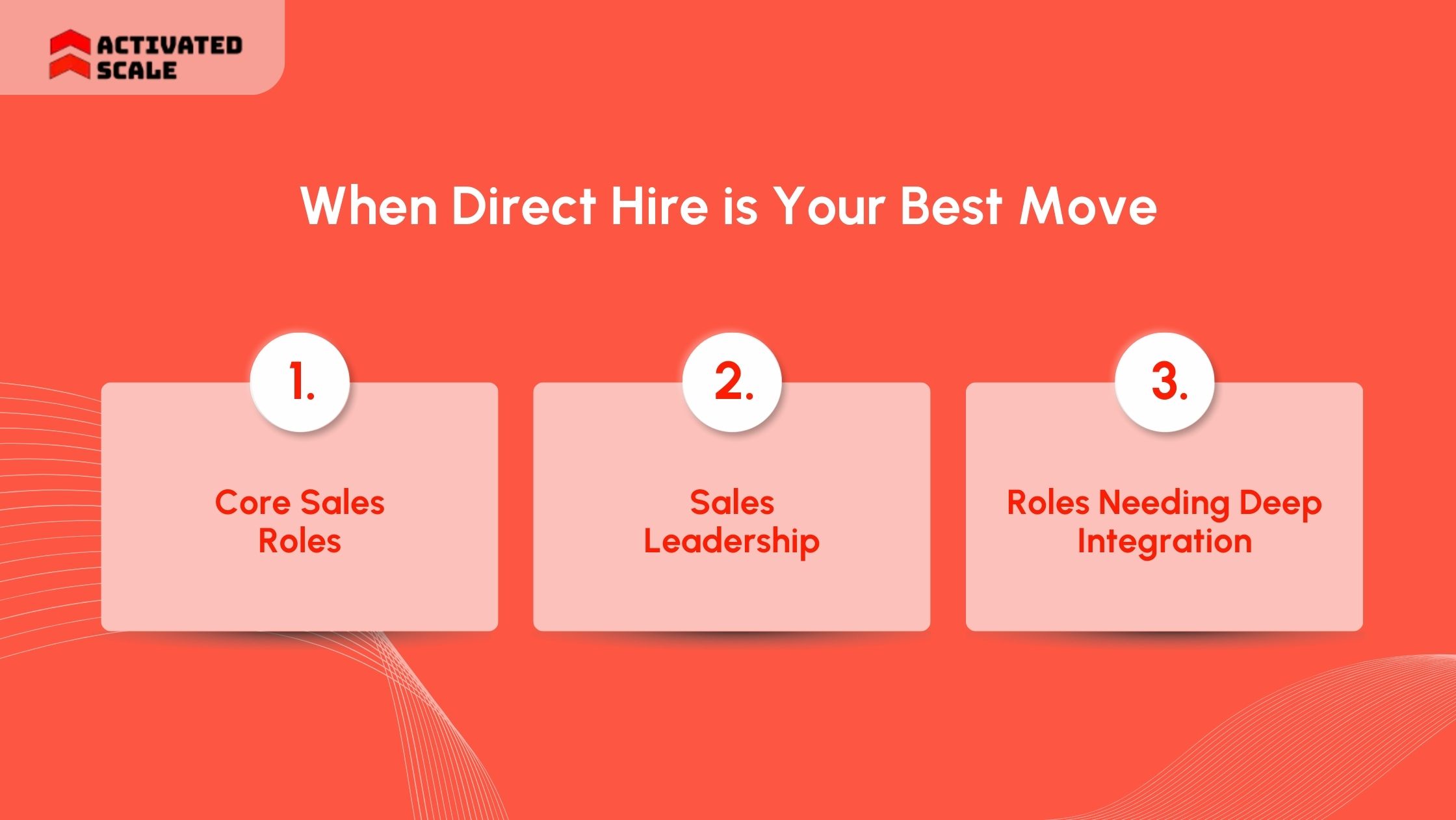
- Core Sales Roles: Your strategic Account Executives and Sales Development Managers drive your essential pipeline and revenue.
- Sales Leadership: Hiring a VP of Sales or a Sales Director requires a direct hire. Because you need a leader fully committed to your vision and strategy.
- Roles Needing Deep Integration: Any position requiring full immersion in your complex sales cycle is a direct hire. They must become a true ambassador of your brand.
These best moves may seem powerful, but that's only half of the picture. It has natural limits. So, how bad is direct hiring?
Also Read: How to Respond to Inbound Leads
Pros and Cons of Direct Hire
You have identified a role that needs a permanent owner. This decision locks in your strategy and budget for years. The benefits of a direct hire are powerful, but the costs of a mistake are severe.
You must weigh them with clear eyes. Skip this analysis, and you risk a costly mis-hire that drains your budget and demoralizes your team.
So, if you feel that the disadvantages of direct hiring will weigh your team down, you still have the option for flexible staffing. Contingent hiring provides you with that.
What is Contingent Staffing?
Contingent staffing is the engagement of talent for a specific need or duration. This worker is not on your permanent payroll. They are often employed and paid by a specialized staffing agency.
You pay the agency a contracted rate. The agency handles the worker's salary, benefits, payroll taxes, and compliance. This creates a flexible, project-based relationship focused on a defined outcome.
The Prime Use Cases for Contingent Staffing
This model is your go-to for variable, urgent, or specialized needs. It injects skill and capacity without long-term commitment.
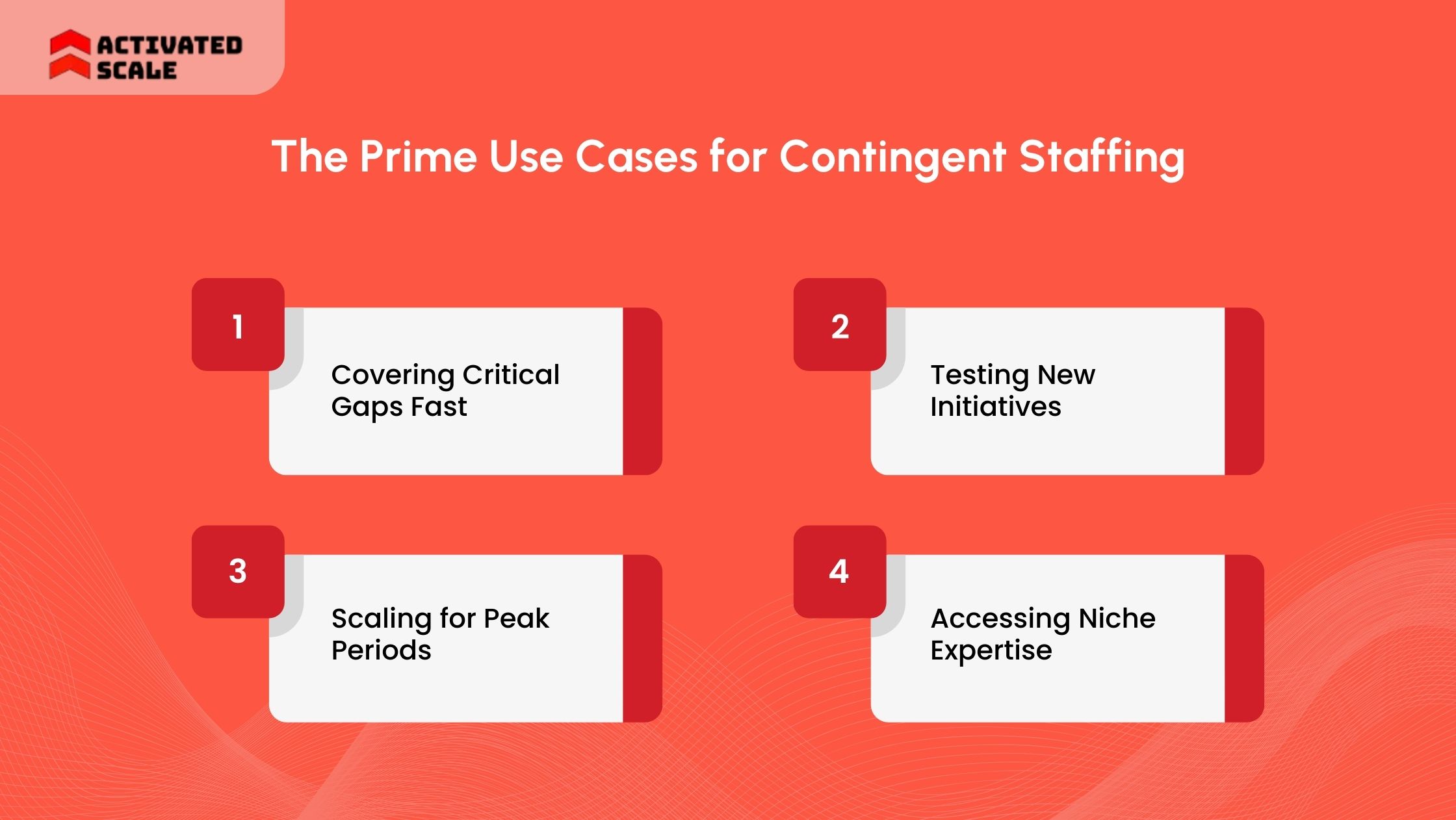
- Covering Critical Gaps Fast: Fill a sudden vacancy from a departure or medical leave within days, not months, to protect the pipeline.
- Testing New Initiatives: Launch a pilot program for a new vertical or product line. Validate the Return on Investment (ROI) before building a full team.
- Scaling for Peak Periods: Ramp up for end-of-quarter pushes, a major product launch, or seasonal sales cycles with temporary SDRs or closers.
- Accessing Niche Expertise: Hire a specialist for a finite project, like launching a specific partnership program or migrating your CRM.
Around 40% of Gen Z and millennial employees say they’d accept lower pay if it meant working remotely or in a hybrid setup. Businesses use this mindset while using contingent staffing.
For sales leaders who see the value in this flexible model but want to minimize risk, a Contract-to-Hire Sales Recruiting service from Activated Scale is the perfect strategic fit. This approach allows you to bring on a vetted sales professional for a contracted period to impact your pipeline.
Just like direct hire, contingent has its own set of advantages and disadvantages.
Pros and Cons of Contingent Staffing
A key account executive announces extended leave during your biggest quarter. A new market vertical opens, requiring immediate but unproven coverage. These moments demand action, not a lengthy hiring process.
Contingent staffing is your strategic tool for these scenarios; however, misunderstanding its trade-offs can leave you with a disjointed team.
You now understand the individual strengths and weaknesses. The critical final step is the direct comparison. This is where theory meets your reality.
Also Read: From Tasks to Skills: What's an Account Executive All About?
Side-by-Side Comparison: Direct Hire vs Contingent Staffing
Confusing a permanent need for a temporary one locks you into unnecessary long-term costs. So, you can't mistake a core role for a project that burns budget and misses revenue targets.
This table is your final guardrail. It translates abstract features into concrete business outcomes.
Use it to match every hiring need with the only model that makes financial sense:
Consider a Contract-to-Hire Sales Recruting service lets you bring a vetted sales professional, an SDR or AE, onto your team for a defined contract period. It is Activated Scale's ultimate "try before you buy" model.
Now, after this breakdown, we'll give you another short checklist, so you can instantly decide which types of service you need.
How and When to Choose: Your 5-Minute Decision Framework
Analysis paralysis kills growth. You need a decision, not more data. This framework forces a clear answer for any role. Use it now.
The five questions that decide everything:
- Is this a permanent need for our core revenue?
YES = Direct Hire. This role is essential to your business. - Must this person start and deliver within 30 days?
YES = Contingent Staffing. Speed is the primary requirement. - Is this for a specific project or to cover a leave?
YES = Contingent Staffing. The need has a defined end date. - Do we need a niche skill we won't use long-term?
YES = Contingent Staffing. You are buying expertise, not a career. - Can we handle the full cost and commitment of a permanent employee?
NO = Contingent Staffing or Contract-to-Hire. Manage your risk and cash flow.
The Rule: If Questions 2, 3, or 4 are "YES," choose Contingent Staffing. If only Question 1 is a strong "YES," choose direct hire.
However, if you want the "try before you buy" safety net, choose contingent hire.
Read Also: Hiring Fractional Sales Reps for Startup Success
Activated Scale: Your Source for Strategic, Flexible Sales Talent
Activated Scale provides the immediate, expert sales capacity you need. We specialize in flexible models that let you access proven sales professionals immediately.
You integrate them into your team to drive specific outcomes. If they are the perfect long-term fit, the path is clear. If the project ends, so does the engagement.
We provide targeted solutions for the most common, high-impact sales challenges:
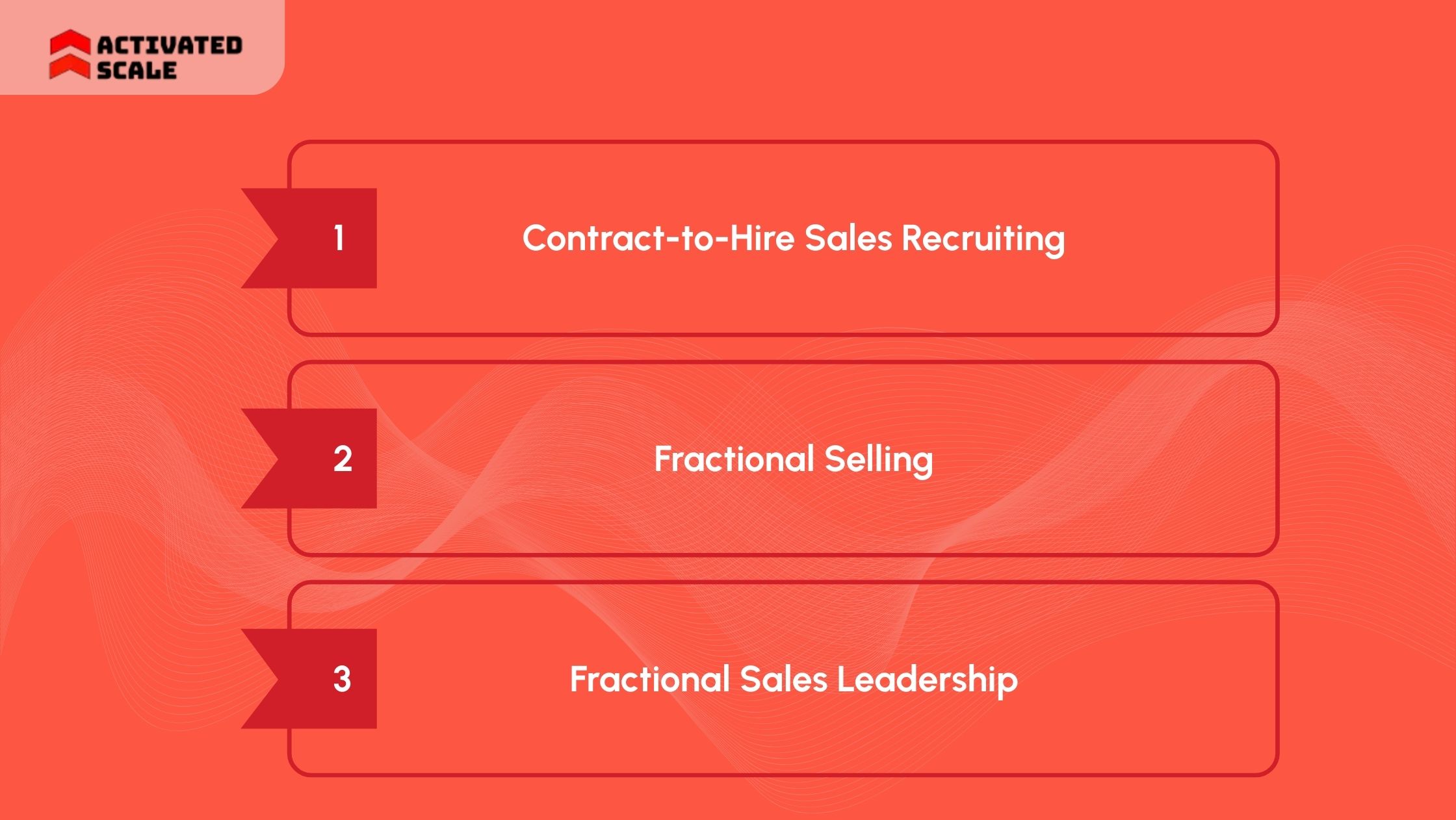
- Contract-to-Hire Sales Recruiting: This is your ultimate de-risking tool. Hire a pre-vetted Account Executive or SDR on a flexible contract.
- Evaluate their real-world performance, cultural fit, and direct impact on your pipeline. Convert them to a full-time team member when you are ready.
- Fractional Selling: You need to generate leads or close deals, but a full-time hire isn't justified. Access experienced sales rep on a part-time, dedicated basis.
- They fill precise sales function gaps, like launching outbound campaigns or managing a new territory.
- Fractional Sales Leadership: Hire a Fractional VP of Sales to build your go-to-market plan, establish partnership programs, and select the right tech stack. Get experienced leadership to scale your process, on demand.
Ready to build your sales engine without permanent overhead? Contact Activated Scale to hire a rep to map your challenge to the right flexible solution.
Final Thoughts
The direct hire vs contingent staffing debate is not about picking a winner. Your core revenue engine needs the stability and cultural depth of direct hires.
Your projects, spikes, and experiments need the speed and specialization of contingent talent. Mastering both models is the mark of a modern sales leader. It allows you to balance long-term investment with short-term agility.
Deploy flexible, expert sales talent precisely when you need it. Tell our experts at Activated Scale about your sales challenge, so we can help you directly.
Frequently Asked Questions (FAQs)
1. Which model is more cost-effective for my business?
Cost-effectiveness depends entirely on the need's duration. For a permanent, core role, direct hire offers better long-term ROI.
For a project under 12 months, contingent staffing avoids the high ongoing costs of a full-time employee.
2. Can a contingent worker transition to a direct hire?
Absolutely. This is the core purpose of a Contract-to-Hire service. It is a structured, low-risk trial period.
You evaluate the professionals' on-the-job performance and team fit before making a permanent offer. It is a strategic path used by many companies.
3. Who handles HR, payroll, and compliance for contingent workers?
When you partner with a specialized staffing firm, they act as the employer of record. They manage all payroll, benefits, taxes, and legal compliance.
This removes a significant administrative burden and risk from your plate, allowing you to focus on managing the work.
4. Does using contingent staff hurt our company culture?
It does not have to. Clear communication and inclusive management are key. Frame contingent professionals as strategic partners helping the team achieve a specific goal.
When integrated properly, they can bring valuable external perspectives and focus without damaging the core cultures.
The Ultimate Guide to Hiring a Salesperson!
Get the step-by-step guide to hiring, onboarding, and ensuring success!