_edi.png)

Marketing teams rarely struggle with ideas. They struggle with execution as complexity increases.
According to HubSpot's 2026 State of Marketing Report, more than 41% of marketers say they're overwhelmed by the number of tools they use, and many struggle to connect data across systems.
As tools, channels, and stakeholders multiply, ownership becomes unclear. Processes fragment, reporting loses trust, and teams spend more time coordinating than executing.
This is where a fractional marketing ops strategy becomes relevant. It gives teams experienced operational ownership without forcing an early full-time hire, helping restore clarity, consistency, and control as marketing scales.
Quick Snapshot:
- Fractional marketing ops brings senior operational expertise into marketing without forcing an early full-time hire.
- It focuses on ownership of process, data, tools, and execution discipline, not creative or channel strategy.
- Teams benefit most when marketing activity grows faster than operational control or reporting clarity.
- A structured implementation roadmap helps stabilize execution before scaling output or headcount.
- Flexible models allow companies to validate systems and roles before committing long-term.
What Fractional Marketing Operations Really Means
Fractional marketing operations means engaging senior marketing operations professionals on a flexible basis to own how marketing systems and processes run. It is not about execution volume. It is about operational ownership.
These specialists are responsible for defining workflows, managing tools, maintaining data integrity, and ensuring campaigns move from planning to launch without breakdowns. They sit close to the work and are accountable for how marketing operates day to day.
The fractional model exists because most teams do not need this role full-time. They need experienced operators to establish structure, fix inefficiencies, and create repeatable ways of working before committing to a permanent hire.
Done well, fractional marketing ops provides clarity and control at the point where marketing complexity increases, while long-term hiring decisions remain uncertain.
When Fractional Marketing Ops Makes the Most Sense
Fractional marketing ops is most useful when marketing activity increases faster than operational control. Campaigns run, tools multiply, and output grows, but ownership of the process and data remains unclear.
This often shows up as inconsistent reporting, unclear attribution, and broken handoffs between marketing and sales. The issue isn't performance. It's the lack of a dedicated operator responsible for how marketing systems work together.
It also fits teams that know they need senior ops expertise but aren't ready to commit to a full-time hire. A fractional model allows companies to fix core gaps, establish structure, and understand the true scope of the role before making a long-term decision.
In short, fractional marketing ops makes sense when execution needs structure, not when strategy needs rewriting.
Core Fractional Marketing Ops Strategies That Drive Impact
Fractional marketing ops works when it installs clarity where marketing execution usually breaks down. The strategies below focus on control, consistency, and decision-making, not surface-level optimization.
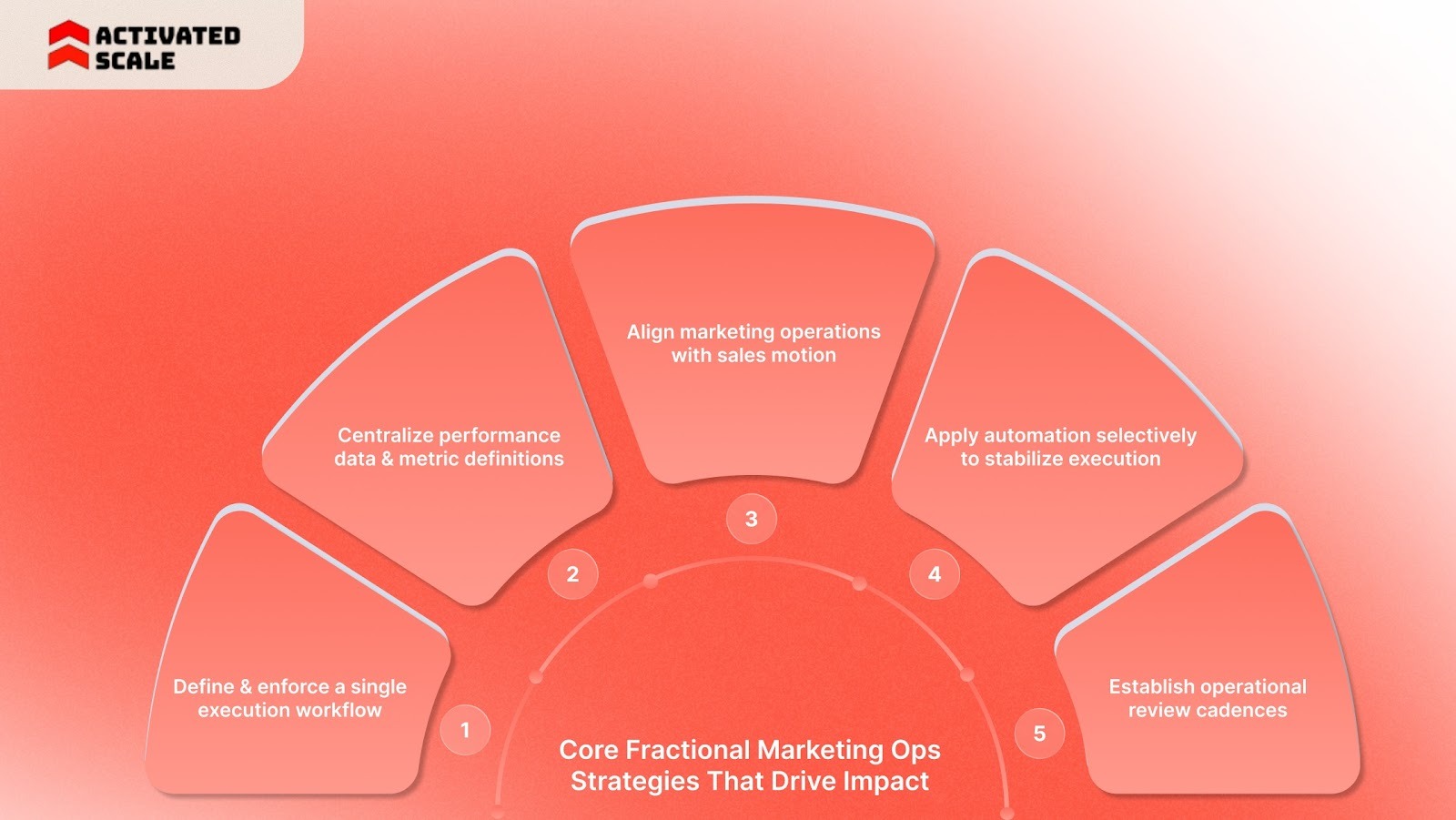
1. Define and enforce a single execution workflow
Marketing ops owns how work moves from request to launch. That includes intake rules, approval paths, dependencies, and launch criteria. Without this, teams operate on assumptions, and execution quality varies from person to person or channel to channel. A clear workflow removes ambiguity and reduces last-minute changes.
2. Centralize performance data and metric definitions
Reporting problems rarely comes from a lack of data. They come from mismatched definitions across tools. Fractional ops aligns lifecycle stages, attribution logic, and reporting cadence so performance discussions are grounded in the same numbers across marketing and sales.
3. Align marketing operations with sales motion
Ops ensures lead stages, handoffs, and feedback loops reflect how deals actually close. This includes syncing campaign goals with pipeline stages, defining response expectations, and closing the loop on lead quality. Alignment here directly impacts revenue efficiency.
4. Apply automation selectively to stabilize execution
Automation removes friction from repeatable tasks such as routing, tagging, and reporting. The focus stays on reliability and visibility, not tool experimentation. Each automation supports a defined process, not the other way around.
5. Establish operational review cadences
Regular reviews of funnel health, campaign execution, and system gaps prevent small issues from compounding. Ops uses these reviews to adjust the process, not just report outcomes.
These strategies matter because they create predictable execution. Fractional marketing ops succeeds when teams know how work moves, how performance is measured, and who owns fixing breakdowns.
Learn more about: Fractional CMO for Startups: Expert Tips and Timing
How Fractional Marketing Ops Improves Speed, Focus, and ROI
Fractional marketing ops improves outcomes by tightening the decision-making and execution processes. The impact shows up less in individual campaigns and more in how reliably the system performs over time.
Speed improves because execution paths are defined upfront.
When intake rules, dependencies, and approval paths are clear, teams spend less time clarifying expectations midstream. Campaigns move forward with fewer pauses, and changes are handled through a process rather than ad hoc conversations. This reduces rework and shortens launch cycles without rushing decisions.
Focus improves because capacity is planned rather than assumed.
Marketing ops makes trade-offs visible. By mapping effort against goals and timelines, teams stop overcommitting and start sequencing work intentionally. This limits context switching, protects high-impact initiatives, and prevents urgent requests from quietly displacing planned work.
ROI improves through earlier course correction.
Consistent attribution logic and shared metric definitions allow teams to spot underperformance sooner. Instead of reviewing results after spend is locked in, ops enables ongoing performance checks that inform adjustments while campaigns are still running.
Cross-functional execution becomes more dependable.
Clear handoffs between marketing and sales reduce lead leakage and mismatched expectations. Forecast inputs become more reliable, and leadership discussions shift from debating numbers to deciding next actions.
The value of fractional marketing ops is stability. When execution paths are clear, data is trusted, and ownership is explicit, teams move faster with fewer surprises and make better decisions with the same resources.
Implementing a Fractional Marketing Ops Strategy: A Practical Roadmap
Implementing fractional marketing ops isn't about reorganizing marketing overnight. It's about restoring control where execution has quietly become inconsistent. The teams that get this right focus first on ownership and sequencing, not speed or scale.
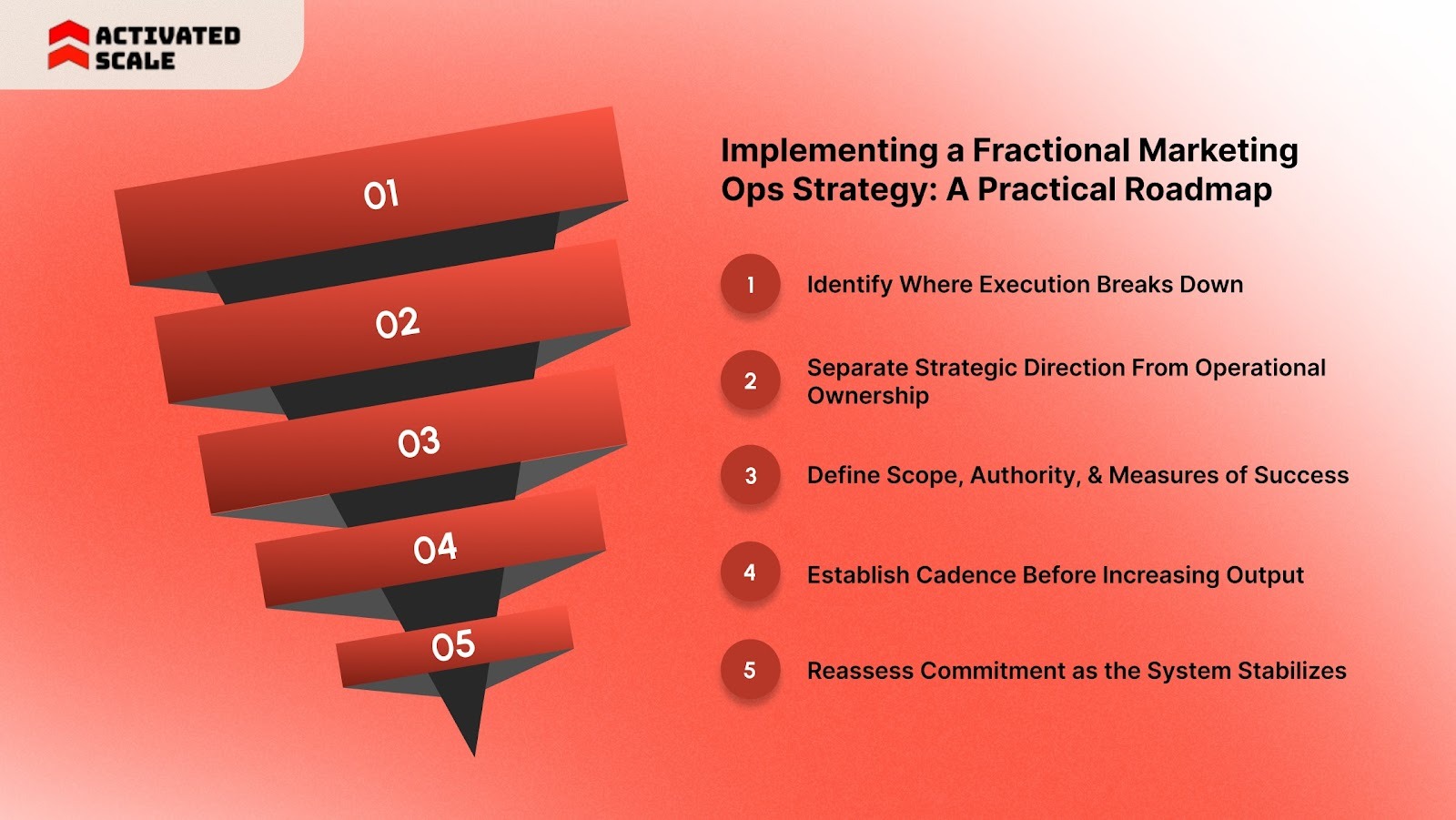
Step 1: Identify Where Execution Breaks Down
Start by examining recent work, not planning documents. Look at campaigns that shipped late, reports that caused debate, or handoffs that required follow-ups to clarify ownership.
Pay close attention to:
- How work enters the system and who prioritizes it
- Where approvals stall, or decisions are revisited
- Gaps between reported performance and actual outcomes
- Friction between marketing and sales during lead handoffs
This step surfaces structural problems that effort alone can't fix.
Step 2: Separate Strategic Direction From Operational Ownership
Marketing leaders should focus on goals, positioning, and priorities. Fractional marketing ops exists to ensure those priorities are executed consistently.
Operational ownership typically includes:
- Designing and enforcing workflows
- Configuring and governing tools
- Maintaining data accuracy and attribution logic
- Coordinating execution with sales and revenue teams
This separation prevents operational work from competing with strategy for time and attention.
Step 3: Define Scope, Authority, and Measures of Success
Fractional models only work when boundaries are clear. Before work begins, teams should align on what the role owns and how progress will be evaluated.
That clarity should cover:
- Systems and processes under ops control
- Decision rights versus escalation paths
- Metrics used to measure effectiveness
- Review cadence and reporting expectations
A clear definition reduces rework and keeps the engagement focused.
Step 4: Establish Cadence Before Increasing Output
Before adding more campaigns or tools, install operating rhythms that surface issues early.
Effective cadences often include:
- Weekly execution and funnel health reviews
- Monthly performance and attribution reviews
- Regular alignment sessions with sales to validate lead quality
Cadence creates consistency. Consistency creates confidence.
Step 5: Reassess Commitment as the System Stabilizes
Once execution becomes predictable, teams can decide how the role should evolve. Some internalize parts of the function. Others keep it fractional as complexity grows.
Many founders prefer flexible models that let them validate execution before committing to long-term commitments, which is why they work with platforms like Activated Scale to access experienced operators without locking into full-time hires too early.
The goal isn't permanence. It's clarity.
A fractional marketing ops strategy succeeds when it reduces uncertainty. By fixing ownership gaps, stabilizing execution, and creating dependable rhythms, teams gain the confidence to scale without guessing where things might break next.
Also read: How to Secure Multiple Fractional CMO Jobs in One Year
Common Mistakes Teams Make With Fractional Marketing Ops
Most issues with fractional marketing ops don't come from the model itself. They come from how teams set it up and what they expect it to solve.
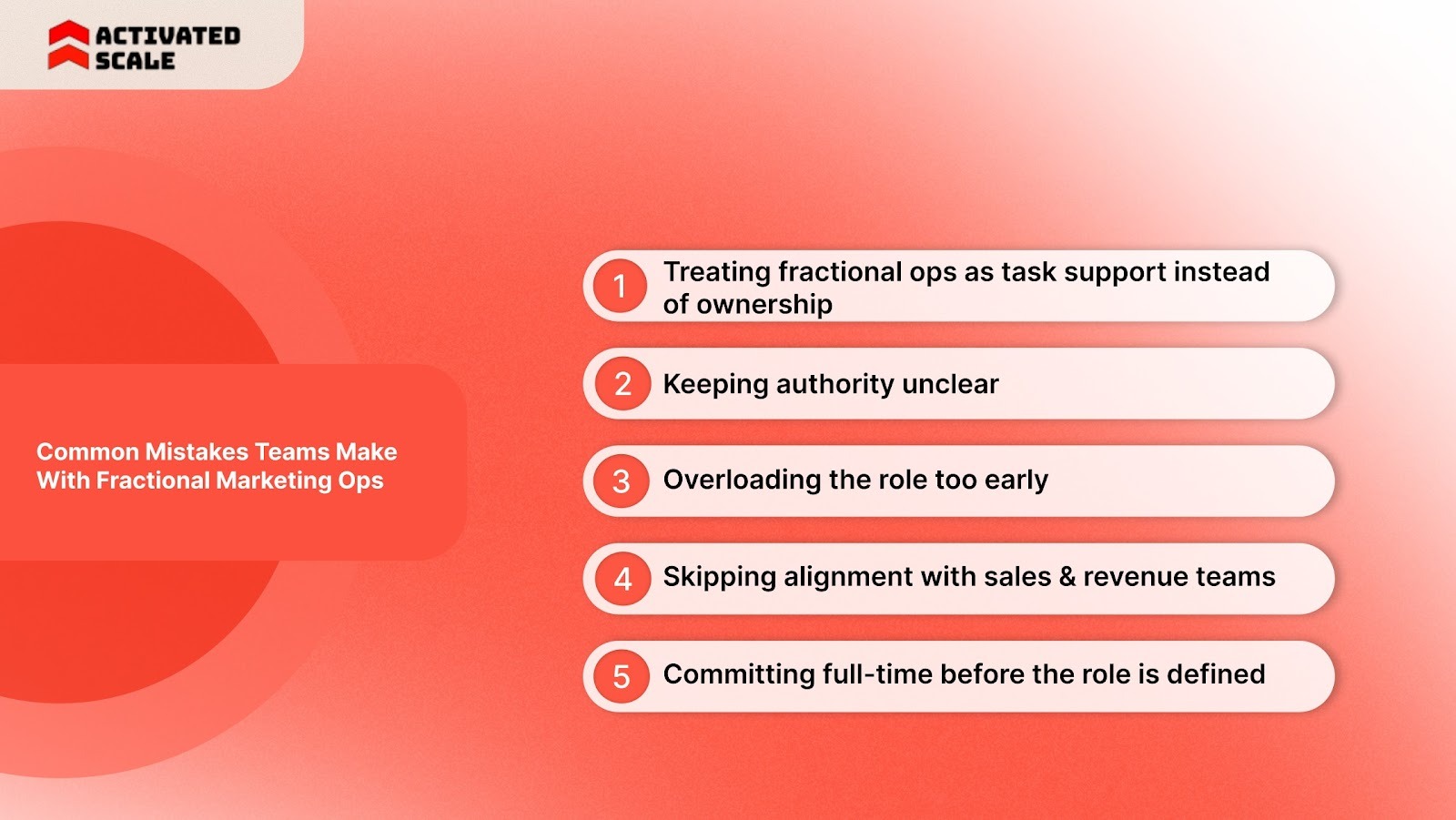
Treating fractional ops as task support instead of ownership
When fractional roles are limited to "helping out," core problems persist. Ops only works when someone is accountable for process, data, and coordination, not just execution tickets.
Keeping authority unclear
Fractional operators can't fix broken workflows if every decision requires escalation. Without clear authority over tools, processes, and reporting standards, improvements stall and work reverts to old habits.
Overloading the role too early
Some teams expect a single fractional operator to clean data, rebuild attribution, manage tools, and run execution simultaneously. Without sequencing, progress slows. Fixing foundations first matters more than covering everything at once.
Skipping alignment with sales and revenue teams
Marketing ops that operate in isolation create clean dashboards but weak outcomes. Lead definitions, handoffs, and feedback loops must reflect how revenue is actually generated.
Committing full-time before the role is defined
A common mistake is hiring permanently before understanding what the ops function truly requires. Many teams avoid this by starting with contract-to-hire or fractional models, which is why founders work with platforms like Activated Scale.
Their approach allows companies to bring in experienced operators, validate impact, and decide on long-term structure based on evidence, not assumptions.
Avoiding these mistakes doesn't require more tools or headcount. It requires clarity around ownership, scope, and sequencing.
Where Activated Scale Fits in a Fractional Marketing Ops Strategy
Fractional marketing ops works best when teams can access experienced operators without committing too early. The challenge is rarely knowing what needs fixing. It's finding the right expertise at the right stage.

This is where Activated Scale fits naturally. Its model is built around validating execution before making long-term hiring decisions.
- Contract-to-Hire Sales Recruiting helps teams test candidates for senior operational or leadership roles before committing to full-time.
- Fractional Selling supports execution continuity while marketing systems and processes are being stabilized.
- Fractional Sales Leadership provides experienced oversight when alignment, cadence, and ownership matter more than headcount.
Together, these approaches give teams flexibility to build structure first, then commit with clarity. That sequencing is what makes fractional marketing ops sustainable.
Scaling Marketing Ops Without Overcommitting
Fractional marketing ops isn't a shortcut or a temporary fix. It's a way to bring experienced ownership into marketing execution at the right time and in the right scope.
When processes are defined, data is trusted, and accountability is clear, marketing teams move with confidence instead of guesswork. More importantly, leaders can make decisions without reacting to surprises late in the quarter.
Many founders apply this same thinking across revenue teams. Instead of committing too early, they validate execution first and scale with clarity. That's why companies work with Activated Scale to access experienced operators through flexible models that match their stage and needs.
If you're evaluating how to bring structure and ownership to your marketing operations, let's connect to discuss what support makes sense for your team.
FAQs
1. What is a fractional marketing ops strategy?
It's an approach where experienced marketing operations professionals are brought in on a flexible basis to own the process, systems, and execution without a full-time commitment.
2. How is fractional marketing ops different from a fractional CMO?
Fractional CMOs focus on strategy and direction. Fractional marketing ops focuses on execution infrastructure processes, tools, data, and operational alignment.
3. When should a company consider fractional marketing ops?
When marketing activity increases but reporting, handoffs, or execution consistency start breaking down, and the team isn't ready for a full-time ops hire.
4. Is fractional marketing ops only for early-stage startups?
No. It's commonly used by growth-stage teams that need senior operational expertise without expanding headcount too early.
5. How do companies usually transition from fractional to full-time roles?
Many teams use fractional or contract-to-hire models to validate the role, clearly define ownership, and then decide whether a full-time hire makes sense.
The Ultimate Guide to Hiring a Salesperson!
Get the step-by-step guide to hiring, onboarding, and ensuring success!