_edi.png)
Early-stage and growth-stage startups invest heavily in driving traffic, booking demos, and filling the pipeline. But when conversion rates stall or lead quality drops, it becomes difficult to see where revenue is leaking. Many founders know there is friction in the funnel but lack a clear, structured way to find and fix it.
That is where a funnel optimization audit becomes critical. It helps teams evaluate each stage of the funnel, identify conversion gaps, and prioritise the fixes that improve pipeline efficiency.
This guide explains how startups can run a funnel optimization audit, what to measure, and how to turn insights into predictable revenue growth.
Core Insights
- A funnel optimization audit identifies exactly where revenue leaks occur: It evaluates each stage, from visitor to closed deal, to uncover conversion gaps, tracking errors, and follow-up issues that reduce pipeline efficiency.
- Startups benefit most from funnel audits between Seed and Series B: This is when acquisition spend increases, pipeline grows quickly, and conversion inefficiencies begin affecting revenue predictability and growth.
- Tracking accuracy and sales follow-up are the most common conversion blockers: Missing attribution, slow lead response, and poor handoffs often reduce conversion more than traffic or lead volume issues.
- Funnel dashboards and structured KPIs turn conversion into a measurable system: Tracking metrics like lead conversion rate, SQL rate, win rate, and sales cycle length helps teams improve funnel performance consistently.
- Execution is the key to turning audit insights into revenue growth: Activated Scale helps startups deploy vetted U.S.-based SDRs, AEs, and sales leaders who improve follow-up, pipeline coverage, and conversion performance.
What Is A Funnel Optimization Audit?
A funnel optimization audit is a systematic review of how prospects move from first touch to closed revenue. It evaluates each stage of the conversion journey, including visitor to lead, lead to opportunity, and opportunity to customer, which helps identify where prospects drop off, slow down, or lose intent.
The goal is to find friction, fix conversion gaps, and improve how efficiently the funnel turns demand into revenue. For SaaS startups, this becomes essential between Seed and Series B. At this stage, companies increase spending on paid acquisition, outbound sales, and growth programs.
Pipeline volume rises, but conversion efficiency often does not. Without a structured audit, teams continue investing in traffic and outreach without knowing whether the funnel is converting effectively. This leads to higher acquisition costs, inconsistent pipeline quality, and unreliable revenue forecasts.
A funnel optimization audit improves three critical outcomes:
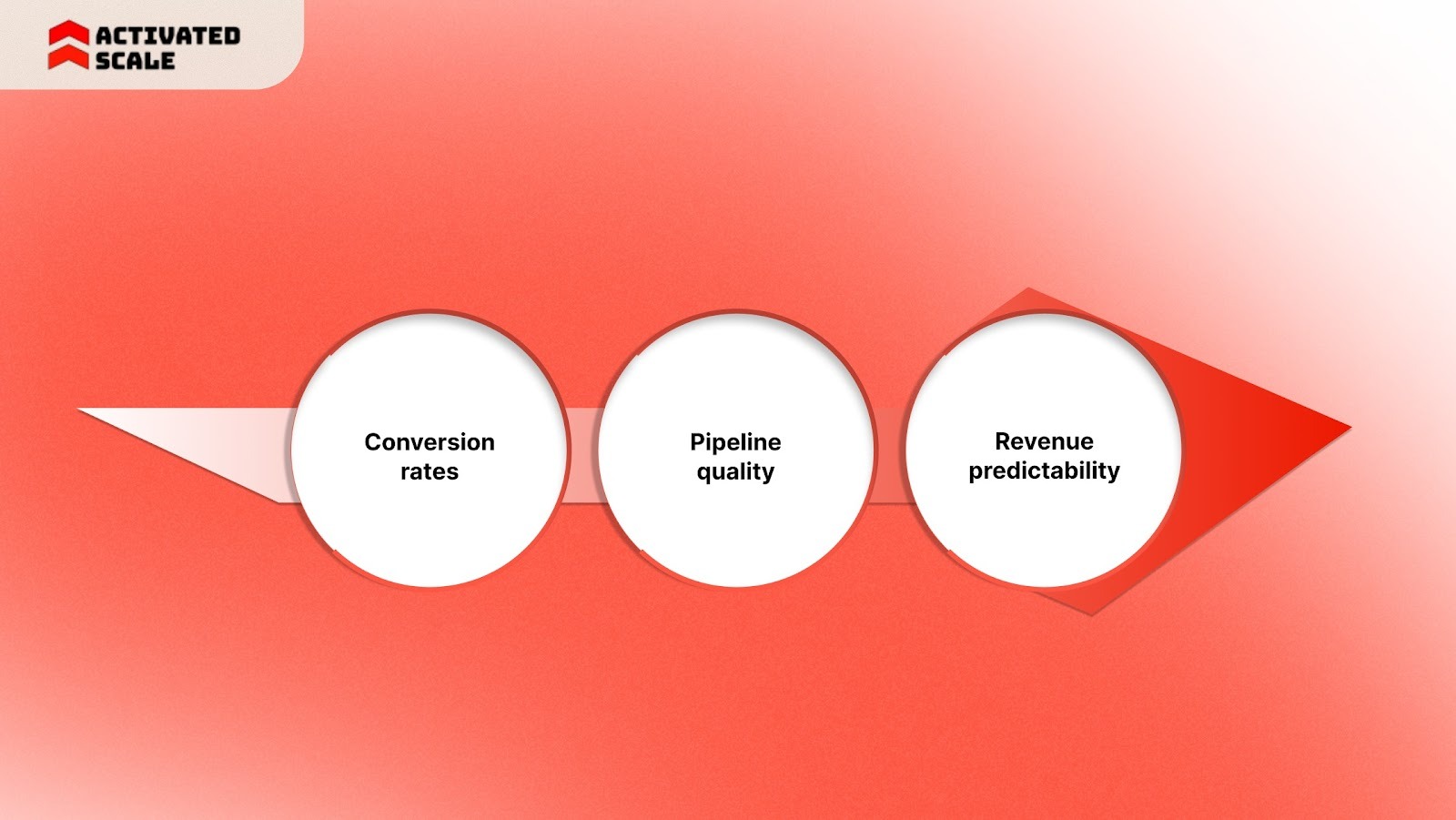
- Conversion rates: Identifies where prospects drop off, helping teams fix messaging, targeting, or process gaps
- Pipeline quality: Ensures leads entering the funnel match the ideal customer profile and have real buying intent
- Revenue predictability: Improves visibility into how pipeline converts, allowing leaders to forecast growth more accurately
It is important to distinguish a funnel audit from related reviews. A funnel optimization audit focuses on the entire conversion path, from first interaction to closed deal. A conversion rate optimization (CRO) audit typically focuses on website performance, such as landing pages and forms.
A sales audit evaluates how sales teams manage deals, including qualification, follow-up, and closing effectiveness. The funnel audit connects all three, giving a complete picture of how revenue flows.
An audit does not fix problems on its own. It reveals where the gaps exist and what needs attention. The next step is understanding exactly where to look inside the funnel to find those conversion blockers.
Also Read: How to Find a CFO for Your Company in 2026?
The 6 Critical Areas Every Funnel Optimization Audit Must Cover
A funnel optimization audit works only when it examines the entire conversion path, not just one stage. Most conversion problems do not come from a single failure.
They happen when tracking breaks, handoffs slow down, or follow-ups never happen. This framework helps startups identify where revenue leaks and what to fix first.
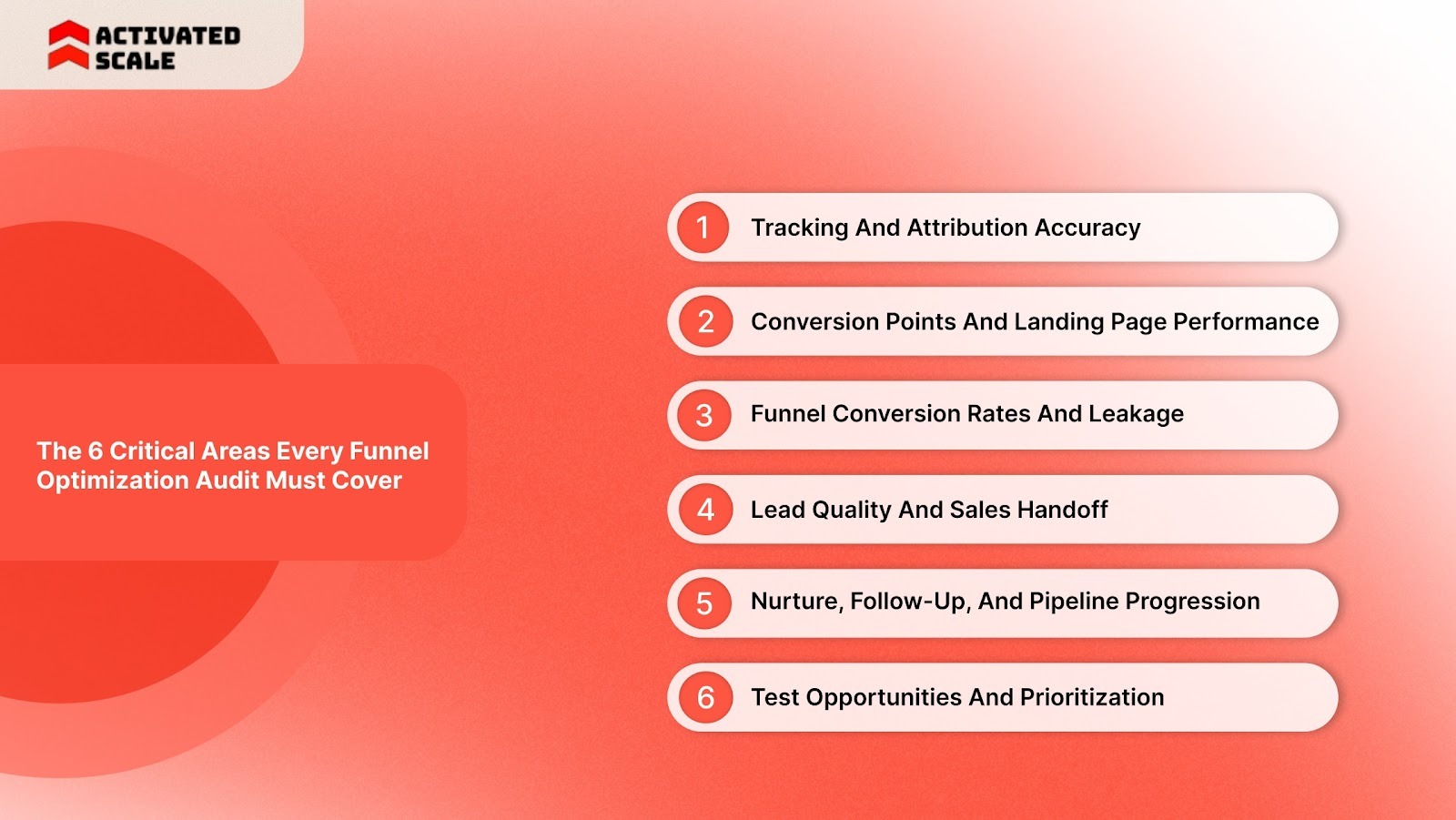
Tracking And Attribution Accuracy
Accurate tracking is the foundation of every funnel audit. Without it, conversion rates and pipeline reports cannot be trusted. Startups should verify that all key actions are tracked correctly in analytics and CRM systems.
Key checks include:
- GA4 events for form submissions, demo bookings, and signups
- CRM attribution showing original source and campaign
- Offline conversions such as sales-qualified opportunities recorded properly
- No missing or duplicate conversion events
Even small tracking gaps can hide major funnel problems.
Conversion Points And Landing Page Performance
Conversion points determine whether visitors become leads. If landing pages are unclear or forms create friction, conversion rates drop immediately.
Audit focus areas:
- Form length and required fields
- Clarity of value proposition and messaging
- Offer strength, such as demo, trial, or consultation
- Page load speed and mobile experience
Small improvements at this stage can significantly increase pipeline volume.
Funnel Conversion Rates And Leakage
This stage identifies exactly where prospects drop off between stages. Measuring stage-by-stage conversion rates reveals funnel leakage.
Example funnel conversion table:
This view helps teams see where improvement will have the greatest revenue impact.
Lead Quality And Sales Handoff
Pipeline problems often begin at the handoff between marketing and sales. If qualification criteria are unclear or follow-up is delayed, strong leads lose momentum.
Audit checks include:
- MQL to SQL conversion rate
- Sales response time to new leads
- Clear ownership assignment
- Lead qualification consistency
Improving handoffs increases conversion without increasing traffic.
Nurture, Follow-Up, And Pipeline Progression
Not every lead converts immediately. Nurture and follow-up processes keep prospects engaged until they are ready to buy.
Key areas to review:
- Email nurture sequences
- SDR outreach and follow-up cadence
- Retargeting campaigns
- Deal progression through pipeline stages
Gaps here often result in lost opportunities that could have been converted later.
Test Opportunities And Prioritization
The final step of the audit is identifying which improvements to implement first. Not all problems have equal impact.
Typical prioritization categories:
- Quick wins, such as form improvements or faster follow-up
- Messaging changes to improve conversion clarity
- Structural fixes, such as redefining qualification criteria
- Long-term improvements, such as automation or process redesign
A funnel optimization audit brings clarity to where conversion problems exist. Once those gaps are visible, startups can take focused action to improve funnel performance and drive predictable growth.
Must read: What Affects Sales Training Costs and How To Plan
Funnel Audit Playbook: Step-By-Step Process
A funnel optimization audit delivers the most value when it follows a structured process with clear ownership and timelines. This ensures insights turn into action, not just reports.
Most SaaS startups can complete a full audit within four weeks if responsibilities are defined early.
Step-By-Step Funnel Audit Process:
Week 1 focuses on tracking validation. Teams confirm that analytics platforms, CRM systems, and conversion events capture accurate data. Without reliable tracking, all downstream analysis becomes unreliable.
Week 2 centers on funnel performance analysis. RevOps teams calculate stage conversion rates and identify abnormal drop-offs.
Week 3 isolates the root causes. Growth teams review landing pages, follow-up speed, and lead quality to determine why conversion gaps exist.
Week 4 translates insights into execution. Leadership prioritizes fixes based on impact, effort, and revenue potential.
Core Funnel Metrics And Sample Formulas
These formulas help teams measure funnel performance consistently.
- Lead conversion rate
lead_conversion_rate = leads / visitors
This shows how effectively traffic converts into pipelines.
- SQL conversion rate
sql_rate = sql / leads
This measures lead quality and qualification effectiveness.
- Expansion revenue rate
expansion_rate = expansion_arr / total_arr
This indicates how effectively the company grows revenue from existing customers.
Tracking these metrics over time reveals whether funnel improvements are working.
Example Funnel Dashboard CSV Structure
A simple dashboard can be built using the following CSV format:
date
traffic_source
visitors
leads
sql
opportunities
closed_won
pipeline_value
revenue
lead_conversion_rate
sql_conversion_rate
sales_cycle_length_days
average_deal_size
expansion_arr
This dashboard provides a clear operational view of funnel performance. It allows marketing, sales, and leadership teams to monitor conversion trends, identify new leaks quickly, and measure the impact of optimization efforts.
Many SaaS companies use platforms like Activated Scale to access vetted, U.S.-based fractional SDRs, AEs, and sales leaders who can execute follow-up, qualify leads, and convert improved funnel performance into pipeline while leadership stays focused on scaling revenue.
Learn more about: How to Hire Overseas Contractors Compliantly in 2026
Funnel Optimization Audit KPIs, Mistakes, And Next Steps
A funnel optimization audit is only valuable if it improves measurable outcomes. Tracking the right KPIs helps startups understand whether funnel changes increase pipeline quality and revenue efficiency.
These metrics should be reviewed regularly by marketing, sales, and leadership teams.
Core Funnel Optimization Audit KPIs:
Monitoring these KPIs helps teams identify whether funnel fixes improve performance or whether additional adjustments are needed.
Common Funnel Optimization Audit Mistakes
Many startups run audits but fail to see results because they focus on the wrong areas or delay execution.
Common mistakes include:
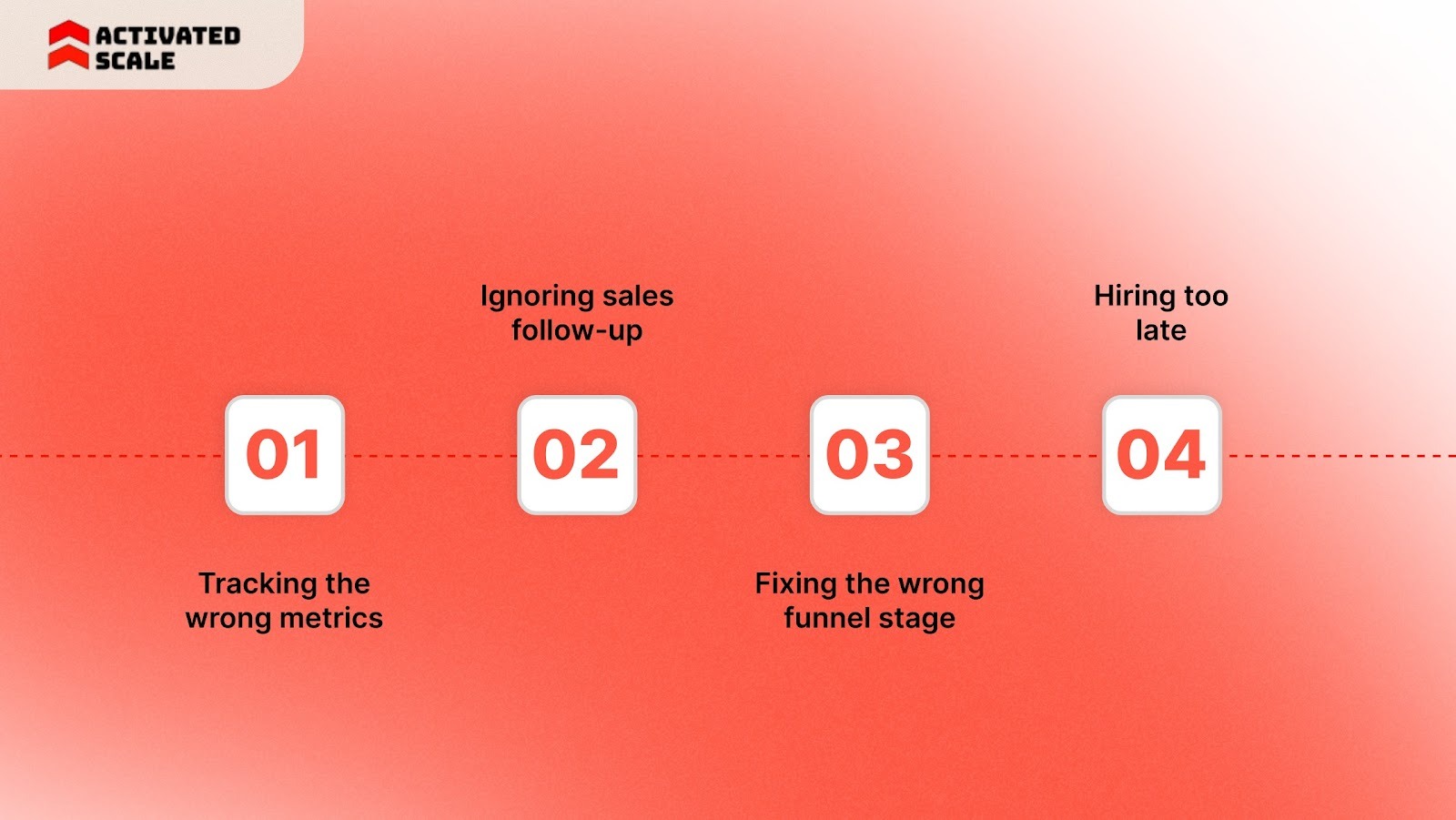
- Tracking the wrong metrics: Focusing only on traffic instead of conversion and revenue metrics
- Ignoring sales follow-up: Slow or inconsistent responses reduce conversion regardless of lead quality
- Fixing the wrong funnel stage: Optimizing landing pages when the real issue is sales qualification or follow-up
- Hiring too late: Delaying sales hiring even when funnel volume increases
Avoiding these mistakes ensures audit insights translate into revenue impact.
A funnel optimization audit gives startups visibility into where revenue leaks and what needs improvement. With the right metrics, structured analysis, and focused execution, companies can increase conversion rates, improve pipeline quality, and build predictable growth.
How Activated Scale Helps Startups Execute Funnel Audit Findings
A funnel optimization audit shows where conversion breaks down, but it does not fix the problem on its own. Most startups discover gaps in follow-up speed, lead qualification, or pipeline coverage. These gaps directly affect opportunity creation and revenue. Execution is what turns audit insights into measurable funnel improvement.
Activated Scale supports startups by providing vetted, U.S.-based sales talent who can act on audit findings and strengthen funnel performance. Instead of delaying improvements while hiring internally, companies can deploy experienced SDRs, AEs, and sales leaders who improve execution immediately.
Activated Scale helps startups execute funnel improvements through flexible hiring models:
1. Contract-to-Hire Recruiting: Startups can deploy experienced SDRs or AEs to improve lead follow-up, qualification, and conversion. This allows companies to validate performance before making a full-time hiring decision.
2. Fractional SDRs And AEs: Fractional sales professionals help startups increase response speed, maintain consistent outreach, and improve pipeline coverage. This ensures leads generated through funnel optimization efforts convert into qualified opportunities.
They directly support:
- Faster response times to inbound leads
- More consistent opportunity creation
- Better follow-up on marketing-generated leads
3. Fractional Sales Leadership: Activated Scale also provides experienced sales leaders who help startups improve funnel structure, refine qualification criteria, and strengthen forecasting. This ensures the funnel operates efficiently from lead to closed revenue.
Activated Scale does not replace the audit process. It helps startups execute what the audit reveals. By providing flexible access to proven sales talent, Activated Scale enables companies to fix funnel gaps faster and turn optimization insights into predictable pipeline growth.
Conclusion
A funnel optimization audit brings clarity to how prospects move through your funnel and where conversion breaks down. Done right, it improves lead conversion rates, strengthens pipeline quality, and makes revenue more predictable. Instead of relying on assumptions, teams can identify specific gaps, prioritise the right fixes, and improve how efficiently the funnel generates customers.
Activated Scale helps startups execute these improvements by connecting them with vetted, U.S.-based SDRs, AEs, and sales leaders who strengthen follow-up, qualification, and pipeline progression. Through contract-to-hire and fractional models, companies can improve funnel execution and conversion performance without committing to full-time hires too early.
Connect with Activated Scale to explore how flexible, proven sales talent can help you turn funnel audit insights into predictable pipeline and revenue growth.
FAQs
1. How often should a startup run a funnel optimization audit?
Most SaaS startups should run a funnel optimization audit every two to three quarters, or whenever conversion rates decline, pipeline quality drops, or a new growth channel is introduced.
2. What data sources are required to perform a funnel audit?
A funnel audit typically requires data from your CRM, website analytics platform, marketing automation tool, and sales pipeline. These sources provide visibility into conversion stages and revenue outcomes.
3. How long does it take to see results after a funnel audit?
Startups often see early improvements within 30 to 60 days after fixing follow-up speed, messaging gaps, or qualification issues. Larger structural fixes may take one or two quarters.
4. Who should own funnel optimization in a SaaS startup?
Funnel optimization is usually owned by revenue operations or growth leaders, with support from marketing and sales. Clear ownership ensures audit findings translate into execution.
5. Can funnel optimization improve results without increasing traffic?
Yes. Many startups increase pipeline and revenue by improving conversion rates within their existing funnel, without spending more on marketing or acquisition.
The Ultimate Guide to Hiring a Salesperson!
Get the step-by-step guide to hiring, onboarding, and ensuring success!