_edi.png)

Long claims queues, endless paperwork, and mounting compliance tasks are slowing your team down. Every delayed claim or overlooked detail affects customer trust and workflow efficiency.
Outsourcing for insurance companies can help lighten this load. With specialized support and proven processes, insurers can speed up workflows, reduce errors, and free internal teams to focus on higher-value work.
This guide breaks down the advantages and the key considerations to help you decide if outsourcing fits your company’s strategy. Let’s get started!
Quick Overview
- Outsourcing helps insurers manage fluctuating workloads without adding fixed costs or expanding internal teams.
- Specialized partners bring process discipline, trained talent, and mature workflows that strengthen overall service delivery.
- Functions like claims, underwriting support, policy management, and customer service benefit the most from external expertise.
- Success depends on evaluating compliance, tech maturity, communication practices, and transition planning, and not pricing alone.
- A structured vendor partnership can improve stability across operations, safeguard continuity, and support faster business growth.
What Is Outsourcing for Insurance Companies?
Outsourcing for insurance companies refers to hiring external partners to handle specific operational tasks that are time-consuming, specialized, or difficult to scale internally. These partners bring trained talent, established processes, and the tools needed to manage high-volume insurance work with accuracy.
Insurers are turning to outsourcing more often due to rising costs, growing compliance demands, and higher expectations for speed and accuracy. The model helps carriers:
- Stabilize workloads during peak periods
- Improve turnaround times
- Reduce operational strain on in-house teams
- Scale support without adding full-time headcount
Now, let's take a look at the functions you can outsource to external providers.
Recommended: How Business Process Outsourcing Boosts Sales Strategy.
Functions Commonly Outsourced in Insurance
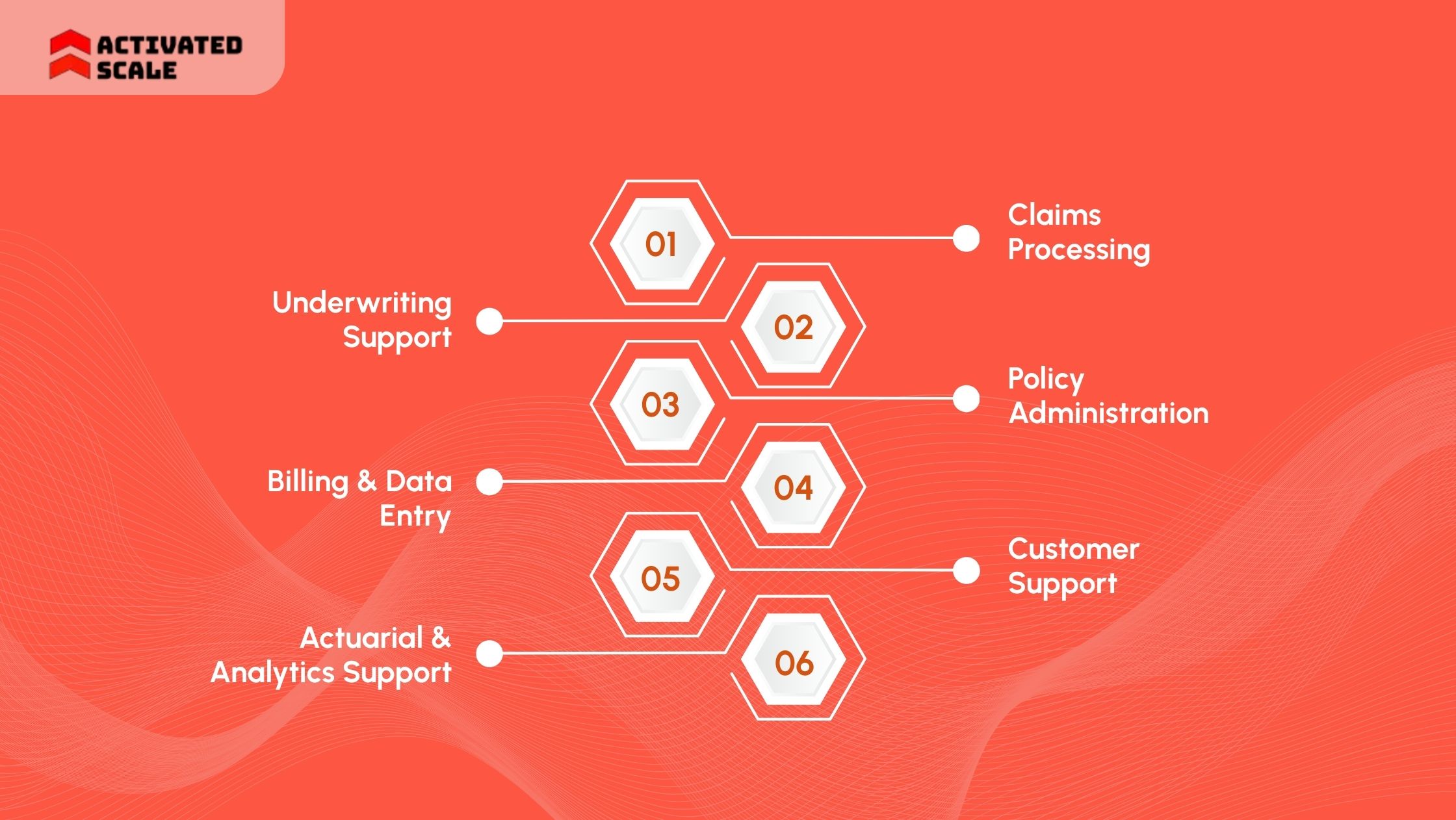
Insurance operations involve many high-volume, detail-oriented tasks that require accuracy and consistent turnaround times. Below are the functions most often supported by external partners:
1. Claims Processing
Outsourced teams assist with claim intake, documentation review, verification, adjudication, and follow-ups. This helps reduce backlogs, improve accuracy, and maintain steady processing speeds during peak claim periods.
2. Underwriting Support
Specialists handle data gathering, risk checks, eligibility review, and application screening. This allows in-house underwriters to focus on high-value evaluations and complex decision-making.
3. Policy Administration
External partners manage endorsements, renewals, cancellations, corrections, and policy updates. This ensures accurate records and faster responses to customer requests.
4. Billing & Data Entry
Teams support payment posting, reconciliations, premium calculations, and high-volume data entry. Their involvement reduces manual errors and keeps financial information consistent and up to date.
5. Customer Support
Outsourced agents respond to policyholder questions through phone, email, and chat. They assist with account inquiries, process guidance, and status updates, providing reliable support across channels.
6. Actuarial & Analytics Support
Analysts assist with modeling, forecasting, dashboarding, and regulatory reporting. Insurers benefit from specialized analytical expertise without hiring additional full-time actuarial staff.
7. Sales Support (Lead Generation & Pipeline Management)
Many insurers also outsource sales-related tasks such as prospect research, appointment setting, outbound outreach, and pipeline follow-up. These activities help agencies and carriers maintain a steady flow of qualified leads without expanding full-time headcount. Platforms like Activated Scale make it easier to access trained, U.S.-based sales talent, such as fractional SDRs to contract-to-hire AEs, to strengthen your top-of-funnel efforts while your internal team focuses on closing.
With these functions handled by experienced external teams, insurers can gain several advantages that directly improve performance and overall cost structure.
Also Read: Outsource Inside Sales: Comparison, Pros, and Selection Guide.
Key Benefits of Insurance Outsourcing
Below are the core benefits insurers gain when partnering with experienced service providers.
- Significant Cost Savings: Outsourcing lowers hiring, training, and infrastructure costs while giving insurers access to skilled teams at predictable, lower operating expenses.
- Access to Specialized Talent & Better Technology: Insurers gain trained professionals and modern tools without investing in new systems or long-term staffing.
- More Accurate, Streamlined Processes: Specialized teams handle repetitive, detail-heavy tasks with consistent quality, reducing errors and improving turnaround times.
- Scalability and Flexibility: Insurers can quickly scale support during peak seasons such as open enrollment or catastrophe events, and scale down when volumes drop.
- Stronger Focus on Core Functions: Internal teams get more time for underwriting, product strategy, distribution, and customer engagement while outsourced teams manage routine workloads.
- Improved Risk Management & Compliance Support: Outsourcing partners help maintain documentation standards, follow regulatory guidelines, and support continuity during unexpected disruptions.
- Better Customer Experience: Faster processing, fewer errors, and responsive support create smoother interactions for policyholders across the lifecycle.
To understand how these advantages play out in real operations, it helps to compare outsourcing directly with traditional in-house models.
Also Check: Fractional Hiring: Definition, Benefits, and Business Impact.
In-House vs. Outsourced Insurance Operations
Let's compare outsourcing with traditional in-house workflow to understand the practical impact across cost, capacity, and overall efficiency.
However, before shifting any function to an external partner, insurers need to evaluate several factors that influence long-term performance and compliance.
Recommended: Best Sales AI Tools for Business Development.
Key Considerations Before Outsourcing for Insurance Companies
Thoughtful planning makes outsourcing work efficiently. The following factors should be considered to set expectations, protect data, and maintain consistent service quality.
- Data Security & Compliance: Verify that the partner adheres to strict security standards and complies with HIPAA, GDPR, and state insurance regulations. You can also look for alignment with state rules such as the NYDFS Cybersecurity Regulation (23 NYCRR 500) or California’s IIPPA. All policyholder data should be encrypted, access-controlled, and monitored through regular audits.
- Vendor Capability & Domain Expertise: Choose a provider with proven insurance experience, trained teams, and the ability to support your specific lines of business and process requirements.
- SLAs & Quality Control: Define metrics for accuracy, turnaround time, responsiveness, and audit processes. Clear SLAs ensure consistent performance and transparency.
- Communication & Workflow Alignment: Establish communication channels, reporting cadence, and escalation paths. Smooth coordination prevents delays and reduces rework.
- Transition Timeline: Plan for knowledge transfer, system integration, pilot phases, and ramp-up. A structured transition reduces disruption to internal teams and customers.
- Cost Evaluation Beyond Pricing: Review hidden or indirect costs of training, integrations, change management, and potential process reengineering, to get a true picture of total spend.
Even with careful planning, outsourcing entails risks that insurers should recognize early in the process.
Also Read: Outsourcing Lead Generation: Solving Common Challenges.
Challenges & Risks of Insurance Outsourcing
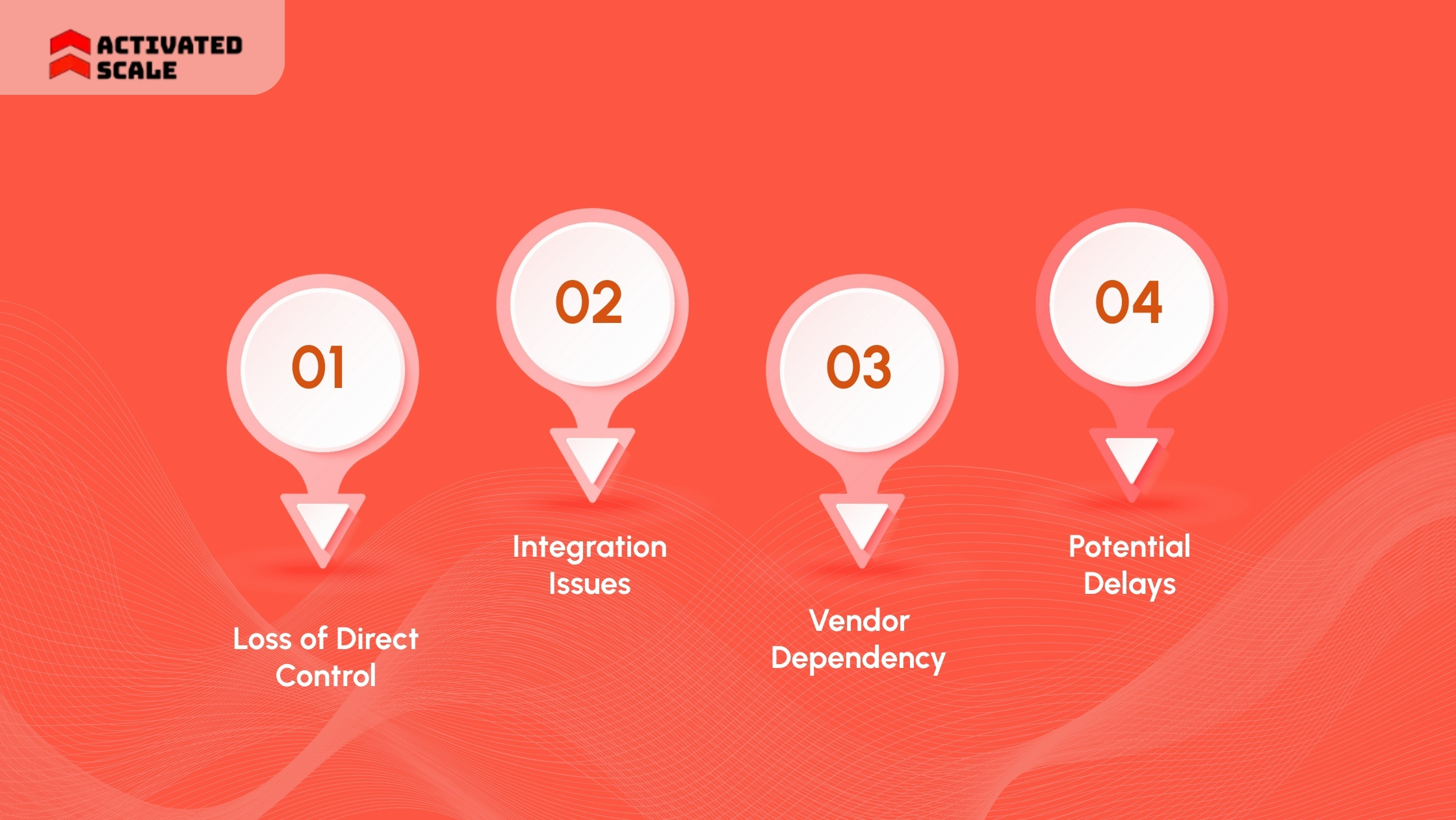
Outsourcing offers strong advantages, but insurers should be aware of potential drawbacks:
- Loss of Direct Control: External teams manage day-to-day tasks, potentially reducing visibility and requiring stronger oversight and governance.
- Integration Issues: Connecting vendor systems with policy admin, claims, or CRM platforms can be complex and may require additional IT support.
- Vendor Dependency: Relying heavily on a single partner can create operational risk if performance drops or contract terms change.
- Potential Delays: If coordination is weak, turnaround times for claims, underwriting reviews, or customer responses may slow down.
Most of these hurdles are manageable when you choose a partner with strong systems and consistent communication. For insurers that also need help hiring skilled sales professionals, a dependable source of qualified talent can make growth smoother.
Also Check: How Companies Outsource Sales and Successfully Manage Teams.
How Activated Scale Can Support Sales Hiring Needs
Operational outsourcing often prompts companies to strengthen their revenue teams as well. Insurance organizations that sell group plans, partnerships, or enterprise solutions frequently need stronger B2B sales capacity. Yet hiring experienced reps quickly can be a challenge.
If your team is expanding its sales pipeline or needs support for outreach, qualification, or account management, Activated Scale offers a practical way to fill those roles without long hiring cycles. The platform connects companies with vetted, U.S.-based SDRs, AEs, and sales leaders available on fractional, contract, or contract-to-hire terms.
Key advantages include:
- Experienced sales talent to accelerate growth: Work with professionals who understand outreach, qualification, and enterprise selling.
- Pre-vetted reps with a track record of selling to similar buyers: Match with talent experienced in your industry or target persona.
- Contract-to-hire sales recruiting: Build your team with lower risk and faster validation.
- Fractional selling support: Add SDR or AE capacity without committing to full-time hires.
- Fractional sales leadership: Access senior sales expertise for strategy, pipeline structure, and coaching.
This helps businesses maintain consistent sales momentum while avoiding the delays and costs of traditional hiring. Let’s talk now if you’re planning to bring experienced sales talent into your team.
Conclusion
Outsourcing has become a practical way for insurers to manage growing workloads, improve accuracy, and maintain consistent service quality without stretching internal teams.
As operations run more smoothly, many companies also take the opportunity to strengthen their revenue engine. Growing distribution channels or expanding B2B sales often requires experienced talent, and that’s where a trusted hiring partner makes a difference.
If your team is planning to add SDRs, AEs, or senior sales leaders, Activated Scale connects you with vetted, U.S.-based professionals who can ramp quickly and support your growth goals.
When you’re ready to add proven sales talent and keep momentum strong, connect with our team to get started!
FAQ’s
1. What tasks do insurance companies outsource most often?
Claims processing, underwriting support, policy administration, billing, customer service, and analytics are the most commonly outsourced functions. They involve high-volume, repetitive work that benefits from specialized teams and faster turnaround.
2. Is outsourcing secure for sensitive insurance data?
Yes, when handled by a compliant provider. Look for partners that follow HIPAA, SOC 2, GDPR, and state-level insurance regulations.
3. How do insurers decide which functions to outsource?
Companies typically outsource high-volume or time-consuming tasks that slow internal teams down. The decision is based on cost, staffing challenges, turnaround time targets, and the need for greater consistency in accuracy.
4. Can outsourcing improve customer experience for policyholders?
It can, especially when experienced teams handle inquiries, documentation updates, or claim intake. Faster response times and fewer processing errors help customers receive clear, timely updates.
5. Does outsourcing replace internal teams?
No. In most cases, outsourcing complements internal staff. External teams manage routine tasks, allowing in-house experts to focus on complex decisions, compliance, and strategic work that requires deeper expertise.
The Ultimate Guide to Hiring a Salesperson!
Get the step-by-step guide to hiring, onboarding, and ensuring success!