_edi.png)

Every startup founder has experienced the same frustrating pattern. One quarter, the pipeline looks healthy, while the next quarter, revenue suddenly slows down. That unpredictability makes planning difficult. Hiring pauses, cautious marketing budgets, and investors asking harder questions.
What most companies actually want is revenue predictability, the ability to forecast future revenue with confidence based on real pipeline data and repeatable sales activity.
The challenge is that many organizations still struggle with forecasting accuracy. Research shows fewer than 25% of sales organizations achieve forecast accuracy within 10% of actual revenue, meaning most companies are making strategic decisions with unreliable projections.
When companies build structured pipelines, track conversion patterns, and develop consistent sales processes, forecasting becomes far more reliable and revenue growth becomes easier to plan.
In this guide, we’ll explore what revenue predictability really means, why startups struggle to achieve it and the metrics and hiring strategies that help build a reliable revenue engine.
Key Takeaways
- Revenue predictability allows companies to forecast future revenue using structured pipeline data and measurable sales activity.
- Metrics such as pipeline coverage ratio, conversion rates, deal size, and sales cycle length are essential for reliable forecasting.
- Clear ideal customer profiles and consistent outbound prospecting help maintain steady pipeline generation.
- Specialized sales roles such as SDRs and account executives improve pipeline efficiency and closing performance.
- Organizations that build repeatable sales processes gain stronger revenue visibility, improved financial planning, and better hiring decisions.
What Does Revenue Predictability Actually Mean?
Revenue predictability refers to the ability of a business to forecast future revenue using consistent pipeline activity, conversion metrics, and structured sales processes. Instead of relying on occasional large deals, companies build systems that generate a steady flow of qualified opportunities.
Predictability appears when sales leaders can answer key operational questions with confidence.
- How many leads enter the pipeline each month?
- How many of those leads convert into opportunities?
- How many opportunities close as revenue?
When these numbers remain consistent, companies can estimate future revenue with greater accuracy.
Predictable Revenue vs Unpredictable Sales Spikes
Many startups experience growth in bursts. A large deal closes one quarter, followed by a slow period. This pattern makes planning difficult and increases pressure on the sales team.
Predictable revenue replaces this uncertainty with a structured pipeline system. Sales activity becomes measurable.
Sales teams that build predictable pipelines track activity such as prospects contacted, meetings booked, and conversion rates at each stage.
Why Forecasting Accuracy Matters
Forecasting accuracy determines how well companies can plan hiring, marketing budgets, and product investments.
Companies with structured sales systems gain several advantages.
- Leadership can plan quarterly growth targets
- Finance teams can allocate budgets with confidence
- Investors receive reliable projections
- Sales teams understand performance benchmarks
A predictable pipeline turns revenue planning into a data-driven process instead of guesswork.
Revenue Predictability vs Recurring Revenue
These concepts are often confused but represent different ideas.
Subscription businesses naturally support predictable revenue because monthly or annual billing creates consistent income streams. However, predictable revenue still requires strong pipeline generation and customer retention.
Why SaaS Companies Depend on Predictable Revenue
SaaS companies rely on subscription revenue and long-term customer relationships. This model depends on consistent acquisition and retention.
Key drivers include:
- Monthly recurring revenue growth
- Customer retention and expansion
- Structured sales pipelines
- Forecast accuracy
Customer success programs also influence revenue performance. Research from Forrester shows that companies that place customers at the center of their strategy report up to twice the revenue growth and profitability compared with companies that do not prioritize customer experience
Predictable revenue allows SaaS companies to scale operations while maintaining stable growth.
Also Read: Scaling Revenue Operations for Growing Scaleups
Why Most Startups Struggle to Achieve Revenue Predictability
Revenue predictability rarely appears automatically. Many startups struggle because their sales processes develop informally during early growth.
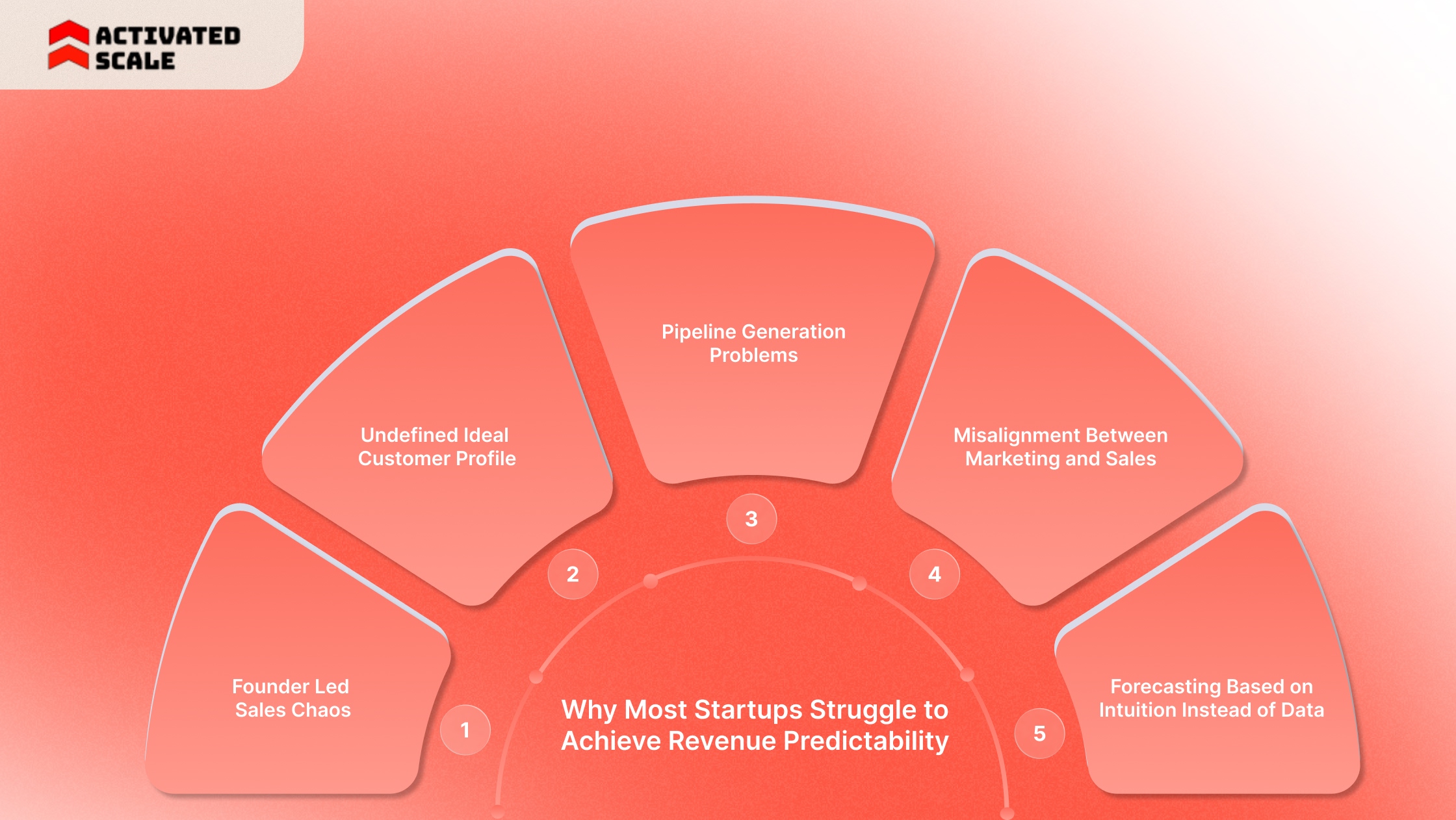
Without structure, revenue performance depends on individual effort rather than on repeatable systems.
1. Founder Led Sales Chaos
Early-stage startups often depend on founders to drive sales.
Founders usually handle multiple responsibilities.
- Sales outreach
- Product demos
- Negotiations
- Customer support
This approach works temporarily but becomes unsustainable as the company grows. Pipeline generation slows when founders shift focus to hiring, product development, or fundraising.
2. Undefined Ideal Customer Profile
Many teams start selling before defining a clear ideal customer profile.
This creates several problems.
- Sales teams target companies that rarely convert
- Marketing campaigns attract low-intent leads
- Sales cycles become longer
A clear ICP improves conversion rates because outreach focuses on buyers with the highest purchase probability.
3. Pipeline Generation Problems
A predictable pipeline requires consistent prospecting activity. Many startups rely on a single demand source, such as inbound marketing or founder networks.
When these sources slow down, revenue growth becomes unpredictable.
High-performing sales organizations create multiple pipeline sources.
- Outbound prospecting
- Partner referrals
- Marketing-generated leads
- Product-led signups
4. Misalignment Between Marketing and Sales
Sales and marketing teams often measure success differently.
Without shared metrics, marketing may deliver large volumes of leads that rarely convert. Sales teams then struggle to meet quotas.
5. Forecasting Based on Intuition Instead of Data
Some startups estimate future revenue based on optimism instead of pipeline metrics.
This creates forecasting gaps.
Predictable forecasting requires consistent measurement of:
- Lead volume
- Opportunity creation
- Win rates
- Sales cycle length
When these metrics remain stable, revenue forecasting becomes more reliable. But many startups face another challenge of building the right sales team to support that pipeline.
Hiring experienced sales professionals too early can strain budgets, while delaying key hires can slow revenue growth.
This is where flexible hiring models become useful. Platforms like Activated Scale connect startups with vetted U.S.-based SDRs, account executives, and fractional sales leaders who can help build a pipeline and sales processes.
Founders can test roles, establish consistent prospecting, and strengthen forecasting accuracy before committing to full-time hires.
Also Read: Hiring Fractional Sales Reps for Startup Success
The Predictable Revenue Framework That Powers Modern B2B Sales
The predictable revenue framework gained recognition after Salesforce adopted a structured outbound sales model that helped the company scale recurring revenue by over $ 100 million.
The framework introduced a systematic approach to pipeline creation. Instead of expecting one salesperson to manage every stage of the sales cycle, teams specialized roles and tracked measurable activity.
The Specialization Model
Role specialization divides the sales process into distinct functions. Each role focuses on a specific stage of the customer journey.
Sales development teams sit between marketing and closing teams. Their primary job is to identify qualified prospects and schedule meetings for sales representatives.
This structure improves efficiency because each role develops expertise in its specific function.
Outbound Prospecting and Pipeline Creation
Outbound prospecting generates new opportunities by proactively reaching potential buyers.
Typical outbound activities include:
- Targeted email campaigns
- Account research
- Cold outreach
- Follow-up sequences
Companies track these activities closely. Metrics such as prospects contacted, meetings scheduled, and opportunities created help sales leaders measure pipeline health.
A predictable pipeline requires consistent prospecting volume.
Why Separating Prospecting and Closing Improves Revenue Predictability
Traditional sales structures expect a single representative to handle every task.
These responsibilities often include:
- Prospecting
- Qualification
- Product demos
- Negotiations
- Contract management
This structure reduces efficiency because prospecting receives less attention when sales reps focus on closing deals.
Separating prospecting from closing solves this problem.
Benefits include:
- SDRs focus entirely on pipeline creation
- AEs spend more time closing deals
- Pipeline growth becomes measurable
This specialization allows organizations to scale sales output without increasing complexity.
How This Framework Changed SaaS Sales Teams
The predictable revenue framework reshaped modern B2B sales organizations. Many SaaS companies now design revenue teams around specialized roles and structured pipelines.
Key structural changes include:
Companies using structured sales systems report forecast accuracy improvements ranging from 10 percent to 40 percent when pipeline data is consistently tracked.
The result is a sales organization that can forecast growth more reliably and scale revenue without depending on unpredictable deals.
Also Read: How to Measure and Prove RevOps ROI
The Metrics That Make Revenue Predictability Possible
Revenue predictability depends on consistent measurement of pipeline activity, deal progression, and revenue efficiency. When these numbers remain stable across quarters, sales leaders can forecast future revenue using historical patterns rather than assumptions.
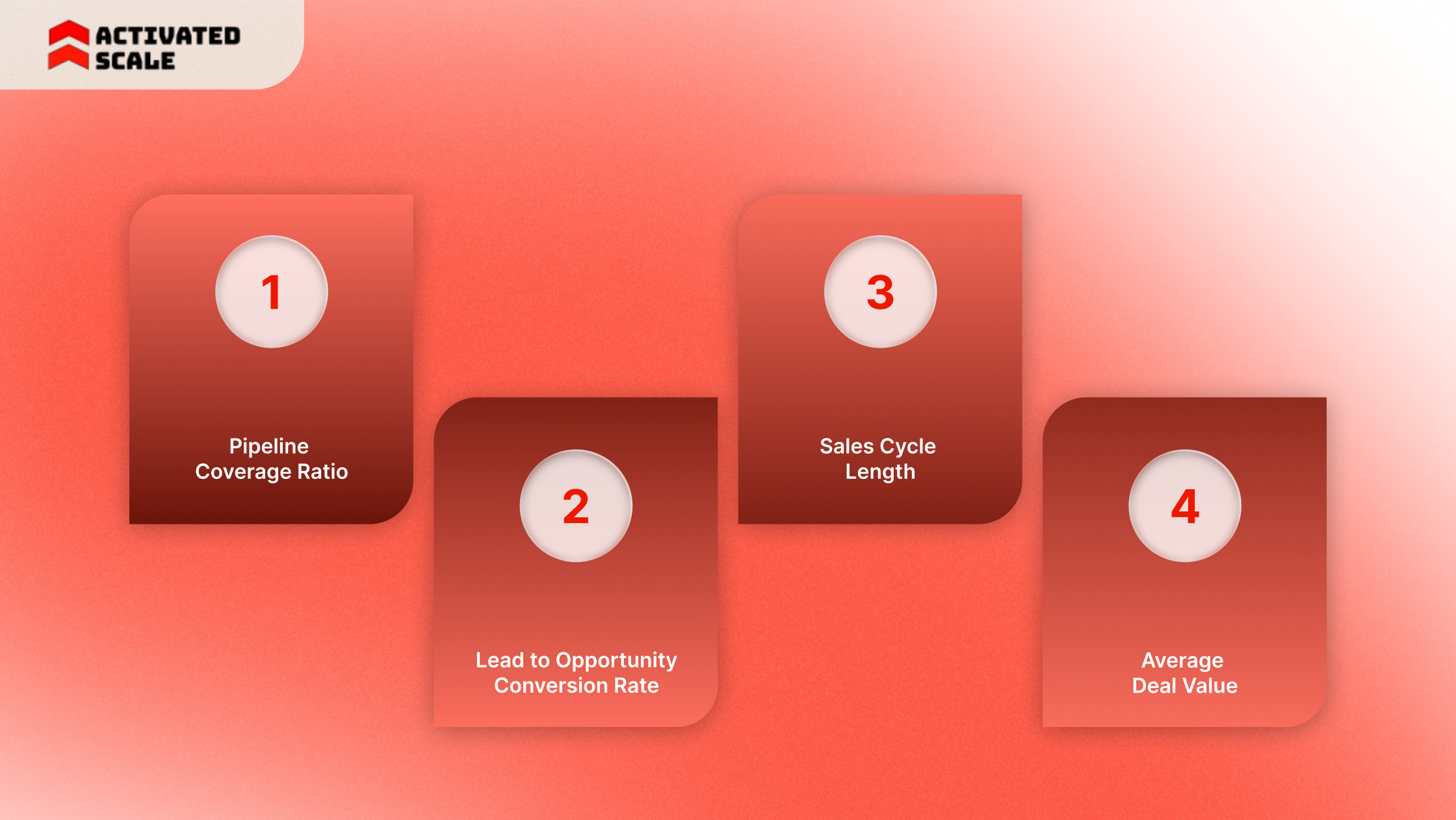
Forecasting discipline is still a challenge for many organizations. Research from Gartner shows that only about 45% of sales leaders are confident in the accuracy of their sales forecasts, highlighting how difficult revenue forecasting becomes when pipeline data is inconsistent.
Tracking the right metrics allows companies to replace guesswork with measurable indicators of future revenue.
1. Pipeline Coverage Ratio
Pipeline coverage ratio indicates whether the current pipeline has sufficient opportunity value to support revenue targets. It compares the value of active deals with the quota for a given period.
The formula is simple.
Pipeline Coverage Ratio = Total Pipeline Value ÷ Revenue Target
If a company has $3 million in active deals and a quarterly target of $1 million, the pipeline coverage ratio equals 3x coverage.
Sales teams use this metric as an early warning signal.
Key insights
- Low coverage means the pipeline is too small to realistically hit quota.
- Extremely high coverage may indicate poor qualification.
- Balanced coverage shows healthy pipeline flow.
Coverage ratios typically vary with win rates and deal sizes, but many B2B teams aim for 3x to 5x pipeline coverage to account for deals that stall or fall through.
2. Lead to Opportunity Conversion Rate
Lead-to-opportunity conversion rate measures how efficiently the sales funnel converts early interest into qualified deals. It indicates whether marketing and prospecting activities are generating the right type of buyers.
A strong conversion rate often signals:
- Clear ideal customer profile
- Accurate qualification criteria
- Relevant outreach messaging
A declining conversion rate usually points to targeting issues or weak lead qualification.
Example
This metric helps forecast how many leads must enter the funnel to create enough opportunities to hit revenue targets.
3. Sales Cycle Length
Sales cycle length measures the time it takes for a deal to move from initial engagement to closed revenue.
This metric directly influences forecast timing. If the average cycle is four months, deals created this quarter may not close until the next quarter.
Sales leaders monitor cycle length to:
- Identify pipeline bottlenecks
- Improve deal velocity
- Estimate closing timelines more accurately
When cycle length remains consistent, revenue projections become far more reliable.
4. Average Deal Value
Average deal value shows how much revenue each closed deal typically generates. This metric connects sales activity directly to revenue outcomes.
Sales teams use it to determine:
- How many deals are needed to hit quota.
- Whether growth is coming from deal volume or larger contracts.
- Whether the pricing strategy is effective.
Example
Understanding deal value allows leaders to forecast pipeline needs more accurately.
Customer Acquisition Cost (CAC)
Customer acquisition cost measures the cost a company incurs to acquire a new customer. It includes sales salaries, marketing expenses, software tools, and outreach costs.
CAC is critical because predictable revenue depends on sustainable growth. If acquisition costs increase faster than revenue, forecasting becomes unreliable.
CAC helps leaders answer three important questions:
- Is the sales model financially sustainable?
- How long does it take to recover acquisition costs?
- How much growth can the company support?
Together, these metrics create a measurable framework for forecasting revenue and identifying problems early in the pipeline.
Hiring the Right Sales Team to Build Revenue Predictability
Predictable revenue requires the right sales structure. Hiring too early or hiring the wrong roles can disrupt pipeline generation and slow growth.
A common pattern appears in early-stage startups. Founders handle sales alone until growth stalls. Then, companies hire senior salespeople without building the supporting pipeline structure first.
This sequence often produces inconsistent results.
When to Hire Your First SDR
Sales Development Representatives focus on prospecting and pipeline generation. Startups usually benefit from hiring SDRs when founders can no longer maintain consistent outreach.
An SDR typically handles tasks such as:
- Prospect research
- Outbound email campaigns
- Cold outreach
- Meeting scheduling
This role increases the volume of qualified opportunities entering the pipeline.
When to Bring in Account Executives
Account Executives focus on running demos, negotiating deals, and closing revenue.
A company usually hires its first AE once two conditions are present.
- There is a consistent flow of qualified meetings
- The founder can no longer manage the closing process alone
Without a steady pipeline, AEs spend too much time prospecting instead of closing deals.
When Startups Need Sales Leadership
Sales leadership becomes important once the company manages multiple sales roles and pipeline stages.
A sales leader helps with:
- Sales process design
- Forecasting discipline
- Pipeline management
- Compensation plans
Early leadership also improves coordination among marketing, SDR, and closing teams.
Hiring experienced sales professionals can take months. Early-stage startups often need experienced sellers sooner, but cannot commit to full-time headcount immediately.
Platforms like Activated Scale help solve this problem by connecting startups with vetted U.S.-based SDRs, account executives, and fractional sales leaders. Founders can build pipeline structure, test sales roles, and improve forecasting discipline before scaling full-time hiring.
Common Sales Hiring Mistakes That Break Predictable Revenue
Many startups struggle with predictable revenue because they make hiring decisions in the wrong order.
Common mistakes include:
- Hiring Account Executives before a pipeline exists
- Skipping the SDR layer entirely
- Hiring a VP of Sales before product market fit
- Expecting one salesperson to handle every stage of the funnel
These decisions create pipeline gaps, rendering revenue forecasting unreliable.
How to Build a Predictable Revenue Engine
Predictable revenue comes from a sales system that is specific enough to repeat and disciplined enough to measure.
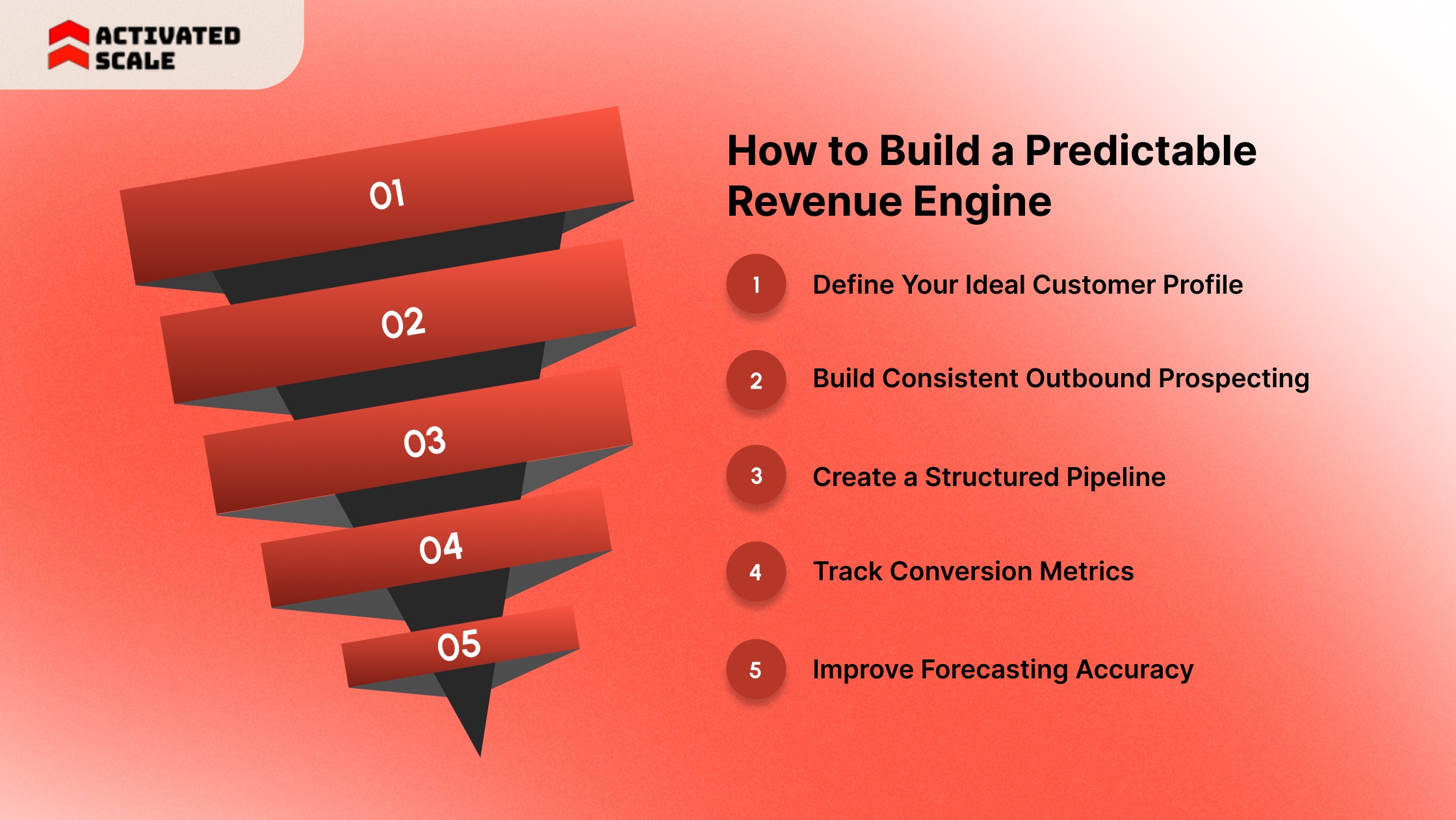
The goal is simple, create a consistent pipeline, move deals through defined stages, and forecast revenue from actual deal movement rather than opinion.
Step 1: Define Your Ideal Customer Profile
Your ideal customer profile identifies the companies most likely to buy, close quickly, and remain valuable after the sale.
A useful ICP should cover:
- Company size
- Industry
- Revenue range
- Geography
- Buyer role
- Core pain points
- Existing tools or tech stack
How this helps
- Sales teams spend less time chasing low-fit accounts.
- Outreach becomes more relevant.
- Qualification becomes faster.
- Conversion rates improve across the funnel.
Example
If your product works best for U.S. B2B SaaS companies with 50 to 200 employees and a lean sales team, that profile is far more useful than targeting “startups” broadly. It gives SDRs a clear account list and gives AEs a cleaner pipeline quality from the start.
Step 2: Build Consistent Outbound Prospecting
Inbound demand can support growth, but it rarely gives startups enough control over pipeline timing. Outbound prospecting gives the team a repeatable way to create opportunities instead of waiting for them.
It is also recommended to start with a clear ideal account profile, then use focused prospecting against the accounts most likely to convert.
A strong outbound motion usually includes:
- Targeted email sequences
- LinkedIn outreach
- Named account lists
- Follow-up cadences
- Event-based or trigger-based outreach
How this helps
- Pipeline creation becomes more predictable month to month.
- Sales leaders can spot prospecting gaps early.
- Revenue targets are less dependent on referrals or inbound swings.
- New reps ramp into a defined motion instead of inventing their own.
Example
An SDR team that works a fixed list of high-fit accounts every week will usually create a more stable pipeline than a team waiting on form fills alone. The quality of the message matters, but consistency of volume matters too.
Step 3: Create a Structured Pipeline
A predictable revenue engine needs clearly defined pipeline stages. Salesforce outlines a common sequence that includes prospecting, qualification, sales call or demo, proposal, negotiation, contract signing, and post-purchase.
The exact stages can vary, but the structure should stay consistent across the team.
Here is a simple version:
How this helps
- Managers can see where deals stall.
- Forecasts become easier to build by stage.
- Coaching becomes more specific.
- Reps know what must happen before a deal moves forward.
A pipeline only works when stage definitions are clear. If one rep moves a deal to proposal after a short intro call and another waits until pricing is discussed, forecast quality drops quickly.
Step 4: Track Conversion Metrics
Pipeline stages by themselves are not enough. You need conversion data to understand whether the system is working. Pipeline forecasting is reliable when teams update deal data frequently and assign probabilities based on real inputs, such as opportunity size and win patterns.
The most useful ratios include:
- Lead to opportunity conversion
- Opportunity to close rate
- Average deal size
- Stage-to-stage conversion
- Pipeline coverage against the target
How this helps
- Forecasts move from guesswork to pattern-based planning.
- Weak stages become easier to identify.
- Hiring plans can be tied to actual pipeline capacity.
- Sales leaders can model how many leads are needed to hit the target.
Example
If 100 qualified leads usually produce 25 opportunities and 6 closed deals, your revenue model becomes much more concrete. You can calculate how much top-of-funnel activity is needed before the quarter begins.
Step 5: Improve Forecasting Accuracy
Forecasting improves when pipeline management and forecasting are treated as distinct yet connected disciplines. Pipeline management focuses on current deal health, while forecasting estimates future revenue based on that pipeline. Sales leaders usually improve forecast quality by:
- Reviewing the pipeline weekly
- Checking deal age by stage
- Using historical win rates
- Removing stale or low probability deals
- Comparing rep forecasts with actual pipeline evidence
How this helps
- Quarter-end surprises decrease
- Leadership can plan hiring and spend earlier
- Reps get coached on deal quality, not optimism
- Revenue projections become more credible with finance and investors
What this system changes:
When these five steps work together, the outcome is not just a cleaner sales process. It is a revenue engine that gives leaders three things they usually lack in early-stage growth:
- Better visibility into future revenue
- More control over pipeline creation
- Stronger confidence in hiring and capacity decisions
That is what makes revenue predictability useful. It turns sales from a series of isolated wins into a system the business can plan around.
Flexible Sales Talent for Building a Predictable Revenue Engine
Many startups struggle to build a predictable revenue system because hiring experienced sales professionals takes time, and early hiring decisions carry financial risk. Access to flexible sales talent helps founders build a pipeline structure without committing to permanent headcount too soon.
Activated Scale connects startups with vetted U.S.-based sales professionals who can strengthen sales operations during early growth stages.
Key services include:
- Contract to hire sales recruiting allowing companies to evaluate sales talent before making full-time offers.
- Fractional SDRs and account executives who generate pipeline and manage sales cycles.
- Fractional sales leadership that helps design GTM strategy, sales playbooks, and forecasting systems.
Conclusion
Predictable revenue comes from a disciplined sales system, not occasional large deals. When companies define their ideal customer profile, maintain consistent prospecting, structure pipeline stages, and track conversion metrics, forecasting becomes far more reliable.
If your startup is building a predictable revenue engine but needs experienced sales support to accelerate the process, explore Activated Scale. We connect companies with vetted U.S-based SDRs, AEs, and fractional sales leaders who can help strengthen pipeline and forecasting discipline.
FAQs
Q: How long does it take to build revenue predictability in a startup?
A: It depends on the maturity of the sales process and pipeline volume. Early stage startups may take several months to stabilize metrics such as lead conversion and sales cycle length. Once consistent prospecting and qualification processes are established, forecasting accuracy usually improves because deal patterns begin to repeat.
Q: Can revenue predictability exist without outbound sales efforts?
A: It is possible but less reliable. Companies relying only on inbound demand often experience fluctuating pipeline volume. Outbound prospecting provides more control over opportunity creation, which helps maintain a steady flow of deals entering the pipeline.
Q: What role does product-market fit play in revenue predictability?
A: Product market fit strongly influences predictable revenue. When a product solves a clear problem for a defined customer segment, conversion rates and deal velocity improve. Without product market fit, pipeline metrics fluctuate widely, and forecasting becomes difficult.
Q: How does deal qualification impact revenue predictability?
A: Strong qualification frameworks help sales teams focus on opportunities that have a higher likelihood of closing. When qualification criteria are clear, pipeline stages contain more realistic deals, and forecasting models become more accurate.
Q: Why do many revenue forecasts fail even when pipeline looks strong?
A: Forecasts often fail when deals are moved through pipeline stages too quickly or when probabilities are assigned without historical data. Sales leaders must review deal progress regularly and remove stalled opportunities to maintain forecast integrity.
The Ultimate Guide to Hiring a Salesperson!
Get the step-by-step guide to hiring, onboarding, and ensuring success!