_edi.png)

As a sales leader, you’re always looking for ways to scale your team efficiently without blowing the budget. Outsourcing offers a way to expand without adding full-time overhead. In fact, the global outsourcing service market is expected to grow at a CAGR of 5.46% from 2025 to 2030.
However, choosing the right model, onshore, nearshore, or offshore, can be overwhelming. Also, picking the wrong outsourcing model can lead to communication breakdowns, hidden costs, and missed opportunities.
This blog breaks down how to select the three forms of outsourcing models to help you make a smarter choice for your business. If you want to stay ahead of the competition, understanding how each model works is a must.
At a Glance
- The global outsourcing service market is expected to grow at a CAGR of 5.46% from 2025 to 2030.
- Many companies use outsourcing to access specialized talent, underscoring the growing trend of outsourcing for efficient sales operations.
- Every year, about 300,000 U.S. jobs are sent overseas through offshore outsourcing, demonstrating the significant cost savings businesses seek.
- 78% of businesses report a positive attitude towards their outsourcing partners, indicating that the nearshore model is highly valued for collaboration.
- Many businesses adopt a hybrid model, combining onshore, nearshore, and offshore outsourcing to optimize cost, control, and talent across various functions.
What If Outsourcing isn’t About Where, But Why?
Outsourcing can be categorized in two main ways: By function and by location. Each model has its distinct characteristics, and understanding both is crucial when deciding on the right outsourcing solution for your business.
Functional Outsourcing refers to the type of work or service being outsourced. For instance:
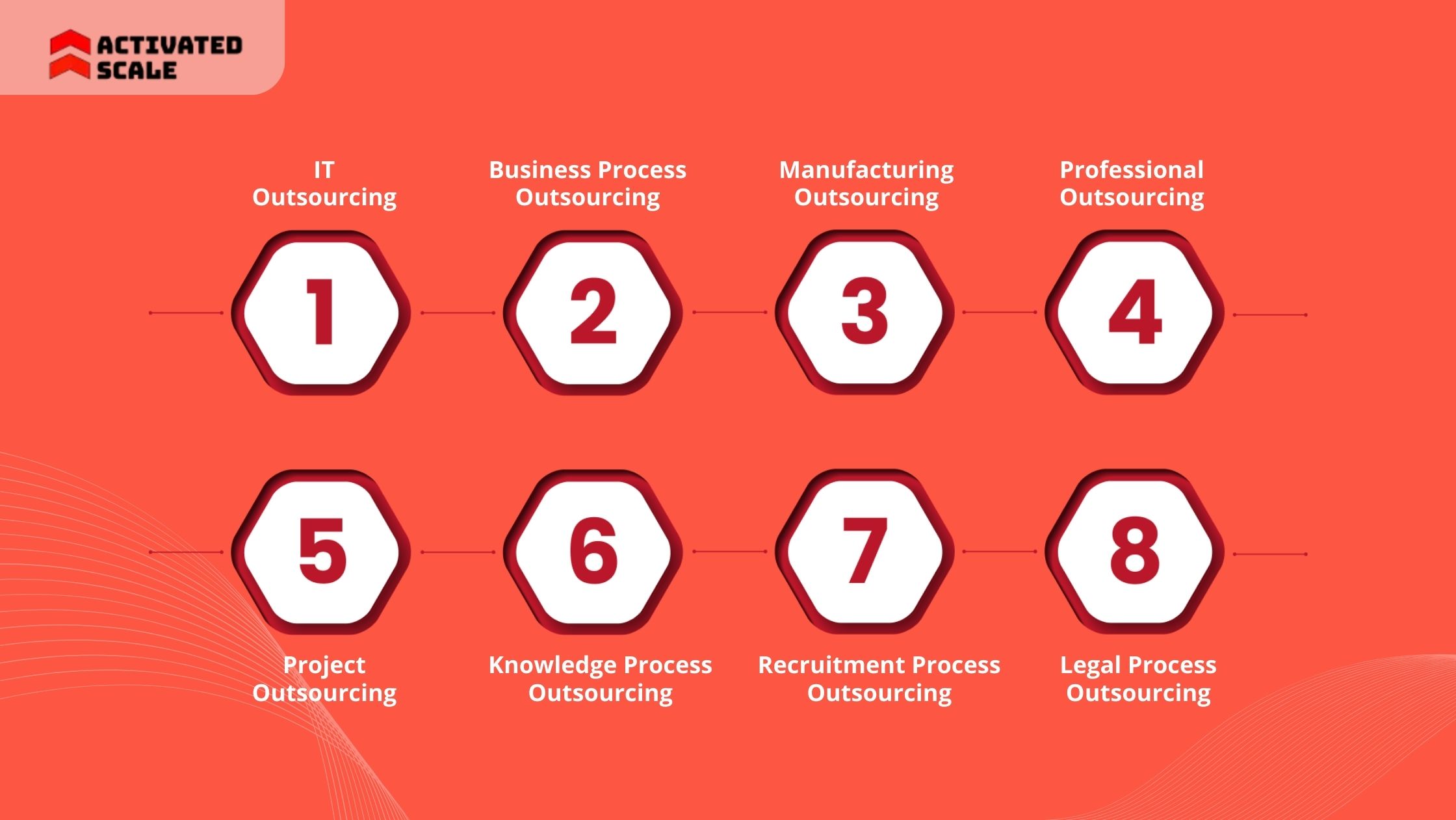
- IT Outsourcing: Managing your company’s technology needs, including software development, maintenance, and IT support.
- Business Process Outsourcing (BPO): Outsourcing non-core business functions like customer service, HR, and payroll.
- Manufacturing Outsourcing: Partnering with external companies to handle production processes.
- Professional Outsourcing: Specialized services like accounting, marketing, or legal assistance.
- Project Outsourcing: Engaging external vendors for specific, short-term projects.
- Knowledge Process Outsourcing (KPO): Outsourcing high-level services such as research, analytics, or consultancy.
- Recruitment Process Outsourcing (RPO): Outsourcing recruitment processes, such as hiring, screening, and interviewing.
- Legal Process Outsourcing (LPO): Outsourcing legal services like contract review and legal research.
While understanding functional needs is critical, when it comes to outsourcing decisions, the service provider's location often carries more weight.
This is where the three core outsourcing models: Onshore, nearshore, and offshore come into play. But how do you select the three forms of outsourcing when you have all these choices?
Also Read: Major Types of Top Outsourcing Companies to Consider in 2026
Guide to Choose Onshore, Nearshore, and Offshore Outsourcing Model
"Should we outsource?" is only the first question. Since many companies use outsourcing to access specialized talent, the critical next step is deciding the "how".
Here’s how to select the essential choice:
1. Onshore Outsourcing
Onshore outsourcing refers to outsourcing to a vendor within the same country as your business. This model eliminates the distance barrier, making collaboration and oversight easier.
Advantages and Disadvantages
When to Choose Onshore Outsourcing
Onshore outsourcing is ideal when you need tight control, frequent interaction, or when compliance is a critical concern. It’s suitable for projects where quality is prioritized over cost, or for businesses that require local knowledge. For example, legal, financial, or government services.
2. Nearshore Outsourcing
Nearshore outsourcing refers to outsourcing to a vendor located in a neighboring or nearby country. This model allows for similar time zones and often a shared language or cultural similarities.
Advantages and Disadvantages
When to Choose Nearshore Outsourcing
Nearshore outsourcing works well for medium-complexity projects that require balancing cost, control, and communication. It's especially valuable when your business needs some local knowledge but can still benefit from cost savings.
If you need greater flexibility and easier coordination, this is a good choice for marketing, customer service, or software development projects. Most importantly, 78% of businesses report a positive attitude towards their outsourcing partners. So, why don't you try today?
Choosing the right outsourcing model can make or break your sales strategy. Activated Scale helps you build a scalable, high-performing sales team without the overhead.
Need experienced Sales Development Representatives (SDRs) or Account Executives (AEs)? Our Contract-to-Hire Sales Recruiting service allows you to vet sales professionals who can assist you in taking the next step.
3. Offshore Outsourcing
Offshore outsourcing involves contracting work to a vendor located in a faraway country, typically in a different time zone. This is the most cost-effective model, allowing companies to tap into global talent pools.
Advantages and Disadvantages
When to Choose Offshore Outsourcing
Offshore outsourcing is best for cost-sensitive projects or large-scale operations where you need to access specialized global talent. It's an excellent choice when you're working on tasks that are clearly defined and can be managed remotely.
Every year, about 300,000 jobs that were once based in the U.S. are sent to other countries. So, yes, you can start offshore outsourcing in 2026.
Offshore is ideal for high-volume projects, software development, customer service, and IT outsourcing.
You’ve got different options for outsourcing, whether it's down the street, a few borders over, or across the globe. Now, the right choice really depends on what you’re trying to do because no two options are the same.
Also Read: Top Sales Outsourcing Companies in 2024
Onshore vs Nearshore vs Offshore Outsourcing: Key Differences You Should Know
Once you quickly grasp the three types of outsourcing, you can choose based on your preferences. The best part of our guide is that we'll help you choose the right model for your needs.
6 Step-by-Step Framework to Choose the Right Outsourcing Model
You're right to take this choice seriously, as it will shape how your team operates. To find the outsourcing model that truly fits, you can’t rely on guesswork. What you need is a practical framework to guide you.
The goal here is to think through your team's needs and your long-term objectives, step by step. We’ll walk you through a transparent process, so you can make a confident decision that actually supports your business goals:
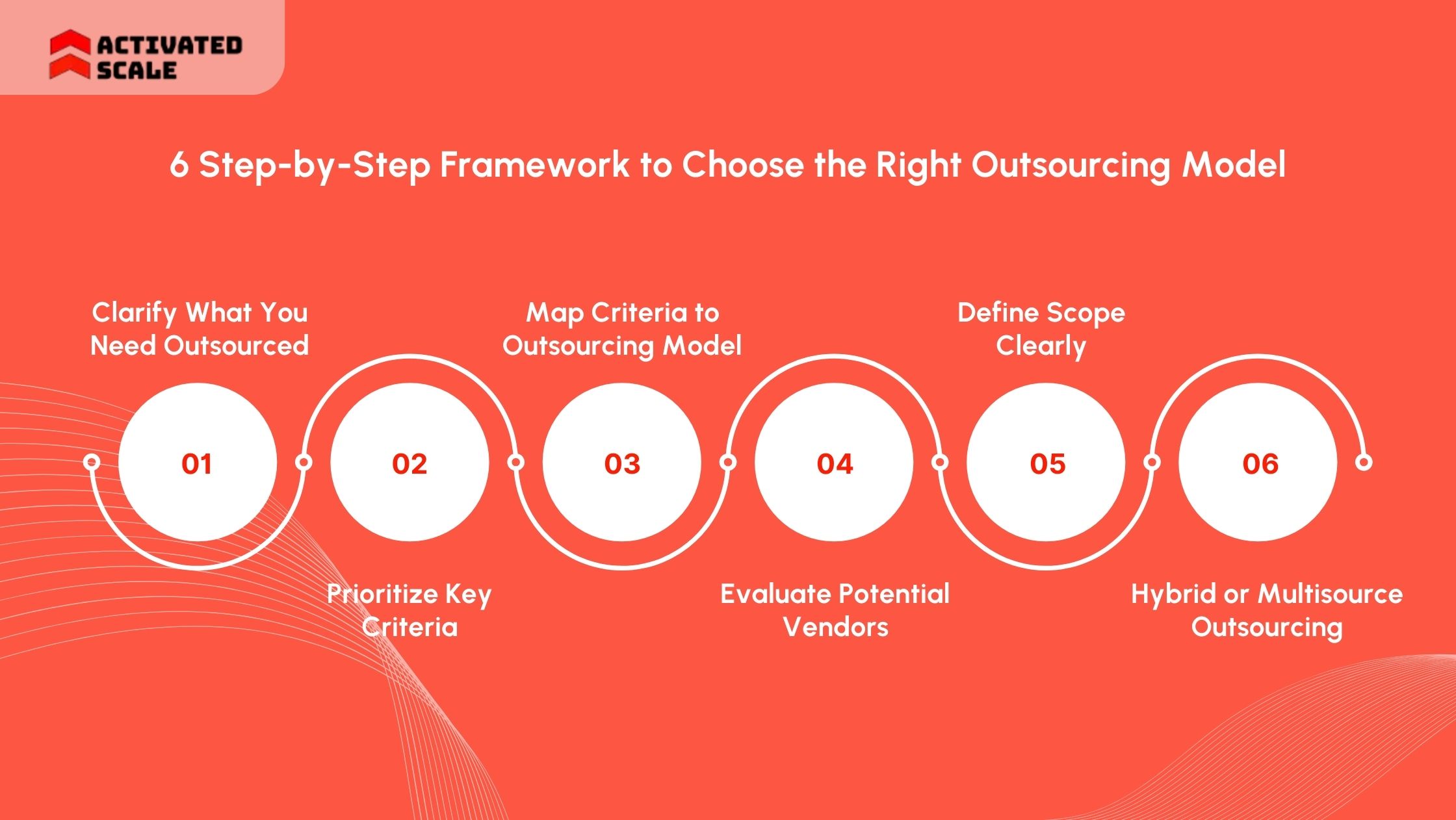
Step 1: Clarify What You Need Outsourced
Start by defining the specific functions or tasks you want to outsource. Are you outsourcing sales development, lead generation, customer service, or even full sales management?
Additionally, decide if you’re outsourcing a short-term project or an ongoing business function. This will help you narrow down your options based on the nature of the task at hand.
Step 2: Prioritize Key Criteria
List the most important factors for your business. These might include:
- Cost savings (is budget a primary concern?)
- Quality (are you prioritizing top-tier talent?)
- Communication ease (how important is seamless interaction?)
- Compliance (do you need to comply with local regulations?)
- Speed and scalability (how quickly do you need results?)
Step 3: Map Criteria to Outsourcing Model
Use a decision matrix to align your priorities with the appropriate model. Here’s a simple approach:
- Is cost crucial, but specialized expertise rare? → Offshore
- Communication and control are top priorities? → Onshore
- Is a balance between cost and collaboration needed? → Nearshore
Step 4: Evaluate Potential Vendors
Examine potential vendors based on these criteria:
- Track record and expertise: Look at their experience with similar projects.
- Technological capabilities: Do they have the right tools to support your needs?
- Cultural fit: How well do they align with your company’s values and communication style?
- Compliance and data security: Make sure they adhere to necessary legal and regulatory standards.
Step 5: Define Scope Clearly
Before moving forward, ensure you have a detailed understanding of what’s being outsourced. Clearly define the deliverables, timelines, and expectations.
Consider implementing Service Level Agreements (SLAs) to ensure all parties are aligned on performance and quality.
Step 6: Consider Hybrid or Multisource Outsourcing
Sometimes the best solution is a mix of models. For example, you might outsource core sales strategy and leadership onshore, while using offshore teams for scale and operational efficiency.
Understanding these steps can help you strike the right balance between cost, control, and talent. Many businesses adopt this approach for a more flexible outsourcing strategy.
Read More: 5 Key Steps to Recruit the Sales Executives You Need
Wrapping Up
Picking an outsourcing model for your sales team is choosing the foundation for how your team will operate and grow. When you decide to select the three forms of outsourcing, what matters is which one (or two) fits the actual rhythm of your work.
So, you need to ask: Can we work with them smoothly, and will they truly make us better? Get that right, and you're building a capability, not just hiring a service.
At Activated Scale, we understand the challenges of scaling a sales team and finding the right mix of talent. That's why our service allows you to test out candidates before making a full-time commitment to build effective strategies and teams.
Reach out to Activated Scale to see how our reps can help you optimize your sales operations with flexible outsourcing models personalized to your needs.
FAQs
1. What's the biggest hidden cost people forget when outsourcing?
Most forget the "management tax." The cheaper the model (often offshore), the more internal time and process you'll invest in coordination, training, and quality oversight.
The true cost is the vendor fee plus your team's managerial overhead.
2. Can we switch models later if our needs change?
Absolutely, but it's not a light switch. You can pivot, but it involves re-scoping work, finding new vendors, and knowledge transfer. Many companies start with a pilot project in one model (e.g., offshore for a discrete task) to test the waters before committing more.
3. How do we maintain our company culture with a remote, outsourced team?
This is a key challenge. It requires intentional effort: Include them in relevant virtual meetings, share company wins, and set up regular "face-time" via video calls.
Proximity (onshore/nearshore) makes this easier, but a defined process is needed for any model.
4. What's a clear red flag when talking to an outsourcing vendor?
Be wary of any vendor that doesn't push back or ask detailed questions. A "yes" to everything suggests they aren't strategically evaluating if they're a proper fit for your specific problem. This can lead to poor results.
The Ultimate Guide to Hiring a Salesperson!
Get the step-by-step guide to hiring, onboarding, and ensuring success!