_edi.png)
Outsourcing has quickly become a practical way for companies to stay focused on what they do best while still getting specialized work done with speed and efficiency. Instead of stretching internal teams beyond their limits, businesses now collaborate with external experts who bring the right skills at the right time.
When done thoughtfully, outsourcing not only reduces workload but also improves quality, accelerates delivery, and helps teams stay flexible as priorities shift.
This guide walks through the key steps that make outsourcing truly effective, from setting clear goals to choosing the ideal model and building smooth, long-term partnerships.
Key Takeaways
- For sales, quality of talent (vetted, experienced) and market understanding (U.S.-based) are non-negotiable. This prevents friction and reduces the time-to-ramp compared to general outsourcing models.
- Models like Contract-to-Hire and Fractional Selling are ideal for startups, as they allow you to access senior talent immediately while mitigating the enormous financial risk associated with hiring full-time bad fits.
- Define success in the contract using clear, verifiable metrics like "Qualified Pipeline Generated" or "Playbook Delivered," rather than simple activity tracking.
- Treat the outsourced talent as part of your team by integrating them fully into your tech stack and communication cadence. Lack of operational integration guarantees failure.
7 Steps to Successful Outsourcing for Growth
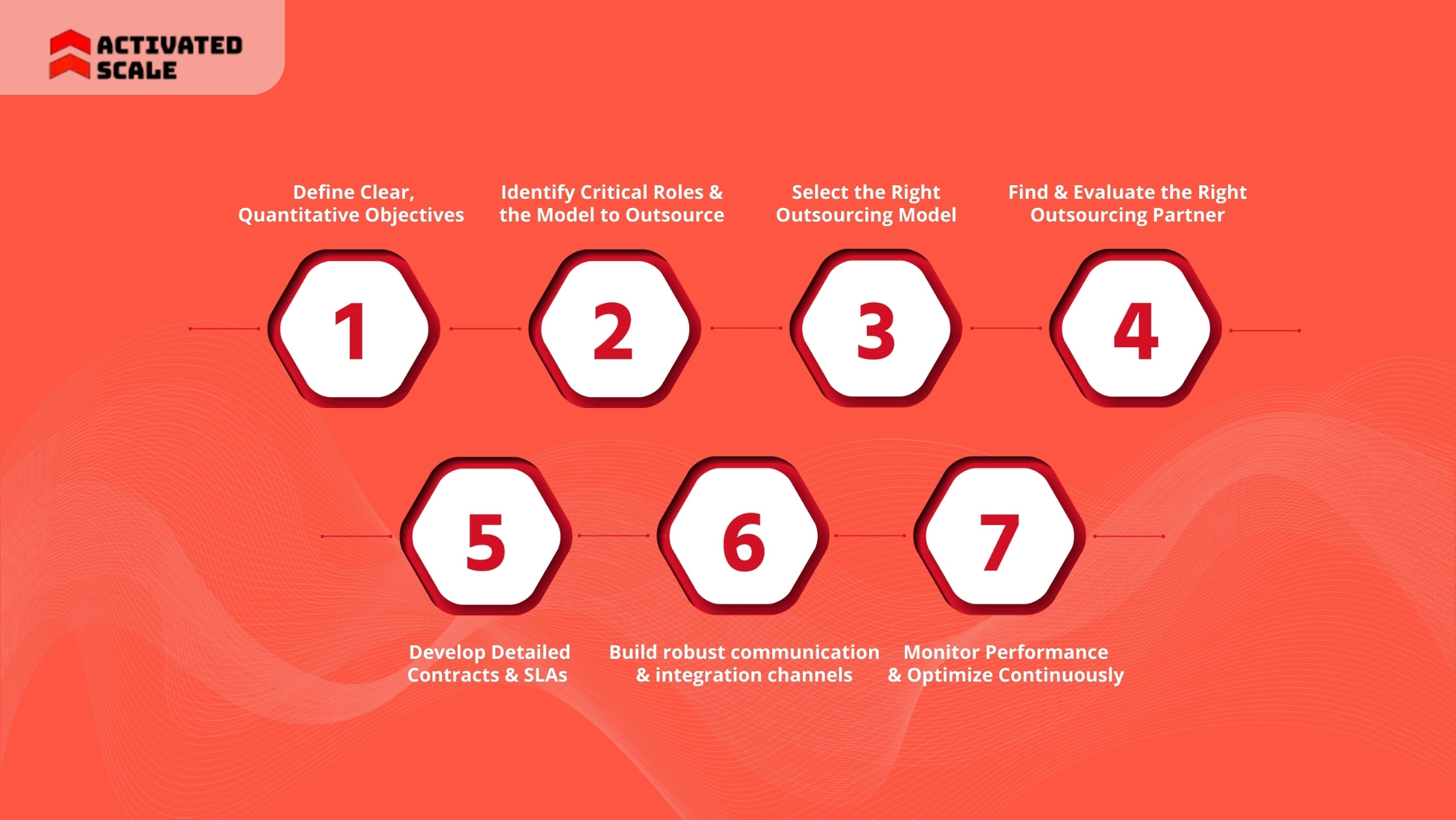
For high-growth companies, the decision to outsource must be viewed through the lens of strategic velocity. Here is the framework for execution, designed to minimize risk and maximize talent quality.
Step 1: Define Clear, Quantitative Objectives
Before you look at a single vendor, you must articulate the core problem you are trying to solve. Cost-saving is a common objective, but for scaling companies, the focus should be on velocity and risk mitigation.
- Primary Goal Alignment: Are you outsourcing to increase top-of-funnel activity (more meetings booked), close a funding round (need predictable revenue data), or reduce hiring risk (avoiding a bad full-time hire)? Be specific.
- Set Success Metrics: Define Key Performance Indicators (KPIs) that directly relate to your goals. If you're outsourcing sales development, your metric is not just "leads generated," but perhaps "15 Qualified Meetings Booked per Month" or "Time-to-Ramp Reduced by 50%."
- The Go-to-Market (GTM) Check: Ensure your outsourcing objective aligns with your current GTM strategy. For example, if you're targeting enterprise clients, outsourcing requires senior Account Executives (AEs) with specific U.S. market experience, not junior talent.
Step 2: Identify Critical Roles and the Model to Outsource
You can't outsource what you don't understand. Pinpoint the exact function and experience level that will deliver the most immediate impact. This step also determines the level of commitment you should make.
- Role Pinpointing: Decide whether the gap is in Fractional SDRs (to book more demos), Fractional AEs (to manage the full sales cycle), or Fractional VPs of Sales (to fix the strategy). For startups, fractional roles are often the perfect fit, offering expert talent without the salary commitment of a full-time leader.
- The Flexibility Check: For roles like sales, where expertise is non-negotiable, consider Contract-to-Hire Sales Recruiting. This flexible model allows you to leverage the talent immediately, assess performance within your environment, and only extend a full-time offer if the fit is perfect, significantly reducing the risk of a bad hire.
- The Core Competency Rule: Never outsource your core product development or core strategy. Sales execution is a high-value task, but its management can be externalized, especially when gaining immediate access to experienced U.S.-based sales professionals is necessary.
Need proven U.S.-based sales talent without the long hiring cycle? Activated Scale gives you access to a pre-vetted network of SDRs, AEs, and sales leaders who can ramp quickly and fit your GTM needs.
Book a call with Activated Scale to hire smarter and faster.
Step 3: Select the Right Outsourcing Model
The choice of model dictates cost, control, and long-term viability. For a scaling startup, models emphasizing flexibility and control over talent quality are superior.
- Fractional Selling: Ideal when you need immediate, high-quality expertise for a limited number of hours per week (e.g., needing a VP of Sales to build a playbook but not manage a large team yet). It's efficient and scales with your budget.
- Contract-to-Hire: The best model for testing the fit and performance of an SDR or AE. You mitigate the high cost of a bad hire while reducing the time-to-ramp because the talent is already vetted and experienced.
- Project-Based: Suitable for one-off needs like setting up a new CRM or performing a market research blitz. Less applicable for ongoing sales execution.
Step 4: Find and Evaluate the Right Outsourcing Partner
This is where quality assurance becomes critical. You are not buying a commodity service; you are acquiring expertise.
- Talent Vetting: Look for a partner like a talent marketplace that pre-vets sales professionals on specific metrics (e.g., verifiable pipeline generation, closing history, tenure). Vetted, experienced, U.S.-based sales professionals should be a non-negotiable requirement to ensure cultural and market alignment.
- Process and Expertise: Assess the partner's domain specialization. For sales, you need a partner who can speak the language of GTM, cold calling, and pipeline generation. Check for case studies demonstrating their ability to scale revenue in similar SaaS or B2B tech environments.
- Operational Transparency: The best partners offer transparency on the talent's past performance and allow you direct access to the rep/leader. Avoid firms that act as a gatekeeper, shielding the talent from you. You need to know the person, not just the agency.
Also Read: The Art of Spotting Sales Talent: Key Traits to Look for in A High-Performing Sales Team
Step 5: Develop Detailed Contracts and SLAs (Sales-Focused)
Contracts and Service Level Agreements (SLAs) for sales outsourcing must be outcome-driven, not activity-driven.
- Define Deliverables, Not Hours: Instead of paying for "40 hours of calling," your contract should specify outcomes: "Minimum 10 qualified meetings per month," or "Development of a documented, repeatable Sales Playbook within 60 days."
- Performance Metrics: Define the specific tools and data points to be used for measurement (e.g., Salesforce reporting, Gong call metrics). Clearly state what constitutes acceptable performance and the process for remediation or replacement if targets are consistently missed.
- Termination Clauses: Since you are focused on minimizing hiring risk, ensure the contract has clear, favorable clauses for quickly transitioning away from a non-performing fractional rep or converting a successful contract hire to full-time status without hidden fees.
Step 6: Establish Strong Communication and Integration Channels
An outsourced sales rep is an extension of your team. Without seamless communication, that extension will feel disconnected and slow.
- Tech Stack Integration: Ensure the outsourced talent integrates immediately into your existing CRM (Salesforce, HubSpot), Sales Engagement platform (Outreach, Salesloft), and Communication platforms (Slack, Teams). No time should be lost learning a new tech stack.
- Daily/Weekly Cadence: Schedule brief, high-impact check-ins. For SDRs, a 15-minute daily stand-up to review yesterday's results and today's priorities is crucial. For VPs, a weekly strategic session is more appropriate. The goal is transparency and responsiveness.
- Knowledge Transfer: Provide the outsourced rep with the same level of training, product information, and marketing content as your in-house team. Success depends on the outsourced talent understanding your product's value proposition as well as you do.
Step 7: Monitor Performance and Optimize Continuously
Successful outsourcing is an ongoing, adaptive process. It requires continuous measurement against the objectives set in Step 1.
- Track KPI Adherence: Regularly audit the agreed-upon KPIs. Are the Fractional SDRs hitting their meeting targets? Is the Fractional AE moving deals through the pipeline at the predicted velocity?
- Feedback Loops: Establish a formal process for giving and receiving feedback, especially in a contract-to-hire model. What are the rep's strengths? Where are the gaps in your market materials? This not only optimizes the talent but also improves your internal processes.
- Scaling the Engagement: Use the data to inform the next step. If your fractional talent is massively successful, you have the evidence needed to convert them to full-time or hire a second fractional rep to double the capacity. This data-driven approach removes the guesswork from scaling.
Conclusion
Successfully scaling your startup or scale-up requires a strategic approach to talent acquisition, moving beyond traditional, high-risk hiring. By following the 7 steps to successful outsourcing, you prioritize quality, flexibility, and market expertise, ensuring your outsourced sales talent drives immediate and measurable revenue growth.
Using models like Contract-to-Hire and Fractional Selling, especially with vetted, experienced, U.S.-based sales professionals, allows you to accelerate your Go-to-Market efforts while minimizing the financial and operational risk of crucial early-stage hires.
Don’t risk another month searching for the right full-time sales hire. Discover how Activated Scale brings top U.S. sales reps and leaders to your inbox today.
Frequently Asked Questions (FAQs)
Q1. Is outsourcing sales execution primarily about cost-saving?
No. For high-growth startups, outsourcing sales execution is primarily about speed, expertise, and mitigating hiring risk. While fractional models save on fixed full-time costs, the main goal is accelerating GTM execution and securing high-quality, pre-vetted sales talent quickly.
Q2. What is the difference between a "Fractional AE" and a "Contract-to-Hire AE"?
A Fractional AE is hired for a limited, part-time scope (e.g., 10-20 hours a week) to fill an immediate need without the intent of conversion. A Contract-to-Hire AE is hired with the explicit intent of trialing them for a full-time role, allowing the company to evaluate their fit and performance before making a permanent commitment.
Q3. Why is U.S.-based talent emphasized for sales outsourcing?
Sales success hinges on cultural fluency and understanding the specific nuances of the buyer's journey, regulatory environment, and business customs. For U.S.-focused B2B startups, using U.S.-based sales professionals ensures the reps are immediately familiar with the American buyer psyche and market expectations.
Q4. How quickly can I expect to see results after implementing the 7 steps to successful outsourcing?
If you follow these 7 steps to successful outsourcing, particularly using pre-vetted talent, you can expect the time-to-ramp to be significantly shorter. An experienced Fractional SDR should begin generating qualified leads within 2–4 weeks, compared to 3–6 months for a new full-time hire.
Q5. What is the risk of outsourcing my entire sales function?
Outsourcing your entire sales function is high-risk. It can lead to a loss of institutional knowledge, cultural misalignment, and dependence on a third party for your core revenue engine. It is wiser to use the fractional model to fill strategic gaps and build internal capacity alongside it.
Q6. What should I prioritize in the SLA for a Fractional Sales VP?
For a Fractional VP of Sales, your SLA should prioritize strategic deliverables: "Completion of a documented GTM strategy," "Definition of the Ideal Customer Profile (ICP)," "Finalized sales playbook and compensation plan," rather than daily activity metrics.
The Ultimate Guide to Hiring a Salesperson!
Get the step-by-step guide to hiring, onboarding, and ensuring success!